PART 3
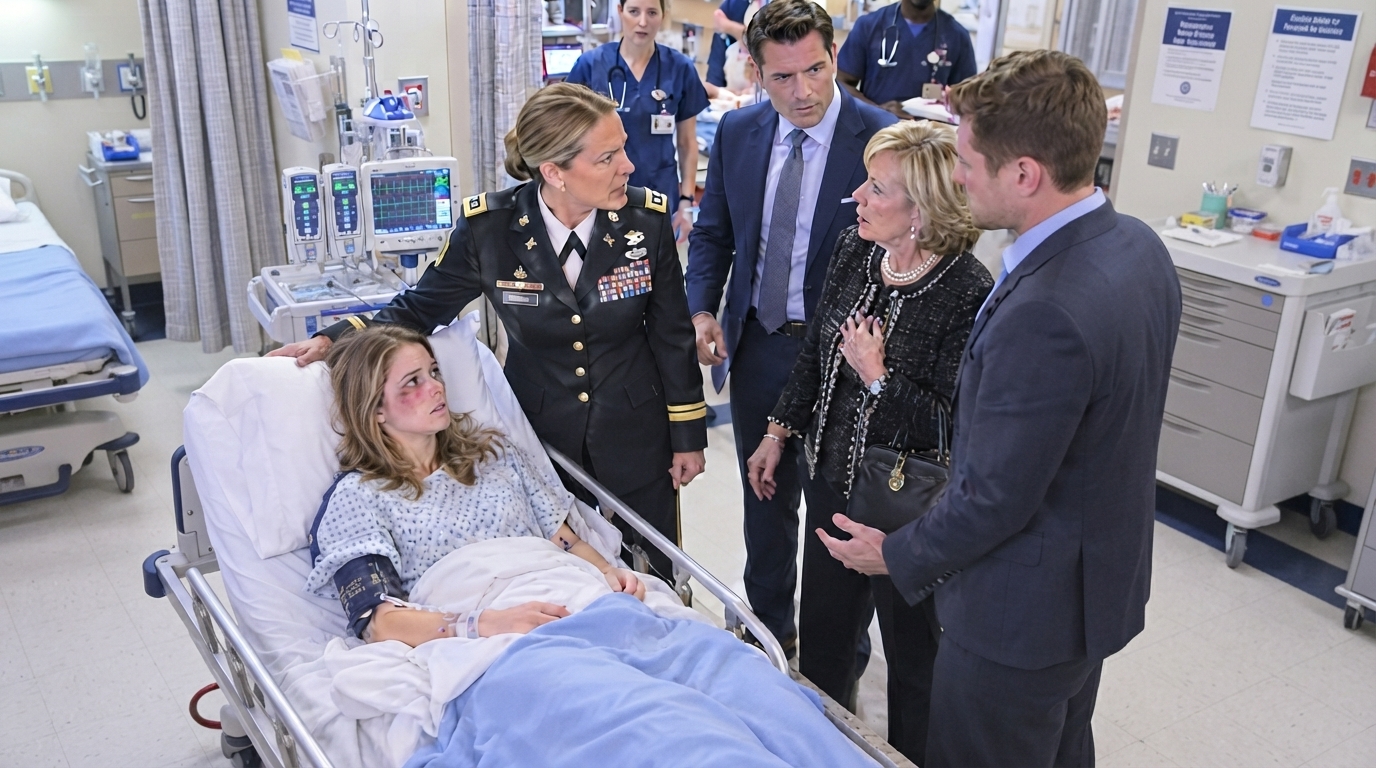
“Mom, there’s another victim.”
My daughter whispered those words so quietly that
I almost didn’t hear them over the steady beeping of
the monitor beside her hospital bed.
I leaned closer.
“What do you mean, sweetheart?”
Emily’s swollen eye filled with tears.
“The woman who worked for them. Her name is Sofia. She tried to help me escape.”
Before she could explain, Margaret Prescott stepped forward.
“That’s enough. Emily needs rest, not another opportunity to invent stories.”
I turned toward her.
For thirty years, I had served in the United States Army.
I had stood in rooms with generals, foreign officials,
and men who believed intimidation was a substitute for authority.
I had learned to recognize fear disguised as arrogance.
And Margaret Prescott was afraid.
Not of my uniform.
Not of my rank.
She was afraid of what my daughter might say next.
“Mrs. Prescott,” I said calmly, “step away from my daughter’s bed.”
Her eyebrows rose.
“Excuse me?”
“You heard me.”
Ethan moved forward.
“Colonel, this is my wife. I have every right to be here.”
I looked at Emily.
“Sweetheart, do you want them in this room?”
She shook her head immediately.
“No.”
That single word changed the atmosphere.
I pressed the call button beside her bed.
A nurse entered moments later.
“My daughter has asked these visitors to leave,” I explained. “She doesn’t feel safe with them here.”
Margaret laughed.
“This is ridiculous. We’re her family.”
The nurse looked at Emily.
“Is that what you want, ma’am?”
Emily nodded.
“Please.”
The nurse stepped toward the door.
“Then I’m going to ask everyone except her mother to leave.”
Brandon’s expression darkened.
“You don’t understand who you’re dealing with.”
The nurse didn’t flinch.
“I understand that my patient has requested privacy.”
For the first time that evening, the Prescotts encountered someone who wasn’t impressed by their surname.
Margaret stared at me.
“You’re making a terrible mistake.”
I met her eyes.
“No, Margaret. I made my mistake when I believed your family would protect my daughter.”
Ethan opened his mouth.
But Emily spoke first.
“Get out.”
He froze.
“Emily—”
“Get out!”
Her voice cracked, but she didn’t look away.
A hospital security officer arrived at the doorway.
The Prescotts finally left.
Margaret was the last to go.
Before disappearing into the hallway, she turned toward me.
“This isn’t finished.”
I looked back at my daughter.
“No,” I answered. “It isn’t.”
Once the door closed, Emily began shaking uncontrollably.
I pulled a chair beside her bed.
“I’m here, baby.”
She covered her face.
“I thought they were going to kill me.”
Those words hurt more than anything Margaret had said.
I reached for her hand.
“Tell me what happened.”
Emily looked toward the doorway.
“Promise you won’t let them take me back.”
“I promise I’ll help you stay safe. You’re an adult, sweetheart. You get to decide where you go.”
She nodded slowly.
Then she began telling me the truth.
The trouble had started six months earlier.
Ethan’s behavior changed after his family’s investment company began experiencing financial difficulties.
He became controlling.
He demanded access to Emily’s phone.
He questioned every purchase.
He accused her of embarrassing him whenever she visited friends without asking permission.
At first, she thought the pressure was temporary.
Then Margaret began interfering.
She criticized Emily’s clothes.
Her friendships.
Her career.
Even the way she spoke at family dinners.
“They told me I wasn’t behaving like a Prescott wife,” Emily whispered.
I squeezed her hand.
“You never needed their permission to be yourself.”
She gave a small, broken smile.
“I know that now.”
Three weeks earlier, Emily had discovered something unusual while using Ethan’s laptop.
A folder containing financial records.
Payments to companies she didn’t recognize.
Transfers involving charitable donations.
And documents bearing signatures that looked suspiciously similar to her own.
“I asked Ethan about them,” she said.
“What did he say?”
“He told me to stay out of family business.”
“Then what?”
“I told him I wanted a divorce.”
She looked down.
“That was when everything changed.”
Ethan took her car keys.
Margaret insisted she needed professional treatment for what she called emotional instability.
Brandon began monitoring her movements around the estate.
And when Emily threatened to call me, Ethan smashed her phone against the kitchen counter.
My jaw tightened.
But I stayed quiet.
Emily needed to tell her story without seeing my anger.
“Tonight,” she continued, “they invited me to dinner at the main house.”
Margaret had prepared an elaborate meal.
Ethan wore a suit.
Brandon sat beside the fireplace.
They told Emily they had arranged a private rehabilitation facility where she could receive treatment.
“They wanted me to sign papers,” she said.
“What kind?”
“I don’t know. Something about medical authorization and financial management.”
My stomach turned.
“Did you sign?”
“No.”
She swallowed.
“I told them I wanted a lawyer.”
That was when Ethan grabbed her arm.
She tried to pull away.
Brandon blocked the doorway.
Margaret told her she was humiliating the family.
Then Ethan struck her.
Once.
Then again.
Emily tried to run.
Brandon caught her near the staircase.
She fell against a table, splitting her lip.
Margaret stood nearby.
Watching.
“Did she try to stop them?” I asked.
Emily shook her head.
“She told Ethan not to leave marks where people could see.”
For several seconds, I couldn’t speak.
I had imagined many things when Emily called me.
But hearing that sentence made the room feel unbearably small.
“Then they locked me in the guest house,” she whispered.
“Where was Sofia?”
“She was cleaning upstairs.”
Sofia Alvarez was a thirty-two-year-old housekeeper who had worked for the Prescotts for four years.
Emily had always liked her.
She was quiet, hardworking, and devoted to her younger sister.
According to Emily, Sofia had witnessed part of the confrontation.
Later, she brought Emily water and a clean towel.
“She told me this wasn’t the first time.”
I leaned forward.
“What wasn’t?”
Emily’s voice dropped.
“Someone being hurt in that house.”
Sofia had explained that another woman, a former employee named Natalie Brooks, had left the estate suddenly two years earlier after an incident involving Brandon.
The family told everyone Natalie had stolen jewelry.
But Sofia believed Natalie had been threatened into silence.
“And Sofia?” I asked.
Emily’s eyes filled.
“She tried to help me get out through the service entrance. Brandon caught us.”
“What happened?”
“He grabbed Sofia and dragged her into the garage.”
I felt my pulse accelerate.
“Did you see what happened afterward?”
“No. But I heard her screaming.”
Emily began crying.
“I don’t know where she is, Mom.”
I held her carefully.
“You did the right thing telling me.”
Then she reached beneath the torn lining of her dress.
Her fingers trembled as she removed a tiny black object wrapped in tissue.
A microSD card.
“Sofia gave me this before Brandon caught us.”
I stared at it.
“What is it?”
“She said it came from the guest-house security system. She copied recordings because she knew the family deleted footage whenever something happened.”
I took the card carefully by its edges.
Emily grabbed my wrist.
“Mom, please don’t lose it.”
“I won’t.”
I didn’t insert it into my phone.
I didn’t open it.
I didn’t send copies to anyone.
Years of handling sensitive information had taught me that evidence could become useless if people couldn’t establish where it came from or whether it had been altered.
I placed it inside a clean paper envelope supplied by the nurse and asked that the time and circumstances of its discovery be documented.
Then I made two calls.
The first was to a civilian attorney named Rachel Morgan.
Rachel had served as an Army judge advocate before entering private practice.
She specialized in protecting victims of domestic violence and handling complex civil litigation.
The second call was to the hospital’s patient advocate.
I requested assistance with safety planning and reporting the assault to local law enforcement.
I did not call a general.
I did not call a politician.
I did not use my rank to demand special treatment.
My daughter deserved justice because she was a human being.
Not because her mother wore an eagle on her shoulders.
Twenty minutes later, a Charlotte-Mecklenburg police officer arrived.
Her name was Detective Laura Bennett.
She was in her early forties, with tired eyes and a calm manner.
She introduced herself to Emily.
“I’m here to listen. You can take your time.”
Emily looked at me.
I nodded.
For nearly an hour, my daughter repeated her account.
Detective Bennett asked careful questions.
Who struck her?
Who restrained her?
Who prevented her from leaving?
Where had Sofia last been seen?
Was there any evidence?
Emily pointed toward the envelope.
The detective arranged for the card to be collected and documented according to department procedures.
She also requested that the hospital preserve relevant records and any available surveillance footage.
Then she asked a question that made Emily go pale.
“Did anyone threaten you if you reported what happened?”
Emily nodded.
“Margaret said nobody would believe me. She said they knew people who could make my mother lose her career.”
Detective Bennett glanced at my uniform.
I remained silent.
The detective wrote something down.
“Your mother’s career isn’t what we’re investigating.”
Emily began crying again.
The detective leaned forward.
“We’re investigating what happened to you.”
For the first time that night, I saw relief cross my daughter’s face.
Then the detective’s phone rang.
She stepped into the hallway.
When she returned, her expression had changed.
“Colonel Hart,” she said, “I need to ask you something.”
“Yes?”
“Do you know where Sofia Alvarez is?”
“No.”
The detective looked at Emily.
“We’ve received a report that a woman matching her description was taken to another hospital earlier tonight.”
Emily sat upright.
“Is she alive?”
The detective paused.
“We’re working to confirm her condition.”
My daughter gripped my hand.
And I realized the night was far from over.
Because somewhere in Charlotte, another woman might be lying in a hospital bed because she had tried to save mine.
And the Prescott family still believed they controlled the story.
They were about to discover that the truth had already begun moving beyond their reach.
PART 4
At 2:37 the following morning, Detective Bennett returned to Emily’s room.
I knew something had happened before she spoke.
Her expression was too serious.
“We located Sofia Alvarez.”
Emily sat up immediately.
“Where?”
“At a hospital in the Charlotte area. She’s receiving treatment.”
“Is she okay?”
“She’s conscious.”
My daughter covered her mouth.
I felt a wave of relief so powerful that I had to grip the back of my chair.
Detective Bennett continued.
“Sofia has agreed to speak with investigators.”
“Did she tell them what happened?” I asked.
“She provided information consistent with parts of Emily’s account.”
Emily began crying.
Not from fear this time.
From relief.
For hours, she had believed Sofia might be dead.
Now she knew the woman who had risked everything to help her was alive.
But the detective wasn’t finished.
“There’s something else.”
I waited.
“Sofia says the family maintains a separate security recording system at the estate.”
Emily looked confused.
“I thought they deleted everything.”
“They may have deleted some recordings from the system they normally access. Sofia says a secondary recorder was installed after a series of insurance claims.”
I looked at Detective Bennett.
“Can you obtain those recordings?”
“We’re pursuing the appropriate legal process.”
She didn’t promise what they would find.
She didn’t pretend a search could happen simply because I wanted it.
And I respected that.
Over the next two days, the investigation expanded.
Emily remained in the hospital while doctors evaluated her injuries.
She had a concussion, extensive bruising, and a fractured rib.
The physicians documented her condition carefully.
A hospital social worker helped her develop a safety plan.
Rachel Morgan met with us to discuss protective measures, financial independence, and the steps Emily could take to begin separating from Ethan.
I stayed beside her whenever she wanted me there.
When she slept, I sat in the chair near the window.
When she woke from nightmares, I held her hand.
When she apologized for not telling me sooner, I reminded her that she had nothing to apologize for.
One afternoon, Emily asked me a question.
“Mom, are you disappointed in me?”
I looked at her.
“Why would I be?”
“Because you taught me to be strong.”
My heart broke.
“Emily, being strong doesn’t mean nobody can hurt you.”
She looked away.
“I should’ve left earlier.”
“You left when you could. And you asked for help. That matters.”
She wiped her eyes.
“I thought if I tried harder, Ethan would become the man I married again.”
I remembered their wedding.
The enormous ballroom.
The white roses.
The string quartet.
Margaret Prescott greeting guests as though she were welcoming royalty into her palace.
Ethan had looked handsome and devoted.
He had held Emily’s hands during the vows.
He had promised to protect her.
And I had believed him.
I had shaken his father’s hand and told him our families were fortunate to be joined.
Now I wondered how many warning signs I had missed.
But guilt wouldn’t help Emily.
So I focused on what would.
Three days after the assault, Rachel called me.
“Victoria, we need to meet.”
“Has something happened?”
“The Prescotts have hired an attorney.”
“That doesn’t surprise me.”
“They’re preparing to argue that Emily’s injuries resulted from an accident and that she has been emotionally unstable.”
I felt anger rise.
“She’s the victim.”
“I know. But we need to prepare for the possibility that they’ll try to undermine her credibility.”
“What do you need from us?”
“Documentation. Messages. Financial records Emily can lawfully access. Names of witnesses. And most importantly, her permission to proceed.”
I looked toward my daughter, who was sitting on the bed reading a magazine.
“She’ll make that decision.”
Rachel’s voice softened.
“Good. That’s exactly how it should be.”
Later that afternoon, Emily agreed to meet with Rachel.
She brought a folder containing screenshots she had saved before Ethan destroyed her phone.
Messages from Ethan.
Emails from Margaret.
Photographs of earlier bruises.
And a voice message in which Brandon warned her not to embarrass the family.
Rachel reviewed everything carefully.
Then she stopped at one email.
“Emily, where did you get this?”
Emily leaned forward.
“Ethan sent it to me by mistake.”
The message was from a senior employee at Prescott Capital Holdings.
It discussed a charitable foundation established in memory of Ethan’s grandfather.
The foundation was supposed to provide scholarships to disadvantaged students.
But the email referenced transfers to companies that appeared unrelated to educational programs.
Rachel frowned.
“Why did Ethan send this to you?”
“He forwarded an entire conversation while asking me to approve a donation announcement. I don’t think he realized the earlier messages were attached.”
Rachel looked at me.
“Victoria, this may explain why the family became so aggressive when Emily started asking questions.”
I felt a chill.
The assault wasn’t simply about a troubled marriage.
It might also have been about protecting financial secrets.
But Rachel was careful.
“These records raise questions. They don’t prove a crime by themselves.”
Emily nodded.
“I understand.”
Rachel continued.
“We’ll preserve them and determine which authorities should review them.”
That evening, Daniel Mercer called.
Daniel was a retired Army major and a longtime family friend.
He had known Emily since she was a child.
He now worked as a security consultant.
“Victoria,” he said, “I heard Emily was hurt. Is she safe?”
“She’s recovering.”
“Do you need anything?”
I thought for a moment.
“Actually, yes. I need someone trustworthy to help arrange security at my home.”
“Done.”
“Daniel, I don’t want anything aggressive. Just proper cameras, lighting, and a review of access points.”
“Understood.”
He paused.
“And Victoria?”
“Yes?”
“Don’t let them drag you into doing something that gives them a way to make this about you.”
I closed my eyes.
He knew me well.
“I won’t.”
“Good. Let the professionals handle the investigation.”
I thanked him.
Then I returned to Emily’s room.
My daughter was staring at her wedding ring.
She slowly removed it.
For a long time, she held it in her palm.
Then she placed it on the bedside table.
“I don’t want to be Mrs. Prescott anymore,” she whispered.
I sat beside her.
“Then you don’t have to be.”
She looked at me.
“Will you help me start over?”
I took her hand.
“Every step you’re comfortable letting me help with.”
The following morning, Detective Bennett called Rachel.
Investigators had obtained access to relevant security recordings through lawful procedures.
The evidence was significant.
Footage from the estate showed Emily attempting to leave the main house.
It showed Ethan grabbing her.
It showed Brandon blocking her path.
And it showed Margaret standing nearby during the confrontation.
Other recordings documented Sofia entering the guest house and later being confronted near the service entrance.
The recordings didn’t capture every moment.
But they directly contradicted the family’s account that Emily had simply fallen during an emotional episode.
Rachel told us the news in person.
Emily stared at her.
“They found it?”
“Yes.”
“They actually found it?”
Rachel nodded.
“Investigators have recordings that support important parts of your statement.”
Emily covered her face.
I wrapped my arm around her shoulders.
For days, the Prescotts had insisted she was lying.
They had treated her injuries as an inconvenience.
They had threatened her reputation.
Now there was independent evidence.
And their money couldn’t make the recordings disappear.
Two days later, Ethan and Brandon were arrested on charges arising from the alleged assaults and unlawful restraint.
Margaret was questioned further about her role and her statements.
The charges were allegations at that stage, and the legal process still had to run its course.
But the family that had threatened to destroy Emily’s reputation was now facing public scrutiny of its own.
The news spread quickly.
Local reporters gathered outside the Prescott estate.
A photograph of Ethan leaving a courthouse appeared online.
Prescott Capital Holdings released a statement saying it was cooperating with authorities.
Margaret’s attorney denied wrongdoing.
Brandon’s attorney claimed the events had been misunderstood.
And Ethan attempted to contact Emily through several channels.
She didn’t respond.
Instead, Rachel helped her pursue a protective order.
The court reviewed the available evidence and granted protection under the applicable legal standards.
When Emily received confirmation, she sat quietly for several minutes.
Then she looked at me.
“Mom, I can finally breathe.”
I hugged her.
But I knew the story wasn’t finished.
Because the financial records were still being examined.
And one afternoon, Rachel received a call from a federal investigator.
The investigator wanted to discuss the documents Emily had preserved concerning the Prescott charitable foundation.
Rachel explained that Emily would cooperate through appropriate channels.
A meeting was arranged.
I did not attend.
This was Emily’s evidence.
Emily’s experience.
Emily’s decision.
For years, I had been accustomed to taking command when something went wrong.
But motherhood required a different kind of strength now.
I had to support my daughter without taking away the control she was fighting to regain.
When she returned from the meeting, she looked exhausted.
I made her tea.
“Do you want to talk about it?”
She nodded.
“They asked about the scholarship foundation.”
“And?”
“They think some of the transactions deserve further investigation.”
I sat beside her.
“Are you okay?”
She looked at me.
“For the first time, I think I might be.”
Then she reached into her purse.
“I have something to show you.”
It was a photograph.
A young woman stood outside a small apartment building, holding a little boy’s hand.
“Who’s that?”
“Natalie Brooks.”
I recognized the name immediately.
The former employee who had disappeared from the Prescott estate two years earlier.
Emily looked at me.
“Sofia found her.”
“Is she safe?”
“Yes.”
“Did she tell anyone what happened?”
Emily nodded.
“She says Brandon assaulted her, and the family threatened to accuse her of theft if she reported it.”
My chest tightened.
“Has she spoken to investigators?”
“She’s considering it.”
I looked at the photograph again.
The little boy couldn’t have been older than five.
He was smiling.
His mother wasn’t.
Emily touched the edge of the picture.
“Mom, I thought I was the only one.”
I shook my head.
“You weren’t.”
She looked toward the window.
“Then I want to help make sure nobody else has to go through this.”
I felt tears rising.
There she was.
My daughter.
Bruised.
Frightened.
Still healing.
And somehow thinking about another woman.
I put my arm around her.
“You already have.”
But that night, another call came.
This time from Rachel.
“Victoria, I need you to sit down.”
My stomach tightened.
“What happened?”
“Margaret Prescott’s attorney has approached us.”
“About what?”
“They’re proposing a private settlement.”
I frowned.
“For Emily’s injuries?”
“Among other things.”
“How much?”
Rachel hesitated.
“Two million dollars.”
I looked across the room at Emily.
She was asleep on the couch, wrapped in a blanket.
Two million dollars.
For silence.
For bruises.
For fear.
For the nights my daughter had believed she might never escape.
I lowered my voice.
“What do they want in return?”
Rachel answered quietly.
“A broad confidentiality agreement and a release of civil claims.”
I stared at the wall.
Then I asked the only question that mattered.
“Does Emily know?”
“Not yet. I wanted to discuss how to present it to her.”
I looked at my sleeping daughter.
“Tell her everything. She deserves to make an informed decision.”
And the next morning, when Emily heard the offer, she said something that made me prouder than any medal I had ever received.
“Tell them my safety isn’t for sale.”
PART 5
Emily didn’t make her decision quickly.
That was one of the things I admired most.
She didn’t react out of anger.
She didn’t pretend that two million dollars was meaningless.
She understood exactly what that amount of money could do.
It could pay for medical care.
It could give her a home.
It could provide security while she rebuilt her career.
It could remove financial worries for years.
But the proposed agreement also contained conditions she wasn’t willing to accept.
Rachel explained each provision carefully.
Emily listened.
Asked questions.
Requested revisions.
And eventually decided that the offer, as written, was unacceptable.
She wasn’t interested in protecting the Prescott family’s reputation at the expense of her own voice.
Rachel communicated that decision through counsel.
The Prescotts responded with another proposal.
Then another.
Negotiations continued, but Emily refused to allow them to interfere with the criminal investigation.
The criminal case belonged to the state.
A private settlement could not erase the evidence or prevent authorities from pursuing charges.
That distinction mattered.
Because the Prescotts had spent years behaving as though every problem had a price.
Now they were discovering that some consequences couldn’t simply be purchased away.
Meanwhile, Emily moved into my home.
I had converted the downstairs guest room into a comfortable bedroom with pale blue curtains, a reading chair, and a small desk overlooking the garden.
She had loved that room as a teenager.
She used to sit by the window and write stories in spiral notebooks.
On her first morning home, I found her standing beside the bookshelf.
She was holding an old photograph.
In it, she was eight years old, wearing an oversized Army cap and saluting the camera.
I smiled.
“You used to steal that hat every time I came home.”
She laughed softly.
“I remember.”
Then her expression changed.
“Mom?”
“Yes?”
“Did you ever feel afraid when you were deployed?”
I considered the question.
“Yes.”
She looked surprised.
“You did?”
“Of course.”
“But you always seemed so brave.”
I sat beside her.
“Emily, courage isn’t the absence of fear. It’s deciding what matters even while you’re afraid.”
She studied the photograph.
“I was terrified when I called you.”
“I know.”
“I thought you’d be disappointed that I couldn’t handle it myself.”
I took the picture from her hands and placed it on the shelf.
“Sweetheart, nobody should have to handle abuse alone.”
Her eyes filled.
I continued.
“You survived something terrible. Asking for help was an act of courage.”
She hugged me.
For a moment, I held the little girl I remembered.
Then she stepped back.
And I saw the woman she was becoming.
Not the woman Ethan had tried to control.
Not the woman Margaret had tried to silence.
A woman learning to trust herself again.
The months that followed were not easy.
Healing rarely happens in a straight line.
Some mornings, Emily woke cheerful and determined.
Other days, a sudden noise made her flinch.
She struggled with nightmares.
She worried about running into someone connected to the Prescott family.
She sometimes blamed herself for staying in the marriage.
With the support of a trauma-informed therapist, she began working through those feelings.
I learned to stop offering solutions every time she cried.
Sometimes she didn’t need advice.
She needed someone to sit beside her.
Sometimes she wanted company.
Sometimes she wanted privacy.
And I learned to respect both.
One afternoon, she came downstairs carrying a laptop.
“Mom, I’ve been thinking.”
“About what?”
“Going back to work.”
Before marrying Ethan, Emily had worked in nonprofit administration.
She loved organizing scholarship programs and helping students apply for educational funding.
But Ethan had gradually persuaded her to leave her job.
He said his family had enough money.
He said she should focus on social obligations.
He said working made her look as though she didn’t trust him to provide.
Now she wanted her career back.
“I found an opening at a community foundation,” she said.
I smiled.
“Are you going to apply?”
“I think so.”
“Then you should.”
She hesitated.
“What if they ask why I haven’t worked in three years?”
“Tell them what you’re comfortable telling them. You don’t owe strangers every detail of your life.”
She nodded.
That evening, we worked on her résumé.
She had forgotten how much she had accomplished.
I reminded her about the fundraising campaigns she organized.
The volunteer programs she managed.
The students she helped.
By midnight, she had submitted her application.
Two weeks later, she received an interview invitation.
She came running into the kitchen.
“Mom!”
I looked up from my coffee.
“What?”
“I got an interview!”
I stood so quickly that my chair scraped the floor.
We hugged.
Then laughed.
Then hugged again.
It was a small victory.
But after months of hospitals, attorneys, and fear, it felt enormous.
While Emily rebuilt her life, the criminal proceedings moved forward.
Investigators interviewed witnesses.
Medical records were reviewed.
The security recordings were authenticated.
Sofia provided a statement about what she had witnessed.
Natalie Brooks eventually agreed to speak with investigators about her own experience.
Her allegations were evaluated separately, and authorities made no promises about what charges, if any, would result from them.
But her willingness to come forward mattered deeply to Emily.
The two women eventually met at Rachel’s office.
I waited outside.
When Emily emerged, her eyes were red.
But she was smiling.
“She thanked me,” Emily said.
“For what?”
“For speaking up.”
I hugged her.
“And what did you say?”
“I told her Sofia was the brave one.”
That was how the story continued.
Not with one heroic person.
But with several frightened women deciding they would no longer carry the truth alone.
The financial investigation also progressed.
Authorities reviewed records involving Prescott Capital Holdings and the family’s charitable foundation.
The examination uncovered transactions that investigators believed warranted further scrutiny.
Some transfers had been described as charitable program expenses but appeared to have benefited businesses associated with family members.
The precise legal responsibility of each person remained subject to investigation and court proceedings.
I refused to speculate.
I had seen what accusations without evidence could do.
I wanted accountability.
Not rumors.
And I wanted Emily to understand that justice wasn’t measured by how many people suffered.
It was measured by whether the truth could be established and the law applied fairly.
Eventually, Ethan’s criminal case reached a decisive stage.
After reviewing the evidence and consulting with his attorney, he entered a guilty plea to charges arising from his assault on Emily and his role in unlawfully restraining her.
Brandon also entered a plea in connection with his actions that night.
The court considered the evidence, their pleas, the harm caused, and the applicable sentencing laws.
Both men received criminal sentences and conditions designed to hold them accountable and protect the victims.
Margaret continued to deny that she had encouraged violence.
However, the recordings and witness statements contradicted significant portions of her original account.
Her role remained the subject of separate legal scrutiny, and the family’s public image suffered severe damage.
The woman who had once told me her connections could make problems disappear now had attorneys speaking for her at every public appearance.
I didn’t celebrate.
I didn’t smile when I heard the sentences.
I thought about the wedding.
The promises.
The years Emily had lost.
And the other women who had been frightened into silence.
Accountability was necessary.
But it didn’t erase what happened.
On the day of Ethan’s sentencing, Emily asked me to accompany her to court.
I wore a simple navy suit.
No uniform.
No medals.
No rank.
Just a mother sitting beside her daughter.
Emily had prepared a victim-impact statement.
She read it herself.
Her hands trembled when she stood.
But her voice was clear.
“When I married Ethan Prescott, I believed I was joining a family that would love and protect me.”
She paused.
“I was wrong.”
The courtroom was silent.
“For months, I was made to believe that my feelings didn’t matter, my choices weren’t mine, and my safety depended on keeping other people happy.”
She looked toward Ethan.
“I was told nobody would believe me.”
Then she looked toward the judge.
“But people did believe me. They listened. They investigated. They found evidence.”
Her voice strengthened.
“I don’t want revenge. I want the freedom to live without fear.”
She took a breath.
“And I want anyone experiencing abuse to know that being frightened doesn’t mean you’re weak.”
I felt tears running down my face.
Emily continued.
“I lost a marriage. I lost my sense of safety. For a while, I lost confidence in myself.”
She looked down at the paper.
“But I didn’t lose my future.”
When she finished, the courtroom remained quiet.
She returned to her seat.
I took her hand.
“You did beautifully,” I whispered.
She squeezed my fingers.
“Thanks, Mom.”
After the hearing, reporters gathered outside.
Cameras flashed.
Microphones appeared.
Someone shouted a question about the Prescott family’s influence.
Another asked whether I believed justice had been served.
I looked toward Emily.
She shook her head slightly.
She didn’t want to speak.
So we kept walking.
We owed the cameras nothing.
We had already given the court what mattered.
The truth.
Several months later, Emily’s divorce was finalized.
She returned to using Hart as her surname.
She had also received a job offer from the community foundation.
The position wasn’t glamorous.
It didn’t come with luxury vacations or designer handbags.
But it came with something far more important.
Independence.
On her first day, she woke before sunrise.
I found her in the kitchen wearing a pale green blouse and black trousers.
She was making coffee.
“Big day?” I asked.
She smiled nervously.
“Very big.”
I handed her a small paper bag.
“What’s this?”
“Lunch.”
She opened it.
A turkey sandwich.
An apple.
And a chocolate chip cookie.
She laughed.
“Mom, I’m thirty-two.”
“And?”
“You packed my lunch.”
“I’ve been waiting years for the opportunity.”
She hugged me.
Then she left for work.
I stood at the front window watching her car disappear down the street.
And for the first time since that terrible phone call, I cried because I was happy.
The next year brought more changes.
Emily moved into her own apartment.
It was small, bright, and filled with plants.
She bought secondhand furniture.
She painted the kitchen herself.
She adopted a rescue dog named Charlie, who had enormous ears and absolutely no understanding of personal space.
She made friends.
She traveled with coworkers.
She began laughing without immediately looking over her shoulder.
Sometimes she still had difficult days.
But those days no longer defined her life.
One Saturday afternoon, she invited me over for dinner.
When I arrived, Charlie nearly knocked me over.
Emily was standing in the kitchen wearing an apron covered in flour.
“Don’t judge,” she warned.
I looked at the counter.
“What happened?”
“I attempted homemade pasta.”
“Attempted?”
She pointed toward a bowl of dough.
“It’s fighting back.”
We laughed until our stomachs hurt.
Then we ordered pizza.
We ate on the couch while Charlie slept between us.
After dinner, Emily became quiet.
“Mom, can I ask you something?”
“Anything.”
“Do you remember what Margaret said at the hospital?”
I nodded.
“She said your rank didn’t impress her.”
Emily smiled faintly.
“Did that bother you?”
I considered the question.
“No.”
“Really?”
“Really.”
She looked surprised.
“Why?”
“Because she was right about one thing.”
Emily frowned.
“What?”
“My rank had nothing to do with whether you deserved protection.”
I took her hand.
“You deserved to be safe because you’re a person. Every victim deserves that, whether their mother is a colonel, a teacher, a waitress, or someone who has no family at all.”
Emily looked down.
“I used to think you were going to save me.”
“I wanted to.”
“You did save me.”
I shook my head gently.
“I came when you called. But you were the one who found the courage to tell the truth.”
She leaned against my shoulder.
“And Sofia.”
“Yes.”
“And Natalie.”
“Yes.”
“And Detective Bennett.”
I smiled.
“And the nurses, doctors, attorneys, advocates, and everyone who did their jobs.”
Emily was quiet for a moment.
Then she whispered, “I think I’m finally starting to feel like myself again.”
I kissed the top of her head.
“I’m glad, sweetheart.”
That evening, when I returned home, I took my uniform jacket from the closet.
I laid it across the bed.
The ribbons were still perfectly aligned.
The medals still shone.
The nameplate still read:
COLONEL VICTORIA HART.
For decades, that uniform had represented service, sacrifice, discipline, and responsibility.
I had worn it through difficult assignments.
I had made decisions that affected hundreds of people.
I had learned how to remain calm when everything around me seemed to be falling apart.
But nothing in my military career had prepared me for the sight of my daughter lying bruised in a hospital bed.
Nothing had prepared me for the sound of her voice saying, “Mom, come get me.”
And nothing had taught me as much about courage as watching her rebuild her life.
I hung the jacket carefully in the closet.
Then I sat beside the window.
Outside, the evening sky was turning orange.
The same color it had been on the night Emily called.
For a moment, I remembered Margaret Prescott standing in that hospital room.
Her expensive clothes.
Her confident smile.
Her threats.
The way she had leaned toward me and said that my military rank meant nothing.
She had believed influence could replace truth.
She had believed wealth could purchase silence.
She had believed my calmness meant I was frightened.
But she had misunderstood something fundamental.
I hadn’t been silent because I was afraid of her.
I had been silent because my daughter needed me to listen.
I didn’t need to shout.
I didn’t need to threaten.
I didn’t need to call in favors.
I needed to protect my daughter, preserve the evidence, and help her reach people who could act lawfully.
And that was exactly what we did.
The Prescotts had spent years surrounding themselves with people who were afraid to challenge them.
But fear is not the same as respect.
And money is not the same as character.
They had built their reputation on appearances.
My daughter rebuilt her life on truth.
Six months later, Emily invited Sofia and Natalie to a small gathering at her apartment.
There were no reporters.
No speeches.
No cameras.
Just three women sharing dinner.
I joined them briefly before leaving them to their evening.
As I was putting on my coat, Sofia approached me.
“Colonel Hart?”
I turned.
“Yes?”
She hesitated.
“Thank you for believing us.”
I looked at her.
“You should never have had to fight so hard to be heard.”
Her eyes filled.
Then she hugged me.
I held her for a moment.
And I thought about all the people who never receive that chance.
People whose calls go unanswered.
People who are told to stay quiet.
People who are made to believe that the powerful always win.
I hoped our experience might remind at least one of them that asking for help can be the beginning of something better.
When I stepped outside, Emily followed me.
“Mom!”
I turned.
She came down the steps and wrapped her arms around me.
“I love you.”
“I love you too.”
She stepped back.
Then she smiled.
A real smile.
The kind I hadn’t seen in far too long.
“Drive safely.”
“I will.”
As I walked toward my car, she called after me.
“And Mom?”
I turned again.
“Yes, sweetheart?”
“I’m not afraid of them anymore.”
I looked at my daughter standing beneath the porch light.
Healthy.
Independent.
Surrounded by people who respected her.
And I realized that was the moment I had been waiting for.
Not the arrests.
Not the courtroom.
Not the financial investigation.
Not the headlines.
This.
My daughter standing in her own doorway, knowing her life belonged to her.
I smiled.
“Neither am I.”
Then I drove home.
And for the first time since that terrible evening, the road ahead felt peaceful.
Because the greatest victory wasn’t watching a wealthy family lose its power.
It was watching my daughter reclaim hers.
And if there’s one thing I learned through everything that happened, it’s this:
Never mistake a mother’s silence for surrender. Sometimes she’s simply listening, protecting her child, and making sure the truth has a chance to be heard.
THE END THANK YOU FOR READING !!!



