PART 3
“Sophie drank some too.”
Those four words nearly stopped my heart.
I stared at Tommy, still clinging to my blue shirt,
his small fingers trembling against my shoulder.
“What do you mean, sweetheart?”
His eyelids fluttered.
“Mom gave us Christmas juice. She said it would make us calm.”
I felt a coldness spread through my chest.
“Where is Sophie?”
Tommy tried to answer, but his words came slowly.
“Upstairs. In the little room.”
Then his head dropped against my shoulder.
“Tommy?”
I gently shook him.
“Stay with me, buddy.”
His eyes opened halfway.
“Grandpa, I’m tired.”
Behind me, Jennifer began shouting.
“Put him down! You’re frightening him!”
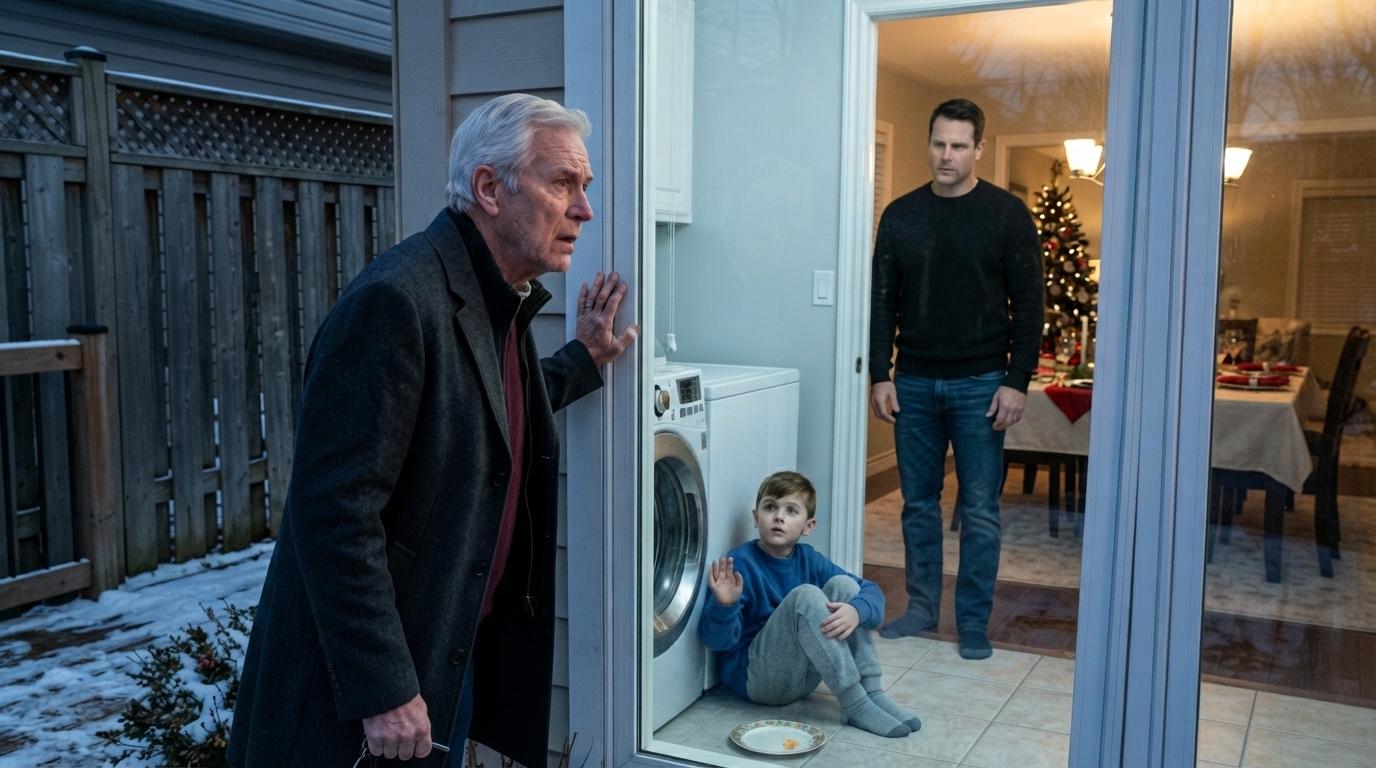
Robert stood in the laundry-room doorway, holding his phone.
“Dad, you’re making everything worse!”
I turned toward my son.
“Where is Sophie?”
Robert blinked.
“What?”
“Your daughter. Where is she?”
Jennifer stepped forward.
“She’s sleeping. Stop being dramatic.”
I stared at her.
“Tommy says you gave them something to drink.”
Her face changed.
Only for a second.
But I saw it.
The same look I’d seen when I told her I’d found Tommy in the laundry room.
Not surprise.
Fear.
Then she folded her arms.
“Children make things up when they’re being punished.”
I looked at Tommy.
His breathing was shallow, but steady.
He was trying to keep his eyes open.
“He’s not making this up.”
Robert raised his phone higher.
“I’m recording everything, Dad.”
“Good,” I answered.
He frowned.
“What?”
“Keep recording. Make sure the officers see what your son looks like.”
The sirens stopped outside.
Someone pounded on the front door.
“Police! Open up!”
Robert hurried away.
Jennifer remained standing between me and the hallway.
“You’re going to regret this,” she whispered.
I looked directly at her.
“If Sophie is hurt, none of your threats matter.”
For the first time since I’d known her, Jennifer had nothing to say.
Two officers entered the laundry room less than a minute later.
The first was a tall man with dark hair and a calm voice.
“Officer Daniel Harris. What’s happening here?”
Robert appeared behind him.
“My father broke into our house. He’s trying to take my son.”
I didn’t move.
“Officer, my grandson called me asking for help. I found him alone on this floor, barely able to stand. He says his mother gave him a drink that made him sleepy.”
Jennifer interrupted.
“He’s confused! Tommy was grounded!”
Officer Harris held up one hand.
“Ma’am, I’ll hear from everyone. First, I need to check the child.”
He knelt beside Tommy.
“Hey, buddy. Can you tell me your name?”
Tommy lifted his head.
“Thomas.”
“How old are you?”
“Twelve.”
“Do you know where you are?”
“Home.”
“Do you feel sick?”
Tommy nodded weakly.
“My head feels funny.”
Officer Harris looked at his partner.
“Request EMS.”
Jennifer stepped forward.
“That’s unnecessary!”
The second officer, a woman named Officer Ramirez, turned toward her.
“Ma’am, please step back.”
Jennifer opened her mouth.
Then closed it.
Officer Harris continued speaking gently to Tommy.
“Did you take any medicine tonight?”
Tommy shook his head.
“Did you drink anything?”
“Juice.”
“Who gave it to you?”
Tommy looked toward Jennifer.
Then buried his face against my shoulder.
I felt his little body trembling.
“It’s okay,” I whispered.
Officer Harris waited.
Finally, Tommy said, “Mom.”
Jennifer made an angry sound.
“He’s lying!”
Officer Ramirez moved between us.
“Ma’am, that’s enough.”
Then Tommy whispered, “Sophie had some too.”
Officer Harris looked up.
“Who’s Sophie?”
“My granddaughter,” I answered. “She’s five.”
The officer turned toward Robert.
“Where is your daughter?”
Robert hesitated.
“Upstairs.”
“Is she awake?”
“I don’t know. She’s sleeping.”
Officer Harris stood immediately.
“Show my partner where she is.”
Robert looked toward Jennifer.
That was when I saw something I would never forget.
My son was afraid of his wife.
Not worried about his daughter.
Not rushing upstairs to check whether Sophie was breathing.
He was looking at Jennifer as though he needed permission.
Officer Ramirez repeated herself.
“Sir. Take me to your daughter. Now.”
Robert finally moved.
The next few minutes stretched into something that felt much longer.
I stayed on the laundry-room floor with Tommy.
Officer Harris asked me to explain what had happened.
I told him about the phone call.
About Tommy whispering that I wasn’t welcome.
About the unanswered doorbell.
About seeing my grandson through the window.
About Robert threatening to call the police.
And about my own decision to enter through the back gate after reporting the situation.
I didn’t hide that part.
“I understand I entered without permission,” I said. “I was frightened for him.”
Officer Harris nodded.
“We’ll document everything. Right now, our priority is the children.”
Then a voice came over his radio.
He listened.
His expression changed.
“Copy. Have EMS come upstairs.”
I gripped Tommy more tightly.
“What happened?”
The officer looked at me.
“They’ve located the little girl. She’s breathing, but she’s difficult to wake.”
My stomach dropped.
“Oh, God.”
He spoke into his radio again.
“Two pediatric patients. Possible ingestion. Advise responding medics.”
Jennifer suddenly began crying.
“I didn’t mean for anything to happen!”
The words escaped her before she seemed to realize what she’d said.
Officer Harris turned slowly.
“What do you mean by that?”
She shook her head.
“Nothing.”
“Ma’am, did you give either child medication?”
“No!”
I looked at her.
She stared back at me.
Then Tommy lifted one trembling hand.
“The cup,” he whispered.
I looked down.
“What cup, buddy?”
“Behind the washer.”
Officer Harris moved toward the machine.
There, partly hidden behind a detergent bottle, was a plastic cup with a cartoon snowman printed on it.
A little orange liquid remained at the bottom.
The officer photographed it and arranged for it to be preserved.
Jennifer covered her mouth.
Robert returned from upstairs just as the paramedics entered.
His face was white.
“Sophie’s going to the hospital,” he said.
I looked at him.
“And Tommy?”
A paramedic knelt beside us.
“We’re going to assess him and take him in too.”
I helped Tommy onto the stretcher.
He reached for my hand.
“Grandpa?”
“I’m right here.”
“Don’t leave.”
I bent close enough for him to hear me.
“I’m not going anywhere.”
And I meant it.
The emergency department was bright, crowded, and painfully familiar.
Mary and I had spent too many nights in hospitals during her final illness.
I knew the smell of disinfectant.
The squeak of rubber shoes.
The quiet urgency in nurses’ voices when they were trying not to frighten a family.
But nothing prepared me to watch my grandson lying on a hospital bed with monitors attached to him.
Tommy was conscious, though still unusually sleepy.
Doctors checked his breathing, heart rate, and neurological responses.
Sophie was being treated in another room.
I kept asking about her.
Nobody could tell me much at first.
Then a pediatric physician approached.
“Mr. Bennett?”
I stood.
“That’s me.”
“I’m Dr. Elaine Porter. I’m helping care for your grandchildren.”
“How are they?”
“Both children are stable at the moment. We’re monitoring them closely because we suspect exposure to a sedating substance.”
I closed my eyes.
“Will they be okay?”
“We’re cautiously optimistic, but we need to continue observing them.”
I nodded.
She paused.
“Tommy has been asking for you.”
I looked through the glass.
My grandson was lying beneath a white blanket.
He looked so small.
Smaller than twelve.
Smaller than the boy who used to race through my backyard pretending he was a firefighter.
“Can I see him?”
“Yes.”
I walked inside.
Tommy opened his eyes.
“Grandpa.”
I pulled a chair beside his bed.
“Hey, buddy.”
“Is Sophie okay?”
“The doctors are helping her.”
His eyes filled.
“I tried to stop her.”
My chest tightened.
“What do you mean?”
He swallowed.
“Mom gave us juice after dinner. Sophie said it tasted funny.”
I listened.
“She didn’t want it.”
“What happened?”
“Mom got mad. She said Sophie was ruining Christmas.”
Tears slid down his cheeks.
“So Sophie drank some.”
I reached for his hand.
“Tommy, none of this is your fault.”
He shook his head.
“I should’ve protected her.”
I felt my heart break.
A twelve-year-old boy.
Lying in a hospital bed.
Believing he was responsible for protecting his five-year-old sister from the adults who were supposed to protect them both.
I leaned closer.
“Listen to me. You did protect her.”
He looked confused.
“You called me.”
He blinked.
“You told the truth.”
His mouth trembled.
“And because you did, the doctors are helping both of you.”
He began crying.
I held his hand until he fell asleep.
Shortly after midnight, Officer Ramirez came to speak with me.
She wasn’t alone.
A woman carrying a notebook stood beside her.
“Mr. Bennett, this is Angela Foster from child protective services.”
I stood.
“Is something wrong?”
Angela gave me a gentle smile.
“We’re gathering information about what happened tonight and whether the children have been safe at home.”
I looked through the glass at Tommy.
“He’s been trying to tell me something for months.”
Angela opened her notebook.
“What do you mean?”
I took a breath.
Then told her everything.
The canceled visits.
The sudden excuses.
The way Robert always said the children were busy.
How Tommy had stopped sounding excited when I called.
How he’d once whispered that he wasn’t allowed to talk about what happened when he got in trouble.
I remembered a visit from September.
Tommy had been wearing a long-sleeved sweatshirt on a warm afternoon.
When I asked whether he was hot, he’d looked at Jennifer before answering.
“No, Grandpa.”
At the time, I’d thought nothing of it.
Now every memory felt different.
Angela listened without interrupting.
Then asked, “Did Tommy ever describe being locked in the laundry room before?”
I shook my head.
“Not directly.”
“Did you ever see injuries?”
“Nothing I could identify as abuse.”
She nodded.
“Thank you for being clear about what you observed and what you’re remembering now.”
I looked down.
“I should have noticed sooner.”
Angela’s expression softened.
“What’s important is that you acted when you saw he was in distress.”
I swallowed.
“What’s going to happen to them?”
“We’re assessing their immediate safety and working with the hospital and investigators. If the children cannot safely return home, we’ll need an appropriate temporary placement.”
I looked at her.
“They can stay with me.”
She studied my face.
“Would you be willing to undergo the necessary assessment?”
“Anything.”
“Do you have space for both children?”
I thought about my little house.
The spare bedroom Mary had decorated years earlier.
The old bunk beds we’d bought when Tommy was six.
The toy chest filled with dolls and building blocks.
“Yes.”
I looked at her.
“I have room.”
And then I added something that made my voice break.
“I’ve always had room.”
At two in the morning, I finally saw Robert.
He was standing near the vending machines.
His Christmas sweater looked ridiculous beneath the hospital lights.
A smiling reindeer across his chest.
The words MERRY AND BRIGHT printed in red letters.
There was nothing merry about his face.
“Dad.”
I stopped.
“Robert.”
He looked exhausted.
“Jennifer’s being questioned.”
I nodded.
He rubbed his forehead.
“She says she only wanted the kids to settle down.”
I stared at him.
“Settle down?”
He swallowed.
“Tommy was upset. Sophie was crying. Jennifer said Christmas was getting ruined.”
I felt anger rising.
“So she gave them something to make them sleep?”
He didn’t answer.
I stepped closer.
“Robert, your son was locked in a laundry room.”
His eyes filled.
“I know.”
“Your daughter was upstairs barely responding.”
He looked away.
“And you were sitting in the living room drinking beer.”
He began crying.
“I didn’t know it was that bad.”
I stared at him.
Then asked the question that had been burning inside me since I saw Tommy through the window.
“Did you know she locked him in there?”
Robert was silent.
I felt my stomach turn.
“Answer me.”
He whispered, “Sometimes.”
The word hit me harder than any shout.
“Sometimes?”
He covered his face.
“She said he needed discipline.”
I stepped back.
My own son.
The little boy Mary and I had raised.
The child we’d taught to be kind.
The man I’d believed would protect his family.
He had watched his own son suffer and called it discipline.
I looked at him.
“Your mother would be ashamed.”
He flinched.
“Dad, please.”
“No.”
My voice was quiet.
“Don’t ask me to make this easier for you.”
He began sobbing.
“I never wanted them hurt.”
I shook my head.
“Then you should have stopped it.”
He looked at me helplessly.
I turned away.
Because at that moment, I didn’t know how to be his father without forgetting that I was also Tommy and Sophie’s grandfather.
And those children needed me more.
By Christmas morning, both children were improving.
The doctors explained that further testing and investigation were needed to establish exactly what they’d ingested.
The hospital’s preliminary findings were consistent with exposure to a sedating medication.
Jennifer’s explanation had changed more than once.
First, she’d denied giving them anything.
Then she’d claimed the drink contained an ordinary supplement.
Later, she said she’d misunderstood the instructions on a product she’d used.
Investigators were working to determine what had actually happened.
I didn’t know what consequences she would face.
But I knew Tommy had told the truth.
And I knew Sophie was alive.
At 9:16 a.m., a nurse led me into her room.
My granddaughter was sitting upright in bed.
Her blond hair was tangled.
Her cheeks were pale.
But her eyes were open.
“Grandpa Joe?”
I stopped in the doorway.
For one terrible second, I couldn’t move.
Then she lifted both arms.
I crossed the room and hugged her carefully.
“Merry Christmas, sweetheart.”
She buried her face against my chest.
“Did Santa come?”
I laughed through tears.
“Oh, honey.”
She looked up.
“Did he forget us?”
I shook my head.
“Never.”
I kissed her forehead.
“Santa had a little trouble with the roads. But your presents are safe in my truck.”
She smiled.
A tiny smile.
But it was enough to make me cry again.
Then she whispered, “Can Tommy come too?”
I held her closer.
“That’s what we’re working on, sweetheart.”
She nodded.
And for the first time in hours, I felt something besides fear.
Hope.
PART 4
The first time Tommy and Sophie came home with me, it wasn’t Christmas Day.
It was four days later.
Those four days felt longer than the previous four years.
There were interviews.
Medical updates.
Phone calls.
Questions about my home.
Questions about my health.
Questions about whether a seventy-one-year-old widower could care for two children.
I answered every one.
I showed the social worker the spare bedroom.
The smoke detectors.
The refrigerator.
The school bus stop at the end of my street.
I gave them references from my church, my neighbors, and Tommy’s former teacher.
I showed them the photographs covering my hallway.
Tommy learning to ride a bicycle.
Sophie wearing a yellow raincoat.
Mary holding both children in her lap.
Every picture was evidence of something I had never doubted.
Those children belonged in my life.
And I belonged in theirs.
Eventually, the authorities approved a temporary kinship placement while the investigation and court proceedings continued.
I understood that nothing was permanent yet.
I understood that Robert and Jennifer had legal rights and that decisions would be made through the proper process.
But when Angela Foster called to tell me the children could come home with me under the temporary arrangement, I sat down at my kitchen table and cried.
I hadn’t realized how tightly I’d been holding myself together.
Not until that moment.
Tommy arrived carrying a small backpack.
Sophie held a stuffed rabbit against her chest.
They looked exhausted.
Not physically, exactly.
More like children who had spent too long waiting for something bad to happen.
I opened the front door.
“Welcome home.”
Sophie looked around.
“Are we sleeping here?”
“For now, sweetheart.”
She turned toward Tommy.
“Both of us?”
I nodded.
“Both of you.”
Tommy stood very still.
Then asked, “Are you sure?”
I felt my throat tighten.
“Of course I’m sure.”
He looked toward the hallway.
“Even if I get in trouble?”
I knelt in front of him.
“Tommy, everybody makes mistakes. If you do something wrong, we’ll talk about it. There will be fair consequences when they’re needed. But nobody is going to lock you away or make you feel unwanted.”
His eyes filled.
“Promise?”
I looked directly at him.
“Promise.”
He threw his arms around me.
I held him as tightly as I could.
Then Sophie wrapped her little arms around both of us.
And there we were.
An old man.
A frightened boy.
A little girl with a stuffed rabbit.
Standing in the hallway of a house that suddenly felt alive again.
I had left the Christmas decorations up.
The little artificial tree still stood beside the fireplace.
The red stockings still hung from the mantel.
And beneath the branches were the presents I’d wrapped on Christmas Eve.
Sophie spotted them immediately.
“Grandpa!”
I smiled.
“What?”
“Santa came!”
I laughed.
“He certainly did.”
She ran toward the tree.
Tommy followed more slowly.
He looked at the presents.
Then at me.
“Grandpa, you didn’t have to.”
I placed a hand on his shoulder.
“Tommy, I bought those before you called me.”
He swallowed.
“I thought you weren’t coming because you didn’t want us anymore.”
My chest tightened.
I sat beside him on the sofa.
“Listen carefully.”
He looked at me.
“There is nothing you could do that would make me stop loving you.”
His lower lip trembled.
“Nothing?”
“Nothing.”
He stared at the floor.
Then whispered, “Mom said you were tired of us.”
I closed my eyes.
I wanted to say terrible things about Jennifer.
I wanted to tell him how angry I was.
But I knew he didn’t need more adults filling his world with hatred.
He needed something steady.
So I said, “Sometimes grown-ups say things that aren’t true. And sometimes they make very serious mistakes. But none of that changes how much I love you.”
He nodded.
Then leaned against me.
For a long time, we sat without speaking.
Sophie was busy opening her doll.
She squealed when she saw the little red coat I’d sewn for it.
“Grandpa, it matches mine!”
I laughed.
“That was the idea.”
She hugged the doll.
Then looked at Tommy.
“Open yours!”
He reached for the box with his name on it.
Inside was a model fire engine.
He stared at it.
I’d remembered something he’d told me months earlier.
That he wanted to become a firefighter.
Not because he liked trucks.
Because firefighters came when people needed help.
He ran one finger along the side of the model.
Then whispered, “Thank you.”
I put my arm around him.
“You’re welcome, buddy.”
And that was how we finally celebrated Christmas.
Four days late.
With reheated turkey.
Mashed potatoes.
A little girl laughing over a doll.
And a boy who kept looking toward the front door, as though he still couldn’t believe nobody was coming to take him away.
The first month was difficult.
More difficult than I expected.
Tommy had nightmares.
Sometimes he woke at two in the morning and stood outside my bedroom.
He never knocked.
He just waited.
The first time I found him there, I nearly stumbled over him.
“Tommy?”
He looked embarrassed.
“Sorry, Grandpa.”
“What are you doing out here?”
He stared at the floor.
“I couldn’t sleep.”
I opened the door wider.
“Come in.”
He hesitated.
“Am I allowed?”
I felt my heart break all over again.
“Of course.”
He sat on the edge of my bed.
For a while, neither of us spoke.
Then he asked, “Do you think Dad misses us?”
I took a slow breath.
“I’m sure he thinks about you.”
Tommy looked down.
“Then why didn’t he help?”
I had no easy answer.
And I refused to lie.
“Sometimes adults fail to do what they should. Your dad made serious mistakes.”
Tommy’s eyes filled.
“Was it because I was bad?”
I shook my head immediately.
“No.”
“But Mom said I made everyone miserable.”
I moved closer.
“Tommy, you are not responsible for making adults happy.”
He stared at me.
“You hear me?”
He nodded.
“Your job is to grow, learn, make mistakes, and become the person you’re meant to be. The adults are supposed to keep you safe.”
He began crying.
I held him.
And I realized that helping him recover would take more than a warm bed and Christmas presents.
He needed time.
Patience.
And people who understood what he’d been through.
Both children began seeing a counselor experienced in helping children after frightening family experiences.
I attended caregiver sessions too.
At first, I felt foolish.
A seventy-one-year-old man sitting in an office, learning how to respond when a child became frightened by an ordinary household sound.
But I quickly realized how much I didn’t know.
Tommy became anxious whenever the washing machine started.
The first time I ran a load of towels, he froze in the hallway.
His face went pale.
“Tommy?”
He stared toward the laundry room.
“Can you turn it off?”
I switched it off immediately.
He began breathing faster.
I sat beside him.
“You’re safe.”
He shook his head.
“I know.”
But his body didn’t seem to believe it yet.
We worked through those moments slowly, with guidance from his counselor.
I stopped treating his fear as something he needed to get over quickly.
Instead, I learned to listen.
Sometimes he wanted to talk.
Sometimes he wanted silence.
Sometimes he just wanted to sit beside me while I watched an old baseball game.
Sophie struggled differently.
She became afraid of sleeping alone.
She asked whether food and drinks were safe.
And sometimes, when I raised my voice to call the children in from the yard, she burst into tears.
The first time it happened, I felt terrible.
I knelt beside her.
“Sophie, honey, I wasn’t angry.”
She sniffled.
“You’re not?”
“No, sweetheart. I was just calling you inside because dinner’s ready.”
She studied my face.
Then whispered, “Okay.”
I began making a point of explaining things before they happened.
When dinner was ready, I told them.
When we needed to leave the house, I told them.
When plans changed, I explained why.
It seemed simple.
But for two children who had spent so long feeling uncertain, knowing what came next mattered.
Meanwhile, the investigation continued.
Authorities reviewed the hospital findings, the evidence collected from the house, and statements from the adults and children.
I was interviewed more than once.
So was Robert.
Jennifer retained an attorney.
I didn’t attend every hearing.
I wasn’t entitled to know every detail.
And I didn’t want Tommy and Sophie growing up believing their lives were nothing more than a courtroom battle.
But eventually, investigators determined that the children had been given a sedating medication without appropriate medical authorization.
The evidence also supported concerns about the repeated confinement and emotional mistreatment Tommy described.
Criminal proceedings followed.
Jennifer faced charges related to the children’s endangerment and the unauthorized administration of medication.
She later entered a guilty plea to certain charges as part of a negotiated resolution.
The court imposed a sentence that included supervision, mandatory treatment requirements, and restrictions on contact with the children.
I didn’t celebrate.
Not when I heard the news.
Not when the case concluded.
Because no court decision could give Tommy back the Christmas Eve he’d spent crying on a laundry-room floor.
And no punishment could erase the fear Sophie had experienced.
But the truth mattered.
For months, Jennifer had acted as though she could decide what everyone was allowed to believe.
She had counted on my age.
My grief.
My son’s silence.
And the fact that children are often afraid to contradict adults.
In the end, it was Tommy’s voice that mattered most.
A twelve-year-old boy had told the truth when telling it frightened him.
And people had finally listened.
Robert’s situation was more complicated.
He had not been the person who administered the medication.
But he had failed to protect his children from harmful treatment he knew was happening.
That failure had consequences.
His contact with Tommy and Sophie remained supervised while he participated in parenting education, counseling, and the court-ordered process for determining whether he could safely rebuild his relationship with them.
At first, he blamed Jennifer.
Then he blamed stress.
Then he blamed his marriage.
But one afternoon, he came to see me alone.
We sat at my kitchen table.
The same table where Mary used to help Tommy with his homework.
Robert looked around.
There were drawings on the refrigerator.
A pair of Sophie’s pink shoes near the back door.
Tommy’s schoolbooks stacked beside the fruit bowl.
My son stared at them for a long time.
Then he whispered, “They look happy here.”
I nodded.
“They’re doing better.”
His eyes filled.
“I don’t know how I let things get so bad.”
I didn’t answer.
He rubbed his face.
“Jennifer always said Tommy was difficult.”
I looked at him.
“Tommy is a child.”
“I know.”
“Children can be difficult sometimes. That’s part of raising them.”
He nodded.
I leaned forward.
“Your mother and I had plenty of difficult days raising you.”
A faint smile crossed his face.
Then disappeared.
“But we never made you wonder whether you were loved.”
He began crying.
“I know, Dad.”
I watched him.
Then asked, “Why didn’t you stop her?”
He stared at the table.
For a long time, he said nothing.
Finally, he whispered, “Because it was easier not to.”
The honesty stunned me.
He continued.
“If I challenged Jennifer, we’d fight. She’d scream. She’d threaten to leave. So I told myself Tommy was exaggerating.”
His shoulders shook.
“And every time I ignored it, it got easier to ignore the next thing.”
I closed my eyes.
There it was.
Not some dramatic secret.
Not some mysterious explanation.
Just cowardice repeated until it became cruelty.
I looked at him.
“Robert, I love you.”
He looked up.
“But I will never help you pretend this wasn’t serious.”
He nodded.
“I don’t want you to.”
I took a breath.
“If you want to become a better father, you have to do the work. Not for me. Not to impress a judge. For your children.”
He wiped his face.
“I will.”
I wanted to believe him.
But I had learned something painful.
Promises meant very little without changed behavior.
So I told him the truth.
“Then show them.”
Spring arrived slowly.
The snow melted from the yard.
The trees began turning green.
And one Saturday morning, Tommy asked whether we could build something.
“What did you have in mind?” I asked.
He shrugged.
“Maybe a birdhouse.”
I smiled.
“Your grandma would’ve loved that.”
We went to the hardware store.
Bought wood, nails, paint, and a small bag of birdseed.
Then we spent the afternoon working in my garage.
Tommy measured the boards.
I helped him cut them.
Sophie insisted on painting the roof yellow.
By the time we finished, the birdhouse leaned slightly to one side.
One wall was crooked.
And there was more paint on Sophie’s hands than on the wood.
It was perfect.
We hung it from the old maple tree near the fence.
Tommy stepped back.
“Grandma would’ve liked it?”
I nodded.
“She would’ve loved it.”
He looked at the tree.
Then said something that made me stop.
“Grandpa, do you think she knows what happened?”
I took a breath.
“I don’t know exactly what people can see after they’re gone.”
He nodded.
“But I know she loved you very much.”
Tommy stared at the birdhouse.
“I miss her.”
I put my arm around his shoulders.
“Me too.”
For a moment, we stood together beneath the tree.
Then Sophie came running across the yard.
“Grandpa! There’s a bird!”
We turned.
A little brown sparrow had landed on the fence.
It looked at our crooked birdhouse.
Tilted its head.
Then flew away.
Sophie gasped.
“He doesn’t like it!”
Tommy laughed.
A real laugh.
Not nervous.
Not forced.
The kind of laugh I hadn’t heard from him in months.
I laughed too.
“Give him time, sweetheart.”
And for the first time since Christmas Eve, I felt something inside me begin to heal.
By summer, the children had settled into routines.
Tommy joined a youth soccer program.
Sophie started taking beginner swimming lessons.
We planted tomatoes in the backyard.
We made pancakes on Sundays.
And every Friday night, we watched a movie together.
Some nights, Tommy still struggled.
Some mornings, Sophie still asked whether she was going to have to leave.
I never promised things I couldn’t control.
Instead, I told them what I knew.
That they were safe with me.
That adults were working to make good decisions for them.
And that whatever happened next, I would continue showing up.
Eventually, the court approved a longer-term guardianship arrangement that allowed the children to remain in my care while Robert continued working toward the requirements for any future change.
It wasn’t the ending I had imagined for my family.
But it gave Tommy and Sophie stability.
And that was what they needed.
The following Christmas Eve, I woke before sunrise.
I was seventy-two.
My knees hurt.
My back complained whenever I bent too quickly.
And I had somehow become the kind of grandfather who knew the names of cartoon characters, schoolteachers, soccer coaches, and every stuffed animal in the house.
Mary would have laughed herself silly.
I made coffee.
Turned on the kitchen lights.
And began preparing the turkey.
At 8:15, Tommy appeared in the doorway.
He was taller now.
His hair was messy.
He wore the blue pajamas I’d bought him the previous winter.
“Morning, Grandpa.”
“Morning, buddy.”
He looked around the kitchen.
“Need help?”
I smiled.
“Absolutely.”
He washed his hands and began peeling potatoes.
A few minutes later, Sophie wandered in carrying her doll.
“Is it Christmas yet?”
“Almost.”
She climbed onto a chair.
“Can we open one present?”
Tommy laughed.
“You ask that every year.”
She stuck out her tongue.
I pretended not to see.
Then I handed her a small wrapped box.
“One.”
Her eyes widened.
“Really?”
“Really.”
She tore off the paper.
Inside was a tiny red ribbon for her doll.
She squealed.
Tommy shook his head.
“Grandpa, you’re spoiling her.”
I smiled.
“Probably.”
Then Sophie looked up.
“Are we having Christmas here again next year?”
I paused.
The question was simple.
But I knew what she was really asking.
Will I still belong?
Will this still be home?
Will someone change their mind?
I knelt beside her.
“Sweetheart, I can’t promise what every year will look like. But I can promise I will always love you and do everything I can to keep you safe.”
She studied my face.
Then smiled.
“Okay.”
And went back to dressing her doll.
That evening, the house filled with people.
My sister Ruth came with a pumpkin pie.
Our neighbor Mr. Collins brought homemade rolls.
Two families from church stopped by.
And Tommy invited his best friend, Mason, whose parents were working late.
There was laughter.
Music.
Too much food.
And wrapping paper everywhere.
At one point, I stepped into the hallway.
I looked toward the living room.
Tommy was showing Mason the model fire engine I’d given him the previous Christmas.
Sophie was sitting beside Ruth, explaining why her doll needed a new hairstyle.
The Christmas tree glowed softly.
And above the fireplace hung a photograph of Mary.
I walked toward it.
Touched the frame.
And whispered, “We did it, sweetheart.”
I could almost imagine her smiling.
Then Tommy appeared beside me.
“Grandpa?”
I turned.
“Yes?”
He looked at the photograph.
“Do you think Grandma would be proud of us?”
My throat tightened.
“Very proud.”
He nodded.
Then slipped his hand into mine.
We stood there for a moment.
An old man and a thirteen-year-old boy.
Both carrying memories we wished we didn’t have.
Both learning that life could still hold beautiful things.
Then Tommy looked up.
“Grandpa, can I tell you something?”
“Anything.”
He swallowed.
“Last Christmas, when I called you, I thought you might not come.”
My chest tightened.
“I know.”
He looked down.
“Mom said nobody wanted me around.”
I squeezed his hand.
“She was wrong.”
He nodded.
“I know that now.”
I felt tears gathering.
Then he said something I will remember for the rest of my life.
“When I heard you knocking on the window, I knew somebody still wanted me.”
I couldn’t speak.
He continued.
“And when you came back, I knew you weren’t going to leave me.”
I pulled him into my arms.
“Oh, Tommy.”
He hugged me tightly.
Then whispered, “Thank you for coming.”
I closed my eyes.
For a moment, I was back on that freezing Christmas Eve.
Standing outside the laundry-room window.
Looking at my grandson sitting on cold tile.
Hearing his frightened voice.
Seeing his little hands reach toward the glass.
I remembered how close I’d come to believing Robert’s excuses.
How easy it would have been to stay home.
To tell myself I was overreacting.
To assume everything was fine because the house looked beautiful from the street.
I held Tommy closer.
“Buddy, there is nowhere in this world I would rather have been than right there when you needed me.”
He began crying.
So did I.
Then Sophie came running toward us.
“Why is everybody hugging without me?”
Tommy laughed.
I opened one arm.
“Get in here.”
She squeezed between us.
And the three of us stood together beneath the Christmas lights.
Later that night, after the guests left and the children went upstairs, I sat alone beside the tree.
The house was quiet.
But it wasn’t the terrible kind of quiet I’d known after Mary’s death.
This quiet felt peaceful.
Safe.
Full of people sleeping upstairs who knew they belonged.
I picked up the old photograph of Mary and me on our wedding day.
She was nineteen.
I was twenty-two.
We looked impossibly young.
I traced her smile with my thumb.
“You would’ve known what to do,” I whispered.
Then I shook my head.
“No. That’s not true.”
Mary would’ve been frightened too.
She would’ve cried.
She would’ve made mistakes.
But she would’ve done what love required.
She would’ve shown up.
And that was what I’d finally learned.
Being a good grandfather wasn’t about having all the answers.
It wasn’t about buying the biggest presents.
Or making the perfect Christmas dinner.
It was about noticing when something was wrong.
Believing a child who was afraid.
Asking for help when the situation was bigger than you could handle.
And staying when staying mattered.
I thought about Robert.
I still loved my son.
I hoped he would continue changing.
I hoped that one day Tommy and Sophie might have a healthy relationship with him.
But I no longer believed love meant ignoring harm.
Sometimes loving your family meant telling the truth about what they’d done.
Sometimes protecting one generation meant refusing to excuse another.
I looked toward the staircase.
Two children were asleep upstairs.
Warm.
Safe.
Loved.
And I knew that whatever tomorrow brought, I would do everything in my power to keep it that way.
The next morning, Tommy came downstairs before Sophie.
He found me sitting at the kitchen table with my coffee.
“Grandpa?”
“Morning, buddy.”
He hesitated.
“Can I ask you something?”
“Of course.”
He sat across from me.
“Do you think people can have a good Christmas even if bad things happened before?”
I looked at him.
Then smiled.
“I think that’s exactly what Christmas can remind us of.”
He considered that.
Then nodded.
“Good.”
“Why?”
He smiled.
“Because this was the best Christmas I’ve ever had.”
My eyes filled.
I reached across the table and squeezed his hand.
“Mine too, buddy.”
And I meant it.
Because the year before, I had driven through the cold believing I was simply checking on my grandson.
I hadn’t known that a quiet phone call would change all our lives.
I hadn’t known that behind the beautiful Christmas lights and cheerful decorations, two children were frightened and alone.
I hadn’t known that I would have to stand against my own son to protect them.
But I had known one thing.
When Tommy whispered, “Grandpa Joe, don’t come,” something in his voice told me he needed me more than ever.
So I went.
And that decision became the most important Christmas gift I ever gave.
Not the doll.
Not the fire engine.
Not the presents beneath the tree.
Just a promise kept.
When someone you love whispers for help, listen.
Because sometimes the most beautiful house on the street is hiding the loneliest child.
And sometimes all it takes to change that child’s life is one person who refuses to walk away.
THE END THANK YOU FOR READING !!!



