PART 3
By the time my son called for the fifth time,
I was sitting in a quiet hotel room twenty-seven miles
from the house I’d spent six years keeping spotless.
My suitcase stood beside the bed.
My husband’s photograph rested on the nightstand.
And my phone wouldn’t stop ringing.
Daniel.
Daniel.
Daniel.
Then Emily.
Then Daniel again.
I watched the screen light up until it finally went dark.
For six years, nobody had worried about where I was.
Nobody had asked whether I was tired.
Nobody had wondered if I wanted a night off.
But the moment I stopped being useful, suddenly everyone needed to find me.
I poured myself a glass of water.
Then another message appeared.
“Mom, please. Tell me you haven’t done what I think you have.”
I read it twice.
Then I finally answered.
“What do you think I’ve done, Daniel?”
His response came immediately.
“Why is there a deed on the kitchen counter?”
I closed my eyes.
There it was.
The question I’d been waiting for.
Six years earlier, when my husband Robert died, Daniel and Emily were struggling financially.
They had two young children, a mountain of credit card debt, and a mortgage payment they could barely afford.
Their previous landlord had sold the house they were renting.
Emily was pregnant with their second child.
Daniel had recently changed jobs.
Everything seemed to be falling apart.
One Sunday afternoon, Daniel sat at my kitchen table and cried.
I had never seen my grown son cry like that.
“Mom, I don’t know what we’re going to do.”
I remember reaching across the table and holding his hand.
“You’re not going to lose your family over money.”
He looked at me.
“What does that mean?”
It meant I had a decision to make.
Robert had left me comfortable.
Not wealthy.
But comfortable.
We owned our home outright, had retirement savings, and carried very little debt.
After forty-two years of marriage, we’d built a quiet, secure life.
Robert had always been careful with money.
He used to say, “Betty, security isn’t about having everything. It’s about knowing nobody can take away what matters.”
I hadn’t understood how important those words were until that night.
Because six years earlier, I made a decision that changed all our lives.
I sold my home.
Then I purchased the house in Columbus where Daniel and Emily wanted to raise their children.
The purchase price was $438,000.
I paid cash.
Every penny.
And because my lawyer insisted on protecting my financial future, the property remained in my name.
Not Daniel’s.
Not Emily’s.
Mine.
At the time, Daniel knew.
He signed a written occupancy agreement acknowledging that the house belonged to me and that he and his family could live there while we worked out a longer-term arrangement.
The agreement required no monthly rent.
Instead, they would pay utilities, ordinary household expenses,
and take responsibility for their own family’s costs.
I would have a permanent bedroom.
And we would treat one another with respect.
That last part wasn’t written in the agreement.
I thought it didn’t need to be.
I was wrong.
At first, everything was wonderful.
The children called my bedroom “Grandma’s room.”
Emily thanked me constantly.
Daniel hugged me whenever he passed through the kitchen.
We ate dinner together.
We celebrated birthdays.
We felt like a family.
Then, slowly, things changed.
Emily began referring to the house as hers.
“My kitchen.”
“My living room.”
“My rules.”
Eventually, she started introducing me to visitors as someone who was “staying with us.”
As though I were a guest.
As though I hadn’t paid for the roof above their heads.
I never corrected her.
Not because I was afraid.
Because I didn’t want to embarrass my son.
That was my first mistake.
My second was allowing Daniel to pretend the arrangement had never existed.
And my third was believing that kindness would eventually be returned.
My phone rang again.
This time, I answered.
“Hello, Daniel.”
“Mom!”
His voice was shaking.
“Where are you?”
“I’m somewhere safe.”
“Why did you leave?”
I looked toward Robert’s photograph.
“Because I finally understood I wasn’t welcome.”
“That’s ridiculous.”
“Is it?”
“Mom, Emily didn’t mean anything by the dinner.”
“She invited nineteen people, Daniel.”
Silence.
“Her mother was there.”
“I know.”
“Her sister was there.”
“I know.”
“Even her coworkers were there.”
He exhaled.
“Mom, please.”
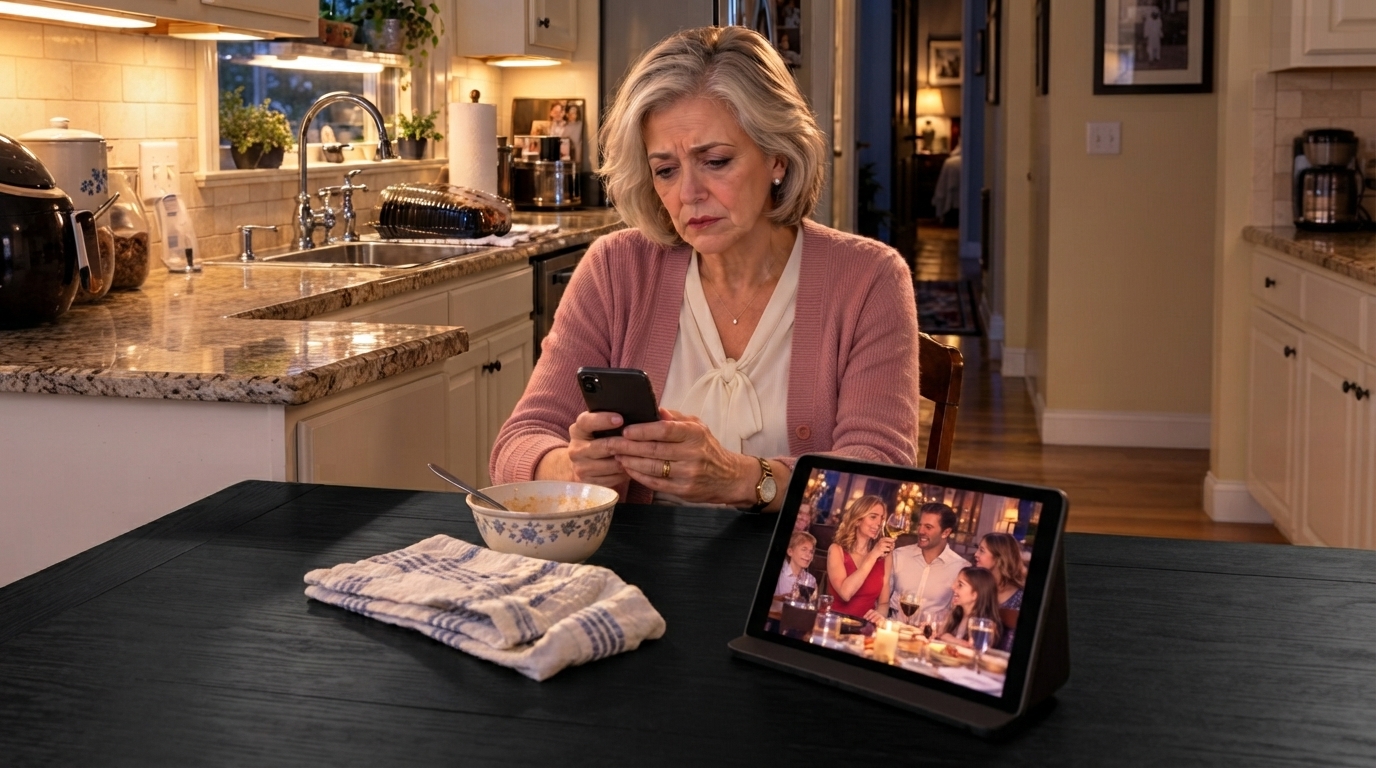
“And I was told to eat leftovers.”
He said nothing.
I continued.
“Do you know what I ate tonight?”
“Mom—”
“Instant soup. From a paper bowl.”
His breathing changed.
“I spent the afternoon ironing your shirt, Daniel. The shirt you wore while celebrating with everyone except me.”
“Emily said you didn’t want to come.”
I went completely still.
“What?”
“She said you weren’t feeling well and preferred to stay home.”
I almost laughed.
Not because it was funny.
Because the lie was so easy.
So convenient.
“Did you ask me?”
Silence.
“Daniel, did you ask your own mother?”
“No.”
“Then you chose to believe whatever made your evening easier.”
He whispered, “I’m sorry.”
For a moment, I almost softened.
Then I remembered the envelope.
“Did you read the letter beside the deed?”
“Yes.”
“All of it?”
“Mom, you can’t be serious.”
“I’ve never been more serious.”
The second document I’d left on the counter was a letter from my attorney, Margaret Collins.
It explained that I had decided to end the rent-free living arrangement.
It did not mean they had to leave immediately.
They had legal occupancy rights, and any termination would follow the proper notice requirements under Ohio law.
But the days of pretending the house belonged to Emily were over.
They would be offered a formal lease at a fair rent, or they could arrange to move elsewhere after the required notice period.
I would no longer provide unpaid childcare, cleaning, cooking, laundry, or household management.
And I would not be returning to live with them.
Daniel’s voice cracked.
“Mom, where are we supposed to go?”
That question hurt more than I expected.
Because it was exactly what I’d been asking myself for years.
Where was I supposed to go when Emily’s relatives visited and my bedroom became their storage room?
Where was I supposed to go when I wanted quiet but was expected to watch the children?
Where was I supposed to go when I was sick but nobody thought to bring me dinner?
Where was I supposed to go when my own family celebrated without me?
I swallowed.
“You have options, Daniel.”
“Emily is crying.”
I looked at the clock.
11:42 p.m.
“Is she?”
“She’s terrified.”
“Of what?”
He hesitated.
“Of losing the house.”
There it was.
Not losing me.
Not hurting me.
Losing the house.
I said quietly, “Then perhaps she should have remembered whose house it was.”
Before he could answer, I heard Emily shouting in the background.
“Give me the phone!”
A moment later, her voice filled my ear.
“Betty, what exactly do you think you’re doing?”
I sat straighter.
“Good evening, Emily.”
“Don’t ‘good evening’ me! Daniel says you’re trying to throw us out!”
“I’m not throwing anyone out tonight.”
“This is our home!”
“Yes,” I replied. “It’s been your home. But it’s my property.”
She gave a sharp laugh.
“You can’t just decide to take everything away because you weren’t invited to one dinner!”
I looked down at my hands.
“You’re right.”
That stopped her.
“What?”
“You’re absolutely right. One dinner wouldn’t justify all this.”
“Then why—”
“Because it wasn’t one dinner, Emily.”
Silence.
“It was six years of being treated like furniture. Six years of making your life easier while you slowly convinced yourself I didn’t matter.”
She scoffed.
“We let you live here!”
I closed my eyes.
There it was.
The sentence I’d suspected she believed.
“We let you live here.”
I repeated it softly.
“Emily, who paid for the house?”
She didn’t answer.
“Who paid $438,000 in cash?”
“Daniel said you helped with the down payment!”
I opened my eyes.
Now it was my turn to be surprised.
“The down payment?”
“Yes!”
I heard Daniel say something in the background.
Emily snapped, “What?”
Then silence.
A long, terrible silence.
“Daniel?”
His voice sounded small.
“Mom.”
“What did you tell your wife?”
He didn’t answer.
“Daniel.”
Finally, he whispered, “I told her you gave us money to help buy the house.”
I stared at the wall.
For six years, Emily had believed Daniel owned the property.
She thought I was an elderly widow living in their spare bedroom out of generosity.
She thought they were supporting me.
And Daniel had allowed that lie to grow until it became the foundation of their marriage.
“Why?” I asked.
His answer was barely audible.
“I didn’t want her to think I couldn’t provide for my family.”
Something inside my chest tightened.
“Oh, Daniel.”
“Mom, I was embarrassed.”
“So you let her humiliate me instead?”
He started crying.
I hadn’t expected that.
But I wasn’t ready to comfort him.
Not this time.
“Your father worked forty-two years to give us security,” I said. “I used that security to help you build a life. And you turned my sacrifice into your accomplishment.”
“Mom, I’m sorry.”
“I believe you regret being caught.”
“No!”
“Then show me something different.”
Emily began shouting again.
But I couldn’t understand her words.
I heard a door slam.
Then Daniel spoke.
“She wants to know if you’re going to sell the house.”
“Not tonight.”
“Please don’t.”
“I’m going to speak with my lawyer on Monday.”
“Mom, the kids—”
“The children are not being punished, Daniel. They will have time, stability, and adults who explain things responsibly. But I am no longer sacrificing my life so everyone else can avoid discomfort.”
He was quiet.
Then he asked the question that finally made me cry.
“Are you ever coming home?”
I looked around the hotel room.
The clean white sheets.
The little lamp.
The suitcase beside the bed.
The photograph of Robert smiling at me.
And for the first time in years, I realized something.
I didn’t know where home was anymore.
But I knew where it wasn’t.
“No, sweetheart,” I whispered. “I’m not.”
Then I ended the call.
I placed my phone facedown.
And I cried.
Not because I regretted leaving.
But because the boy I’d raised had become a man who was willing to let his mother disappear inside his life.
And I didn’t know whether he would ever find his way back.
What I didn’t know was that the following morning, Emily would make a decision so outrageous that even Daniel would finally be forced to choose between protecting her lies and telling the truth.
And this time, the truth wouldn’t stay inside our family.
PART 4
At 7:16 the following morning, I woke to thirty-eight missed calls.
Eleven were from Daniel.
Nine were from Emily.
The rest came from relatives I hadn’t spoken to in months.
I sat on the edge of the hotel bed, staring at the screen.
Then I noticed a message from Emily’s mother, Patricia.
“Betty, I don’t know what game you’re playing, but threatening a family with homelessness over a dinner invitation is disgraceful.”
I read it twice.
Then another message arrived.
“You should be grateful Daniel and Emily have cared for you all these years.”
I almost smiled.
Grateful.
That word had followed me through six years of unpaid work.
I was supposed to be grateful for having a bedroom in a house I owned.
Grateful for being allowed to cook dinner.
Grateful for being included in family photographs when someone remembered.
Grateful for whatever scraps of affection remained after everyone else’s needs were satisfied.
But I wasn’t angry anymore.
I was finished.
I forwarded Patricia’s message to Margaret Collins.
My attorney called ten minutes later.
“Betty, are you somewhere safe?”
“Yes.”
“Good. Don’t argue with anyone. We will handle the property arrangements properly.”
“I don’t want the children frightened.”
“I understand.”
“And I don’t want anyone thrown out overnight.”
“That’s not how we’re proceeding.”
I took a breath.
“Then what happens now?”
“We document the ownership, confirm the occupancy terms, and deliver formal notice. They will have an opportunity to negotiate a lease or make other arrangements.”
I hesitated.
“Margaret?”
“Yes?”
“Am I doing the right thing?”
She was quiet for a moment.
Then she said, “You asked me that same question three months ago.”
I looked toward the window.
Three months earlier, I’d visited Margaret after Emily told me I needed permission before inviting my old friend Helen over for coffee.
I’d been embarrassed.
Sixty-nine years old.
A widow.
A homeowner.
And asking permission to invite a friend into my own kitchen.
That afternoon, Margaret asked me a question.
“Betty, if you weren’t related to these people, would you accept this arrangement?”
I hadn’t answered.
Because I couldn’t.
Now, sitting in the hotel room, I finally could.
“No,” I whispered.
Margaret’s voice softened.
“Then there’s your answer.”
After we hung up, I ordered breakfast.
Real breakfast.
Scrambled eggs.
Toast.
Fresh fruit.
Coffee.
I ate slowly.
Nobody asked where the children’s socks were.
Nobody complained about the dishwasher.
Nobody reminded me that the bathroom towels needed washing.
For the first time in years, I finished a meal while it was still hot.
At 9:43 a.m., Daniel called again.
I answered.
“Mom, we have a problem.”
I closed my eyes.
“What happened?”
“Emily posted something online.”
Of course she had.
“What did she post?”
He hesitated.
“She said you’re trying to evict us because she didn’t invite you to dinner.”
I said nothing.
“She said we’ve supported you financially for years.”
My hand tightened around the phone.
“And?”
“She said you’re becoming confused and making irrational decisions.”
I felt my stomach drop.
There it was.
The accusation I’d feared most.
When an older woman refuses to cooperate, suddenly she’s confused.
When she sets boundaries, she’s unstable.
When she demands respect, she’s difficult.
“Daniel,” I said carefully, “did you correct her?”
Silence.
I stared at the wall.
“Daniel?”
“Not yet.”
I closed my eyes.
For a moment, I was back in the kitchen the previous afternoon.
Watching him leave.
Waiting for him to say something.
Anything.
And once again, he had chosen silence.
“Then you haven’t learned anything.”
“Mom, please. I’m trying to keep everyone calm.”
“No, Daniel. You’re trying to keep everyone comfortable.”
He started to speak.
I interrupted.
“Those are not the same thing.”
Then I ended the call.
I didn’t open social media immediately.
I knew what I’d find.
Angry relatives.
Sympathetic strangers.
People confidently discussing a situation they knew nothing about.
But at noon, Helen called.
“Betty, honey, are you sitting down?”
“I am.”
“Good. Because I think you need to know what your daughter-in-law is telling people.”
Helen had been my friend for thirty-seven years.
She knew Robert.
She’d attended our wedding anniversary celebrations.
She’d helped me pack when I sold my old house.
And she knew exactly who owned the property.
“What is she saying?”
Helen sighed.
“She’s telling everyone you lived off their generosity and now you’re trying to steal their house.”
I looked at Robert’s photograph.
Then I laughed.
A real laugh.
The kind that surprises you because you haven’t heard yourself make that sound in years.
“Betty?”
“I’m sorry, Helen.”
“Are you all right?”
“I think I finally am.”
Helen was quiet.
Then she asked, “What are you going to do?”
I looked at the folder Margaret had emailed me that morning.
“Something I should have done years ago.”
That afternoon, I wrote one short statement.
No insults.
No accusations about Emily’s character.
No embarrassing stories about the children.
Just facts.
I explained that I had purchased the property with my own money six years earlier.
That I remained its legal owner.
That my son and his family had lived there without paying rent.
That I had also provided extensive household help and childcare.
And that I had now decided to establish different living arrangements.
I ended with one sentence.
“I love my family, but love does not require me to surrender my dignity.”
Before posting it, I sent it to Margaret.
She suggested two small changes to keep the wording precise.
Then I published it.
Within an hour, the messages changed.
Patricia deleted her earlier comment.
Emily’s sister stopped posting.
Several relatives apologized.
But the message that surprised me most came from Emily’s coworker, Rachel.
“Mrs. Thompson, I was at the dinner. Emily told us you were too sick to attend. I had no idea. I’m sorry.”
I stared at it.
Then another message arrived.
From a woman named Linda, who had attended the celebration.
“She also told everyone you were lucky they had taken you in after your husband died.”
I set down the phone.
That hurt.
More than the dinner.
More than the leftovers.
Because Robert had worked his entire life to make sure I would never be helpless.
And my own family had rewritten our history to make me look like a burden.
At 4:30 p.m., Daniel appeared at my hotel.
He hadn’t been told my room number, but I’d agreed to meet him in the lobby after he asked.
When I stepped out of the elevator, I barely recognized him.
His eyes were red.
His shoulders slumped.
He looked exhausted.
“Mom.”
I stopped a few feet away.
“Hello, Daniel.”
He looked at me for a long moment.
Then he began crying.
Not quietly.
Not politely.
He covered his face with both hands.
“I’m so sorry.”
People glanced toward us.
I didn’t move.
I wanted to hug him.
Every instinct in my body screamed to comfort my son.
But I’d spent six years protecting him from the consequences of his choices.
And I knew that if I rescued him from this moment, nothing would change.
Finally, he lowered his hands.
“I told Emily everything.”
I waited.
“About the house. About the money. About how much you helped us.”
“Good.”
“And I told her I lied.”
That surprised me.
“What did she say?”
He looked away.
“She said I humiliated her.”
I nodded.
“I imagine she feels betrayed.”
He stared at me.
“You’re defending her?”
“No. I’m recognizing that you lied to her for six years.”
He sat down heavily.
“I thought if she knew the truth, she’d never respect me.”
I sat opposite him.
“And did hiding it earn you respect?”
He shook his head.
“No.”
For a while, neither of us spoke.
Then Daniel reached into his jacket.
He pulled out a folded sheet of paper.
“I wrote down everything you did for us.”
I looked at him.
“Why?”
“Because I couldn’t remember the last time I thanked you.”
He unfolded it.
And began reading.
“You bought the house. You paid for the new furnace when it broke. You covered the emergency plumbing repairs. You watched the kids when Emily went back to work. You took care of Sophie when she had pneumonia. You drove Mason to therapy appointments. You made every birthday cake.”
His voice broke.
“You were there for everything.”
I felt tears rising.
He looked up.
“And I let you become invisible.”
I pressed my lips together.
“Yes,” I whispered. “You did.”
He wiped his eyes.
“Can you forgive me?”
I looked at my son.
The little boy who used to fall asleep on Robert’s chest.
The teenager who brought me wildflowers because he forgot Mother’s Day.
The young father who cried at my kitchen table because he was afraid of failing his children.
I loved him.
I would always love him.
But love and trust were no longer the same thing.
“I want to,” I said. “But forgiveness isn’t the same as returning to the way things were.”
He nodded.
“I understand.”
“Do you?”
“Yes.”
“Then tell me what happens next.”
He looked down at the paper.
“We’re going to find somewhere else to live.”
I hadn’t expected that.
“What?”
“I talked to Emily. She doesn’t want to pay rent to you. And I don’t think staying there is healthy for anyone.”
I studied his face.
“Where will you go?”
“There’s a townhouse near the children’s school. We can afford it if we make some changes.”
“Changes?”
He gave a sad smile.
“Less eating out. No new car. Maybe cancel a few subscriptions.”
I almost laughed.
“That sounds like adulthood.”
He laughed through his tears.
Then his expression became serious.
“Mom, I want you to know something.”
“What?”
“I’m not asking you to give us the house.”
I looked at him.
“I’m not asking you to change your mind.”
My throat tightened.
“For the first time,” he continued, “I want to handle my own responsibilities.”
And something in his voice told me he meant it.
Not perfectly.
Not without fear.
But sincerely.
We sat together for another hour.
We talked about Robert.
About the children.
About the years we’d lost while pretending everything was fine.
Before leaving, Daniel hugged me.
I hugged him back.
And for the first time in years, I didn’t feel like I was holding up the entire weight of his life.
I was simply holding my son.
But Emily wasn’t ready to let go.
Three days later, she called.
Her voice was cold.
“I suppose you’re happy.”
I was sitting in Helen’s garden, watching a butterfly settle on a lavender bush.
“About what?”
“Everyone thinks I’m a terrible person.”
I took a breath.
“Emily, I didn’t tell anyone what to think.”
“You embarrassed me.”
“You told people I was confused and financially dependent on you.”
She went quiet.
Then she said, “I didn’t know the house was yours.”
“I understand.”
“Daniel lied to me.”
“Yes, he did.”
“So why am I the villain?”
I considered that.
“You’re not the villain because you didn’t know who owned the house.”
She didn’t answer.
“You’re responsible for how you treated me when you believed I had nothing to offer you.”
Silence.
I continued.
“You thought I was a dependent widow living under your roof. And instead of treating me with kindness, you treated me like an inconvenience.”
Her breathing changed.
“I was stressed.”
“So was I.”
“I worked hard for that promotion.”
“I know. I was proud of you.”
That stopped her.
“What?”
“I was proud of you, Emily. I told Helen about your promotion. I even bought you a little gift.”
I heard her inhale.
“What gift?”
“A silver bracelet. It’s still wrapped in my suitcase.”
She said nothing.
“I was going to give it to you at dinner.”
For several seconds, the line remained silent.
Then I heard her crying.
Not dramatically.
Not loudly.
Just quiet, broken breaths.
“I didn’t know,” she whispered.
“I know.”
“I thought you judged me.”
“Why?”
“Because I was always working. Because I wasn’t home enough. Because you were better at taking care of the children than I was.”
My heart softened.
“Oh, Emily.”
“I felt like I was failing at everything.”
I looked down at my hands.
“Then you should have talked to me.”
“I know.”
“Instead, you made me smaller so you could feel bigger.”
She began crying harder.
“I’m sorry.”
I let the apology settle.
Then I said, “Thank you.”
“Can we fix this?”
I watched the butterfly lift into the sunlight.
“Maybe. But not by pretending it never happened.”
Over the following weeks, things changed.
Daniel and Emily rented the townhouse.
They moved out of my property voluntarily, after coordinating the transition with Margaret.
I didn’t rush them.
The children finished their school activities.
They packed their toys.
They chose their new bedrooms.
And I made sure they understood that Grandma wasn’t abandoning them.
I told Sophie, who was nine, that grown-ups sometimes needed different homes to be happy.
She hugged me tightly.
“Will you still come to my birthday?”
I kissed her forehead.
“Try keeping me away.”
Mason, who was twelve, asked a harder question.
“Did Mom and Dad make you sad?”
I looked at him.
“Sometimes families hurt one another without understanding how much.”
He nodded thoughtfully.
“Are you still family?”
I held his face between my hands.
“Always.”
The day Daniel handed me the keys, he stood in the empty kitchen.
The same kitchen where I’d spent thousands of hours cooking, cleaning, and trying to make everyone comfortable.
He looked around.
“Are you going to move back in?”
I shook my head.
“No.”
“Sell it?”
“Eventually, perhaps.”
“Then what will you do?”
I smiled.
“Something I’ve wanted to do for a very long time.”
Two months later, I bought a small cottage near a lake.
Not enormous.
Not impressive.
Just two bedrooms, a sunny kitchen, a garden, and a porch overlooking the water.
It reminded me of the place Robert and I used to visit every summer.
The first morning there, I made coffee and carried it outside.
The air smelled of pine trees.
Birds moved through the branches.
Sunlight shimmered across the lake.
And nobody needed anything from me.
I sat down.
Opened a book.
And cried.
Not from loneliness.
From relief.
Three weeks later, Daniel brought the children for the weekend.
He arrived carrying groceries.
Real groceries.
Not a list of things he expected me to buy.
He cooked dinner.
Washed the dishes.
And told the children to clean up their toys before leaving.
I watched him from the doorway.
He caught me smiling.
“What?”
“Nothing.”
“Mom.”
I laughed.
“Your father would be proud of you.”
His expression softened.
“I hope so.”
Then, just before sunset, another car pulled into the driveway.
Emily stepped out.
She carried a small gift bag.
I opened the door.
“Hello, Emily.”
She looked nervous.
“Can we talk?”
I stepped aside.
We sat on the porch.
For a while, neither of us spoke.
Then she handed me the bag.
Inside was a framed photograph.
It showed Robert and me standing beside the lake, laughing in the sunshine.
The same photograph I’d carried away in my suitcase.
But this one had been restored and enlarged.
Beneath it, Emily had placed a small engraved plaque.
It read:
“Thank you for giving us a home. I’m sorry we forgot to give you one.”
I stared at the words.
My eyes filled.
Emily began crying.
“I can’t undo what I did,” she whispered. “But I want to be someone who never treats you that way again.”
I looked at her for a long time.
Then I reached across the table and took her hand.
“That’s where we start.”
We didn’t become perfect overnight.
There were awkward conversations.
There were boundaries.
There were days when old habits threatened to return.
But things were different.
Daniel called because he wanted to hear my voice, not because he needed childcare.
Emily invited me to lunch and made sure I understood I could say no.
The children visited because they loved me, not because their parents needed a free babysitter.
And slowly, we began building something healthier.
Six months after that terrible dinner, Emily received another award at work.
This time, she called me personally.
“Betty, we’re having a celebration next Friday. I’d really love for you to come.”
I smiled.
“That sounds lovely.”
Then she added something I never expected.
“And if you don’t feel like coming, that’s okay too. I just want you to know you’re wanted.”
I sat quietly for a moment.
Because that was all I’d ever needed.
Not expensive gifts.
Not public apologies.
Not a house full of people pretending everything was perfect.
Just the simple knowledge that my presence mattered.
That Friday, I attended the celebration.
I wore a blue dress Robert had always loved.
Daniel pulled out my chair.
Emily introduced me to her coworkers.
“This is Betty,” she said proudly. “My mother-in-law. She’s the reason our family had a chance to build a good life.”
I looked at her.
She squeezed my hand.
And for once, I didn’t feel invisible.
Later that evening, I drove back to my cottage.
I placed my shoes beside the door.
Made myself a cup of tea.
And sat beneath the framed photograph of Robert and me.
I thought about the night everything changed.
The expensive restaurant.
The red dress.
The white shirt I’d ironed.
The message telling me to eat leftovers.
The old blue suitcase.
And the deed I’d left on the kitchen counter.
For years, I’d believed that being a good mother meant giving until there was nothing left.
I’d confused sacrifice with love.
Silence with peace.
Being needed with being valued.
But I finally understood something Robert had tried to teach me long ago.
You can love people without letting them use you.
You can forgive someone without giving them permission to hurt you again.
And you can walk away from a house full of family without walking away from love.
Sometimes, leaving is the only way to show people that you were never furniture.
Never a servant.
Never a burden.
You were a person.
A person with a heart.
A history.
A life.
And a right to be treated with dignity.
That night, before going to bed, I received one final message from Emily.
“Thank you for coming tonight. I love you, Betty.”
I smiled.
Then I typed back:
“I love you too.”
I put my phone down and looked at Robert’s photograph.
“You were right,” I whispered. “Security isn’t about having everything.”
Outside, moonlight stretched across the lake.
The house was quiet.
The dishes were done.
The doors were locked.
And for the first time in six years, I was exactly where I belonged.
Home.
THE END THANK YOU FOR READING !!!



