PART 3
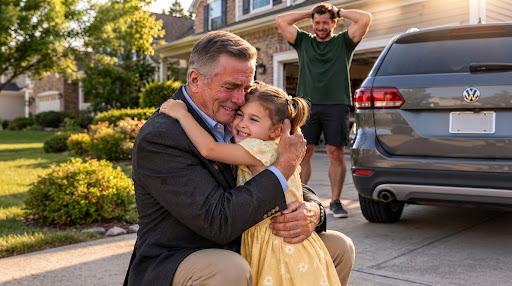
For seven years, I had believed my daughter was dead.
I had stood beside her coffin at a funeral
where nobody was allowed to see her face.
I had carried an urn into my house,
placed it on the mantel beside her photograph,
and spoken to it on birthdays,
Christmas mornings,
and nights when the loneliness became unbearable.
I had watched my wife, Dorothy, fall apart after losing our only child.
Six months later, I buried her too.
And now, through the windshield of my car,
I had watched my son-in-law hand a cup of coffee to a woman
who looked exactly like the daughter
I had spent seven years mourning.
Melissa.
My Melissa.
I sat outside Havenwood Neurological Recovery Center long
after Calvin disappeared through the glass doors with her.
My hands wouldn’t stop shaking.
I wanted to believe my eyes.
I wanted to run inside, shout her name,
and hold her until someone convinced me this wasn’t another cruel dream.
But something kept me frozen.
If Melissa was alive, why hadn’t Calvin told me?
And why had my seven-year-old granddaughter been the one to lead me here?
Eventually, Calvin came back outside alone.
He looked exhausted. He stood beside his SUV, rubbing his forehead before climbing inside and driving away.
I waited until his vehicle disappeared.
Then I stepped out of my car.
Every footstep toward those glass doors felt heavier than the last.
Inside, a receptionist smiled politely.
“Good afternoon, sir. Can I help you?”
I gripped the counter.
“I’m looking for Melissa Brooks.”
“Are you a family member?”
My voice cracked.
“I’m her father.”
The receptionist glanced at her computer, then looked back at me.
“I’m sorry, sir. We can’t confirm patient information without authorization.”
I nodded, although I could barely understand her words.
“Please. I saw her outside. She was wearing a blue cardigan. There’s a little scar above her eyebrow.”
“Sir—”
“My daughter died seven years ago.”
The receptionist stopped speaking.
“At least, that’s what they told me.”
She looked genuinely concerned.
“Perhaps I can find someone to speak with you.”
Before she could reach for the telephone, a voice came from behind me.
“Dad?”
I froze.
I knew that voice.
I had heard it in old birthday videos. In saved voicemail messages. In dreams that ended the moment I opened my eyes.
Slowly, I turned.
Melissa stood in the hallway.
She was thinner than I remembered, with shorter hair and a slight uncertainty in the way she balanced herself.
But those eyes were hers.
The little scar was hers.
And the way she pressed her lips together when she was trying not to cry was something I had known since she was a child.
“Dad?” she whispered again. “Is it really you?”
I couldn’t speak.
I simply opened my arms.
She crossed the hallway, and I caught her against my chest.
For several seconds, I forgot how to breathe.
She was warm.
She was real.
She was alive.
“My little girl,” I sobbed. “Oh, Melissa. My little girl.”
Her arms tightened around me.
“I’m sorry, Daddy.”
I pulled back just enough to see her face.
“Sorry? Sweetheart, what are you sorry for?”
She looked frightened.
“For taking so long to remember.”
Those words nearly broke me.
A woman wearing a staff identification badge approached us.
“I’m Dr. Elaine Foster. I’m one of Melissa’s rehabilitation psychologists. Would you like somewhere private to sit?”
I nodded.
Melissa held my hand all the way down the hallway.
I was terrified that if I let go, she might disappear.
Inside a small consultation room, Dr. Foster explained what had happened.
Seven years earlier, Melissa had been driving a coworker named Nora Vance home during a violent storm.
Their car had left the highway and crashed.
One woman was found near the wreckage. Another was discovered farther away, unconscious and without identification.
The accident had been chaotic.
Melissa’s purse, coat, and bracelet had been found near Nora. The initial identification had relied heavily on those belongings, and a series of serious administrative mistakes had allowed that identification to become official.
Meanwhile, Melissa had been admitted to another hospital as an unidentified patient.
She had suffered a severe traumatic brain injury.
For months, she couldn’t reliably speak, remember her name, or recognize familiar information.
She eventually moved through several rehabilitation programs before arriving at Havenwood.
I stared at Dr. Foster.
“But we had a funeral.”
“I understand.”
“We cremated someone.”
Her expression softened.
“An investigation will be needed to establish exactly what happened with the identification.”
I turned toward Melissa.
“Sweetheart, did you know we thought you were dead?”
She lowered her head.
“Not at first.”
Her fingers twisted a tissue.
“For a long time, I didn’t even know who I was.”
She told me her memories had returned slowly.
A kitchen painted yellow.
The smell of cinnamon rolls.
A little girl laughing.
An old oak tree.
And eventually, the words Grant Family Market.
About eighteen months earlier, a social worker had searched for the store online and found a photograph of our family.
That photograph led them to Calvin.
I sat perfectly still.
“Eighteen months?”
Melissa nodded.
I felt something cold spread through my chest.
“Calvin has known you’re alive for eighteen months?”
She looked toward Dr. Foster.
“He came when they found him.”
I stood so suddenly that my chair scraped across the floor.
“Eighteen months!”
Melissa flinched.
I immediately lowered my voice.
“I’m sorry, sweetheart. I’m not angry with you.”
But I was angry.
More furious than I had ever been in my life.
For eighteen months, I had visited a grave that shouldn’t have been hers.
I had cried beside Dorothy’s photograph, wishing our daughter could have survived.
And Calvin had known.
Dr. Foster explained that Melissa had initially struggled with overwhelming confusion and anxiety.
Seeing photographs didn’t always mean she could understand the relationships behind them.
She had needed time to process learning that seven years had passed, her mother had died, and her baby daughter was now a little girl.
Melissa touched my arm.
“I was scared, Dad. I thought you might expect me to remember everything.”
I sat beside her again.
“Melissa, you could have forgotten every single thing about me, and I still would have come.”
She began crying.
I held her hand.
“There’s nothing you have to remember to earn your father’s love.”
A few minutes later, Dr. Foster asked whether we wanted Calvin to join us.
I said yes.
Twenty-five minutes later, he entered the room.
The moment he saw me, his face drained of color.
“Daniel.”
I looked at him.
“Sit down.”
He obeyed.
For a long moment, nobody spoke.
Then I asked the question that had been burning inside me.
“How long were you planning to keep my daughter from me?”
He swallowed.
“I wasn’t trying to keep her from you.”
“Eighteen months, Calvin.”
“I know.”
“Eighteen months of birthdays. Christmases. Every single day you watched me mourn a daughter you knew was alive.”
His eyes filled with tears.
“Melissa wasn’t ready.”
I looked at her.
“Sweetheart, did you tell him not to contact me?”
She hesitated.
“I told him I needed time.”
Calvin leaned forward.
“I thought I was protecting her.”
“Then why didn’t you tell me there was even a possibility?”
He stared at the floor.
“I was afraid you’d rush here. That you’d overwhelm her. And then the longer I waited, the harder it became to explain.”
I felt my jaw tighten.
“So you kept waiting.”
He nodded.
Then he said something that made my stomach turn.
“Ava knew.”
I looked at him.
“What?”
“She’s visited Melissa three times.”
I slowly turned toward my daughter.
Melissa’s eyes filled again.
“I wanted to meet her. I remembered holding a baby, but I didn’t understand how she could already be seven.”
A family counselor had helped arrange the visits.
Ava had met her mother gradually, with support.
But Calvin had asked her not to tell me yet.
I could barely believe what I was hearing.
“You asked a seven-year-old child to keep her mother a secret from her grandfather?”
Calvin covered his face.
“I made a mistake.”
“No,” I said quietly. “You gave a little girl a burden that grown adults couldn’t handle.”
Suddenly, everything made sense.
Ava’s nervous eyes.
Her little fingers gripping my sleeve.
Grandpa, please follow Daddy.
She hadn’t been trying to expose stolen money.
She had been trying to bring her family back together.
And she’d been too frightened to tell me herself.
Then I remembered the money.
Seven years.
Forty thousand dollars every January.
Two hundred and eighty thousand dollars.
I looked at Calvin.
“Tell me where the money went.”
He raised his head.
“Daniel—”
“Don’t lie to me. Not again.”
He reached for the folder he had carried into the room.
“I brought the records.”
He opened it.
“Most of the money went toward Ava’s expenses. Some is still in her education account.”
“How much went somewhere else?”
He hesitated.
“Twenty-eight thousand dollars.”
I stared at him.
“For what?”
He looked toward Melissa.
“Her rehabilitation. Insurance didn’t cover everything.”
I felt my anger collide with something much more painful.
“Calvin, she’s my daughter.”
“I know.”
“If you had called me and said Melissa was alive and needed medical care, I would have sold my entire grocery store to help her.”
He started crying.
“I know, Daniel.”
“Then why didn’t you trust me?”
His voice broke.
“Because I was ashamed. I couldn’t fix what happened. I couldn’t even tell you the truth.”
I shook my head.
“You didn’t have to fix everything. You only had to stop hiding it.”
Before I left, I asked for complete financial records.
Calvin agreed.
But just as we stood to go, he handed me an old photograph.
It showed Dorothy holding Melissa as a baby.
I recognized it immediately.
My wife had kept it in her bedside drawer.
I turned it over.
There, in Dorothy’s handwriting, was a note dated four months after Melissa’s funeral.
Called again today. Still no confirmation. If there’s even a chance, I have to keep looking.
I stared at the words.
My wife had been searching for Melissa.
While the rest of us had accepted her death, Dorothy had kept looking.
I raised my eyes toward Calvin.
“You knew she was questioning the identification?”
He looked away.
“She had doubts.”
“And you never told me?”
“Daniel, everyone thought she was grieving.”
I looked down at the photograph.
Then Melissa spoke softly.
“Dad, I remember a woman visiting me in a hospital.”
My heart stopped.
“Who?”
“She wore a green scarf. She held my hand and talked about cinnamon rolls.”
I felt the room spin.
Dorothy had owned a green scarf.
She wore it almost every winter.
Melissa looked at me.
“She kept asking me to squeeze her hand if I knew her.”
My eyes filled with tears.
Because I suddenly understood something terrible.
My wife might have found our daughter before she died.
And I had never known.
PART 4
I didn’t sleep that night.
I sat at my kitchen table with Dorothy’s photograph in front of me, staring at the note she’d written.
If there’s even a chance, I have to keep looking.
For seven years, I had believed my wife died without knowing what happened to our daughter.
Now I wondered whether she’d spent her final months fighting to uncover a truth the rest of us had been too exhausted to question.
At sunrise, I opened the closet where I’d stored her belongings.
I hadn’t touched most of those boxes since her funeral.
There were recipe cards, old Christmas decorations, birthday letters, and notebooks filled with grocery lists.
Then I found a small blue notebook.
Inside were dates.
Telephone numbers.
Names of hospitals.
And pages of notes about Melissa’s accident.
My hands shook as I read.
Dorothy had questioned the identification almost immediately.
She’d requested information about dental records.
She’d asked whether the authorities had confirmed the victim’s identity through DNA.
And she’d contacted a rehabilitation facility called St. Anne’s.
One entry caught my attention.
Unidentified female. Approximately Melissa’s age. Serious brain injury. Transferred after Highway 24 accident.
I felt my throat close.
Further down the page, Dorothy had written:
Calvin says I need to accept she’s gone. Daniel agrees. But I know my daughter.
I put the notebook down.
I remembered that conversation.
Dorothy had been sitting at our kitchen table, telling me something didn’t feel right about the funeral.
I’d held her hand and told her we needed to accept what the investigators had said.
I thought I was helping her heal.
Instead, I had asked her to stop looking.
I sat there crying until the morning light filled the kitchen.
Then I called St. Anne’s.
It took several conversations, appropriate authorization from Melissa, and help from her rehabilitation team before we could speak with a retired nurse named Carol Bennett.
Carol remembered Dorothy.
“Your wife came here twice,” she told me.
I gripped the telephone.
“Did she see Melissa?”
“She met an unidentified patient who she believed might be her daughter.”
“Did the patient recognize her?”
“There were moments of apparent recognition, but we couldn’t establish what they meant at the time.”
Carol paused.
“Your wife was very determined.”
I closed my eyes.
“That sounds like Dorothy.”
“She talked to the patient about a grocery store. And cinnamon rolls.”
I began crying again.
“She made the best cinnamon rolls in the world.”
Carol’s voice softened.
“Your wife told me she was going to bring you back when she had confirmation.”
But Dorothy never got that chance.
She died before the testing and records review could be completed.
Carol explained that attempts had been made to follow up afterward, but communication between facilities and agencies had broken down.
I remembered the months after Dorothy’s death.
I’d ignored unfamiliar telephone numbers.
I’d spent nights sleeping in my office above the grocery store because I couldn’t bear returning to an empty house.
There had been days when I barely opened the mail.
I wondered how many chances I’d missed.
Then Carol mentioned something else.
“Dorothy left a letter with a family keepsake. She told me she’d put another copy somewhere safe.”
I remembered the small silver key Dorothy wore around her neck.
Melissa had owned a matching pendant.
Years earlier, they’d rented a safe-deposit box for letters and sentimental belongings.
I called Melissa.
“Sweetheart, there’s something we need to find.”
Three days later, after arranging the necessary access, we visited the bank together.
Melissa held my hand while the employee brought us the box.
Inside were old photographs, childhood drawings, a ribbon from Melissa’s graduation, and several envelopes.
One was addressed to me.
Dorothy’s handwriting.
I opened it carefully.
My darling Daniel,
If you’re reading this, I hope it’s because we finally have answers.
I know everyone believes Melissa is gone. I know you think my searching is hurting me. But I can’t stop wondering whether the young woman at St. Anne’s is our girl.
When I spoke about the market, she cried. When I mentioned cinnamon rolls, she squeezed my hand.
Maybe I’m wrong. Maybe grief has made me see what I want to see.
But if I’m right, I need you to promise me something.
Don’t ask her to become the Melissa we lost.
Meet the Melissa who survived.
I pressed the letter against my chest.
For a long time, neither of us spoke.
Then Melissa reached for me.
“Mom knew?”
I nodded through my tears.
“She never stopped looking for you.”
Melissa covered her mouth.
“I wish I could remember her.”
I put my arm around her.
“She remembered enough for both of you.”
We sat together in that little bank office, grieving the woman who had come so close to bringing us back together.
But Dorothy’s letter changed something inside me.
I’d spent every moment since finding Melissa thinking about the seven years we’d lost.
I wanted her back in the family house.
I wanted her working at the grocery store.
I wanted her laughing at our kitchen table as though the accident had never happened.
But Dorothy had understood something I hadn’t.
Melissa wasn’t a missing piece I could simply put back where she belonged.
She was a person who had survived seven years of pain, confusion, and recovery.
And she deserved to decide what came next.
That afternoon, Melissa surprised me.
“Dad, I don’t think I want to move back in with Calvin.”
I looked at her.
“Why not, sweetheart?”
She hesitated.
“I love Ava. I care about Calvin. But I don’t remember enough of our marriage to pretend everything is the same.”
I waited.
“Sometimes I look at our wedding pictures, and I know the woman in them is me. But I don’t remember how she felt.”
Her eyes filled.
“Everyone keeps telling me I can go home. But I don’t know which home they’re talking about.”
I wanted to offer her my house.
I wanted to tell her I’d make everything right.
Instead, I remembered Dorothy’s words.
“What would make you happy, Melissa?”
She looked surprised.
Then she smiled.
“A small apartment near Havenwood. Somewhere I can learn to live on my own.”
I nodded.
“Then that’s what we’ll work toward.”
She squeezed my hand.
“Thank you, Dad.”
The following week, Calvin brought the financial records to my house.
We spent an entire afternoon reviewing them.
Of the $280,000 I’d transferred over seven years, approximately $196,000 had gone toward Ava’s living expenses.
Another $56,000 remained in accounts designated for her education.
The remaining $28,000 had been used for Melissa’s uncovered medical and rehabilitation costs.
Calvin had already begun replacing that money from his own savings.
The records didn’t excuse the secrecy.
But they showed me something important.
He hadn’t been living some extravagant double life.
He’d been trying to manage an impossible situation and had made terrible decisions about whom to trust with the truth.
“I don’t know whether I can forgive you,” I told him.
He nodded.
“I understand.”
“But Ava will never be asked to keep another secret like this.”
“Never again,” he promised.
“And any money I provide for her will be handled openly.”
“Agreed.”
I looked at him for a long moment.
“Calvin, you were afraid of hurting Melissa. I understand that. But protecting someone doesn’t mean making every decision for everyone else.”
He wiped his eyes.
“I know that now.”
Over the following weeks, we also contacted the county investigator assigned to review the accident.
Her name was Lena Ortiz.
She reopened the identification file and arranged for the appropriate testing.
Melissa and I provided DNA samples to confirm our relationship.
Eleven days later, the results arrived.
I sat at my kitchen table holding the report.
I had recognized my daughter the moment I saw her outside Havenwood.
But seeing the confirmation in writing made me cry all over again.
Melissa was my daughter.
She was alive.
The investigation eventually confirmed that the remains we’d received belonged to Nora Vance, Melissa’s coworker.
Nora had a younger sister named Rebecca living in Oregon.
When Rebecca learned what had happened, she traveled to meet us.
I expected anger.
Instead, she sat beside Melissa and cried.
“For seven years, I didn’t know where my sister was,” she whispered.
Melissa reached across the table.
“I’m so sorry.”
Rebecca shook her head.
“You didn’t cause this.”
The two women talked for hours.
Melissa remembered only fragments of the accident.
Rain against the windshield.
Nora laughing about a birthday present she’d bought for her nephew.
A baseball glove.
Rebecca smiled through her tears.
“She bought that for my son.”
It was a small memory.
But it gave Rebecca something she’d been missing for seven years.
Eventually, Nora’s remains were returned to her family, and Rebecca arranged a memorial in Oregon.
She later sent Melissa a photograph of Nora smiling on a beach.
Melissa placed it beside a picture of Dorothy.
“I want to remember both of them,” she told me.
By autumn, Melissa had moved into a modest apartment with blue kitchen cabinets and a balcony overlooking a little garden.
Ava helped choose the cushions.
Calvin assembled a bookshelf and accidentally installed one shelf backward.
When I pointed it out, he blamed the instructions.
Melissa rolled her eyes.
For one beautiful moment, she looked exactly like the daughter I remembered.
But there were difficult days too.
Some mornings, she couldn’t remember conversations from the previous afternoon.
Sometimes crowded rooms overwhelmed her.
Other times, she’d become frustrated because her hands didn’t move as quickly as she wanted.
I learned not to rush her.
I learned not to finish her sentences.
And I learned that loving someone sometimes means standing nearby without trying to control what happens next.
One Saturday, Melissa asked if she could visit Grant Family Market.
I opened the store early.
Maria, my longtime manager, waited beside the registers.
She had known Melissa since she was a teenager.
When my daughter walked through the entrance, the little bell above the door rang.
Melissa stopped.
She looked toward the bakery.
Then she smiled.
“Cinnamon.”
I laughed.
“Your mother’s recipe.”
She walked slowly toward the counter.
“Is the red stool still here?”
My heart tightened.
“You remember that?”
“I used to sit there and do my homework.”
“And steal cookies.”
She smiled.
“I don’t remember that part.”
“Convenient.”
Maria laughed through her tears.
That morning, Melissa helped prepare a batch of cinnamon rolls.
She measured the ingredients carefully, sometimes checking the instructions twice.
When the first tray came out of the oven, she stood quietly looking at it.
“Mom used to put extra cinnamon in these.”
I nodded.
“Too much, if you asked me.”
Melissa raised an eyebrow.
“She probably ignored you.”
“Every single time.”
We laughed.
And for a moment, the grocery store felt like home again.
As Christmas approached, Melissa and Calvin began having serious conversations about their marriage.
They attended counseling.
They spent time together with Ava.
But Melissa wasn’t ready to promise they would return to the relationship they’d had before the accident.
One afternoon, Calvin came to see me.
“We’re going to take things slowly,” he said.
I nodded.
“That’s probably wise.”
“I kept thinking that once she remembered enough, everything would go back to normal.”
He looked down.
“But she’s changed. And so have I.”
I put a hand on his shoulder.
“Then you have to learn who each other is now.”
He smiled sadly.
“That’s what she said.”
I didn’t know whether their marriage would survive.
But I knew they were finally being honest.
And after everything we’d endured, honesty mattered more than pretending.
Christmas morning, we gathered at my house.
Melissa brought cinnamon rolls she’d baked herself.
Ava ran through the living room carrying a paper star she’d made for Dorothy.
“Grandpa, where should Grandma’s star go?”
I pointed toward the mantel.
“Right beside her picture.”
The urn was gone.
Sometimes I still looked toward the place where it had stood for seven years.
But now Dorothy’s photograph sat beside fresh flowers and a small silver key pendant.
Melissa stood beside me.
“I wish Mom could see us.”
I swallowed.
“She’d be so proud of you.”
Melissa leaned against my shoulder.
“I don’t remember everything about her.”
“You don’t have to.”
I kissed her forehead.
“I’ll tell you stories for as long as you want to hear them.”
From the kitchen, Ava shouted, “Mom! Come help me!”
Melissa lifted her head.
“Coming!”
She hurried toward her daughter.
I stood there listening to them laugh.
For seven years, I had wondered what it would sound like to hear Ava call Melissa Mom.
Now I knew.
It was the most beautiful sound in the world.
When January arrived, I didn’t make my usual $40,000 transfer into Calvin’s personal account.
Instead, we arranged for future contributions to go directly into an account designated for Ava’s needs and education, with clear records and agreed oversight.
No more unexplained expenses.
No more hidden arrangements.
And absolutely no more asking a child to carry adult secrets.
After we finished at the bank, Ava looked up at me.
“Grandpa?”
“Yes, sweetheart?”
“Can I use some of that money to buy a horse?”
I laughed.
“No.”
She frowned thoughtfully.
“What if it’s an educational horse?”
Melissa burst out laughing.
Calvin shook his head.
And for the first time in years, I heard all of us laughing together without anything terrible hiding beneath it.
Spring came.
Melissa began working four mornings a week at the bakery counter.
She invented a new cinnamon-roll recipe with orange zest and less sugar.
I told her she was ruining a family tradition.
The first batch sold out before nine.
Ava started doing her homework on a stool beside the register, just as her mother had done when she was little.
Sometimes Calvin stopped by after work, bringing groceries so he and Melissa could cook dinner together.
Their future remained uncertain.
But they were treating each other with kindness.
And I was learning that uncertainty didn’t have to mean disaster.
One warm afternoon, I found Ava sitting beneath the old oak tree behind the market.
It was the same place where she’d warned me about the money.
The same place where she’d looked frightened and whispered that I needed to follow her father.
This time, she was eating strawberry ice cream.
Melissa stood nearby, hanging a new wooden swing from the tree with Calvin’s help.
I sat beside Ava.
“Sweetheart, do you remember what you told me here?”
She nodded.
“About Daddy?”
“Yes.”
She looked down at her ice cream.
“I was scared you’d be mad.”
I took her little hand.
“Why would I be mad?”
“Because I knew Mommy was alive, and you didn’t.”
My eyes filled.
“Oh, Ava.”
I pulled her gently into my arms.
“You never should have had to keep that secret.”
She hugged me.
“I just wanted you to see Mommy.”
“I know, sweetheart.”
“Are you happy now?”
I looked toward Melissa.
She was laughing because Calvin couldn’t figure out how to attach the swing properly.
For a moment, I could almost see Dorothy standing beside them, wearing her green scarf and shaking her head at our clumsy efforts.
I smiled through my tears.
“Yes, Ava. I’m happy.”
My granddaughter considered that answer.
Then she whispered, “Grandpa, I think Grandma helped us.”
I looked at her.
“What makes you say that?”
“Because Mommy says Grandma never stopped looking.”
I held Ava a little tighter.
“She didn’t.”
Melissa finally called us over.
“Dad! Come see!”
The swing was ready.
Ava climbed onto it while Calvin stood behind her.
Melissa took the other side.
Together, they gave her a gentle push.
Ava squealed with delight.
“Higher!”
“Not too high,” I warned.
Melissa looked over her shoulder.
“Dad, you said that when I was little.”
I laughed.
“And you never listened.”
She smiled.
For a moment, the years between us seemed to disappear.
But I no longer wished to erase them.
Those years had changed all of us.
They had taken Dorothy from me.
They had taken memories from Melissa.
They had left Calvin carrying guilt and Ava carrying questions no little girl should ever have been asked to answer.
Yet somehow, we were still standing beneath the same oak tree.
Together.
That evening, after everyone went home, I returned to my kitchen and took Dorothy’s letter from the drawer.
I read her final words again.
Don’t ask her to become the Melissa we lost. Meet the Melissa who survived.
Then I looked at a new photograph on the refrigerator.
Melissa stood behind the bakery counter, flour on her cheek.
Ava was beside her, grinning.
Calvin stood in the background holding a tray of cinnamon rolls.
And I was smiling wider than I had in seven years.
I finally understood what Dorothy had been trying to tell me.
For years, I thought keeping my promise to Melissa meant sending money every January.
I believed that if Ava had enough food, clothing, education, and security, I was doing everything a grandfather should.
But money couldn’t replace truth.
It couldn’t replace trust.
And it certainly couldn’t replace the courage to ask difficult questions.
My granddaughter hadn’t needed another forty thousand dollars nearly as much as she’d needed someone to listen.
And when she finally found the courage to speak, she changed all our lives.
I placed Dorothy’s letter beside her photograph.
“Well, sweetheart,” I whispered, “you were right.”
Then I smiled.
“Our girl made it home.”
Not to the life she’d lost.
Not to the woman she’d once been.
But to a new beginning she was choosing for herself.
Sometimes getting your family back doesn’t mean recovering the life you lost. It means learning to love the people standing in front of you, even when everything has changed.
For seven years, I believed my daughter’s story had ended.
But Melissa had been fighting her way back to us all along.
And thanks to one brave little girl who refused to let a terrible secret stay buried, we finally had the chance to begin again.
THE END THANK YOU FOR READING !!!



