PART 3
For a moment, nobody moved.
Commander Nathaniel Hayes stood at the microphone,
his expression solemn.
Behind him, the American flag shifted
gently in the California breeze.
My mother was staring at me.
My father looked as though someone
had knocked the air out of his lungs.
And Ryan, my younger brother,
stood among the newly qualified SEALs with an
expression I’d never seen on his face before.
Uncertainty.
For twenty-eight years,
Ryan had been the person our family celebrated.
Now, for the first time, he was looking at me as though he didn’t know who I was.
Hayes adjusted the microphone.
Before we proceed, I want to clarify that the details being
shared today have been reviewed and authorized for public release.
Colonel Carter’s service includes assignments that remain classified,
and those matters will remain private.
I felt my shoulders relax slightly.
I’d spent too many years learning the importance of that distinction.
There were things I could discuss.
And things I would carry quietly for the rest of my life.
Hayes continued.
“Seven years ago, a joint military team was conducting a recovery operation overseas when its extraction became compromised. Several American service members were injured, and their position was at risk of being overrun.”
The audience became completely silent.
“Colonel Carter was part of the joint command element coordinating the recovery. When communications failed, she helped establish an alternate route for the evacuation and remained in the operational area until the last wounded service member was recovered.”
My mother pressed a hand over her mouth.
I stared straight ahead.
I remembered that night.
Not the details that belonged in classified reports.
The human details.
The smell of dust.
The sound of someone struggling to breathe.
A young corpsman repeating that he couldn’t feel his legs.
And the terrible knowledge that if we made one wrong decision, families thousands of miles away would receive phone calls that changed their lives forever.
Hayes paused.
“Colonel Carter was wounded during that operation. Her actions helped save the lives of multiple service members, including one man who is with us today.”
He turned toward the decorated senior chief standing beside the stage.
“Senior Chief Daniel Reeves.”
The man stepped forward.
He was broad-shouldered, with silver beginning to show at his temples.
His dress uniform displayed years of service.
But what I noticed was the way he looked at me.
Like someone seeing a person he’d once believed he would never have the chance to thank properly.
Daniel approached the microphone.
For several seconds, he simply stood there.
Then he looked toward the audience.
“Seven years ago, I was lying on the ground in a place I was certain I would never leave.”
His voice was steady.
“I had been seriously wounded. Our team was trying to get everyone out, but the situation was deteriorating.”
He turned toward me.
“Colonel Carter was one of the people who refused to let that be the end of my story.”
I lowered my eyes.
He continued.
“I remember hearing her voice. I remember her telling me to stay awake. And I remember that when I said I was slowing everyone down, she told me something I’ve never forgotten.”
He paused.
Then smiled faintly.
“She said, ‘You don’t get to make that decision for the people who love you.'”
My throat tightened.
I remembered saying it.
I hadn’t known he remembered.
Daniel looked toward the audience again.
“I made it home. I watched my daughter graduate high school. I walked her down the aisle last year. And next month, I’m going to become a grandfather.”
A few people began wiping their eyes.
He turned back toward me.
“Ma’am, I don’t know how to thank you for those years.”
I stood.
“You already did, Senior Chief.”
He shook his head.
“No, ma’am. I don’t think I ever can.”
Then he saluted.
I returned it.
And for the first time that morning, I felt tears burning behind my eyes.
When I sat down, I accidentally looked toward my family.
Mom was crying.
Dad’s mouth hung slightly open.
Aunt Patricia had stopped smiling.
Madison looked down at her phone, suddenly fascinated by the blank screen.
But Ryan was watching Daniel Reeves.
He recognized the name.
I could tell by the way his expression changed.
During SEAL training, he’d heard stories about men who had served before him.
Men whose names carried weight.
Daniel Reeves was one of them.
And now he was standing in front of the entire ceremony, thanking the sister Ryan had told not to embarrass him.
Commander Hayes resumed speaking.
“Today’s Trident ceremony celebrates the commitment of those who have completed an extraordinary course of training. The insignia they receive represents responsibility, teamwork, and service.”
He looked toward the newly qualified men.
“That service is never performed alone.”
His gaze moved briefly toward me.
“It depends on people whose names may never appear in public accounts, people whose contributions are known only to those who were there.”
Then he gestured toward Daniel.
“Senior Chief Reeves has been invited to take part in a special recognition connected to today’s ceremony. Colonel Carter will join us for that presentation.”
I rose.
Daniel stepped beside me.
The recognition was not a second award for Ryan, nor a replacement for the normal pinning proceedings.
It was a moment set aside to acknowledge the continuity of service between those who had come before and those who were just beginning.
Daniel had brought his own Trident.
The one he’d worn through years of deployments.
It would remain his.
But he’d asked me to stand with him as he presented a commemorative display to the training command, honoring the people who had helped bring his team home.
I took my place beside him.
The display held a photograph of the recovered team, a unit patch, and a small engraved plate.
The inscription read:
NO ONE COMES HOME ALONE.
My hands trembled slightly as I accepted it.
Not because of the audience.
Because I remembered the men in that photograph.
Some had recovered.
Some still lived with injuries that would never completely heal.
And some had spent years rebuilding lives interrupted in a single night.
I looked at Daniel.
He nodded.
Together, we presented the display.
The audience stood.
And the applause rolled through the tent.
Afterward, the ceremony continued.
The newly qualified SEALs received their Tridents in accordance with the day’s planned proceedings.
Ryan stepped forward when his name was called.
I watched him stand tall.
Despite everything, I felt proud of him.
He had endured demanding training.
He had earned his qualification.
Whatever my family had done that morning, it didn’t erase his achievement.
When his Trident was presented, I applauded.
I meant it.
But when Ryan turned toward the family section, he didn’t look at Mom.
He didn’t look at Dad.
He looked at me.
And for the first time, he didn’t smile.
The ceremony ended shortly before noon.
Families gathered around their loved ones.
Photographs were taken.
People embraced.
Children ran between folding chairs.
I remained near the stage speaking with Commander Hayes.
He looked at me carefully.
“Are you all right, Emily?”
I smiled faintly.
“I’ve had worse mornings.”
He didn’t smile.
“I was informed there was a seating problem.”
I looked away.
“It was a misunderstanding.”
“Was it?”
I hesitated.
Then said, “My family didn’t know why I was invited.”
Hayes studied my face.
“That doesn’t explain why anyone believed you shouldn’t be treated respectfully.”
I said nothing.
He continued.
“You’re not required to explain your service to people who refuse to respect you.”
I swallowed.
“Thank you, sir.”
He nodded.
“Enjoy the rest of the day. You’ve earned it.”
I was walking toward the parking area when I heard my mother calling.
“Emily!”
I stopped.
She hurried toward me, Dad close behind.
Ryan followed several steps back.
Aunt Patricia and Madison trailed them.
Mom reached me first.
“Emily, sweetheart!”
She tried to hug me.
I stepped aside.
Her smile faltered.
“What’s wrong?”
I stared at her.
“What’s wrong?”
She looked confused.
“Darling, we’re so proud of you!”
I almost laughed.
An hour earlier, she’d told security I wasn’t important.
Now she was calling me darling.
I looked at her.
“Mom, you asked security to move me away from the front.”
Her cheeks reddened.
“That was a misunderstanding.”
“You said I wasn’t important.”
“I didn’t mean it like that.”
I waited.
She glanced toward Dad.
Then whispered, “I didn’t know you were a colonel.”
The words landed exactly where she hadn’t intended.
I nodded slowly.
“That’s the problem.”
She frowned.
“What?”
“You think the mistake was not knowing my rank.”
Mom opened her mouth.
I continued.
“The mistake was believing I deserved to be humiliated when you thought I was ordinary.”
She began crying.
“Emily, please.”
I looked at Dad.
He couldn’t meet my eyes.
My father cleared his throat.
“Why didn’t you tell us?”
I stared at him.
“Tell you what?”
“About your career. Your rank. Everything.”
I took a breath.
“Dad, I told you I was serving.”
He shook his head.
“You never said anything about being a colonel.”
“I told you I was working in military intelligence and joint operations. I told you I was deploying. I told you some assignments weren’t things I could discuss.”
He looked uncomfortable.
I continued.
“You called it secretarial work.”
He stared at me.
“You said I was hiding behind a desk because I couldn’t finish college.”
His face changed.
I remembered that conversation.
Thanksgiving.
Six years earlier.
I’d come home after a difficult assignment.
I had barely slept.
My shoulder was still healing.
And Dad had announced to everyone that Ryan was considering military service.
Then he’d looked at me and said, “At least one of my children might do something meaningful.”
I’d left the table.
Nobody had followed.
Dad rubbed his forehead.
“I didn’t understand.”
I nodded.
“No. You didn’t.”
He swallowed.
“You could have explained.”
I stared at him.
“I tried.”
He looked away.
I continued.
“Every time I started talking about my work, you changed the subject to Ryan.”
Mom whispered, “We didn’t know.”
I looked at her.
“You didn’t want to know.”
Silence.
Then Ryan stepped forward.
“Emily.”
I turned.
His face was pale.
“Can we talk?”
I looked at him.
“Go ahead.”
He glanced at our parents.
“Alone.”
I hesitated.
Then nodded.
We walked toward a quieter section near the edge of the parking lot.
For a while, neither of us spoke.
Ryan stared at the pavement.
Then he said, “Senior Chief Reeves is a legend.”
I nodded.
“He’s a good man.”
Ryan looked up.
“They told us about him during training.”
I said nothing.
“He came back from injuries that should have ended his career.”
“Yes.”
Ryan swallowed.
“And you helped bring him home.”
I nodded.
He stared at me.
“Why didn’t you tell me?”
I looked toward the distant water.
“Would you have listened?”
He opened his mouth.
Then closed it.
I continued.
“Ryan, you told me not to embarrass you before the ceremony even started.”
His face reddened.
“I know.”
“You laughed when Madison called me a disappointment.”
He looked down.
“I know.”
“You stood there while Mom tried to have me moved.”
He swallowed.
“I know.”
I took a breath.
“I came because I was proud of you.”
He looked at me.
“And you treated me like I was something you needed to hide.”
His eyes filled.
“I’m sorry.”
I nodded.
But I didn’t say it was okay.
Because it wasn’t.
Ryan wiped his face.
“Did you really get hurt overseas?”
I looked at him.
“Yes.”
He glanced toward my shoulder.
“The scars?”
I nodded.
He looked devastated.
“I thought you got them in a car accident.”
“That’s what Dad assumed.”
He swallowed.
“And you never corrected him?”
“I wasn’t going to discuss details I wasn’t authorized to share. And nobody asked how I was recovering.”
Ryan looked down.
For several seconds, he said nothing.
Then he whispered, “I don’t think I ever asked how you were doing.”
I felt tears gather.
“No.”
He covered his face.
And my younger brother, the man our family had always called strong, began to cry.
When he finally looked up, he said something that surprised me.
“I thought you hated me.”
I stared at him.
“What?”
He wiped his cheeks.
“Because you never came to my games. You missed graduation. You missed birthdays.”
I swallowed.
“I was deployed for some of those.”
He nodded.
“I know that now.”
I looked away.
He continued.
“Mom always said you were jealous.”
My chest tightened.
“Jealous?”
“Of how much attention I got.”
I laughed sadly.
“Ryan, I wanted you to have a good life.”
He stared at me.
“I know.”
I took a breath.
“I just wanted our parents to remember they had two children.”
He began crying again.
Then whispered, “I should have known.”
I shook my head.
“You should have asked.”
We stood quietly for several minutes.
Then Ryan looked at me.
“Will you come to the reception?”
I hesitated.
He swallowed.
“Please.”
I thought about Dad’s warning.
Don’t come unless Ryan invites you.
I looked at my brother.
“Are you inviting me because of what happened onstage?”
He shook his head.
“No.”
“Then why?”
His voice broke.
“Because you’re my sister.”
I stared at him.
He continued.
“And because I should have been proud to have you here before I knew anything about your rank.”
For the first time that morning, I believed him.
But I wasn’t ready to pretend everything was fixed.
“I’ll think about it,” I said.
He nodded.
“That’s fair.”
Then he reached into his pocket.
He held out a small folded card.
It was the official invitation he’d received for the ceremony.
On the back, in his handwriting, were the words:
I hope you’ll come.
I stared at it.
He swallowed.
“I wrote that weeks ago. I never sent it.”
“Why?”
He looked ashamed.
“Because Mom said you probably wouldn’t care.”
I closed my eyes.
And suddenly, I understood that my family’s cruelty hadn’t begun that morning.
It had been building for years.
But what happened at the reception would reveal something even more painful.
Because my father was about to discover that the daughter he called a disappointment had been protecting his family long before anyone knew her rank.
PART 4
I almost didn’t go to the reception.
I stood beside my car for several minutes, holding Ryan’s invitation.
Part of me wanted to leave.
Drive six hours home.
Take off my uncomfortable shoes.
Make coffee.
And return to the quiet life I’d built away from my family’s constant comparisons.
But then I remembered Ryan crying.
Not because he was embarrassed.
Because he’d finally understood something about the way he’d treated me.
I looked at the invitation again.
I hope you’ll come.
So I went.
Not for my parents.
Not for Aunt Patricia.
Not for Madison.
For my brother.
The reception was held in a large room overlooking the water.
Families gathered around tables decorated with navy-blue ribbons.
Photographs from training were displayed near the entrance.
I found Ryan speaking with several teammates.
When he saw me, his face brightened.
“Emily!”
He came toward me.
For a moment, I braced myself for another awkward conversation.
Instead, he hugged me.
Tightly.
“I’m glad you came.”
I swallowed.
“Me too.”
He stepped back.
Then turned toward the men beside him.
“Guys, this is my sister, Colonel Emily Carter.”
I shook my head.
“Ryan.”
He smiled.
“What?”
“You can just say Emily.”
His expression softened.
Then he looked at his teammates.
“This is my sister, Emily.”
And somehow, that meant more.
For the next hour, Ryan introduced me to people.
Some recognized my name.
Others didn’t.
I preferred the ones who didn’t.
We talked about training.
About family.
About how difficult it was to sleep properly during demanding schedules.
I laughed more than I expected.
At one point, Senior Chief Reeves approached with a woman beside him.
“Colonel Carter, I’d like you to meet my wife, Angela.”
Angela immediately took my hands.
“I’ve wanted to meet you for years.”
I smiled.
“It’s wonderful to meet you.”
Her eyes filled.
“Daniel told me about you.”
I looked toward him.
He smiled.
“Only the good parts.”
Angela laughed softly.
Then she said something that made my throat tighten.
“When he came home, he couldn’t sleep through the night for months. He was in pain. He was frightened. And sometimes he felt guilty that other people had been hurt bringing him back.”
I nodded.
I understood.
She continued.
“But whenever he talked about that night, he always mentioned the woman who refused to leave anyone behind.”
I looked down.
Angela squeezed my hands.
“Thank you for giving our family more time.”
I couldn’t speak.
So I hugged her.
And for a moment, the room disappeared.
When I stepped away, my father was standing nearby.
He had heard everything.
His eyes were wet.
I looked at him.
“Dad.”
He swallowed.
“Emily.”
For a moment, neither of us spoke.
Then he said, “Can we sit somewhere?”
I hesitated.
But nodded.
We found two chairs near the windows.
Outside, sunlight glittered across the water.
Dad folded his hands.
I recognized the gesture.
He always did that when he didn’t know how to begin.
Finally, he spoke.
“I owe you an apology.”
I stared at him.
He continued.
“Not because you’re a colonel.”
I felt my chest tighten.
“Not because the commander saluted you.”
He swallowed.
“Because I was a terrible father to you.”
I looked away.
Those words hurt more than I’d expected.
He continued.
“I spent your childhood telling you to be more like Ryan.”
I nodded.
“I know.”
“I praised him for everything.”
I stared at my hands.
“And when you accomplished something, I acted like it wasn’t enough.”
I swallowed.
“Yes.”
His voice broke.
“I thought I was motivating you.”
I looked at him.
“You were teaching me that nothing I did would ever matter.”
He closed his eyes.
A tear slipped down his cheek.
“I’m sorry.”
I wanted to forgive him immediately.
I wanted to reach across the table and tell him everything was fine.
Because that’s what I’d done my whole life.
Make everyone comfortable.
Absorb the hurt.
Move on.
But I’d spent years learning that some wounds couldn’t be healed by pretending they didn’t exist.
So I took a breath.
“Dad, do you remember my twenty-fifth birthday?”
He frowned.
“Not exactly.”
I nodded.
“I came home for dinner.”
He looked confused.
“Ryan had just been accepted into a training program.”
His expression changed.
I continued.
“You spent the whole evening talking about him.”
Dad stared at me.
“I brought you a photograph from my first overseas assignment. I wanted to show you the people I’d worked with.”
He swallowed.
“You told me not to bore everyone with office pictures.”
His eyes filled.
“I remember.”
I looked down.
“I went outside and cried in my car.”
Dad covered his mouth.
I continued.
“And the next morning, I left before breakfast.”
He whispered, “Emily.”
I shook my head.
“That’s why I stopped telling you things.”
He began crying.
Not loudly.
Just quietly, with his head bowed.
And for the first time, I didn’t feel responsible for making him stop.
After a while, he looked up.
“Your mother told me you were struggling.”
I stared at him.
“Struggling?”
He nodded.
“She said you kept moving because you couldn’t hold down a job.”
I almost laughed.
“I moved because of assignments.”
He closed his eyes.
“She said you didn’t finish college because you couldn’t handle it.”
I shook my head.
“I left my original college program to enter military service. I completed my degree later while serving.”
Dad looked stunned.
“You finished?”
I stared at him.
“Years ago.”
He looked down.
“I didn’t know.”
I nodded.
“You never asked.”
He whispered, “You’re right.”
Then he said something that made me pause.
“Emily, there’s something else.”
I looked at him.
“What?”
He rubbed his forehead.
“Three years ago, when I had that heart problem…”
I felt my stomach tighten.
Dad had undergone emergency cardiac surgery.
I’d been overseas when Mom called.
I couldn’t travel home immediately.
But I had arranged help.
Not through the military.
Through a trusted civilian friend who worked in patient advocacy.
I’d also paid several household expenses while Dad recovered, using money from my personal savings.
I had asked Mom not to make a big announcement about it.
I didn’t want Dad feeling embarrassed.
And I didn’t want Ryan to think I was trying to compete.
Dad continued.
“Your mother told me Ryan helped cover the bills.”
I stared at him.
My stomach dropped.
“What?”
He looked confused.
“She said Ryan arranged everything.”
I closed my eyes.
Of course.
Of course she had.
I took a breath.
“Dad, I paid those bills.”
He stared at me.
“What?”
“I sent Mom money for the mortgage, utilities, and some medical expenses while you were recovering.”
His mouth opened.
Then closed.
“How much?”
I hesitated.
“About twenty-eight thousand dollars over several months.”
Dad went pale.
“Emily…”
I looked toward the window.
“I didn’t want you worrying about money while you were healing.”
He stared at me.
“And your mother told me Ryan did it.”
I nodded.
“Apparently.”
He covered his face.
For several seconds, he didn’t move.
Then he whispered, “I thanked Ryan.”
I swallowed.
“I know.”
He looked up.
“You knew?”
I nodded.
“He mentioned it during Thanksgiving.”
Dad stared at me.
“And you didn’t say anything?”
I looked down.
“What would it have changed?”
He began crying again.
My mother approached a few minutes later.
She looked nervous.
“Michael? Emily?”
Dad stood.
“Karen, sit down.”
She frowned.
“What?”
“Sit.”
I recognized his tone.
It was the same voice he’d used when I was a teenager and he’d discovered something he didn’t like.
Mom sat.
Dad looked at her.
“Did Emily pay our bills after my surgery?”
Mom froze.
Her eyes moved toward me.
Then back to Dad.
“Michael—”
“Answer me.”
She swallowed.
“She helped.”
Dad stared at her.
“How much?”
Mom looked down.
“I don’t remember exactly.”
I spoke quietly.
“Twenty-eight thousand dollars.”
Mom began crying.
Dad stepped back.
“And you told me Ryan paid it?”
She covered her face.
“I didn’t want you to feel ashamed.”
Dad stared at her.
“Ashamed of what?”
She whispered, “Needing help from Emily.”
The words hung between us.
I felt something inside me go completely still.
There it was.
The truth.
My mother had been ashamed that the daughter she considered a disappointment was the one helping.
So she’d given the credit to Ryan.
Not because he deserved it.
But because it fit the story she’d been telling for years.
Dad sat down heavily.
I looked at Mom.
“Why?”
She cried harder.
“Emily, please.”
“Why?”
She wiped her cheeks.
“You were always so independent.”
I stared at her.
“What does that have to do with anything?”
She swallowed.
“Ryan needed encouragement.”
I almost laughed.
“So you gave him credit for my money?”
She looked away.
“I didn’t think it would matter.”
I stared at her.
“Mom, you let Dad believe I was a failure.”
She began crying.
“I never said that.”
I shook my head.
“You didn’t have to. You stood beside him every time he said it.”
Silence.
Then I continued.
“You told security I wasn’t important this morning.”
Mom covered her face.
“And now you’re sitting here crying because everyone knows I have a rank.”
I took a breath.
“Would you be apologizing if Commander Hayes hadn’t recognized me?”
She didn’t answer.
That was answer enough.
Ryan approached as Mom was leaving the table.
He looked between us.
“What happened?”
Dad turned toward him.
“Did you know Emily paid the bills after my surgery?”
Ryan froze.
“What?”
I looked at him.
He shook his head.
“No.”
Dad stared.
“But you accepted credit for it.”
Ryan looked horrified.
“Dad, I didn’t know what you were talking about.”
I frowned.
He continued.
“Mom told me you were thanking me for helping around the house while you recovered.”
Mom looked down.
Ryan stared at her.
“Mom?”
She began crying again.
He took a step back.
“You told Dad I paid the bills?”
She didn’t answer.
Ryan looked at me.
“Emily, I swear I didn’t know.”
I studied his face.
For once, I believed him.
He looked genuinely devastated.
Then he turned toward Mom.
“Why would you do that?”
She whispered, “I wanted your father to feel proud.”
Ryan stared at her.
“Proud of a lie?”
Mom covered her face.
And my brother said something I’d never expected to hear.
“Mom, you made me think I was better than my sister because you kept telling me I was.”
The room went quiet.
He continued.
“And I believed you.”
He looked at me.
“I’m sorry, Emily.”
I nodded.
“Thank you.”
We left the reception separately.
Mom and Dad drove back to their hotel.
Ryan stayed with his teammates.
I returned to mine.
That night, I sat beside the window looking at the lights along the waterfront.
My phone kept ringing.
Mom.
Dad.
Aunt Patricia.
Madison.
I didn’t answer.
Then a message arrived from Ryan.
Thank you for coming today. I’m sorry I made you feel unwelcome. I hope someday I can earn back your trust.
I read it twice.
Then replied:
I’m proud of you, Ryan. I always have been.
He responded almost immediately.
I wish I’d known that.
I stared at the screen.
Then typed:
I wish you’d asked.
The following weeks were strange.
My parents wanted to talk constantly.
Dad called every few days.
Mom sent long messages apologizing.
Aunt Patricia suddenly wanted to know everything about my career.
Madison asked whether she could post a photograph of us together.
I declined.
I wasn’t interested in becoming a family trophy.
For years, they’d been embarrassed by me.
Now they wanted to display me.
I needed time to understand whether they actually respected me or simply admired the uniform they hadn’t known I wore.
Ryan was different.
He didn’t ask for favors.
He didn’t ask for introductions.
He didn’t ask me to help his career.
He called to talk.
Sometimes about training.
Sometimes about ordinary things.
He asked whether I was sleeping.
Whether my shoulder still bothered me.
Whether I’d eaten dinner.
Small questions.
Questions that showed he was finally interested in the person behind the rank.
One evening, he called while I was making coffee.
“Emily?”
“Yeah?”
“Can I ask you something?”
“Sure.”
“Do you ever get tired of being strong?”
I stopped.
For a moment, I couldn’t answer.
Then I said quietly, “All the time.”
He was silent.
Then he whispered, “Me too.”
We talked for almost two hours.
Not as the golden son and the disappointing daughter.
As a brother and sister.
And for the first time in years, I felt like we might actually become friends.
Three months later, Dad came to visit me.
He didn’t bring Mom.
He didn’t bring a speech.
He brought a small wooden box.
We sat at my kitchen table.
He pushed it toward me.
“What’s this?” I asked.
He swallowed.
“Open it.”
Inside was a photograph.
Me at thirteen.
Standing beside a science fair project.
I’d built a model of a bridge using wooden sticks and fishing line.
I remembered that day.
I’d won first place.
Dad hadn’t attended because Ryan had a football game.
I stared at the photograph.
“Where did you find this?”
Dad smiled sadly.
“In the attic.”
I looked up.
He continued.
“I found your certificates too. Your school awards. Your letters.”
My throat tightened.
He swallowed.
“I realized how many things I missed.”
I looked down.
He continued.
“I can’t give those years back.”
I nodded.
“No.”
“But I can stop pretending they didn’t matter.”
He reached into the box.
There was a small brass plaque.
It read:
EMILY CARTER — ALWAYS WORTH BEING PROUD OF.
I stared at it.
My eyes filled.
Dad whispered, “Not because you’re a colonel.”
I looked at him.
“Because you’re my daughter.”
I began crying.
And for the first time, my father didn’t tell me to stop.
He simply sat beside me.
Mom’s apology took longer.
She had spent so many years managing the family’s image that she struggled to admit how much damage she’d caused.
But eventually, she wrote me a letter.
She acknowledged taking credit away from me.
She acknowledged encouraging Ryan’s superiority.
She acknowledged that she’d treated my silence as evidence that I had nothing important to say.
And she admitted something I hadn’t expected.
She’d been frightened by my military service.
Frightened by the deployments.
Frightened by the scars.
Frightened by the possibility that something terrible might happen to me.
So she’d minimized it.
Pretended it wasn’t important.
Pretended I was simply drifting through life.
It didn’t excuse her behavior.
But it helped me understand it.
I wrote back.
I told her I loved her.
I told her I needed time.
And I told her that if we were going to have a relationship, it had to be built on honesty.
Not appearances.
Not comparisons.
Not silence.
A year after Ryan’s Trident ceremony, our family gathered for a small dinner.
No speeches.
No audience.
Just Mom, Dad, Ryan, and me.
The conversation was awkward at first.
But slowly, it became easier.
Ryan talked about his work without revealing anything he wasn’t permitted to share.
I talked about mine in the same careful way.
Dad asked questions.
Mom listened.
And nobody compared us.
At one point, Ryan raised his glass.
“To Emily.”
I shook my head.
“Ryan, don’t.”
He smiled.
“Relax. I’m not giving a speech.”
I laughed.
He continued.
“To the sister who showed up for me even when I didn’t deserve it.”
My eyes filled.
He looked at me.
“And to the person who taught me that respect isn’t something you give people after you discover they’re important.”
He paused.
“It’s something you should have given them all along.”
Dad nodded.
Mom wiped her eyes.
I raised my glass.
And for once, I didn’t feel invisible.
Sometimes I think about that morning at Coronado.
The heat.
The white uniforms.
The gold Tridents.
The folding chairs.
The way my mother tugged at her pearls and told security I wasn’t important.
The way Ryan warned me not to embarrass him.
The way my father called me a disappointment without ever asking what I’d accomplished.
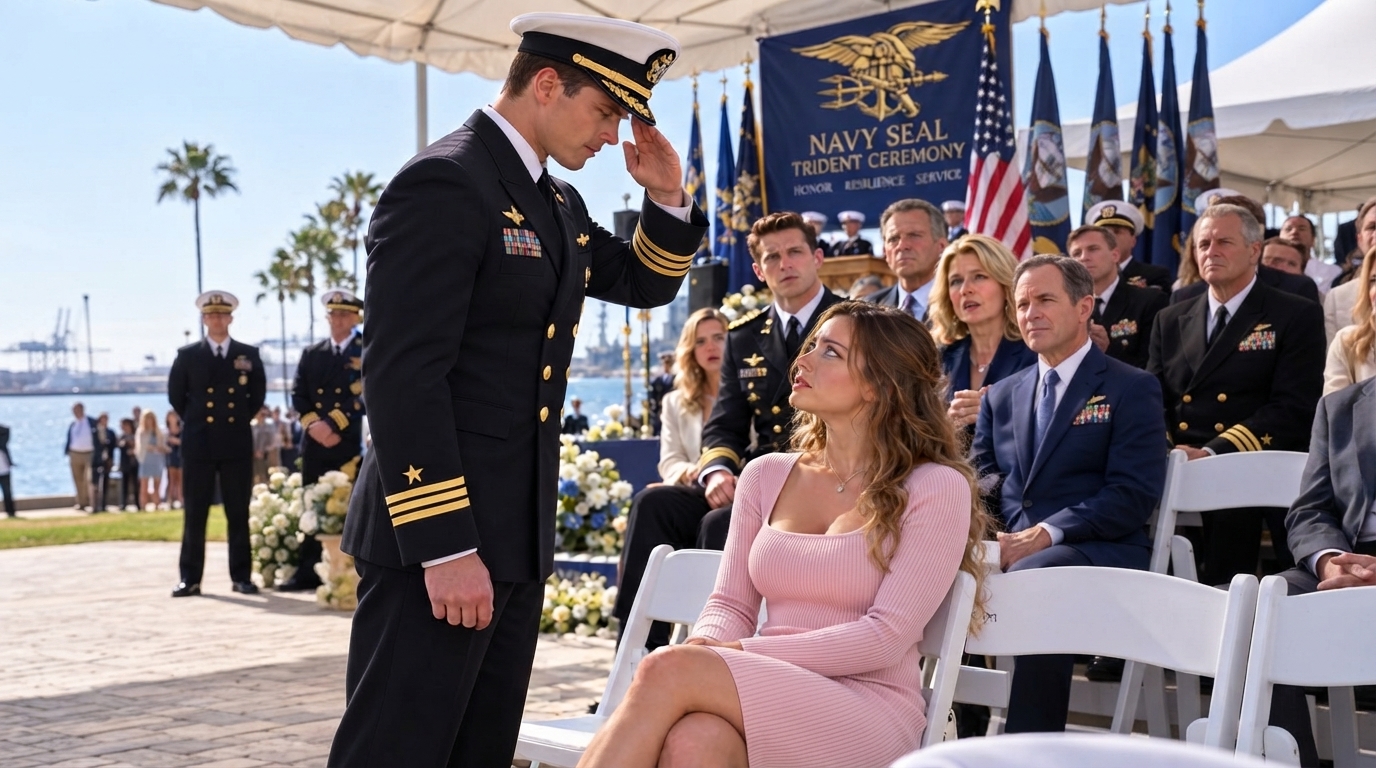
And then Commander Hayes stepped away from the podium.
Walked toward me.
Saluted.
And said:
“Ma’am, we’ve been waiting for you.”
My family thought that salute changed my worth.
It didn’t.
I was the same woman before he recognized me.
The same sister.
The same daughter.
The same person who had served quietly, sacrificed privately, and loved a family that rarely made room for her.
The salute didn’t make me important.
It simply forced them to see what had been there all along.
And that was the lesson I carried home.
Your value does not depend on whether your family recognizes it.
Your achievements do not become real only when someone applauds.
And you should never have to reveal a title, a rank, or a sacrifice to earn basic respect from the people who claim to love you.
I came to my brother’s ceremony expecting nothing more than to watch him receive his Trident.
Instead, I watched my family discover that the daughter they’d dismissed had a life they knew almost nothing about.
But the greatest victory wasn’t the applause.
It wasn’t the salute.
It wasn’t the recognition.
It was the moment I realized I no longer needed their approval to know who I was.
I had never been the disappointing sister.
I had simply been the daughter they never bothered to understand.
THE END THANK YOU FOR READING !!!



