PART 3
For several seconds, nobody moved.
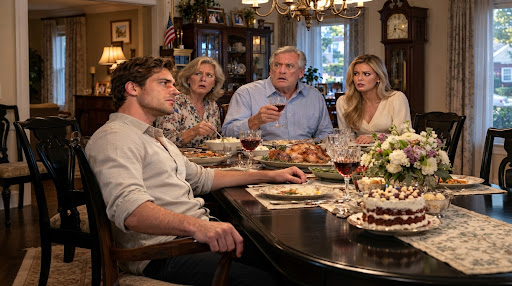
Khloe’s phone lay faceup on the dining table,
its screen glowing beneath the chandelier.
Congratulations, Khloe! Your $68,000 down payment cleared.
We can finalize your luxury condo purchase Monday.
I read the message once.
Then again.
Sixty-eight thousand dollars.
My parents’ mortgage was three months behind.
And my sister had just put sixty-eight thousand dollars
toward a luxury condominium in Chicago.
Dad was the first to speak.
“Khloe?”
She snatched her phone off the table.
“That’s private.”
I stared at her.
“Private?”
She shoved the phone into her purse.
“My finances are none of your business.”
I stood.
“Your finances became my business when seventy-two thousand dollars disappeared from my account.”
“Don’t be dramatic, Lucas.”
I almost laughed.
There it was.
The same phrase she’d used since childhood whenever I caught her doing something wrong.
Don’t be dramatic.
When she broke my model airplane and blamed the dog.
When she borrowed my car without asking.
When she told Dad I’d refused to help her move,
even though I’d spent six hours carrying furniture up three flights of stairs.
Every time, she made me sound unreasonable for noticing what she’d done.
But this wasn’t a broken toy.
This was seventy-two thousand dollars.
And our parents were facing foreclosure.
Dad rose slowly from his chair.
“Sit down, Khloe.”
She looked at him.
“Daddy, you’re embarrassing me.”
His voice cracked.
“Sit. Down.”
For the first time that evening, my sister obeyed.
Mom began gathering pieces of the broken wineglass.
Her hands were shaking so badly that she nearly cut herself.
“Mom, leave it,” I said.
She shook her head.
“I need to clean this.”
“Please.”
I gently took the dustpan from her.
She looked up at me, tears running down her face.
“Lucas, I don’t understand.”
Neither did I.
Or maybe I understood too well.
I looked at Khloe.
“Did you use my money for your condo?”
She crossed her arms.
“No.”
“Then show me where it went.”
“I don’t have to prove anything to you.”
Dad leaned forward.
“Your brother has been sending you six thousand dollars a month?”
Khloe sighed.
“Yes.”
“And you told us that money was coming from you?”
She looked away.
“I was managing everything.”
Dad stared at her.
“Managing what?”
“The bills.”
“Which bills?”
She didn’t answer.
I took out my phone.
“Let’s start with the mortgage.”
Khloe’s expression changed.
“Lucas, don’t.”
I looked at her.
“Don’t what?”
“Don’t make this worse.”
I felt something inside me turn cold.
“Khloe, our parents could lose their house. There isn’t a version of this that gets worse because I ask questions.”
Dad disappeared into his bedroom.
When he returned, he was carrying a thick envelope.
He placed it on the table.
Inside were letters from the mortgage company.
Late-payment notices.
Past-due statements.
A formal notice explaining that the loan was in default and warning of further action if the arrears weren’t resolved.
I read the most recent letter.
The overdue amount was $18,742, including missed payments and charges.
I stared at the figure.
I had sent Khloe eighteen thousand dollars during those same three months.
Enough to cover the regular payments and most of the amount being demanded.
But the money hadn’t reached the mortgage company.
I looked up.
“Why didn’t you tell me?”
Dad’s face crumpled.
“Because I was ashamed.”
I swallowed.
“Of what?”
He stared at the table.
“Of needing help.”
I glanced at Khloe.
“But you thought she was helping.”
He nodded.
“She told us she’d been making the payments. When the letters started coming, she said the bank had made an error.”
My mother wiped her cheeks.
“She told us not to worry you.”
I closed my eyes.
Khloe had not only taken credit for my financial support.
She had used my parents’ embarrassment to keep them from checking whether the payments were actually being made.
I turned toward her.
“How long have you known the mortgage was behind?”
She said nothing.
“Khloe.”
She rubbed her forehead.
“Since October.”
I stared at her.
“October?”
She nodded.
“Three months?”
“Yes.”
I felt sick.
“Why didn’t you tell anyone?”
“I thought I could fix it.”
“With what money?”
She looked away.
I pointed toward her purse.
“The condo?”
Her eyes filled.
“I worked hard for that opportunity.”
I stared at her.
“What opportunity?”
“The market in Chicago is moving fast. I found a beautiful place below market value. I knew if I didn’t move immediately, I’d lose it.”
Dad looked confused.
“So you bought an apartment?”
Khloe shook her head.
“I haven’t closed yet.”
“With whose money?” he asked.
She began crying.
And suddenly, I knew.
Not because she confessed.
Not because she apologized.
But because she couldn’t look at me.
“How much of my seventy-two thousand dollars is left?” I asked.
She whispered something.
“What?”
“Not much.”
My stomach dropped.
“How much?”
She stared at the table.
“About eleven hundred.”
I sat down.
For a moment, I couldn’t speak.
Seventy-two thousand dollars.
Gone.
My parents’ mortgage unpaid.
My sister preparing to buy a condominium.
And the only thing left was eleven hundred dollars.
I thought about the nights I’d worked overtime.
The vacations I’d postponed.
The old car I’d kept driving because I didn’t want another monthly payment.
The apartment I’d considered buying but decided against because my parents needed help.
I thought about every time Khloe had sent me that single word.
Handled.
I looked at her.
“You watched me send money every month.”
She cried harder.
“You knew I thought it was paying the mortgage.”
She nodded.
“And you let Dad believe you were the one helping.”
She covered her face.
“Lucas, please.”
I shook my head.
“Please what?”
She looked up.
“Please don’t ruin my life.”
I stared at her.
Then I said quietly, “You were willing to ruin three other lives to build yours.”
Dad sat down heavily.
His birthday dinner was still on the table.
The chicken had gone cold.
The candles were crooked.
His cake sat untouched beneath a plastic cover.
He looked at Khloe.
“Why?”
She shook her head.
“I didn’t mean for things to get this bad.”
“Why?” he repeated.
She began talking quickly.
About her career.
About the pressure to look successful.
About her friends buying homes.
About how expensive Chicago had become.
About how she’d been overlooked for a promotion.
I frowned.
“Wait. You said you got promoted.”
She froze.
Dad looked at her.
“Khloe?”
She wiped her cheeks.
“I was supposed to.”
I stared.
“So you didn’t get promoted?”
She shook her head.
“And the new clients?”
She said nothing.
I leaned back.
The beautiful clothes.
The expensive dinners.
The confident stories.
The photographs of rooftop restaurants.
The speeches about building success from nothing.
How much of it had been real?
Finally, Khloe whispered, “I got laid off in August.”
Mom gasped.
Dad stared at her.
I felt my anger mix with disbelief.
“You lost your job?”
She nodded.
“And you didn’t tell anyone?”
“I was embarrassed.”
I looked at her.
“Then why were you still telling us about promotions?”
She began crying again.
“Because everyone expected me to be successful.”
I stared at Dad.
He looked as though someone had struck him.
For years, my father had held Khloe up as the example.
The ambitious one.
The talented one.
The one who had figured everything out.
And I had accepted being the disappointment.
Not because I believed it.
But because arguing never changed his mind.
Now the truth was sitting in front of us.
My sister had lost her job.
She had spent money intended for our parents’ mortgage.
She had hidden the delinquency.
And she was trying to purchase a luxury condo with funds that included money I’d sent for a completely different purpose.
Dad looked at me.
“Lucas.”
I didn’t answer.
He swallowed.
“Son, I didn’t know.”
I stared at him.
“I know.”
His eyes filled.
“I really didn’t know.”
I nodded.
But knowing that didn’t erase the years of insults.
It didn’t erase the birthday toast.
And it didn’t erase how easily he’d believed I was less successful simply because I didn’t advertise every achievement.
Khloe suddenly stood.
“I’m leaving.”
Dad looked up.
“No.”
She grabbed her purse.
“I can’t sit here while everyone attacks me.”
I stood too.
“Khloe, before you go, I need you to understand something.”
She glared at me.
“What?”
“I’m not sending you another dollar.”
She laughed bitterly.
“Fine.”
“And tomorrow, I’m contacting an attorney.”
Her face changed.
“Lucas.”
I continued.
“I’ll preserve every transfer, every message, and every record showing what the money was intended for.”
She stepped closer.
“You’d sue your own sister?”
I looked at her.
“You took money I trusted you to deliver to our parents.”
She began crying.
“We’re family.”
I nodded.
“That’s why I trusted you.”
She stared at me.
Then whispered, “You’re going to destroy everything.”
I shook my head.
“No, Khloe. I’m going to find out what happened to everything.”
The following morning, I called the mortgage company with Dad sitting beside me.
This time, he agreed to use the online account.
I helped him navigate the website while he verified his identity.
The representative confirmed the overdue balance and explained the available options for addressing the default.
There was no completed foreclosure sale scheduled at that moment, but the account needed immediate attention.
Dad looked exhausted.
“Can we save the house?”
The representative explained that we would need to review the account, discuss possible loss-mitigation options, and submit any required financial information.
After the call, Dad sat silently.
Then he whispered, “I should have checked.”
I looked at him.
“Yes.”
He nodded.
“I trusted Khloe.”
“So did I.”
He looked down.
For once, he didn’t argue.
That afternoon, I met with an attorney named Daniel Whitaker.
He reviewed the bank transfers and messages.
Then he asked a question I hadn’t considered.
“Lucas, did you ever tell Khloe she could use this money for anything other than your parents’ mortgage?”
“No.”
“Did she acknowledge that purpose?”
I opened my phone.
There were twelve messages.
One each month.
MORTGAGE SENT. PLEASE CONFIRM WHEN PAID.
And twelve replies.
Handled.
Daniel studied the records.
“These messages may be important evidence of the purpose of the transfers and her representations about them.”
I swallowed.
“Can I get the money back?”
He leaned back.
“We need to examine the full circumstances, trace what we can, and assess the available civil claims. We should also act quickly regarding the pending condo purchase.”
I looked up.
“What can we do?”
“We can send a formal demand and explore appropriate legal steps. But we shouldn’t assume the entire down payment is recoverable without examining where the funds came from.”
I nodded.
He continued.
“One more thing. Don’t threaten her publicly. Don’t post accusations online. Let the documents speak.”
I looked down.
For the first time since the birthday dinner, I felt like I had a plan.
Two days later, Khloe called me.
Her voice was shaking.
“Lucas, the condo closing is on hold.”
I said nothing.
“My attorney says I need to provide documentation about the source of the down payment.”
I closed my eyes.
“And?”
She began crying.
“I can’t explain all of it.”
I gripped the phone.
“Then tell the truth.”
She whispered, “If I do, I lose everything.”
I stared out my office window at the snowy Minneapolis streets.
Then I answered, “Khloe, Mom and Dad almost lost their house because you were afraid to lose yours.”
She began sobbing.
And I realized that for the first time in her life, my sister was facing a problem that our parents couldn’t praise away.
But three days later, Dad called me with news that made the entire situation even worse.
“Lucas,” he whispered, “your sister didn’t just spend your money.”
I sat upright.
“What do you mean?”
His voice broke.
“She took out a loan using the house as collateral. Your mother and I never knew.”
PART 4
I sat motionless at my desk.
Outside my office window, snow was falling over downtown Minneapolis.
Architectural drawings covered my monitor.
My coffee had gone cold.
And my father had just told me that my sister might have put another financial obligation against the house.
“What loan?” I asked.
Dad took a shaky breath.
“A home equity loan. Or something like that. I don’t understand the paperwork.”
My stomach tightened.
“How much?”
“Forty-five thousand dollars.”
I closed my eyes.
“Who signed it?”
He hesitated.
“That’s the problem.”
“Dad.”
“Your mother says she never signed anything.”
I stood so quickly my chair rolled backward.
“And you?”
“I didn’t either.”
I stared at the wall.
“Where did you find it?”
“A letter came in the mail. It says there’s an outstanding balance.”
I took a breath.
“Don’t sign anything. Don’t pay anything yet. Send me a photograph of every page.”
He agreed.
Then his voice cracked.
“Lucas, I’m scared.”
I closed my eyes.
For sixty-five years, my father had been the man who believed fear was weakness.
He’d mocked people who asked for help.
He’d taught me to solve problems without complaining.
And now he was admitting he was frightened.
“I know, Dad.”
He swallowed.
“Can you fix this?”
I stared at the drawings on my desk.
For years, that question had controlled my life.
Can you fix this?
Can you pay that?
Can you help your sister?
Can you keep the peace?
I took a breath.
“I’ll help you understand what’s happening. But I’m not paying another debt that someone else created.”
There was a long silence.
Then he whispered, “Okay.”
The documents arrived twenty minutes later.
I forwarded them to Daniel Whitaker.
He called me that afternoon.
“Lucas, we need to be careful about what this actually is.”
I frowned.
“What do you mean?”
“The letter appears to concern a loan secured by a recorded lien against your parents’ property. But we need to verify the lender, the recorded instrument, and the signatures.”
I nodded.
“Can Khloe borrow against their house without permission?”
“Not lawfully just because she’s their daughter. We need to establish whether there was valid authorization, whether anyone signed on their behalf, and whether the lender relied on improper documents.”
I swallowed.
“What should we do?”
“Your parents should obtain independent legal advice, dispute any unauthorized signatures promptly, and request copies of the complete loan file.”
I looked down.
“And Khloe?”
“We’ll deal with the evidence before making accusations.”
Over the next week, the truth began emerging.
The recorded documents showed a deed of trust associated with a $45,000 loan.
The borrowers were listed as my parents.
But Dad insisted he hadn’t applied.
Mom said the same.
Their signatures appeared on the documents.
And both looked suspicious.
The lender opened a fraud review after receiving the dispute.
Daniel arranged for a real estate attorney to examine the recorded documents and help my parents protect their interests.
Nothing was resolved overnight.
But the investigation established that Khloe had been involved in submitting information for the loan.
The lender’s records included correspondence from an email address she controlled.
There were also copies of identification documents that my parents had previously given her for what she’d described as routine financial assistance.
When I learned that, I felt physically sick.
My parents had trusted Khloe with their personal information.
I had trusted her with my money.
And she’d apparently used both forms of trust to keep her financial problems hidden.
Dad called me one evening.
His voice sounded hollow.
“Lucas, I don’t understand how she became this person.”
I sat at my kitchen table.
“I don’t know.”
He was quiet.
Then said, “I think I helped.”
I stared at the wall.
“What?”
He swallowed.
“I spent her whole life telling her she was special.”
I said nothing.
“I told her she was destined for big things. That she was better than ordinary work. That she shouldn’t settle.”
He took a shaky breath.
“And I spent your whole life telling you to work harder.”
My eyes filled.
Dad continued.
“Every time she failed, I found someone else to blame. Every time you succeeded, I acted like it was expected.”
I closed my eyes.
“I noticed.”
His voice broke.
“I know you did.”
For the first time in my life, my father sounded ashamed of how he’d treated me.
Not angry.
Not defensive.
Ashamed.
A month after the birthday dinner, Khloe agreed to meet with our attorneys.
She looked different.
Her expensive coat was wrinkled.
Her hair was tied back.
There were dark circles beneath her eyes.
She sat across from me and stared at her hands.
Daniel began.
“Khloe, we’re here to discuss the transfers Lucas made and the documentation related to your parents’ property.”
She nodded.
Her attorney sat beside her.
I waited.
Then she looked at me.
“Lucas, I’m sorry.”
I didn’t answer.
She swallowed.
“I know you don’t believe me.”
I leaned back.
“I’m listening.”
She began crying.
“I lost my job, and everything started falling apart.”
I stared at her.
“I had credit card debt. Rent. A car payment. I thought I’d find another job quickly.”
She wiped her cheeks.
“Then the mortgage money started coming in.”
My chest tightened.
She continued.
“At first, I used some of it to cover my bills and planned to replace it before the mortgage payment was due.”
I closed my eyes.
“Did you?”
She shook her head.
“Then another month came. And another.”
I looked at her.
“And the condo?”
She began crying harder.
“I thought if I bought something, I’d finally have an asset. Something real. Something that proved I wasn’t failing.”
I stared at her.
“So you tried to buy proof of success with money that wasn’t yours.”
She lowered her head.
“Yes.”
The meeting continued for nearly two hours.
Khloe acknowledged diverting funds I’d sent for the mortgage.
She admitted she’d misrepresented her employment situation.
And she acknowledged involvement in the loan application connected to our parents’ property.
Her attorney advised her carefully about the disputed signatures and the ongoing investigation.
I didn’t receive every answer that day.
But I received enough to know that my trust had been deliberately abused.
Daniel explained that any repayment arrangement would need to be supported by enforceable documents and a realistic assessment of her finances.
I wasn’t interested in another vague promise.
I wanted accountability.
The condo purchase collapsed.
The seller moved on.
Khloe lost the opportunity she’d been so desperate to secure.
The disputed down payment funds became part of the financial investigation and recovery efforts.
Some money was eventually returned through the closing process and settlement arrangements.
Other amounts were harder to trace.
Khloe had spent portions on rent, credit cards, travel, and personal expenses.
The full seventy-two thousand dollars wasn’t sitting in one account waiting to be handed back.
That was the painful truth.
Money could disappear much faster than trust could be rebuilt.
My parents’ mortgage situation required immediate attention.
The lender reviewed their delinquency and discussed options for avoiding foreclosure.
With help from a housing counselor and their attorney, they submitted the necessary financial information.
They cut expenses.
Dad sold his fishing boat.
Mom stopped using a credit card she’d been relying on for household purchases.
They also rented out a spare room for a period, after checking the practical and legal requirements.
It wasn’t glamorous.
It wasn’t easy.
But they began taking responsibility for their own finances.
I helped them organize paperwork.
I accompanied Dad to meetings when he asked.
I explained documents he didn’t understand.
But I didn’t send another six thousand dollars.
And when Dad apologized for needing my help, I told him something I wish I’d said years earlier.
“Dad, helping you understand a problem is different from paying to make it disappear.”
He nodded.
“I know that now.”
The disputed home-equity loan took longer to resolve.
The lender’s investigation and the legal review examined the signatures, the application records, and the disbursement of funds.
My parents maintained that they had not authorized the borrowing.
Their attorney pursued the appropriate process to challenge the lien.
Eventually, the lender agreed to a resolution that removed the disputed lien from the property records, while reserving its rights against those responsible for the unauthorized transaction.
There were still consequences for Khloe.
The matter had been referred to the appropriate authorities, and she had to address the legal issues through counsel.
I didn’t celebrate that.
She was my sister.
I remembered teaching her to ride a bicycle.
I remembered carrying her backpack when she broke her wrist.
I remembered helping her study for exams.
I didn’t want her life destroyed.
But I also couldn’t pretend that loving someone meant shielding them from every consequence of their decisions.
By early summer, my parents had entered a workable mortgage repayment arrangement.
The house was no longer facing an immediate foreclosure sale.
They had a budget.
They had a plan.
And for the first time in years, they knew exactly where their money was going.
Dad called me after making the first payment under the new arrangement.
“Lucas?”
“Yeah?”
“I did it.”
I smiled.
“Did what?”
“Paid it myself.”
My throat tightened.
“That’s good, Dad.”
He laughed softly.
“Feels strange.”
I smiled.
“You’ll get used to it.”
Then he became quiet.
“Son?”
“Yeah?”
“I’m sorry about your birthday dinner.”
I stared at the wall.
“It was your birthday, Dad.”
“I know.”
He swallowed.
“I’m sorry about what I said.”
I didn’t answer.
He continued.
“You’ve worked hard for everything you have. I should have been proud of you.”
My eyes filled.
I took a breath.
“Thank you.”
He whispered, “I was proud. I just never said it.”
I closed my eyes.
“That matters, Dad.”
“I know.”
A few weeks later, Mom visited me in Minneapolis.
She brought a homemade apple pie.
The same kind she’d made when I was little.
We sat at my kitchen table while rain tapped against the windows.
She looked around my apartment.
“I didn’t realize how small this place was.”
I smiled sadly.
“It’s enough for me.”
She nodded.
Then she looked at the architectural drawings spread across my desk.
“Are those yours?”
I nodded.
“A project we’re working on downtown.”
She studied them.
“Lucas, these are beautiful.”
I laughed softly.
“Thanks.”
She looked at me.
Then whispered, “I don’t think we ever really asked about your work.”
I looked down.
“No. You didn’t.”
Her eyes filled.
“We were always talking about Khloe.”
I nodded.
She reached across the table.
“I’m sorry.”
For once, I believed she understood what she was apologizing for.
The money recovery process continued through the year.
Khloe eventually entered into a written repayment agreement resolving my civil claim.
The arrangement required her to make regular payments based on her actual income.
It didn’t erase the other legal matters.
And it didn’t guarantee that every dollar would be recovered immediately.
But it established responsibility.
The first payment arrived in September.
Eight hundred dollars.
I stared at the notification.
Then opened a separate savings account.
I labeled it:
MY FUTURE.
Not Mom and Dad.
Not Khloe.
Not family emergencies.
My future.
For years, I’d postponed my own plans because someone else always needed something.
Now I was going to build something for myself.
I began looking at houses.
Small ones.
Nothing extravagant.
A modest place in Minneapolis with a backyard and a room I could turn into a home office.
I had always wanted to own a house.
Not because I needed to impress anyone.
But because I spent my days designing spaces for other people.
I wanted one of my own.
One afternoon, my real estate agent showed me a small brick house with a maple tree in the front yard.
The kitchen needed updating.
The basement smelled faintly of old paint.
The upstairs bathroom had an ugly green sink.
I loved it immediately.
I stood in the living room imagining what I could do with the space.
For the first time, I wasn’t calculating how much money I needed to keep available for someone else’s mortgage.
I was thinking about mine.
I closed on the house the following spring.
Dad came to help me move.
He arrived wearing old jeans and carrying a toolbox.
I watched him walk through the front door.
He looked around.
Then smiled.
“Nice place, son.”
I laughed.
“Needs work.”
He nodded.
“Most good things do.”
We spent the afternoon assembling shelves and fixing a loose cabinet hinge.
At one point, Dad stood in the doorway of my future office.
“You’re going to work in here?”
I nodded.
“That’s the plan.”
He studied the windows.
“Good light.”
I smiled.
“Yeah.”
Then he looked at me.
“Lucas, I want you to know something.”
I set down my screwdriver.
“What?”
He swallowed.
“I’m proud of you.”
I stared at him.
For thirty-something years, I’d imagined hearing those words.
I’d thought they would come after a promotion.
Or an award.
Or some achievement impressive enough to make him notice.
But they came in an empty room with unfinished shelves.
And somehow, that made them mean more.
“Thanks, Dad.”
He nodded.
Then we went back to work.
Khloe and I didn’t become close again overnight.
Trust doesn’t work that way.
She found another job.
A less glamorous one.
She moved into a smaller apartment.
She sold several expensive belongings.
And she continued making payments under the agreement.
Sometimes she called.
Sometimes I answered.
We talked about ordinary things.
Work.
Weather.
Mom’s garden.
Dad’s latest home repair project.
But I no longer pretended everything was fine.
When she apologized, I listened.
When she made excuses, I ended the conversation.
And slowly, she began learning that accountability wasn’t something she could charm her way around.
The following year, Dad invited us all to his sixty-sixth birthday dinner.
I almost declined.
The memory of the previous year still hurt.
But Mom called and said something that surprised me.
“Lucas, we’d really like you there. But if you’re not comfortable, we understand.”
No guilt.
No pressure.
No lecture about keeping the peace.
I thought about it.
Then agreed.
When I arrived, the house looked different.
The porch had been repainted.
The flickering light had been replaced.
Mom had planted flowers beside the steps.
Inside, the old kitchen clock still ticked too loudly.
Some things never changed.
Khloe was already there.
She stood when I entered.
“Hey, Lucas.”
“Hey.”
She hesitated.
Then smiled.
“Good to see you.”
I nodded.
“You too.”
It wasn’t a perfect reunion.
But it was peaceful.
And that was enough.
Dinner was simple.
Roast chicken.
Potatoes.
Vegetables.
Apple pie.
No expensive decorations.
No elaborate speeches.
Just family around a table.
After dinner, Dad stood with his glass.
I felt my stomach tighten.
For a moment, I was back at the previous birthday.
Hearing him laugh.
Hearing him praise Khloe.
Hearing those words.
Unlike you.
Dad looked around the table.
Then his eyes settled on me.
“Last year,” he began, “I said something cruel to my son.”
The room went quiet.
I stared at him.
He continued.
“I made a joke at his expense because I thought success was something you could measure by how loudly someone talked about it.”
Khloe looked down.
Dad swallowed.
“I was wrong.”
My eyes filled.
He continued.
“Lucas helped this family more than any of us understood. He did it quietly, without asking for recognition.”
He paused.
“And instead of thanking him, I made him feel small.”
Mom began crying.
Dad looked directly at me.
“Son, I’m sorry.”
I couldn’t speak.
He raised his glass.
“To Lucas. For everything he’s built, and for finally teaching his old father that being dependable doesn’t mean being obligated.”
I looked down.
Then raised my glass.
For once, the room wasn’t celebrating Khloe’s achievements.
It wasn’t celebrating mine either.
It was acknowledging the truth.
And that felt better than praise.
Later that evening, Khloe found me standing on the porch.
She stepped beside me.
“Remember when we were kids and Dad made us race to the mailbox?”
I smiled.
“Yeah.”
“You always let me win.”
I laughed softly.
“Not always.”
She looked at me.
“Most of the time.”
I shrugged.
“You were little.”
She was quiet.
Then said, “I think I got used to everyone letting me win.”
I looked at her.
She stared toward the street.
“And when I couldn’t win anymore, I started pretending.”
I didn’t answer.
She continued.
“I’m sorry, Lucas.”
I nodded.
“I know.”
She looked at me.
“Do you think we’ll ever be okay?”
I thought about that.
Then said, “Maybe. But it’s going to take time.”
She nodded.
“That’s fair.”
We stood quietly.
Then she whispered, “You didn’t deserve any of it.”
I looked at her.
For once, she wasn’t asking me to make her feel better.
She was simply telling the truth.
“Thank you,” I said.
Driving home that night, I thought about the birthday dinner that had changed everything.
Dad had laughed and said:
“Your sister earned everything on her own, unlike you.”
And I had answered:
“Then I’ll stop sending you money. Now it’s her burden.”
He had turned pale.
Then asked:
“What money?”
Those two words had uncovered a year of deception.
Seventy-two thousand dollars.
A mortgage on the brink of foreclosure.
A luxury condo purchased with money that wasn’t meant for it.
A disputed loan.
And a lifetime of family favoritism.
But they had also uncovered something else.
The truth about who I was.
For years, I’d believed my value came from how much I could give.
How many problems I could solve.
How quietly I could absorb another insult.
How often I could put myself last.
I had mistaken being needed for being appreciated.
And I had mistaken silence for peace.
Now I knew better.
I still loved my family.
I still wanted my parents safe.
I still hoped my sister would rebuild her life.
But I no longer believed I had to sacrifice my own future to prove any of it.
My parents learned to manage their finances.
My sister learned that success couldn’t be built on someone else’s money.
And I finally learned that being a good son didn’t mean being everyone’s emergency fund.
The house I bought in Minneapolis wasn’t large.
It didn’t have marble countertops or expensive furniture.
But it had something I’d never been able to afford while paying everyone else’s bills.
Freedom.
And every morning, when sunlight came through the windows of my new home, I remembered the lesson that cost me seventy-two thousand dollars to learn.
You can love your family without financing their mistakes.
You can forgive someone without trusting them with your money again.
And you can walk away from a table where you’re constantly belittled, even if you’re the one who has been paying to keep the lights on.
THE END THANK YOU FOR READING !!!



