PART 3
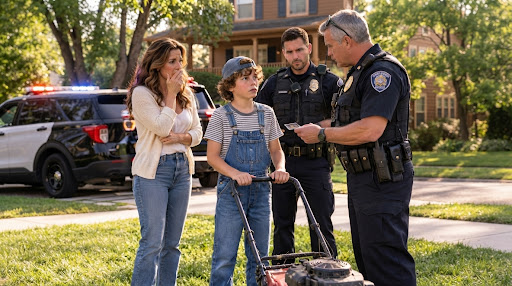
Officer Daniels stopped with his radio halfway to his mouth.
“What little boy, Ethan?”
My son looked at me.
I had never seen him so frightened.
Not when he broke his wrist falling off his bicycle.
Not when he accidentally shattered our kitchen window with a baseball.
Not even when he thought he’d lost our dog,
Max, during a thunderstorm.
This was different.
His face was pale, and his hands trembled against his shorts.
“His name is Noah,” Ethan whispered. “He’s five.”
Officer Daniels exchanged a look with the younger officer,
whose name tag read MARTINEZ.
“Is Noah Evelyn’s grandson too?” Martinez asked.
Ethan shook his head.
“I don’t know. Lily calls him her brother.”
My heart hammered.
“Why were they hiding in a shed?”
Ethan looked down.
“Because they heard their dad’s truck.”
Officer Daniels immediately spoke into his radio.
He gave the address of the blue house on Hawthorne Street and requested additional officers and emergency medical assistance.
Then he turned back to my son.
“Ethan, listen carefully. Are the children still inside that shed?”
“I think so.”
“When did you leave them?”
“About ten this morning.”
It was nearly noon.
Two hours.
Two frightened children could have been hiding in a garden shed for two hours in the August heat.
I grabbed the doorframe.
“Why didn’t you tell me?”
Ethan’s eyes filled.
“Because Lily made me promise.”
“Ethan—”
“Mom, she said if anybody knew, her dad would find them!”
His voice cracked.
“She was crying. Noah was crying. I didn’t know what to do.”
I knelt in front of him.
“Oh, sweetheart.”
He looked at me desperately.
“I was going to tell you after lunch. I really was.”
I believed him.
But believing him didn’t make the fear disappear.
Officer Daniels lowered himself to Ethan’s level.
“Son, you did the right thing by telling us now. We’re going to check on those children.”
Ethan grabbed his sleeve.
“Please don’t let their dad take them.”
The officer’s expression changed.
“We’re going to make sure they’re safe.”
Then both officers hurried toward their patrol cars.
I watched the vehicles pull away.
And suddenly, the entire summer looked different.
The afternoons Ethan returned home with grass stains on his knees.
The sandwiches he started making in pairs.
The extra bottles of water disappearing from our refrigerator.
The way he’d asked whether children could get sick from staying indoors too long.
I’d answered every question without realizing what he was really asking.
Now I wondered how many times my son had tried to tell me something without knowing how.
Ten minutes later, Ethan and I were sitting at the kitchen table.
He hadn’t touched the grilled cheese sandwich on his plate.
I placed a glass of water in front of him.
“Ethan, I need you to tell me everything.”
He nodded.
His lower lip trembled.
“It started three weeks ago.”
He explained that he’d been mowing Evelyn’s front lawn when he heard a strange tapping sound from inside the house.
At first, he thought it was a television.
Then he heard a little girl’s voice.
“She asked if I had any water.”
I stared at him.
“From inside the house?”
He nodded.
“Through a window near the back porch. It was open a little.”
“What did you do?”
“I gave her my water bottle.”
He looked down.
“She drank almost all of it.”
The image made my chest ache.
A child standing behind a barely opened window, asking a stranger for water.
“Did you tell Evelyn?”
“Yeah. She came outside and looked really scared.”
“Scared of you?”
“No. Scared that somebody heard Lily.”
He rubbed his eyes.
“She told me Lily was her granddaughter and that her dad didn’t want people knowing she was there.”
“Why?”
“Evelyn said there were family problems.”
I closed my eyes.
Those two words.
Family problems.
Adults used them to hide so many things.
Arguments.
Debt.
Neglect.
Cruelty.
And sometimes things far worse.
Ethan continued.
“The next time I went, Lily was sitting by the back door. Evelyn said I could give her a sandwich if I wanted.”
I remembered that afternoon.
Ethan had asked if we could buy extra bread.
I’d thought he was going through a growth spurt.
“What about Noah?”
“I didn’t see him until last week.”
My heart sank.
“He was hiding behind Lily. He had a stuffed dinosaur with one eye.”
Ethan’s voice became softer.
“He was really skinny, Mom.”
I reached across the table.
My son took my hand.
“He asked if I could bring him a banana.”
I felt tears sting my eyes.
“And you did?”
Ethan nodded.
“Every time.”
I was still trying to understand when my phone rang.
Officer Daniels.
I answered immediately.
“Hello?”
“Mrs. Parker?”
“Yes.”
“This is Officer Daniels. We located both children.”
My knees weakened.
“Are they okay?”
“They’re alive and being evaluated by medical personnel.”
I pressed a hand over my mouth.
“Thank God.”
He paused.
“We may need to speak with Ethan again. For now, please stay home, and don’t contact anyone connected to that property.”
I nodded, though he couldn’t see me.
“Of course.”
Then I asked the question that had been haunting me.
“What happened to Evelyn?”
His voice softened.
“She’s in the hospital. We’re still establishing the circumstances.”
After the call ended, I looked at Ethan.
“They found them.”
He stared at me.
“Both?”
“Both.”
His face crumpled.
He began sobbing so hard I barely understood him.
“I thought they were going to die.”
I pulled him into my arms.
And held him.
Because my twelve-year-old son had spent three weeks carrying a fear no child should ever have to carry alone.
That afternoon, a child protection investigator named Sarah Collins came to our house with Officer Martinez.
She spoke gently.
She explained that she wanted to understand what Ethan had witnessed, but she didn’t want him to feel pressured.
I sat beside my son while he described the children, the shed, and the conversations he’d had with Evelyn.
Sarah listened carefully.
Then she asked, “Ethan, did Lily ever tell you why she wasn’t going to school?”
He nodded.
“She said her dad told people they moved away.”
“Did she tell you where they lived before?”
“Somewhere near Harrisburg.”
Sarah wrote something down.
“And did Lily ever say she was hurt?”
Ethan hesitated.
I felt my stomach tighten.
He looked toward me.
Then whispered, “She had bruises.”
Sarah’s expression remained calm.
“Where?”
“On her arm.”
“Did she tell you how she got them?”
Ethan nodded.
“She said her dad grabbed her when she tried to leave.”
I closed my eyes.
Sarah asked a few more questions, carefully avoiding putting words in his mouth.
Then Ethan said something that made her stop writing.
“Lily told me she used to live with her mom.”
Sarah looked up.
“Did she say where her mother was?”
Ethan nodded.
“She said her dad told her Mommy didn’t want them anymore.”
He swallowed.
“But Lily said she didn’t believe him.”
The room went silent.
After Sarah and Officer Martinez left, I sat on the couch beside Ethan.
He stared at his sneakers.
“Mom?”
“Yes, sweetheart?”
“Am I in trouble?”
The question broke my heart.
I turned toward him.
“No.”
He looked uncertain.
“But I broke your rules.”
I nodded slowly.
“You kept a secret about something dangerous. And we need to talk about that.”
His eyes filled.
“But I was trying to help.”
“I know.”
I took his hand.
“And helping was kind. Bringing them food and water was kind. But when children are frightened, hungry, or hiding from someone, that’s too big for you to handle by yourself.”
He nodded.
I continued.
“You can always tell me. Even if somebody makes you promise not to.”
His voice trembled.
“What if telling makes things worse?”
I swallowed.
“Then we find adults who know how to protect them. We don’t leave you alone with that responsibility.”
He leaned against me.
“I’m sorry.”
I kissed his hair.
“I love you.”
He whispered, “I love you too.”
The following morning, I learned more.
Not from gossip.
Not from neighbors standing on sidewalks.
But from a brief update Officer Daniels was permitted to share.
The children were receiving medical attention.
Evelyn remained hospitalized.
And investigators were trying to establish who had legal custody of Lily and Noah.
Their father, a man named Curtis Bennett, had been located for questioning.
I didn’t know what that meant.
I didn’t know whether he’d been arrested.
And I wasn’t going to invent answers.
But I knew one thing.
The children were no longer hiding in a shed.
Three days later, Mrs. Hall came to my door.
She carried a plate of oatmeal cookies.
Her eyes were red.
“I heard about the children.”
I stepped aside.
“Come in.”
She sat at my kitchen table.
For a while, she simply stared at the plate.
Then she whispered, “Evelyn used to be my friend.”
I looked at her.
“You knew her?”
Mrs. Hall nodded.
“Years ago. Before her son moved back.”
My stomach tightened.
“What was he like?”
She sighed.
“Curtis was always controlling. He didn’t like Evelyn having visitors.”
I sat across from her.
“Did you know there were children in the house?”
She shook her head.
“No.”
Then she looked toward the window.
“But I noticed she stopped coming to church. She stopped visiting the grocery store. Whenever I called, Curtis answered.”
Her voice broke.
“I should have checked.”
I reached across the table.
“Mrs. Hall, you didn’t know.”
She wiped her cheeks.
“Neither did Ethan. Not at first.”
We sat quietly.
Then she said something I never forgot.
“Sometimes a neighborhood can be full of people, and someone can still disappear right in the middle of it.”
A week after the police came, Sarah Collins called.
She asked whether Ethan would be comfortable receiving a short message.
I looked at him.
He nodded immediately.
Sarah read it aloud.
It was from Lily.
Thank you for the sandwiches.
Noah says thank you for the bananas.
We are somewhere safe now.
I hope you still like mowing lawns.
Ethan covered his face.
He cried.
Then he laughed.
Then he cried again.
And when Sarah asked whether he wanted to send a reply, he said:
“Tell Lily she doesn’t have to be scared of asking for help anymore.”
Sarah paused.
Then answered softly.
“I’ll tell her.”
I thought that would be the end.
I thought the children would receive care, the adults would sort out what had happened, and Ethan would slowly return to being an ordinary twelve-year-old.
But two weeks later, Officer Daniels called again.
“Mrs. Parker, I wanted to update you on something.”
My stomach tightened.
“Is Ethan okay?”
“Yes. This concerns Evelyn.”
I sat down.
“Is she alive?”
“Yes. She’s recovering.”
I closed my eyes.
Then he said something unexpected.
“She’s asked whether she can speak with you.”
I stared at the wall.
“With me?”
“Yes.”
I hesitated.
Because I didn’t know what to feel about Evelyn.
She had been frightened.
Possibly controlled.
Possibly trying to protect the children.
But she had also allowed them to remain hidden.
She had watched my son bring them food instead of getting immediate help.
And I couldn’t pretend that didn’t matter.
“Why?” I asked.
Officer Daniels paused.
“She says there’s something she wants you to understand.”
I looked toward the backyard.
Ethan was sitting on the grass beside our dog.
The afternoon sunlight caught his hair.
He looked so young.
Then I said quietly, “I’ll listen.”
And I had no idea that what Evelyn told me would change how I understood the entire summer.
PART 4
Evelyn looked smaller than I expected.
She was sitting in a wheelchair near a hospital window when I arrived.
Her silver hair had been brushed neatly.
A pale blanket covered her knees.
There was a bruise near her temple, and one hand rested awkwardly in her lap.
She looked at me with tired eyes.
“You’re Ethan’s mother?”
I nodded.
“Yes.”
Her lips trembled.
“Thank you for coming.”
I sat in the chair across from her.
For a moment, neither of us spoke.
Then she whispered, “I owe you an apology.”
I looked at her.
“Why?”
Her eyes filled.
“Because I put your boy in a terrible position.”
I waited.
She took a shaky breath.
“Curtis is my son.”
I nodded.
“I know.”
She looked toward the window.
“He came to stay with me in June. He told me he was having trouble with the children’s mother.”
Her voice weakened.
“He said she was unstable. He said she had abandoned them.”
I felt my chest tighten.
“Did you believe him?”
“At first.”
She closed her eyes.
“Then I began noticing things.”
I waited.
“Lily wasn’t allowed to use the telephone. Noah wasn’t allowed to play outside. Curtis kept the doors locked when he left.”
My stomach twisted.
“Why didn’t you call someone?”
Tears slid down her cheeks.
“I tried.”
She looked at me.
“The first time, he took my phone.”
I stared at her.
“The second time, he threatened to take the children somewhere I’d never find them.”
Her hands trembled.
“He told me if I contacted the police, he’d say I was confused and couldn’t live alone.”
I swallowed.
Evelyn continued.
“I was frightened. And I kept telling myself I could find a way to fix it.”
She looked down.
“But I couldn’t.”
I asked about the morning Ethan had found the children in the shed.
Evelyn began crying.
“Curtis came home unexpectedly.”
She wiped her cheeks.
“He’d been drinking. He was angry because Lily had asked me to call her mother.”
My chest tightened.
“What happened?”
“He grabbed Lily. I tried to stop him.”
She touched the bruise near her temple.
“He pushed me.”
I stared at her.
“I fell against the kitchen counter.”
She nodded toward the window.
“Lily took Noah out the back door while Curtis was distracted.”
I whispered, “Into the shed.”
Evelyn nodded.
“She knew where the spare garden key was.”
My eyes filled.
“And Ethan?”
“He was mowing the lawn.”
She gave a shaky smile.
“He saw them run.”
I covered my mouth.
Evelyn continued.
“He helped Lily get Noah inside the shed. Then he came back to check on me.”
I stared at her.
“He came inside?”
She nodded.
“He opened the back door when I called for help. He found me on the floor.”
My heart nearly stopped.
“He didn’t tell me that.”
Evelyn wiped her eyes.
“He was scared.”
I closed my eyes.
She continued.
“I told him to go home and tell his mother. But I was confused. I couldn’t remember whether I’d actually said the words clearly.”
Her voice broke.
“Then everything went dark.”
I sat very still.
Because suddenly I understood why Ethan had returned home looking normal.
Why he’d showered.
Why he’d made sandwiches.
Why he’d sat at the kitchen table without saying anything.
He hadn’t known how to explain what he’d seen.
He’d been trying to process something no child should have witnessed.
And when the police arrived, he’d finally understood that the danger was real.
Evelyn reached for my hand.
“Your son is a good boy.”
I swallowed.
“He’s a child.”
She nodded.
“I know.”
Her eyes filled.
“And I should never have allowed him to become responsible for those children.”
I looked at her.
“Did you know he was bringing them food?”
She nodded.
“I knew some of it.”
I waited.
“I thought if I could keep them fed and calm until I found help, everything would be all right.”
Her voice cracked.
“But I was wrong.”
I took a breath.
“Evelyn, I believe you were frightened. But Lily and Noah needed help long before that morning.”
She closed her eyes.
“I know.”
There was no excuse.
No attempt to defend herself.
Just an elderly woman facing the terrible consequences of waiting too long.
And somehow, that honesty made it easier to sit beside her.
Before I left, Evelyn asked one final question.
“How is Ethan?”
I smiled sadly.
“He’s having a hard time.”
Her eyes filled.
“I’m sorry.”
I nodded.
“He worries about Lily and Noah.”
Evelyn gave a small smile.
“They’re safe now.”
I looked at her.
“That’s what I keep telling him.”
She squeezed my hand.
“Please tell him he saved them.”
I hesitated.
Then answered carefully.
“I’ll tell him that speaking up helped get them to safety.”
Because I wanted Ethan to understand something important.
He had done something brave.
But he wasn’t responsible for everything that happened before the adults intervened.
He was twelve.
He deserved to be twelve.
When I got home, Ethan was sitting at the kitchen table doing a puzzle.
He looked up.
“Did you see Evelyn?”
I nodded.
“Yes.”
“Is she okay?”
“She’s getting better.”
He exhaled.
Then asked, “Did she remember me?”
I smiled.
“Of course.”
He looked down at the puzzle.
I sat beside him.
“Ethan, Evelyn told me what happened that morning.”
His hands stopped moving.
I continued.
“She told me you found her on the kitchen floor.”
His eyes filled.
“I didn’t know what to do.”
I took his hand.
“Sweetheart, you were scared.”
He nodded.
“I thought she was dead.”
My heart broke.
He began crying.
“I tried calling her name, but she wouldn’t answer. Then Lily started screaming because Noah was crying, and I didn’t know who to help first.”
I pulled him into my arms.
He sobbed against my shoulder.
“I thought if I told you, you’d make me stop going there.”
I closed my eyes.
“Oh, Ethan.”
He continued.
“And then nobody would bring them food.”
I held him tighter.
I wanted to go back in time.
To the first day he’d asked for extra bread.
To the afternoon he’d returned home quieter than usual.
To every moment when I could have asked one more question.
But I couldn’t.
All I could do was help him now.
Over the following weeks, I arranged for Ethan to speak with a counselor experienced in helping children after frightening events.
At first, he resisted.
“I’m not crazy, Mom.”
I smiled gently.
“Of course you’re not.”
“Then why do I need a counselor?”
“Because you saw something scary, and talking about it can help.”
He looked uncertain.
I continued.
“You wouldn’t try to fix a broken arm by yourself. You’d let someone help you.”
He thought about that.
Then nodded.
“Okay.”
The first few sessions were difficult.
He didn’t want to talk.
He worried that Lily and Noah would be angry with him.
He worried Evelyn would die.
He worried Curtis would come looking for him.
We worked with the counselor and the officers on a safety plan, and I made sure Ethan knew he could tell me whenever he felt frightened.
Slowly, the nightmares became less frequent.
He started laughing again.
He complained about homework.
He left wet towels on the floor.
And one morning, I found an empty cereal box back in the pantry.
I almost cried with relief.
Because my ordinary, frustrating, wonderful twelve-year-old was beginning to feel like himself again.
The investigation continued.
I learned that Lily and Noah’s mother, Amanda Bennett, had been searching for her children for weeks.
The children had been staying with Curtis under an agreed arrangement when he stopped returning calls and failed to bring them back.
The exact custody and criminal matters were being handled through the courts.
I didn’t know every detail.
And I didn’t need to.
What mattered to me was that the children were safe and receiving care.
Several weeks later, Sarah Collins called.
“Lily asked whether she could send Ethan another letter.”
I looked toward the living room.
Ethan was sprawled on the carpet building a model airplane.
“Of course.”
The letter arrived three days later.
It was written in careful, uneven handwriting.
Dear Ethan,
Noah and I are with Mom now.
We have our own beds.
Noah still has his dinosaur.
I started school again.
I told my teacher about you.
She said you were a very good friend.
Thank you for helping us when we were scared.
Your friend, Lily.
Ethan read it twice.
Then a third time.
Finally, he looked at me.
“Mom?”
“Yes?”
“She has her own bed.”
I nodded.
“She does.”
He smiled.
And for the first time since the police arrived, that smile reached his eyes.
By October, the neighborhood had changed.
Not dramatically.
The houses were still the same.
The lawns still needed mowing.
Mrs. Hall still complained about the squirrels eating her tomatoes.
But people had started paying closer attention to one another.
Neighbors checked on elderly residents.
The community center organized a volunteer program for yard work and grocery deliveries.
Adults were assigned to supervise.
Children could help, but they weren’t expected to enter homes or handle emergencies alone.
Ethan was invited to participate.
At first, I wasn’t sure.
I worried he’d feel responsible for everyone.
But his counselor encouraged us to let him return to activities he enjoyed, with clear boundaries.
So we agreed.
He could help mow lawns on Saturday mornings.
With an adult nearby.
With his phone charged.
And with one new rule.
If he saw anything that frightened or worried him, he had to tell a trusted adult immediately.
No secret promises.
No trying to solve dangerous situations alone.
Ethan agreed.
And this time, he understood why.
One Saturday morning, Mrs. Hall stood on her porch watching Ethan push the mower across her lawn.
I sat nearby with a cup of coffee.
She smiled.
“He’s getting taller.”
I laughed.
“Too fast.”
She nodded.
“Good boy.”
I watched him carefully guide the mower around her flower bed.
Then I said something I’d been thinking for weeks.
“He’s a good boy. But I think we all need to remember he’s still a boy.”
Mrs. Hall looked at me.
I continued.
“People kept praising him for helping everyone. I was proud too. But somewhere along the way, he started believing it was his job to fix every problem he saw.”
She nodded slowly.
“You’re right.”
I looked toward Ethan.
“He needs to know he can help without carrying the whole world.”
Mrs. Hall smiled sadly.
“That’s a lesson some adults never learn.”
In November, Evelyn returned home.
Her recovery had taken months.
She now received regular assistance, and the people helping her knew how to contact authorities if they became concerned about her safety.
Curtis was not living with her.
I didn’t ask for details about every court order or investigation.
I simply hoped she would finally be safe.
One afternoon, she called me.
“Mrs. Parker?”
“Hello, Evelyn.”
Her voice trembled.
“I wanted to ask whether Ethan might visit.”
I hesitated.
Then said, “I’d be happy to bring him by for a short visit.”
She sounded relieved.
“Thank you.”
The following Saturday, Ethan and I walked to the little blue house.
The lawn had been freshly cut by the neighborhood volunteer team.
The porch had been repaired.
There were new flowers beside the steps.
Evelyn opened the door slowly.
When she saw Ethan, her eyes filled.
“Oh, sweetheart.”
Ethan smiled shyly.
“Hi, Evelyn.”
She held out her arms.
He looked at me.
I nodded.
He stepped forward and hugged her.
Evelyn began crying.
“I’m so sorry.”
Ethan looked confused.
“For what?”
“For letting you carry something that wasn’t yours to carry.”
He looked down.
She continued.
“You were kind to Lily and Noah. You were kind to me. But you should never have had to keep our secrets.”
Ethan swallowed.
“It’s okay.”
Evelyn shook her head gently.
“No, sweetheart. It wasn’t okay. But I’m grateful you told the police the truth.”
He nodded.
Then she smiled.
“Would you like some lemonade?”
Ethan looked at me.
I smiled.
“That sounds nice.”
We sat together on the porch.
The afternoon sun warmed the wooden steps.
For the first time, the blue house didn’t feel frightening.
It felt like a place where something terrible had happened, but where healing had finally begun.
Before we left, Evelyn handed Ethan a small package.
He opened it carefully.
Inside was a wooden birdhouse.
Painted blue.
With a tiny white door.
Ethan stared at it.
“Did you make this?”
Evelyn smiled.
“My husband made it years ago. I painted it last week.”
She pointed to the roof.
“I thought you might like it.”
Ethan turned it over.
On the bottom, in careful handwriting, were six words.
Thank you for caring. Keep being kind.
His eyes filled.
“I love it.”
Evelyn smiled.
“Good.”
Then she looked at me.
“And thank you for raising a son who notices when someone needs help.”
I smiled.
“Thank you.”
But I also knew the lesson wasn’t simply about raising a kind child.
It was about teaching him that kindness and safety must go together.
Winter came.
Then spring.
Ethan turned thirteen.
He started eighth grade the following fall.
He still mowed lawns.
Still forgot homework occasionally.
Still ate more grilled cheese sandwiches than seemed medically reasonable.
But something had changed.
He was more thoughtful.
More willing to ask questions.
And, thankfully, more willing to ask for help.
One evening, we were walking home from Mrs. Hall’s house when he stopped beside the sidewalk.
“Mom?”
“Yes?”
“Do you think Lily and Noah are happy?”
I looked at him.
“I hope so.”
He nodded.
“I hope they have a backyard.”
I smiled.
“Me too.”
He thought for a moment.
“Maybe Noah has a swing.”
I squeezed his hand.
“Maybe.”
Then he looked up at me.
“Do you think I did enough?”
My throat tightened.
I stopped walking.
“Ethan, look at me.”
He did.
“You gave them food when they were hungry. You treated them kindly when they were frightened. And when the police asked you what you knew, you told them.”
He nodded.
I continued.
“But listen carefully. You were never responsible for saving everyone by yourself.”
His eyes filled.
“Okay.”
“Your job is to be a kid. To learn. To play. To make mistakes. To ask for help when something is too big.”
He smiled faintly.
“Even if I promised not to tell?”
“Especially then, if someone might be in danger.”
He nodded.
Then slipped his hand into mine.
And we continued walking home.
Sometimes I still think about that August afternoon.
Two police cars outside my house.
Two officers standing on my porch.
My twelve-year-old son hesitating before answering a question.
I remember the terror.
The confusion.
The awful realization that something serious had been happening only a few streets away.
I also remember how proud I’d been of Ethan’s summer.
I’d watched him push that old mower down the sidewalk and thought I was raising a boy who understood kindness.
I hadn’t realized how much he was carrying.
And I hadn’t understood that even the kindest child in the world still needs adults who pay attention.
Today, the little blue birdhouse hangs from the maple tree in our backyard.
Every spring, birds nest inside it.
Ethan checks it from a distance, careful not to disturb them.
Sometimes he stands beneath it for a long time.
And when I ask what he’s thinking, he usually shrugs.
“Nothing.”
But once, he gave me a different answer.
“I was thinking about Lily and Noah.”
I stood beside him.
“What about them?”
He looked up at the birdhouse.
“I hope they know they don’t have to hide anymore.”
My eyes filled.
I put my arm around his shoulders.
“I hope so too.”
That summer, I thought the greatest thing my son was doing was mowing lawns for elderly neighbors.
I thought he was learning responsibility.
Generosity.
The value of helping without expecting payment.
And he was.
But he was also learning something far more difficult.
That sometimes people need help they are too frightened to ask for.
That sometimes adults make terrible choices.
And that keeping a promise isn’t always the right thing when someone’s safety is at risk.
Most importantly, he learned that asking for help is not a failure.
It’s often the bravest thing a person can do.
Two police cars came to my house because my son had been visiting a little blue house on Hawthorne Street.
I thought I was about to learn that he’d done something wrong.
Instead, I learned that he’d been trying to protect two frightened children with nothing more than sandwiches, bottles of water, and a twelve-year-old heart that couldn’t bear to look away.
He didn’t solve everything.
He couldn’t.
He was a child.
But when the moment came, he told the truth.
And that truth helped bring Lily and Noah out of hiding.
I still tell Ethan I’m proud of him.
Not because he tried to carry everyone’s problems.
But because he cared.
Because he listened.
And because, eventually, he trusted the adults around him enough to let them help.
That was the summer my son learned that kindness matters.
And I learned that even the strongest little heart still needs someone to hold it.
THE END THANK YOU FOR READING !!!



