PART 3
For several seconds, nobody spoke.
My mother sat at the head of her dining table,
her lips pressed into a thin line.
Rochelle stared at the documents as though
the words might rearrange
themselves if she looked long enough.
Tamson’s face had gone from smug to pale.
Victor Hale, the attorney Rochelle had invited,
slowly removed his glasses.
“Mr. Fontaine,” he said, turning toward my brother,
“did you submit this application?”
Tamson shifted in his chair.
“I was just trying to get the process started.”
“That wasn’t my question.”
My brother glanced at Mom.
She immediately leaned forward.
“Victor, surely we don’t need to turn this into some kind of interrogation. We’re family.”
Creswell folded his hands.
Mrs. Fontaine, your son submitted an application to
occupy property belonging to a corporation he does not control.
The application included a signature purporting to
authorize him to act on the company’s behalf.
Mom waved dismissively.
“Renie would have agreed eventually.”
I stared at her.
Those six words told me everything.
Not we thought she agreed.
Not there must have been a misunderstanding.
She would have agreed eventually.
My mother had never believed my permission mattered.
She believed that if she pushed hard enough, I would surrender.
Just like I had surrendered my bedroom at fourteen.
Just like I’d surrendered my graduation celebration because Tamson needed money for a car.
Just like I’d canceled a college internship when Mom insisted I come home to help him move.
But I wasn’t that girl anymore.
“Mom,” I said quietly, “what makes you think you can decide what happens to my house?”
She looked offended.
“Because I’m your mother.”
“And?”
She blinked.
“What do you mean, and?”
“Being my mother doesn’t give you ownership of my property.”
Her expression hardened.
“After everything I sacrificed raising you, I can’t believe you’d speak to me this way.”
I leaned back.
“What did you sacrifice for me, Mom?”
She opened her mouth.
Then closed it.
I continued.
“Because I remember sacrificing plenty for Tamson.”
“Don’t start digging up the past.”
“Why not? You’ve been repeating it for twenty-three years.”
Tamson slammed his hand against the table.
“Enough! You’re acting like we asked you to give us a mansion!”
I turned toward him.
“You asked me to surrender three bedrooms, a finished basement, and most of the common areas of my home.”
“We were going to share!”
“No. You were going to move your wife and children into my house without my consent.”
Rochelle crossed her arms.
“We would have contributed to groceries.”
I stared at her.
“How generous.”
She flushed.
“There’s no need to be sarcastic.”
“Then stop pretending groceries are equivalent to taking over somebody’s home.”
Victor cleared his throat.
“Perhaps we should focus on the document.”
He turned toward Tamson.
“Who signed this authorization?”
My brother looked at Rochelle.
That was when I understood.
She hadn’t simply researched the ownership records.
She had helped him prepare the paperwork.
Rochelle sat up straighter.
“We didn’t think it was a big deal.”
Creswell looked at her.
“Which part?”
“The application. We were just exploring options.”
“Then why does it contain a signature represented as Renee’s?”
She looked away.
Tamson spoke quickly.
“Rochelle filled it out. I didn’t even read the whole thing.”
His wife turned toward him.
“Excuse me?”
“You handled the paperwork!”
“Because you told me your mother had already spoken to Renee!”
Mom raised both hands.
“Everyone needs to calm down.”
I almost laughed.
The three people who had arrived at my house planning to divide it among themselves were now arguing about who had been responsible.
Victor gathered the documents.
“I need to make something clear. I was retained to advise regarding a potential occupancy arrangement. I was not informed that the property owner had expressly refused permission or that this authorization was disputed.”
He turned toward Rochelle.
“You told me Renee was a property manager acting for an investment company.”
Rochelle stared at the table.
“That’s what I thought.”
“Yet you submitted a document bearing her purported authorization.”
She said nothing.
Victor closed his folder.
“I cannot advise you to proceed on the basis of this document. Any questions concerning its preparation or use need to be addressed separately.”
Mom looked horrified.
“You’re leaving?”
“I believe this meeting has reached its conclusion.”
He stood.
Then he turned toward Creswell.
“Please send any formal correspondence to my office while I determine the scope of my representation.”
Creswell nodded.
“Of course.”
Victor left without another word.
The front door closed.
And suddenly it was just us.
My mother.
My brother.
My sister-in-law.
My husband.
And me.
Twenty-three years of family history sat between us.
Mom broke the silence.
“Renie, you’re humiliating your brother.”
I stared at her.
“That’s what you’re worried about?”
“Tamson is under tremendous pressure.”
“Then he needs to solve his problems without taking my house.”
She sighed dramatically.
“You have always been so independent. Sometimes I wonder whether you even understand what family means.”
I looked at Creswell.
He didn’t interrupt.
He simply sat beside me, letting me decide how much I wanted to say.
I turned back toward Mom.
“I understand family better than you think.”
She scoffed.
“Really?”
“Yes.”
“Then why won’t you help your brother?”
I took a breath.
“Because helping someone isn’t the same as letting them control your life.”
Tamson leaned forward.
“You don’t understand what it’s like having three children and bills piling up.”
I looked at him.
“Then explain it.”
He blinked.
“What?”
“Explain your situation. Tell me what happened to your contracting business. Tell me why you decided to end your lease before asking whether you could live with me.”
He looked uncomfortable.
Rochelle stared at her hands.
Finally, Tamson said, “Business has been slow.”
“How slow?”
He hesitated.
“Very.”
“Are you behind on rent?”
Silence.
“Tamson?”
“Three months.”
Mom gasped.
I felt a small pang of sympathy.
Three months behind.
Three children.
A failing business.
That was frightening.
But it still didn’t explain why they’d tried to claim my home.
“Why didn’t you tell me?” I asked.
Tamson laughed bitterly.
“Because you would have said no.”
I looked at him.
“To moving into my house? Yes.”
He threw up his hands.
“See?”
“But I might have helped you find legitimate housing resources, negotiate with your landlord, or make a financial plan.”
He stared at me.
Then Rochelle muttered, “We didn’t want advice.”
I looked at her.
“What did you want?”
She met my eyes.
“A place where the kids could have their own rooms.”
For the first time, her voice sounded genuinely tired.
I could understand wanting that.
But understanding someone’s desire didn’t make me responsible for satisfying it.
“I hope your children get that someday,” I said. “But not by taking my children’s home.”
Mom frowned.
“Your children?”
The room went silent.
I realized what I’d said.
Creswell looked toward me.
I took a breath.
There was no reason to hide anymore.
“Yes, Mom. My children.”
Her eyes widened.
“What children?”
I looked directly at her.
“My sons.”
She stared.
Then laughed nervously.
“Renie, what are you talking about?”
I reached into my briefcase.
And took out a photograph.
The picture had been taken three weeks earlier.
Eli and Theo stood between Creswell and me in our backyard.
Both boys wore matching blue sweaters.
Eli was missing a front tooth.
Theo was making a ridiculous face.
Creswell had one arm around my shoulders.
I was laughing.
It was my favorite photograph of our family.
I placed it on the table.
Mom stared.
Tamson leaned forward.
Rochelle’s mouth fell open.
“Who are those boys?” Mom whispered.
“My sons.”
She looked at Creswell.
Then back at me.
“Your sons?”
“Yes.”
“How old?”
“Six.”
Her face went white.
“Six?”
I nodded.
“They’re twins.”
Mom covered her mouth.
“You have children?”
“Yes.”
“And you never told me?”
I looked at her.
“No.”
She stared at the photograph.
Then her eyes filled with tears.
“How could you keep my grandchildren from me?”
The familiar guilt rose automatically.
For a second, I felt fourteen again.
Standing in the doorway of the television room with my clothes in a laundry basket.
Wondering whether I’d done something wrong by wanting my own space.
Then I remembered the last seven years.
The quiet mornings with Creswell.
The twins’ first steps.
Their birthdays.
The home we’d built together.
All the things I’d protected by keeping my biological family at a distance.
“Mom,” I said softly, “you never asked about my life.”
She looked up.
“Of course I did!”
I shook my head.
“You asked about my job. My salary. Whether I could help Tamson. Whether I could lend him money.”
My voice trembled.
“But you never asked whether I was happy.”
She began crying.
“That’s not fair.”
I looked at her.
“When I told you I was moving to Toronto, you said I was abandoning the family.”
She wiped her cheeks.
“When I told you I’d started my first real-estate company, you asked whether I could give Tamson a job.”
I swallowed.
“When I bought my first investment property, you wanted me to let him renovate it.”
Tamson looked away.
“And when I stopped sharing details, none of you seemed to notice.”
The room was silent.
I looked at the photograph.
“I didn’t hide my children because I was ashamed of them.”
My voice broke.
“I hid them because I was afraid you’d treat their home the way you treated mine.”
Mom stared at me.
And for the first time in my life, she had no immediate answer.
Rochelle reached toward the photograph.
“They’re beautiful,” she whispered.
I nodded.
“They are.”
She looked at me.
“Does this mean you have more than one house?”
I stared at her.
Even now.
Even after learning I had two children she’d never met.
Her mind had returned to property.
Creswell noticed it too.
He leaned forward.
“Renee’s financial affairs are not relevant to your housing situation.”
Rochelle flushed.
“I was only asking.”
I looked at her.
“Yes, Rochelle. I own other properties.”
Tamson sat upright.
“How many?”
I didn’t answer immediately.
Then I said, “Enough that I understand exactly how difficult housing can be.”
His eyes brightened.
“So you could help us.”
I closed my eyes.
There it was.
The reason I’d kept my life private.
Not because I wanted to punish them.
Because every achievement became an opportunity for them to demand something.
I stood.
“This meeting is over.”
Mom looked up.
“Renie—”
“No.”
My voice was firm.
“You came here to accuse me of lying about my own house. You brought an attorney. You presented paperwork I never authorized. And when you learned I have a husband and children, your first instinct was to ask how much property I own.”
I gathered the documents.
“I’ve heard enough.”
Tamson stood.
“So you’re just going to leave us homeless?”
I turned toward him.
“You’re forty-one years old, Tamson. You have a wife, three children, and a business. Your responsibilities belong to you.”
He looked furious.
“You’ve always thought you were better than me.”
I shook my head.
“No. I spent twenty-three years trying to stop you from taking things that belonged to me.”
Then Creswell stood beside me.
And together, we walked out.
In the car, I stared through the windshield.
For several minutes, neither of us spoke.
Then Creswell reached across the console and took my hand.
“Are you okay?”
I nodded.
Then shook my head.
Then began crying.
He pulled into a quiet parking lot.
I covered my face.
“I thought telling her about the boys would feel different.”
He waited.
“I thought maybe she’d ask what they’re like. Whether they’re happy. What they love doing.”
My voice cracked.
“But all she wanted to know was how many houses I own.”
Creswell squeezed my hand.
“I’m sorry.”
I wiped my cheeks.
“Do you think I was wrong to keep them away?”
He looked at me carefully.
“I think you made the decision you believed would keep our children safe from a pattern that hurt you.”
I stared at him.
“And now?”
“Now we decide what happens next based on their behavior, not their demands.”
I leaned against the seat.
He continued.
“Being related to someone doesn’t automatically give them access to our children.”
I closed my eyes.
That was what I’d needed to hear.
Three days later, a courier delivered a letter to my office.
It was from Victor Hale.
He confirmed that he no longer represented Tamson and Rochelle in any proposed occupancy arrangement involving Birwood Residential Holdings.
He also requested that all parties preserve documents relating to the disputed application.
Creswell reviewed it.
Then he arranged for an independent attorney to handle the property matter on Birwood’s behalf.
I didn’t want my husband personally involved in every dispute with my family.
And I certainly didn’t want anyone claiming we’d used his legal position to intimidate them.
The company issued a formal written notice stating that Tamson and Rochelle had no authorization to occupy or negotiate concerning the property.
The disputed signature was referred for appropriate review.
No lease had been created.
No possession had been granted.
And my home remained exactly what it had always been.
Mine.
But the emotional consequences were only beginning.
Because the following Sunday, my mother appeared at our front gate.
And this time, she wasn’t alone.
She had brought all three of Tamson’s children.
PART 4
I saw them on the security monitor just after eleven.
Mom stood outside the gate wearing a cream-colored cardigan.
Beside her were three children.
Two boys and a little girl.
My nephews and niece.
Children I’d met only a handful of times.
Children who had never done anything to hurt me.
My heart sank.
Creswell was in the kitchen helping Eli and Theo make pancakes.
I walked over to him.
“My mother’s here.”
He looked up.
“Did she call first?”
“No.”
“Is she alone?”
I shook my head.
“She brought Tamson’s children.”
His expression changed.
“Ah.”
I nodded.
“Exactly.”
We had already discussed what we would do if my family appeared unexpectedly.
The boys would stay inside.
I would speak through the gate intercom.
Nobody would enter without an invitation.
I walked to the security panel.
“Mom?”
She looked toward the camera.
“Renie! Open the gate, sweetheart.”
I took a breath.
“Why are you here?”
She smiled brightly.
“I brought the children. I thought it was time the cousins met.”
I closed my eyes.
The cousins.
She had never once asked whether I wanted that meeting.
She had simply brought three children to my home and expected me to open the door.
“Mom, we didn’t arrange a visit.”
Her smile faltered.
“Don’t be ridiculous. They’re family.”
I looked at the children.
The youngest was holding a stuffed rabbit.
She looked tired.
My chest tightened.
I wasn’t angry with them.
I was angry that my mother had placed them in the middle of another confrontation.
“Mom, please don’t involve the children in this.”
Her expression hardened.
“They’ve been looking forward to seeing your house.”
I paused.
“My house?”
She looked away.
Then said, “And meeting their cousins, of course.”
I stared at the monitor.
“Did you tell them they might be moving here?”
Silence.
“Mom?”
She sighed.
“Tamson and Rochelle are having a very difficult time.”
I closed my eyes.
Of course.
The visit wasn’t about cousins.
It was another attempt to make me feel guilty.
“Mom, I’m not discussing housing in front of children.”
She looked furious.
“You’re really going to leave them standing outside?”
I took a breath.
“No. I’m going to ask you to take them home. And if you want to arrange a family visit in the future, we can discuss it in advance.”
Her mouth fell open.
“Renie!”
“Goodbye, Mom.”
I ended the call.
Then I stood there for a moment, breathing slowly.
Behind me, I heard small footsteps.
Theo stood in the hallway.
“Mommy?”
I turned.
“Yes, sweetheart?”
“Who’s at the gate?”
I knelt.
“Some relatives.”
He looked curious.
“Are they coming inside?”
“Not today.”
He thought about that.
Then nodded.
“Okay. Eli put too much chocolate in the pancakes.”
I laughed despite myself.
“Did he?”
Theo nodded solemnly.
“Way too much.”
I kissed his forehead.
“Then I’d better investigate.”
And I followed him back to the kitchen.
That afternoon, my phone filled with messages.
Mom accused me of humiliating her in front of the children.
Tamson said I had broken their hearts.
Rochelle claimed her daughter had cried because I refused to let her see the house.
I didn’t answer immediately.
Instead, I called Tamson.
He picked up on the first ring.
“Finally.”
I ignored the tone.
“Did you know Mom was bringing your children to my house?”
He hesitated.
“She said you might be more reasonable if you met them.”
I closed my eyes.
“Tamson, your children are not bargaining tools.”
He became defensive.
“Nobody said they were.”
“Then don’t send them to pressure me into providing housing.”
He was silent.
I continued.
“If your children need stable housing, that’s a serious problem. But it needs to be solved through honest planning, not by making them believe they have a claim to my home.”
His voice changed.
“We’re going to lose our rental.”
I took a breath.
“Have you spoken to your landlord about a payment plan?”
“Yes.”
“And?”
“He wants the overdue rent.”
“Have you looked for a smaller place?”
Rochelle’s voice came from the background.
“We can’t put five people in a tiny apartment!”
I stared at the phone.
“You’ve been living in a two-bedroom rental.”
“Exactly!” she shouted.
I took a breath.
“Then you may need to consider another two-bedroom rental while you stabilize your finances.”
Tamson sounded furious.
“You really have no idea how hard things are.”
I looked around my kitchen.
At the cabinets I’d paid for.
At the drawings Eli and Theo had taped to the refrigerator.
At the table where Creswell and I had spent countless evenings reviewing budgets before we could afford this house.
“Tamson, I know exactly how hard things can be.”
He laughed bitterly.
“Easy for you to say with your millions.”
I went still.
There it was again.
My success had erased my right to say no.
I spoke quietly.
“Tamson, I worked for everything I have. And I’m not going to apologize for it.”
He said nothing.
Then I added, “I hope you find a solution for your children. But my house is not available.”
I ended the call.
Over the next month, my brother’s housing situation became more complicated.
His landlord pursued the overdue rent through the proper legal process.
Tamson eventually negotiated a move-out agreement.
He and Rochelle found a smaller rental in another neighborhood.
It wasn’t the house they’d wanted.
It didn’t have three upstairs bedrooms.
It didn’t have a finished basement.
But it was a place they could afford while Tamson looked for steadier work.
I learned later that Rochelle had taken a part-time administrative job.
Tamson began working for another contractor while rebuilding his own business.
For the first time in years, he was making decisions based on his actual finances rather than the assumption that someone else would rescue him.
I was relieved for the children.
But I kept my distance.
My mother didn’t speak to me for six weeks.
Then, one rainy Tuesday evening, she called.
I almost didn’t answer.
But Creswell was beside me on the sofa, reading a book.
He looked at the screen.
“Your choice,” he said.
I nodded.
Then answered.
“Hello, Mom.”
Her voice was quieter than usual.
“Renie.”
“Yes?”
“Can we talk?”
I hesitated.
“About what?”
She took a breath.
“About your boys.”
My chest tightened.
“What about them?”
“I’ve been thinking about what you said.”
I waited.
She continued.
“That I never asked about your life.”
I looked toward the fireplace.
“Okay.”
“I went through our old messages.”
I said nothing.
“And you were right.”
My eyes filled with tears.
She began crying softly.
“I asked about your job. Your money. Whether you could help Tamson. But I didn’t ask whether you were happy.”
I closed my eyes.
It was the first time she’d acknowledged that pattern.
She continued.
“I didn’t know you were married.”
“No.”
“I didn’t know you had children.”
“No.”
Her voice broke.
“And that’s my fault too, isn’t it?”
I took a breath.
“Mom, I made the decision not to tell you. But I made it because I didn’t feel safe sharing anything good with you.”
She began crying harder.
“I never wanted you to feel that way.”
I stared at the ceiling.
“Maybe not. But you kept making me feel that way.”
For a long time, neither of us spoke.
Then she whispered, “I’m sorry about your bedroom.”
I sat upright.
“What?”
“When you were fourteen.”
My heart began pounding.
She continued.
“I remember giving Tamson your room. I remember telling you he needed it more.”
Tears slid down my cheeks.
“I slept on that sofa for eleven months.”
“I know.”
“You told me I was selfish when I asked for my room back.”
Her voice broke.
“I know.”
I covered my mouth.
For twenty-three years, I had carried that memory.
Not because the room itself was so important.
But because of what it represented.
I had learned that my needs were negotiable.
That my belongings could be reassigned.
That saying no made me selfish.
And now, finally, my mother was acknowledging it.
“I’m sorry, Renie,” she whispered. “I should have protected your space.”
I began crying.
Not because everything was suddenly fixed.
But because I’d waited so long to hear those words.
Mom asked whether she could meet Eli and Theo.
I didn’t say yes immediately.
Instead, I told her what would need to happen first.
No surprise visits.
No discussing money or property.
No using the children to pressure me.
No criticizing our parenting decisions.
And no inviting Tamson or Rochelle without our permission.
She listened.
Then said, “I understand.”
I hoped she did.
But I also knew that promises were easy.
Change required time.
So we started slowly.
A phone call.
Then another.
A video chat where the boys showed her their dinosaur collection.
Mom smiled so widely I almost didn’t recognize her.
Theo held up a plastic triceratops.
“This one is my favorite.”
Mom laughed.
“Why?”
“Because it has three horns.”
Eli interrupted.
“Mine’s a T. rex!”
They began arguing about which dinosaur was stronger.
Mom laughed again.
And for a moment, I saw the grandmother she might have been if she’d learned to love without controlling.
It was a small beginning.
But it mattered.
Three months later, we met at a public park.
Creswell came with me.
The boys ran toward the playground.
Mom arrived carrying two small gift bags.
I immediately felt nervous.
She noticed.
“Just books,” she said quickly. “Nothing expensive.”
I relaxed slightly.
The boys opened them.
Dinosaur books.
Of course.
Theo squealed.
Eli hugged his.
Mom looked delighted.
Then she turned toward me.
“Thank you for letting me meet them.”
I nodded.
“You’re welcome.”
She hesitated.
“May I ask something?”
“Yes.”
“Why did you name one of them Eli?”
I smiled.
“After Creswell’s grandfather.”
She nodded.
“And Theo?”
I looked toward my husband.
He smiled.
“After my father’s best friend,” I said. “He helped us when we were starting out.”
Mom looked thoughtful.
Then she whispered, “You really did build a whole life.”
I nodded.
“Yes.”
She looked at the boys.
Then back at me.
“And I missed so much of it.”
I didn’t know what to say.
So I told the truth.
“Yes, Mom. You did.”
She wiped her eyes.
But this time, she didn’t blame me.
She simply nodded.
Tamson was less willing to change.
He sent occasional messages.
Usually when something went wrong.
A car repair.
A business expense.
An unexpected bill.
For a while, I didn’t respond.
Then one day, he sent something different.
Renie, I owe you an apology.
I stared at the screen.
A second message appeared.
I treated your house like it was mine to claim. I shouldn’t have done that.
Then:
I’m not asking for anything. I just wanted you to know.
I read the messages several times.
Then I replied.
Thank you for saying that. I hope things are getting better for you and the kids.
He responded a few minutes later.
Slowly. I’m working steady again.
I smiled faintly.
I’m glad.
That was all.
No dramatic reconciliation.
No sudden family reunion.
Just two people acknowledging the beginning of something different.
I didn’t invite him to my house.
I didn’t offer money.
I didn’t pretend everything had been repaired.
But I left the door open to the possibility that one day, we might have a relationship built on respect instead of obligation.
A year after the confrontation in my kitchen, Creswell and I hosted a small birthday party for Eli and Theo.
Seven years old.
Seven candles on each cake.
Two different flavors because the boys couldn’t agree.
Eli wanted chocolate.
Theo insisted on vanilla.
I smiled when I remembered how much effort we’d once spent choosing the perfect kitchen island.
Now the surface was covered in frosting, wrapping paper, plastic dinosaurs, and sticky little fingerprints.
And I loved every inch of it.
Creswell stood beside me.
“Happy?” he asked.
I looked around.
Our friends filled the living room.
Children raced through the hallway.
The backyard was decorated with blue and green balloons.
Mom sat on the patio reading a dinosaur book to Theo.
Eli was trying to convince Creswell to let him have a second slice of cake.
I smiled.
“Very.”
Creswell kissed my forehead.
“Good.”
I leaned against him.
For a moment, I remembered that first afternoon.
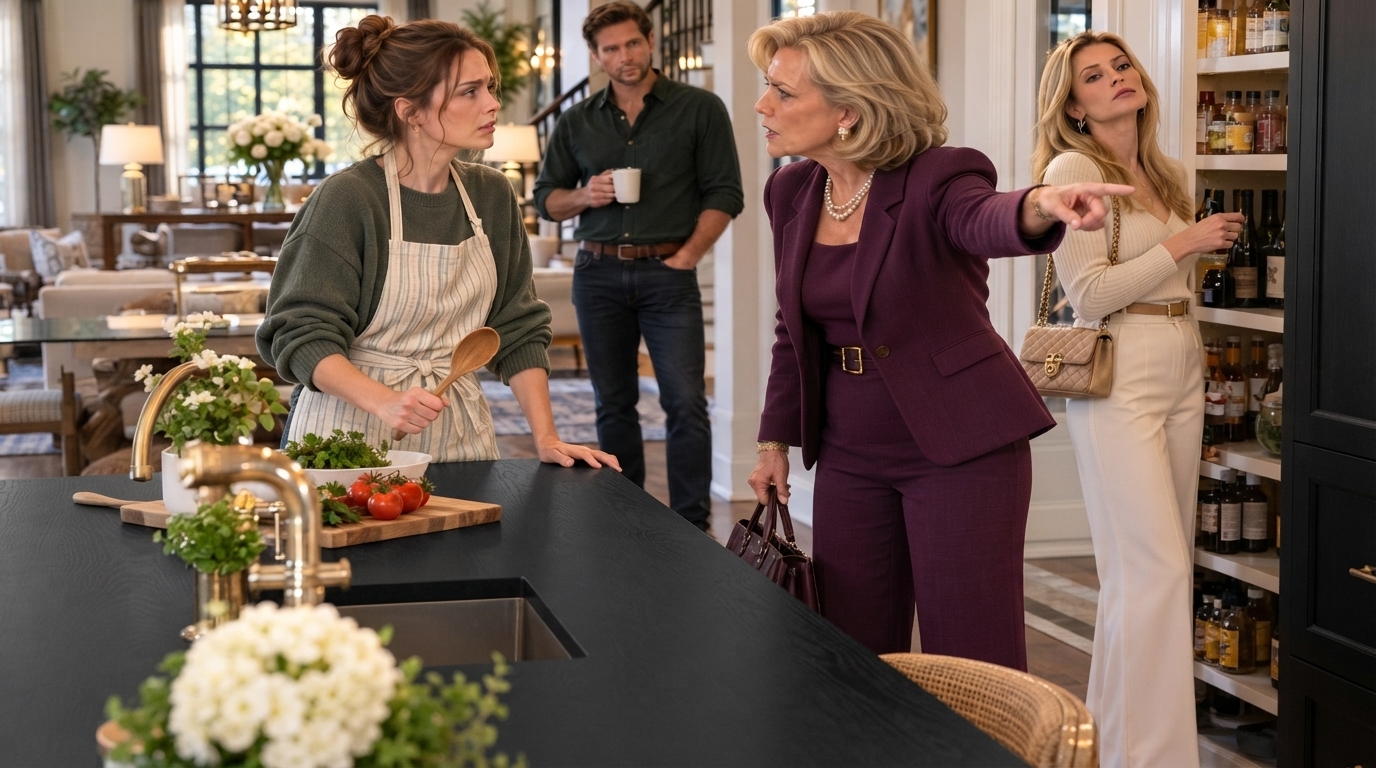
Mom standing at my quartz island.
Rochelle opening my pantry.
Tamson assigning himself three bedrooms and the basement.
The certainty in their voices.
The assumption that my home existed for them to use.
Then I looked around again.
At the family I’d built.
At the life I’d protected.
At the children who had never been asked to surrender their bedrooms because someone else supposedly needed them more.
And I felt something I hadn’t expected.
Not victory.
Not revenge.
Peace.
That evening, after the guests left, I walked upstairs.
The boys were asleep.
Eli had fallen asleep clutching his new dinosaur encyclopedia.
Theo was curled beneath his blanket with a stuffed triceratops.
I stood in their doorway.
Two small beds.
Two desks.
Shelves filled with books and toys.
Their drawings taped to the walls.
Their favorite colors.
Their little worlds.
I remembered being fourteen.
Standing in my bedroom while Mom handed me a laundry basket.
Tamson needs this room more.
I remembered carrying my belongings into the television room.
Sleeping on the pullout sofa.
Doing homework at the kitchen table because I no longer had a desk.
Feeling as though I had become a guest in my own home.
Then I looked at my sons.
And I made myself a promise.
They would never have to earn the right to belong in their own house.
Their rooms would be theirs.
Their feelings would matter.
Their boundaries would be respected.
And if they ever told me someone was making them feel small, I would listen.
Not because I wanted them to grow up selfish.
But because I wanted them to understand something I hadn’t learned until adulthood.
Generosity is meaningful only when it’s freely given.
Love doesn’t require surrendering your dignity.
And family should never make you feel that your existence is an inconvenience.
Later, I went downstairs.
Creswell was cleaning the kitchen.
He looked up.
“Everything okay?”
I nodded.
Then I walked toward the quartz island.
The same island my mother had touched while announcing that my brother’s family would be moving in.
I ran my hand across the cool surface.
Creswell watched me.
“What are you thinking?”
I smiled.
“About how strange life is.”
He leaned against the counter.
“How so?”
“Twenty-three years ago, I lost my bedroom because Mom decided Tamson needed it more.”
He nodded.
“And?”
I looked around the kitchen.
“Now I own this house, two real-estate companies, and more than I ever imagined.”
He smiled.
“You worked hard for it.”
“I did.”
I paused.
“But the best part isn’t the money.”
He raised an eyebrow.
“No?”
I shook my head.
“The best part is knowing nobody gets to walk into my home and decide I don’t belong.”
Creswell stepped closer.
He wrapped his arms around me.
“You’ve always belonged here.”
I rested my head against his chest.
And for the first time, I fully believed it.
My mother once told me that family meant sharing everything.
For years, I believed her.
I shared my space.
My time.
My opportunities.
My money.
My silence.
But somehow, the sharing always seemed to move in one direction.
Toward Tamson.
Away from me.
It took twenty-three years, a marriage, two children, and a home I’d spent seven years building to understand that love and entitlement were not the same thing.
I could love my mother without allowing her to control my decisions.
I could care about my brother without giving him my house.
I could forgive the past without pretending it hadn’t happened.
And I could protect my children without feeling guilty for having boundaries.
My family had arrived expecting to take three bedrooms and a finished basement.
They believed I was simply a woman living in a corporate-owned house.
They thought the company belonged to someone more powerful.
They never imagined the woman they’d spent decades underestimating was the person who owned it.
But the greatest surprise wasn’t the deed.
It wasn’t the corporate records.
It wasn’t the money.
It was the life I’d built beyond their control.
A husband who respected me.
Two sons who felt safe.
A home filled with laughter.
And the quiet certainty that I would never again have to ask permission to keep what was mine.
At fourteen, my mother took away my bedroom because my brother needed it more.
At thirty-seven, I built a home where nobody could make that decision for me again.
And when I turned off the kitchen lights that night, I smiled.
Because every room in that house belonged to the people who lived there.
Not to whoever demanded it most loudly.
THE END THANK YOU FOR READING !!!



