PART 3
For several seconds, nobody moved.
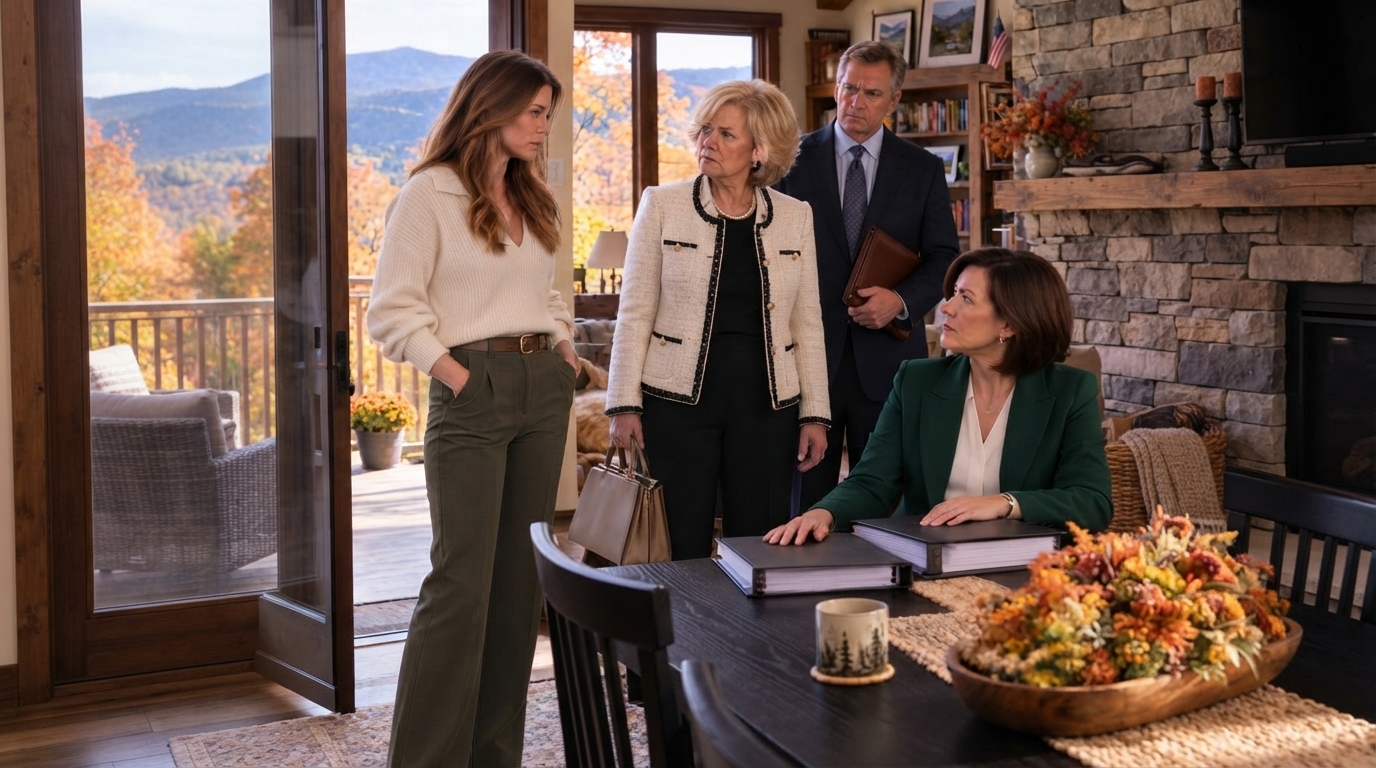
Dara stood beside my kitchen door,
her expensive coat still buttoned, her face drained of color.
Her attorney, Mr. Bennett, stared at
the photograph Patricia had placed on the table.
Then he slowly turned toward my sister.
“Dara, what exactly did you file with the county?”
She opened her mouth.
Nothing came out.
“Dara,” he repeated, his voice firmer,
“I need you to answer that question.”
She glanced at me.
I recognized that look immediately.
It was the same expression she had worn
when we were children and she had broken something valuable,
then waited for me to take the blame.
But I wasn’t twelve anymore.
And this wasn’t our mother’s favorite vase.
This was my home.
“I didn’t file anything fraudulent,” Dara finally snapped. “I was simply trying to protect family property.”
Patricia folded her hands.
“Then perhaps you can explain this.”
She opened the binder and removed a certified copy of an affidavit.
Across the top were the words:
AFFIDAVIT OF HEIRSHIP AND CLAIMED FAMILY INTEREST.
Beneath them was Dara’s name.
And below that, a statement declaring that the forty-acre parcel had been held by our grandfather’s family and that Dara was acting on behalf of his surviving descendants.
I stared at the document.
“Acting on behalf of his descendants?”
Patricia nodded.
“That’s what she claimed.”
I looked at Dara.
“Who gave you permission to speak for me?”
She crossed her arms.
“Someone had to take responsibility.”
I almost laughed.
“For property I bought with my own money?”
“You don’t understand the history!”
“Then explain it.”
She looked toward Bennett.
He wasn’t helping her.
Instead, he was reading the affidavit with increasing concern.
“Ms. O’Day,” he said to Patricia, “was this document accepted for recording?”
“No. The submission was flagged for deficiencies and never became an effective recorded claim against the property. The county retained the attempted filing and related correspondence.”
He exhaled.
“And your client has a copy?”
“Yes.”
Dara suddenly slammed her handbag onto the table.
“This is ridiculous! You’re treating me like a criminal because I asked questions about land that belonged to our family!”
Patricia remained calm.
“Asking questions is not the problem. Submitting false statements to a public office can be.”
Dara’s eyes flashed.
“You can’t prove anything was false.”
Patricia opened another folder.
“Actually, we can establish several factual inconsistencies.”
She spread three documents across the table.
The first was an old county map.
The second was a deed from 1947.
The third was my current survey.
“Your grandfather’s great-uncle owned property in this county,” Patricia explained. “But his parcel was approximately eleven miles northwest of this one.”
She pointed to the map.
“That property was sold in 1952.”
Then she pointed to my survey.
“This parcel has a separate chain of title. The two properties were never part of the same recorded tract.”
Bennett studied the documents.
Dara looked away.
“And,” Patricia continued, “the historical document your client brought today appears to have been assembled using information from unrelated records.”
Bennett’s expression hardened.
“Dara, where did you get this paper?”
She hesitated.
“From Grandpa’s belongings.”
“Who prepared the typed description?”
Silence.
“Dara?”
She swallowed.
“I had someone help me organize the information.”
Bennett slowly closed his briefcase.
“I was retained to investigate a possible historical ownership issue. I was not informed that you had already submitted an affidavit or that any documents might have been altered.”
Dara turned toward him.
“You’re supposed to be on my side!”
“I’m supposed to advise you based on accurate information.”
She stared at him.
Then at Patricia.
Then at me.
And finally, the truth began to emerge.
“I was going to tell you,” Dara said.
I leaned back in my chair.
“Tell me what?”
“About Grandpa’s land.”
“You mean the land he never owned?”
She flinched.
“Stop twisting everything!”
I looked at her.
“Dara, you’ve spent months researching my property, tried to file a claim against it, and arrived here demanding I return it to the family. What exactly am I twisting?”
She stared at the kitchen floor.
Then she whispered, “Mom and Dad deserve somewhere to retire.”
I blinked.
“What?”
She looked up.
“They’ve been talking about moving to the mountains for years.”
I felt something cold settle in my stomach.
“And?”
“And you have forty acres!”
I stared at her.
“Forty acres that I bought.”
“You don’t even live here full-time!”
“That doesn’t make it available.”
Her voice rose.
“You have an apartment in the city. You have a career. You have money. Mom and Dad are getting older!”
I sat silently.
There it was.
The real reason.
Not historical property rights.
Not our grandfather’s legacy.
Not a complicated inheritance question.
My sister had decided that because I owned something valuable, she had the authority to redistribute it.
“Did Mom and Dad ask you to do this?” I asked.
She hesitated.
That hesitation told me enough.
“Dara.”
“They said they’d love to retire somewhere peaceful.”
“That’s not what I asked.”
She looked away.
I felt my patience thinning.
“Did they tell you to claim my cabin?”
“No.”
“Do they even know I own it?”
She said nothing.
I stared at her.
“You told them it was family property, didn’t you?”
Her face turned red.
“I told them we might have an interest.”
I closed my eyes.
My sister had done what she always did.
She had created a plan.
Presented it as a family decision.
And expected everyone else to cooperate.
Except this time, the plan involved taking my home.
Bennett stood.
“I believe this meeting should end.”
Dara spun toward him.
“What?”
“I need to review the documents independently and determine whether I can continue representing you.”
She looked horrified.
“You can’t just abandon me!”
He gave her a steady look.
“You withheld material information from me.”
Patricia stood as well.
“I agree that we should conclude the meeting. My client has made her position clear.”
I looked directly at Dara.
“You’re not getting my cabin.”
She folded her arms.
“We’ll see.”
“No, Dara. We won’t.”
My voice was quiet.
But something about it made her pause.
“This property is mine. I paid for it. I maintain it. I pay the taxes. I renovated it. I don’t owe you, Mom, Dad, or anyone else a share.”
Her eyes filled with angry tears.
“You’ve changed.”
I nodded.
“Yes.”
She shook her head.
“You used to care about family.”
I stood.
“I still do. But caring about family doesn’t mean surrendering everything I work for.”
She grabbed her handbag.
“Mom is going to be devastated when she hears how you treated me.”
I looked toward the door.
“Then tell her the truth.”
Dara stormed outside.
Bennett paused before following her.
He turned toward Patricia.
“I’ll be in contact after reviewing the filing.”
Patricia nodded.
“Please do.”
Then he looked at me.
“I’m sorry this meeting unfolded this way.”
I didn’t answer.
I simply watched him leave.
A moment later, Dara’s SUV disappeared down the gravel driveway.
And for the first time all morning, the cabin was quiet.
I stood beside the window, staring at the empty driveway.
Patricia began gathering the documents.
“You handled that well,” she said.
I laughed bitterly.
“Did I?”
“You stayed calm. You didn’t make threats. You let the records speak.”
I looked at her.
“She’s going to tell everyone I stole Grandpa’s property.”
Patricia closed the binder.
“Then we correct the record with facts.”
I sat down.
“Can she still sue me?”
“Anyone can file a lawsuit if they find an attorney willing to pursue it. But based on the records we’ve reviewed, she has no credible ownership claim.”
I nodded.
“What about the affidavit?”
“We’ll preserve the evidence and address the attempted filing through the appropriate channels. If there was deliberate falsification, the relevant authorities can determine whether further action is warranted.”
I stared at the table.
“I never wanted any of this.”
Patricia’s expression softened.
“I know.”
“I bought this place because I wanted peace.”
She glanced toward the windows.
Beyond them, the mountains were turning gold beneath the afternoon sunlight.
“Then don’t let your sister convince you that protecting your peace is an act of aggression.”
I looked at her.
She continued.
“Setting boundaries doesn’t create the underlying problem. It reveals who was benefiting from the absence of boundaries.”
I sat with those words for a long time.
By Sunday evening, my phone was exploding.
Mom called first.
I answered.
“Hello?”
“What have you done to your sister?”
I closed my eyes.
“Hi, Mom.”
“Don’t ‘hi, Mom’ me. Dara says you humiliated her in front of her attorney!”
“Did she tell you why she came here?”
“She said you refused to discuss Grandpa’s land.”
“Grandpa’s land?”
Mom hesitated.
“Well, that’s what she said.”
I took a breath.
“Mom, Grandpa never owned my property.”
Silence.
“What?”
“I bought forty acres three years ago. With my own savings and a mortgage. It’s in my name.”
Mom sounded confused.
“Three years ago?”
“Yes.”
“Why didn’t you tell us?”
I looked around my kitchen.
At the green sofa visible through the doorway.
At the shelves I’d installed myself.
At the old wooden dining table I’d restored.
“Because I wanted something that was mine before anyone else had an opinion about it.”
Mom was quiet.
Then she said, “Dara told us she had discovered a family inheritance.”
I closed my eyes.
Of course she had.
“She also told us she was trying to secure it for your father and me.”
“Did you ask her to?”
“No.”
“Did you know she tried to file paperwork claiming ownership?”
“What?”
Her voice changed immediately.
“What paperwork?”
I explained.
The affidavit.
The false historical connection.
The attorney.
The meeting.
By the time I finished, Mom was crying.
“I had no idea.”
I believed her.
But belief didn’t erase years of silence.
“Mom,” I said, “Dara excluded me from the reunion. Then she discovered I owned something valuable and decided she had a right to it.”
Mom whispered, “I’m sure she didn’t mean—”
“Please don’t.”
She stopped.
I took a breath.
“Please don’t explain this away as another misunderstanding.”
For a long moment, neither of us spoke.
Then Mom said something unexpected.
“You’re right.”
I stared at the phone.
“What?”
“You’re right. I’ve been making excuses for Dara for years.”
My throat tightened.
She began crying harder.
“I thought keeping everyone calm meant keeping the family together.”
I looked out at the mountains.
“Sometimes it just means letting one person hurt everyone else.”
Mom was silent.
Then she whispered, “I’m sorry.”
It was the first time I remembered hearing her say those words about Dara.
Two days later, Dad called.
He didn’t shout.
He didn’t accuse.
He simply asked, “Can you send me the property records?”
I did.
The deed.
The survey.
The historical maps.
The title summary.
An hour later, he called back.
“Your sister lied to us.”
I sat on my porch.
“Yes.”
Dad exhaled.
“She told us Grandpa’s family had owned that exact land.”
“They didn’t.”
“I can see that.”
I waited.
Then he said, “I’m sorry we didn’t ask you directly.”
Those words hurt more than I expected.
Because that was all I had wanted.
For someone to ask me.
To listen.
To believe that I could make a decision without Dara’s approval.
Dad continued.
“Your mother and I would never have asked you to give us your home.”
I looked toward the creek.
“I know.”
And for the first time, I truly believed it.
But the situation wasn’t over.
Because three weeks later, Patricia called with news.
“Dara has made another move.”
My stomach tightened.
“What now?”
“She’s contacted several relatives and is asking them to contribute money to a legal fund.”
I stared at the phone.
“A legal fund?”
“To challenge your ownership.”
I closed my eyes.
Of course.
Dara wasn’t finished.
She had simply changed tactics.
Patricia paused.
“There’s something else.”
“What?”
“She’s telling people you secretly purchased family property using information from your grandfather’s estate.”
I felt anger rise in my chest.
“That’s completely false.”
“I know.”
“What do we do?”
Patricia’s voice remained calm.
“We respond with the truth. And this time, we make sure everyone sees it.”
PART 4
The following Saturday, I sat at my kitchen table with my laptop open and a cup of coffee growing cold beside me.
Patricia had prepared a factual summary of the property records.
Not an angry letter.
Not a threat.
A simple explanation supported by documents.
It included the purchase date, recorded deed, parcel identification, and historical title information showing that my cabin had never belonged to our grandfather or his relatives.
Patricia had also included a short statement explaining that Dara’s attempted ownership affidavit did not establish any legal interest.
I read the document twice.
Then I opened the family group chat.
The same group chat where Dara had organized reunions, assigned holiday meals, and decided who was included.
For years, I’d remained mostly silent in that chat.
I didn’t want arguments.
I didn’t want drama.
And I certainly didn’t want to challenge Dara in front of everyone.
But this time, silence would allow a lie to spread.
So I typed.
Hi, everyone. I’ve learned that some relatives have been told I purchased land belonging to Grandpa’s family and that there is a legal effort to recover it.
That information is false.
I purchased my property three years ago from an unrelated private owner. The deed is recorded in my name. Two independent title reviews found no family ownership connection.
I’ve attached a summary of the relevant public records. Please do not contribute money to any legal fund based on claims that my property belongs to the family.
I won’t be discussing this further in the group chat, but I wanted everyone to have accurate information.
I attached the document.
Then I pressed send.
For nearly five minutes, nothing happened.
Then Alicia replied.
Thank you for clearing this up. I was wondering why Dara was asking for money.
My cousin Marcus wrote:
Wait. Dara told me Grandpa left the land to all the grandchildren.
Another cousin replied:
She told us it was being held illegally.
Then Aunt Helen entered the conversation.
Dara, is this true?
I watched the messages appear.
One after another.
Questions.
Confusion.
Disbelief.
Finally, Dara responded.
This is a private family matter. Tessa had no right to share legal documents with everyone.
I stared at the screen.
Then Alicia replied.
You asked everyone to donate money to sue her. That made it everyone’s business.
I nearly laughed.
Dara didn’t answer.
Ten minutes later, she left the group chat.
That afternoon, my phone rang.
It was Aunt Helen.
She was seventy-two and had been one of Grandpa’s closest relatives.
When I answered, she sounded furious.
“Sweetheart, I’m sorry.”
I blinked.
“For what?”
“For believing Dara.”
I sat down.
“What did she tell you?”
Helen sighed.
“She said she’d discovered land Grandpa’s father had owned and that you’d purchased it before the rest of us could claim our inheritance.”
I closed my eyes.
“That’s not true.”
“I know that now.”
She paused.
“She asked me for five thousand dollars.”
I sat upright.
“Five thousand?”
“For legal expenses.”
My stomach dropped.
“Did you give it to her?”
“No. I told her I needed to speak with my financial adviser first.”
Relief washed through me.
“Thank goodness.”
Helen hesitated.
“But your cousin Raymond sent her two thousand.”
I closed my eyes.
Dara had gone beyond trying to take my property.
Now she was collecting money from relatives based on a story she couldn’t support.
“Has Raymond asked for it back?”
“He tried. She told him the legal fund was nonrefundable.”
I stared at the wall.
Of course she had.
I thanked Helen and immediately called Patricia.
She listened carefully.
Then she said, “We need to document these reports. Anyone who contributed money should preserve their communications and payment records and seek advice about recovering the funds.”
“Could Dara get into trouble?”
“That depends on the facts, including what she represented and what she knew. We shouldn’t jump to conclusions, but the allegations deserve careful review.”
I nodded.
Then I asked the question that had been bothering me for weeks.
“Why is she doing this?”
Patricia was quiet.
Finally, she said, “I can’t tell you what motivates your sister. But her behavior suggests she’s having difficulty accepting that she doesn’t control this decision.”
I looked around my cabin.
The green sofa.
The bookshelves.
The porch beyond the windows.
For years, Dara had been able to influence nearly every family decision.
But she couldn’t influence this one.
And apparently, that was unbearable to her.
A week later, Dad called.
“Tessa, your sister wants to have a family meeting.”
I laughed once.
“Of course she does.”
“She says she wants to explain everything.”
I looked at the mountains.
“Does she want to apologize?”
Dad hesitated.
“She didn’t say.”
“Then what does she want?”
He sighed.
“She wants everyone to understand her side.”
I closed my eyes.
There it was again.
Dara didn’t want accountability.
She wanted an audience.
I thought about refusing.
But then I remembered the relatives who had been asked for money.
The false claims.
The months of uncertainty.
Maybe a meeting would finally put an end to it.
“I’ll come,” I said.
Dad sounded relieved.
“Thank you.”
“But I have conditions.”
“Of course.”
“Patricia will attend. The meeting will be in a neutral location. And if Dara starts making accusations without evidence, I’m leaving.”
Dad paused.
Then said, “That’s fair.”
I nearly smiled.
For the first time in years, someone in my family had called one of my boundaries fair.
The meeting took place at a community center near my parents’ home.
Twenty-three relatives attended.
Alicia sat beside me.
Patricia sat on my other side.
Dara arrived fifteen minutes late.
She wore a cream-colored blazer and carried a folder.
She looked composed.
Confident.
Almost cheerful.
I knew that expression.
It was the face she wore when she expected to win.
Mom stood near the coffee table.
Dad sat in the front row.
Aunt Helen was beside Raymond, who looked deeply uncomfortable.
Dara walked to the front of the room.
“Thank you all for coming,” she began.
She smiled.
“I know there’s been some confusion about Grandpa’s property.”
I felt Patricia shift beside me.
Dara continued.
“My intention has always been to protect our family’s legacy.”
Alicia whispered, “Here we go.”
Dara ignored her.
“Unfortunately, my sister has chosen to make this a personal attack.”
I looked down at my hands.
I had promised myself I wouldn’t interrupt.
Not yet.
Dara lifted a document.
“This is a historical deed connected to our grandfather’s family.”
Patricia raised her hand.
“Dara, is that the same document you presented at the cabin?”
Dara stiffened.
“Yes.”
Patricia stood.
“Then before you continue, I think everyone should know that the parcel identification on that document does not correspond to the period in which it supposedly originated.”
Dara flushed.
“That’s your interpretation.”
“No,” Patricia replied calmly. “It’s a matter of county records.”
She placed a copy of the historical map on the table.
“The land owned by your grandfather’s relative was located approximately eleven miles from Tessa’s property. It was sold decades before Tessa was born.”
Raymond leaned forward.
“Then why did Dara tell me Grandpa left us forty acres?”
The room fell silent.
Dara looked at him.
“I said there might be a claim.”
Raymond shook his head.
“No. You told me we had a claim. You asked me to contribute money so we could get the property back.”
Dara’s face reddened.
“Raymond, I was acting on information available at the time.”
He stood.
“Then give me my two thousand dollars back.”
Aunt Helen nodded firmly.
“That seems reasonable.”
Dara looked around the room.
Her expression changed.
For the first time, she seemed to realize that the usual family script wasn’t working.
Nobody was rushing to defend her.
Nobody was telling me to be quiet.
Nobody was asking everyone to move on.
They were asking questions.
And expecting answers.
Dad stood slowly.
“Dara, sit down.”
She turned toward him.
“Dad, I’m trying to explain—”
“Sit down.”
His voice was firm.
She froze.
I couldn’t remember the last time Dad had spoken to her that way.
Dara sat.
Dad looked around the room.
“I owe everyone an apology.”
Mom moved closer to him.
He continued.
“When Dara first told us she’d discovered family land, I believed her. I didn’t ask for documents. I didn’t speak to Tessa.”
He looked directly at me.
“And that was wrong.”
My throat tightened.
Dad took a breath.
“I’ve reviewed the records. Tessa bought that cabin with her own money. It does not belong to our family. It never did.”
Dara stared at him.
“Dad!”
He raised his hand.
“No, Dara. You’ve had your turn.”
The room became completely silent.
Dad looked at Raymond.
“If you gave money based on incorrect information, you deserve a proper accounting of where it went.”
Raymond nodded.
Then Dad turned toward me.
“Tessa, I’m sorry we allowed this to go so far.”
I felt tears gathering.
For most of my life, I’d waited for someone to stand up to Dara.
Not because I wanted her punished.
But because I wanted the truth to matter more than keeping her happy.
And now, finally, it did.
Dara began crying.
At first, I felt the familiar pull of guilt.
The urge to comfort her.
To soften my words.
To say it wasn’t that bad.
But then I remembered the attempted affidavit.
The false deed.
The legal fund.
The months she had spent trying to take something that belonged to me.
I remained seated.
Dara looked at me.
“Are you happy now?”
I took a breath.
“No.”
She blinked.
“I’m not happy that you lied to our relatives. I’m not happy that you tried to claim my property. And I’m not happy that we’re sitting here discussing whether people can get their money back.”
Her eyes filled with fresh tears.
“Then why are you doing this?”
I looked directly at her.
“Because you don’t get to hurt people and call accountability cruelty.”
She looked away.
I continued.
“Dara, I didn’t buy the cabin to embarrass you. I didn’t keep it secret to punish you. I bought it because I wanted something of my own.”
My voice trembled.
“For years, every decision I made became something you felt entitled to approve or criticize.”
She opened her mouth.
I shook my head.
“Please let me finish.”
She closed it.
“When I moved away for work, you called it abandonment. When I missed a holiday because of a project deadline, you told everyone I didn’t care about family.”
I swallowed.
“And when you organized the reunion without inviting me, you said you were trying not to inconvenience me.”
Dara stared at the floor.
“Then you discovered I owned something valuable, and suddenly you wanted me involved again.”
The room was silent.
I took one final breath.
“I don’t hate you, Dara. But I don’t trust you. And until that changes, you will not be welcome at my cabin.”
She began crying harder.
For once, nobody told me to apologize.
The meeting ended quietly.
Raymond spoke privately with Dara about the money.
Other relatives asked Patricia a few questions about the property records.
Mom hugged me.
Dad shook Patricia’s hand.
And Alicia walked outside with me.
We stood beside my car beneath a pale autumn sky.
“Well,” she said, “that was something.”
I laughed.
“That’s one way to describe it.”
She looked at me.
“You know, I always wondered why you never fought back.”
I thought about that.
“Because fighting back always seemed to make things worse.”
Alicia nodded.
“And now?”
I looked toward the mountains in the distance.
“Now I think sometimes the only way things get better is when someone finally stops pretending everything is fine.”
She smiled.
“Grandpa would’ve liked that.”
I smiled back.
“I hope so.”
Over the following months, the legal issues were addressed.
Dara’s attempted ownership claim did not affect my recorded title.
Patricia helped ensure that the county records accurately reflected the failed submission and that no unresolved claim remained against my parcel.
The relatives who had contributed money pursued repayment.
Raymond eventually recovered his two thousand dollars through a written repayment agreement.
Dara’s attorney withdrew from representing her in the property dispute.
No court ever recognized a family ownership interest in my cabin.
And the matter finally came to an end.
But the family consequences lasted longer.
Dara stopped speaking to me.
At first, I thought the silence would hurt.
Instead, I discovered something surprising.
I could breathe.
I could make plans without anticipating criticism.
I could visit my cabin without wondering whether my sister would call to tell me what I should be doing instead.
I could enjoy my own life.
And slowly, that freedom became familiar.
The following spring, Mom called.
“Tessa, your father and I were wondering if we could visit your cabin.”
I hesitated.
Not because I didn’t want them there.
But because I needed to know the visit would be different from the family gatherings I remembered.
“Just the two of you?” I asked.
“Just us.”
“No Dara?”
Mom paused.
“No Dara.”
I smiled.
“Then I’d love that.”
They arrived on a Friday afternoon.
Dad carried a small toolbox.
Mom brought homemade lemon cake.
I stood on the porch as they stepped out of the car.
Dad looked around.
The trees were turning green.
The creek sparkled beyond the meadow.
The cabin sat quietly beneath the mountains.
He whistled.
“Tessa, this is beautiful.”
I felt an unexpected lump in my throat.
“Thank you.”
Mom walked toward the porch.
“You did all this?”
I nodded.
“Some myself. Some with contractors.”
She touched the railing.
“It’s wonderful.”
For the first time, my parents were looking at something I’d built without immediately asking what it could do for someone else.
Dad spent the afternoon helping me repair a loose porch step.
Mom and I made dinner.
We sat outside afterward, watching the sky turn pink over the ridge.
Nobody argued.
Nobody issued instructions.
Nobody mentioned Dara.
It was peaceful.
Ordinary.
Exactly what I’d wanted.
That evening, Dad looked at me across the porch table.
“Can I tell you something?”
I nodded.
“When you were little, your grandfather used to say you were the most independent person he’d ever met.”
I smiled.
“He did?”
Dad nodded.
“He said you’d build a life that was entirely your own.”
I looked toward the mountains.
“I think I finally did.”
Dad was quiet for a moment.
Then he said, “I’m sorry we made you feel like independence meant you loved us less.”
My eyes filled with tears.
I looked at him.
“Thank you, Dad.”
He reached across the table and squeezed my hand.
It wasn’t a perfect apology.
It didn’t erase everything.
But it mattered.
Summer came again.
And with it, another family reunion.
This time, Alicia organized it.
She created a group chat.
Asked everyone for available dates.
Sent the invitations herself.
And included my name.
I stared at the message for a long time.
Then I smiled.
I attended.
Not because I felt obligated.
Not because I was afraid of being excluded.
But because I wanted to.
The reunion was held at a rented lodge near Asheville.
There were card games.
Too much food.
Children running through the hallways.
And the familiar arguments about who had forgotten to buy enough coffee.
It felt like the reunions I remembered from childhood.
Except something important had changed.
Nobody was allowed to decide who belonged simply because they were the loudest person in the room.
Dara didn’t attend.
I heard she had begun counseling and was working to repair relationships with several relatives.
I hoped she succeeded.
But I didn’t feel responsible for making that happen.
On the final morning of the reunion, Alicia and I sat outside drinking coffee.
She looked at me.
“Are you glad you came?”
I smiled.
“Yes.”
She nodded toward the mountains.
“And how’s your secret cabin?”
I laughed.
“Not so secret anymore.”
“Still yours, though.”
I looked out at the blue ridges.
“Yes.”
She smiled.
“Good.”
And that simple word stayed with me.
Good.
Not selfish.
Not disloyal.
Not cruel.
Just good.
It was good that I had worked hard.
Good that I had bought something I loved.
Good that I had protected it.
Good that I had finally stopped apologizing for building a life of my own.
That autumn, I spent a quiet weekend at the cabin.
I woke before sunrise.
Made coffee.
Opened the back door.
And stepped onto the porch.
The mountains stretched endlessly beneath a blanket of pale blue mist.
The creek murmured through the trees.
Leaves drifted slowly across the grass.
Everything was exactly as it had been the morning Dara arrived with her attorney.
Except I was different.
Back then, I’d been frightened that protecting my property would destroy my family.
Now I understood that the damage had begun long before anyone mentioned the cabin.
It began every time someone stayed silent to avoid upsetting Dara.
Every time my decisions were questioned.
Every time my independence was treated like betrayal.
Every time I convinced myself that keeping the peace mattered more than telling the truth.
I had spent years believing family harmony required me to make myself smaller.
But the cabin taught me something else.
Peace doesn’t come from giving everyone what they demand.
Sometimes it comes from finally saying no.
I sat in the wooden rocking chair Dad had helped me repair.
A warm mug rested between my hands.
And I thought about Grandpa.
He had loved these mountains.
He used to say that the best thing about them was how they stayed exactly where they belonged, no matter how the weather changed.
I smiled at the memory.
Because that was what I had finally learned to do.
Stay where I belonged.
Stand on what was mine.
And stop allowing someone else’s anger to determine the boundaries of my life.
My sister had left my name off the reunion list because she thought belonging was something she could control.
Then she tried to claim my cabin because she believed ownership was something she could take.
She was wrong about both.
A family invitation doesn’t determine your worth. And someone else’s entitlement doesn’t erase your ownership.
I had bought forty acres, a small cabin, and a view of the Blue Ridge Mountains.
But what I truly gained was something I’d spent my entire life searching for.
The freedom to live without asking permission.
And as the morning sunlight spread across the ridge, I realized I had never needed Dara to give me a place in the family.
I had already built a place where I belonged.
THE END THANK YOU FOR READING !!!



