PART 3
My father’s face had gone so pale that,
for one terrifying second,
I thought he might collapse right there beside the fireplace.
He held the envelope in both hands,
staring at the letter as though the words might
rearrange themselves into something less frightening.
“Tessa,” he whispered again. “You can’t do this.”
I looked at him calmly.
“I already did.”
My mother leaned across the table.
“What is that? Richard, what does it say?”
Dad didn’t answer.
Instead, he looked at me with an expression
I hadn’t seen since I was a teenager and told him
I had received a full scholarship to college.
Back then, he hadn’t looked proud.
He’d looked inconvenienced.
Now he looked frightened.
“You’re canceling the mortgage payments?” he asked.
“Yes.”
Brooke nearly knocked over her water glass.
“What mortgage payments?”
I turned toward her.
“The ones I’ve been making on Mom and Dad’s house for the past eight years.”
Her mouth fell open.
“Eight years?”
“Every month.”
Mom pressed a hand against her chest.
“Richard, you told me the mortgage was nearly paid off.”
Dad looked away.
I almost laughed.
Of course.
Even my mother didn’t know how much of their comfortable life depended on me.
For years, Dad had told everyone that his retirement investments were doing wonderfully.
He drove a luxury SUV.
Mom wore expensive jewelry.
They hosted holiday parties and took cruises.
And whenever someone complimented their lifestyle, Dad smiled and said, “Hard work pays off.”
Apparently, my hard work paid off for everyone.
“The letter is a notice,” I explained. “I have ended the voluntary monthly transfers I was making toward your mortgage. The bank has been notified that future payments must come from your own account.”
Dad slammed the envelope down.
“You promised to help us!”
“I promised to help when you were struggling. I never promised to support you forever.”
“We’re your parents!”
“And Emma is your granddaughter.”
Silence.
I looked toward my daughter.
She was standing beside Evan, holding his hand.
Her cheeks were pink.
She looked embarrassed, and that hurt more than anything my parents could have said.
I lowered my voice.
“Emma, sweetheart, would you go with Evan and see the room? I’ll be there in a minute.”
She looked at me uncertainly.
“Are you coming?”
“Absolutely.”
Evan smiled reassuringly.
“Come on, Em. I heard there’s chocolate cake involved.”
Her expression brightened slightly.
As they walked away, Brooke leaned toward me.
“You planned this?”
I met her eyes.
“I planned a nice evening for my daughter. I planned to pay for the entire family dinner, too, until Dad decided Emma was the only child who didn’t deserve to be included.”
Mom shook her head.
“You’re twisting his words.”
“No, Mom. I’m finally listening to them.”
Dad pushed his chair back.
“Sit down, Tessa. We’re not finished.”
I looked at the chair.
For forty-one years, those two words had controlled me.
Sit down.
Be reasonable.
Don’t make a scene.
Think about the family.
I had spent my childhood obeying them and my adulthood financing them.
But I wasn’t a child anymore.
“No, Dad,” I said. “We’re finished.”
I turned toward the private dining room.
Then Brooke said something that stopped me.
“You think you’re better than us because you make more money?”
I slowly turned back.
“No, Brooke. I think I deserve to be treated like a person instead of a checking account.”
She folded her arms.
“You’ve always been jealous of me.”
The accusation was so familiar that I almost smiled.
Growing up, every time I complained about being treated differently, my parents said the same thing.
I was jealous.
Jealous when Brooke got a new car.
Jealous when they paid for her European vacation.
Jealous when they missed my graduation.
Jealous when they praised her for accomplishments they barely acknowledged when I achieved them.
But I wasn’t jealous anymore.
I was exhausted.
“Brooke,” I said quietly, “do you know how much money I’ve given you personally?”
She rolled her eyes.
“Here we go.”
“Seventy-three thousand, four hundred dollars.”
Her expression changed.
“That’s ridiculous.”
“Your car payments. The apartment deposit after your divorce. The credit cards you asked me to cover. The emergency dental bills. The money for your children’s summer camps.”
Mom interrupted.
“Those were gifts!”
“Some were. Some were loans you promised to repay. I’m not demanding repayment tonight. I’m telling you there won’t be any more.”
Brooke’s eyes filled with angry tears.
“You can’t just abandon us.”
I stared at her.
“Funny. Nobody called it abandonment when you all forgot Emma’s birthday.”
She opened her mouth.
Nothing came out.
“Nobody called it abandonment when you missed her recital. Or when Dad told her she couldn’t order the same dinner as your children.”
I picked up my purse.
“Enjoy your lobster.”
Then I walked away.
The private dining room was glowing with warm golden light.
A long table stood beneath a chandelier decorated with tiny evergreen branches.
There were flowers, candles, and place cards.
But the most beautiful thing in that room was Emma’s face.
She was laughing.
Really laughing.
Her best friend, Lily, was showing her a ridiculous photograph on her phone.
Her science teacher, Mrs. Bennett, was talking to Evan’s parents.
And Evan was standing beside the fireplace, smiling when he saw me.
“Everything okay?” he asked quietly.
I took a breath.
“It will be.”
He squeezed my hand.
“You did the right thing.”
I looked at Emma.
“Did I?”
He followed my gaze.
“Tess, look at her.”
I did.
My daughter was surrounded by people who had shown up for her.
People who remembered her accomplishments.
People who asked about her science projects.
People who loved her without comparing her to anyone else.
“That’s what matters,” Evan whispered.
I nodded.
For the first time that evening, my chest loosened.
Then Emma ran toward me.
“Mom! They have the chocolate lava cake!”
I laughed.
“Then we’d better order one.”
She hesitated.
“Is it expensive?”
The question nearly broke me.
I crouched beside her.
“Sweetheart, listen to me.”
She looked into my eyes.
“You never have to earn your place at a table by ordering the cheapest thing.”
Her lower lip trembled.
“Grandpa said—”
“I know what Grandpa said.”
I brushed a strand of hair behind her ear.
“And he was wrong.”
She whispered, “Did I do something bad?”
“No, baby. You did absolutely nothing wrong.”
“Then why doesn’t he want to pay for me?”
I swallowed.
“Because sometimes adults make unfair choices. And sometimes those choices hurt people who don’t deserve it.”
She looked down.
“Does that mean he doesn’t love me?”
I couldn’t give her an easy lie.
“I don’t know why Grandpa acts the way he does. But I know this: you are loved, and you never have to make yourself smaller to deserve kindness.”
She threw her arms around my neck.
I held her tightly.
Across the room, Evan’s mother, Margaret, quietly wiped her eyes.
Dinner was wonderful.
We ordered appetizers.
We laughed.
Mrs. Bennett told everyone how Emma had stayed after school to help a younger student finish a science project.
Lily’s mother shared a story about the girls trying to build a homemade weather station and accidentally soaking their backyard.
Emma laughed until she could barely breathe.
And when the waiter brought out her favorite dessert, everyone applauded.
Nobody told her it cost too much.
Nobody compared her to her cousins.
Nobody made her feel like an inconvenience.
For one evening, my daughter was simply allowed to be happy.
But halfway through dessert, my phone began vibrating.
Dad.
Mom.
Brooke.
Dad again.
Then a text message appeared.
DAD: You need to come back immediately. Your mother is crying, and Brooke can’t afford this bill.
I stared at the screen.
Then another message arrived.
BROOKE: The waiter says our total is over $900. You need to fix this.
I showed Evan.
He shook his head.
“Don’t answer.”
I turned my phone face down.
But five minutes later, the private dining room door opened.
My father stood in the doorway.
His face was red.
Behind him, the restaurant manager looked deeply uncomfortable.
“Ms. Caldwell,” the manager said, “I’m sorry. I explained that this room was reserved privately, but your father insisted.”
Dad stepped inside.
“Enough of this nonsense.”
The room went silent.
Emma’s smile disappeared.
I stood.
“Dad, you need to leave.”
He ignored me.
“You’re going to pay that bill.”
“No.”
“You invited us here!”
“And I was prepared to pay until you announced that my daughter wasn’t worth including.”
He looked around the room.
“You’re humiliating me in front of strangers.”
I glanced at the people sitting at the table.
“These aren’t strangers. They’re people who care about Emma.”
His eyes narrowed.
“So that’s what this is? Replacing your family?”
I took a slow breath.
“No. This is me recognizing who actually behaves like family.”
He pointed toward Emma.
“All this drama over one spoiled child ordering dinner?”
The room became painfully quiet.
I felt something inside me turn to steel.
“Don’t call my daughter spoiled.”
Dad scoffed.
“She needs to learn that the world doesn’t revolve around her.”
I stepped between him and Emma.
“And you need to learn that being someone’s grandfather doesn’t give you permission to humiliate them.”
His expression hardened.
“You wouldn’t have anything without this family.”
I looked directly at him.
“Then explain something, Dad.”
He crossed his arms.
“What?”
“If I owe everything to you, why have I spent the last fourteen years paying for the life you claim you built?”
Nobody moved.
His mouth opened.
Then closed.
I continued.
“I paid my own tuition. I bought my own home. I built my career. I raised my daughter. And every time you called with another emergency, I helped.”
My voice trembled, but I didn’t stop.
“I never asked you to worship me. I never asked for special treatment. I asked for basic kindness toward my child.”
Dad stared at me.
“And tonight, even that was too much.”
The manager stepped forward.
“Sir, I’m going to have to ask you to return to your table.”
Dad looked at him furiously.
“Do you know who I am?”
The manager remained calm.
“Yes, sir. You’re a guest who is disturbing another private reservation.”
For once, Dad had no answer.
He turned toward me.
“You’ll regret this.”
I shook my head.
“No, Dad. I regret waiting this long.”
He stormed out.
The door closed behind him.
For several seconds, nobody spoke.
Then Emma quietly reached for my hand.
“Mom?”
I looked down.
“Yes, sweetheart?”
She smiled a little.
“I’m glad you stood up for me.”
And just like that, I knew I had made the right decision.
The next morning, I woke to thirty-seven missed calls.
Brooke had sent seventeen messages.
Mom had left six voicemails.
Dad had sent one email.
Its subject line read:
YOU HAVE DESTROYED THIS FAMILY.
I opened it.
The message was four paragraphs long.
He accused me of disrespect.
Selfishness.
Cruelty.
He said I had embarrassed him publicly and threatened his financial security.
Then, near the bottom, he wrote something that made my stomach twist.
If you stop paying the mortgage, the bank will take our home. After everything we’ve done for you, I cannot believe you would let your parents become homeless.
I read it twice.
Then I opened my spreadsheet.
Fourteen years of transfers.
Every payment.
Every request.
Every promise to repay.
And for the first time, I didn’t feel guilty looking at the total.
I felt angry.
Because the money was only part of the story.
The other part was everything that money had cost me.
Time with Emma.
Vacations I postponed.
Savings I delayed.
Nights spent worrying about my parents’ emergencies while they enjoyed luxuries I rarely allowed myself.
I had sacrificed peace to maintain a relationship that only seemed to function when I was giving something.
I closed the spreadsheet.
Then I opened a new document.
At the top, I typed:
Caldwell Family Financial Boundaries — Effective Immediately.
I listed every recurring payment I would no longer make.
Mortgage contributions.
Insurance premiums.
Credit card assistance.
Brooke’s car payments.
Holiday expenses.
Emergency transfers.
I sent the document to my financial adviser and asked him to help me close every remaining arrangement responsibly, without interfering with obligations legally belonging to me.
Then I sent one message to my parents and sister.
I will no longer provide financial support. I will honor any legal obligations I personally have, but all voluntary payments are ending. Please make your own arrangements. I will not discuss money further.
I pressed send.
And for the first time in years, I felt free.
But I had no idea what was coming.
Because three days later, my mother appeared at my office.
She wasn’t crying.
She wasn’t apologizing.
She was carrying a thick manila folder.
And the first thing she said was:
“Tessa, your father has been lying to both of us.”
PART 4
I stared at my mother across the conference table.
She looked different.
Her hair was pulled back without its usual careful styling.
There was no expensive handbag.
No jewelry except her wedding ring.
And the folder in her hands was trembling.
“What do you mean Dad has been lying?” I asked.
Mom sat down slowly.
“About the mortgage.”
I felt my stomach tighten.
“What about it?”
She opened the folder.
Inside were bank statements, loan documents, and printed emails.
I recognized the name of the bank.
But the account numbers were unfamiliar.
Mom pushed a statement toward me.
“Richard told me you were helping us with the mortgage because our retirement income wasn’t enough.”
“That’s true.”
She shook her head.
“No, Tessa. That’s only part of it.”
I studied the statement.
A home equity line of credit.
Balance: $186,400.
I looked up.
“What is this?”
Mom’s eyes filled with tears.
“Your father borrowed against the house.”
“When?”
“Over the past six years.”
My mind raced.
“Why?”
She swallowed.
“Brooke.”
I closed my eyes.
Of course.
“How much did he give her?”
Mom’s voice cracked.
“Most of it.”
I stared at her.
“Most?”
She nodded.
“Her business. Her vacations. Her divorce attorney. The apartment she rented after the divorce. The money she said she needed for the children.”
I leaned back.
Brooke had started an online clothing boutique four years earlier.
It had failed within eighteen months.
Dad had told everyone she was a brave entrepreneur who had been unlucky.
Apparently, he had financed that bravery with money borrowed against the family home.
While I was paying the mortgage.
I felt sick.
“So let me understand this,” I said carefully. “I was sending Dad money to help keep the house. Meanwhile, he was borrowing against the house to support Brooke.”
Mom nodded.
“And he never told me.”
“No.”
“Did you know?”
She lowered her eyes.
“Not until last week.”
I studied her face.
“Why are you telling me now?”
She looked down at her wedding ring.
“Because when you stopped paying, Richard told me we might lose the house. I asked to see the accounts. He refused. So I went to the bank.”
I waited.
“He had been telling me the mortgage was almost finished. But between the remaining mortgage and the home equity loan, we owe far more than I thought.”
I rubbed my temples.
“And he expects me to fix it.”
Mom began crying.
“He said you would come around. He said you always do.”
Those words hit harder than the numbers.
You always do.
That was how my family had built its financial plan.
Not around income.
Not around savings.
Around my inability to say no.
I looked at Mom.
“What do you want from me?”
She shook her head.
“I don’t want money.”
I didn’t believe her immediately.
She must have seen it.
“I know you don’t trust me,” she whispered. “And I understand why.”
I waited.
Then she said something I had never heard from either parent.
“I owe you an apology.”
My throat tightened.
Mom took a breath.
“I let your father treat you like you were responsible for everything. I watched him favor Brooke. I made excuses because it was easier than confronting him.”
Tears slid down her cheeks.
“And I watched him treat Emma the same way.”
I looked away.
Mom continued.
“When he told Emma to order something cheap, I knew it was wrong. I knew she was hurt. And I said nothing.”
Her voice broke.
“I’m ashamed of that.”
I stared at the table.
For years, I had imagined my mother finally admitting the truth.
I thought it would feel satisfying.
Instead, it felt terribly sad.
Because she had known.
All along.
She had seen what was happening.
And she had chosen silence.
“I appreciate the apology,” I said eventually. “But it doesn’t change what happened.”
“I know.”
“And it doesn’t mean I’ll start paying again.”
She nodded.
“I know that, too.”
For the first time, I believed her.
That evening, Evan came over after work.
Emma was upstairs finishing homework.
I spread the documents across the kitchen table.
He studied them quietly.
Then he whistled.
“That’s a lot of debt.”
“Almost two hundred thousand on the home equity line alone.”
He shook his head.
“And your father let you believe he was struggling with ordinary mortgage payments?”
“Yes.”
Evan looked at me.
“Tess, you need to protect yourself.”
“I know.”
“No, I mean financially and legally. Make sure none of these debts are connected to your name.”
I nodded.
The next morning, I met with my financial adviser and an attorney.
We reviewed my credit reports, accounts, and every document I had signed for my family.
Fortunately, I had never cosigned the mortgage or the home equity loan.
The debt belonged to my parents.
But the review uncovered something else.
Three years earlier, Dad had asked me to sign what he called a routine family financial document.
He said it would simplify paperwork if he ever became ill.
I remembered signing it during a rushed Sunday lunch.
At the time, I hadn’t questioned him.
Now I was terrified.
My attorney examined the document.
It was a limited financial authorization.
It did not make me responsible for the loans, but it gave Dad authority to communicate with one financial institution on my behalf for a specific account.
The authorization had never been used to borrow money.
Still, I revoked it immediately.
I sat in the attorney’s office afterward, staring at the confirmation.
“How did I let this happen?” I whispered.
My attorney looked at me kindly.
“You trusted your father. Now you’re making sure that trust doesn’t expose you to unnecessary risk.”
I nodded.
But inside, I was furious.
Not because Dad had tricked me into owing his debts.
He hadn’t.
I was furious because he had expected me to sign without asking questions.
Just as he had expected me to pay without asking questions.
A week later, Brooke appeared at my house.
She didn’t call first.
She simply rang the doorbell repeatedly until I answered.
“What do you want?” I asked.
She crossed her arms.
“We need to talk.”
“Then talk.”
She glanced past me.
“Can I come inside?”
“No.”
Her expression hardened.
“You’re really enjoying this, aren’t you?”
I stared at her.
“Enjoying what?”
“Watching Mom and Dad suffer.”
I felt my patience thinning.
“Brooke, Mom and Dad borrowed money. Dad chose how to spend it. I didn’t create their debt.”
“You know Dad only borrowed because he wanted to help me.”
“Then why aren’t you helping him repay it?”
She blinked.
“What?”
I folded my arms.
“You received most of that money. What are you contributing?”
Her face flushed.
“I have three children!”
“And I have one.”
“You’re rich!”
“I’m financially stable because I work, save, and plan. That doesn’t make me responsible for your expenses.”
She scoffed.
“You have no idea how hard my life is.”
I looked at her.
“Brooke, I know life is difficult. I’ve helped you through years of it. But when does helping become enough?”
She looked away.
I continued.
“When your boutique failed, I paid your rent for four months.”
“I was going through a divorce!”
“When your car was repossessed, I helped you buy another one.”
“I needed transportation!”
“When your youngest needed braces, I paid the deposit.”
She opened her mouth.
I raised my hand.
“And when Emma won her science fair, you couldn’t even send her a congratulatory message.”
Brooke went silent.
I felt tears burning behind my eyes.
“That’s what hurts, Brooke. Not the money. The fact that you only remember I exist when you need something.”
She stared at me.
For a moment, I thought she might apologize.
Instead, she said, “So you’re going to punish my children?”
I shook my head.
“No. I’m going to stop teaching them that their aunt exists to pay for everything.”
She started crying.
“What am I supposed to do?”
I answered gently.
“Make a plan. Find work that covers your expenses. Talk to your creditors. Ask Dad what he can realistically afford. And stop spending money you don’t have.”
She wiped her cheeks.
“You sound just like him.”
“Like who?”
“Grandpa Caldwell.”
I froze.
Our grandfather had died when I was twenty-three.
He was the only person in my childhood who consistently treated Brooke and me equally.
He had helped me apply for scholarships.
He had attended my school concerts.
And when my parents missed my graduation, he had been recovering from surgery and couldn’t travel.
But he sent flowers.
A handwritten letter.
And a photograph of himself holding a sign that said:
PROUD OF YOU, TESSA.
I still kept it in my bedroom.
Brooke looked down.
“He always said we needed to stand on our own feet.”
I nodded.
“He did.”
She whispered, “I hated when he said that.”
“I know.”
She looked up.
“But maybe he was right.”
It was the first honest thing she had said all afternoon.
The months that followed weren’t easy.
Dad refused to speak to me.
He told relatives I had abandoned my parents.
He said I was selfish.
Ungrateful.
Coldhearted.
A few cousins called to lecture me.
I asked each of them the same question.
“How much are you willing to contribute?”
The conversations ended quickly.
Mom began working with a financial counselor.
She and Dad sold the luxury SUV.
They canceled two planned vacations.
They put the house on the market after determining they could no longer comfortably afford the combined loan payments.
It wasn’t the dramatic catastrophe Dad had predicted.
It was a difficult financial adjustment.
They eventually sold the house and moved into a smaller townhouse.
Mom told me later that the move had been painful.
But manageable.
Dad hated it.
He complained about the smaller kitchen.
The lack of a formal dining room.
The fact that their neighbors were closer.
But the bills were finally within their means.
And for the first time in years, I wasn’t paying them.
Brooke also made changes.
She took a full-time job as an office administrator.
At first, she complained constantly.
Then, slowly, she stopped calling me with emergencies.
One afternoon, she sent me a photograph.
Her first paycheck.
Underneath it, she wrote:
It’s not much, but I earned it.
I smiled.
Then I replied:
That’s something to be proud of.
She sent back a heart.
It wasn’t forgiveness.
It wasn’t a complete transformation.
But it was a beginning.
Meanwhile, something wonderful was happening in my own life.
Without the constant financial pressure of supporting my family, I began saving for things I’d postponed.
I increased Emma’s college fund.
I took fewer weekend consulting projects.
I started coming home earlier.
Emma and I spent Saturdays exploring museums, baking cookies, and visiting bookstores.
Evan joined us whenever he could.
One evening, Emma asked whether we could take a trip to Washington, D.C., to visit the Smithsonian museums.
Normally, I would have checked my bank account and thought about Dad’s next mortgage payment.
This time, I simply said yes.
Her face lit up.
“Really?”
“Really.”
She threw her arms around me.
“Best mom ever!”
I laughed.
And for the first time in years, I didn’t feel guilty spending money on my own daughter.
Then came Emma’s twelfth birthday.
I had planned a small party at home.
Nothing extravagant.
Pizza.
Cake.
A science-themed scavenger hunt.
Her friends.
Evan’s parents.
People who loved her.
Two days before the party, Mom called.
“Tessa?”
“Hi, Mom.”
She hesitated.
“I was wondering if Emma might like a birthday card from us.”
I was quiet.
“Of course she can receive a card.”
“Could we bring it?”
I took a breath.
“Mom, I need to ask Emma how she feels.”
“I understand.”
I was surprised.
A year earlier, she would have accused me of being cruel.
Now she simply waited.
That evening, I asked Emma.
She thought for a long moment.
“Will Grandpa be mean again?”
My heart tightened.
“I won’t allow that.”
She looked at me.
“Can Grandma come without him?”
I nodded.
“If that’s what you want.”
She smiled.
“Okay.”
Mom arrived on Saturday afternoon carrying a small wrapped gift.
Not a tablet.
Not something expensive.
A handmade wooden music box.
She told Emma she had found it at a local craft fair.
Inside was a tiny violin.
Emma turned the key.
A soft melody filled the room.
Her eyes widened.
“Grandma, it’s beautiful.”
Mom began crying.
“I’m glad you like it, sweetheart.”
Then she said something I hadn’t expected.
“I’m sorry I missed your recital.”
Emma looked up.
Mom continued.
“I should have been there. And I’m sorry I made you feel less important than your cousins.”
The room went quiet.
Emma looked at me.
I gave her a small reassuring smile.
Then she turned back to her grandmother.
“Thank you for saying sorry.”
Mom hugged her gently.
It was a small moment.
But sometimes healing begins with small moments.
Dad didn’t come.
He didn’t send a card.
He didn’t call.
And for the first time, I didn’t chase him.
I didn’t remind him.
I didn’t make excuses.
I simply let his absence belong to him.
Three months later, he finally contacted me.
His message was short.
I hear Emma had a nice birthday.
I stared at it.
Then I replied:
She did.
Several minutes passed.
Then another message arrived.
Your mother says I owe you both an apology.
I waited.
Finally, he wrote:
I was wrong about the restaurant.
I read the words twice.
It wasn’t much.
But from my father, it was something.
I replied:
You hurt Emma. If you want a relationship with her, you need to acknowledge that directly and treat her differently.
He didn’t respond that night.
Or the next.
But two weeks later, a handwritten letter arrived addressed to Emma.
I read it first, with her permission.
Dad apologized for embarrassing her at dinner.
He admitted that he had treated her unfairly.
He wrote that she deserved the same love and respect as her cousins.
And he promised to do better.
I showed Emma the letter.
She read it quietly.
Then she asked, “Do I have to forgive him?”
I shook my head.
“No, sweetheart.”
“Can I think about it?”
“Take all the time you need.”
She folded the letter and placed it in her desk drawer.
I didn’t push her.
Because I had finally learned something my parents never taught me.
Love doesn’t mean forcing someone to accept an apology before they’re ready.
One year after the disastrous dinner at the Hearth and Crown, Evan asked me a question.
“Do you want to go back?”
I looked at him.
“To the restaurant?”
He nodded.
“For our year-end dinner.”
I thought about it.
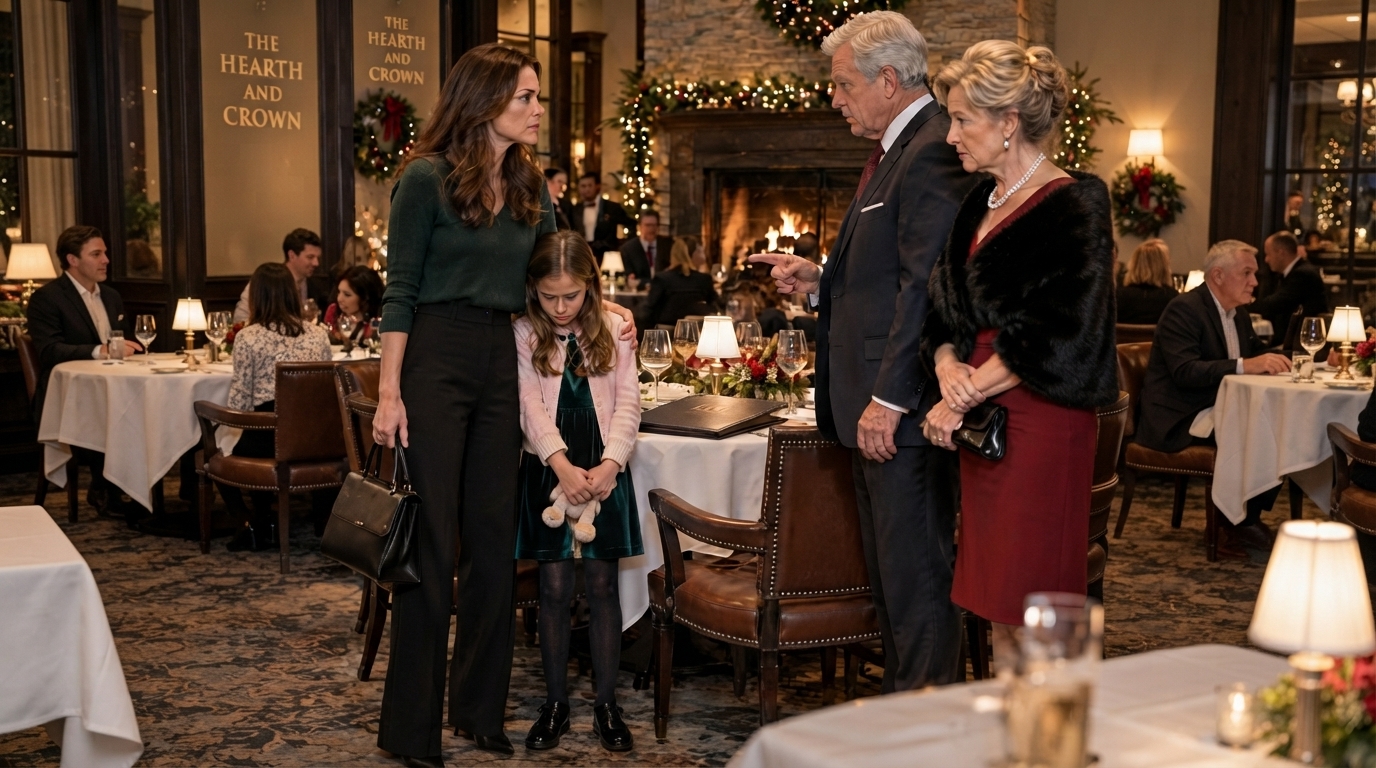
The fireplace.
The leather menus.
Emma staring at her plate.
Dad’s voice telling her to order something cheap.
For a moment, the memory hurt.
Then I looked at Evan.
“Yes,” I said. “I think we should.”
We reserved the same private dining room.
This time, the guest list was smaller.
Emma.
Evan.
His parents.
Claire.
A few close friends.
And, at Emma’s request, my mother.
Brooke came too, bringing her children.
She paid for their meals herself.
When she handed the waiter her card, she glanced at me and smiled.
“Look at that. I survived.”
I laughed.
“You did.”
It wasn’t a perfect family reunion.
Dad still wasn’t ready to attend.
Some wounds remained.
Some relationships were still complicated.
But nobody argued over the bill.
Nobody told Emma to order something cheap.
Nobody treated me like the person responsible for everyone else’s happiness.
When the waiter approached, Emma looked at the menu.
“Mom?”
“Yes?”
“Can I order the lobster?”
I smiled.
“Do you want lobster?”
She considered it.
Then she laughed.
“Actually, I think I want the chicken.”
I laughed too.
“Then order the chicken.”
She grinned.
“With extra mashed potatoes?”
“Absolutely.”
Across the table, Evan squeezed my hand.
And as I looked around that room, I realized how much had changed.
Not because I had become richer.
Not because my family had suddenly become perfect.
But because I had finally stopped confusing sacrifice with love.
For years, I believed being a good daughter meant saying yes.
Yes to every emergency.
Yes to every transfer.
Yes to every unreasonable demand.
I thought that if I kept giving, eventually my family would recognize my worth.
But worth isn’t something you earn by exhausting yourself.
And love isn’t something you purchase by paying everyone’s bills.
That night, as Emma laughed with her cousins and the fireplace crackled behind us, I thought about the moment everything changed.
My father had looked at my daughter and told her to order something cheap.
He thought I would quietly accept it.
He thought I would pay the bill.
He thought I would swallow the insult and preserve the peace.
Instead, I asked for separate checks.
And those two words changed our lives.
Because the moment I stopped paying for everyone’s comfort, I finally had room to build a life that felt like my own.
Later that evening, Emma leaned against my shoulder.
“Mom?”
“Yes, sweetheart?”
“Do you remember what Grandpa said last year?”
I brushed her hair away from her face.
“I remember.”
She looked around the table.
“I’m glad we came back.”
“Me too.”
Then she whispered something I’ll never forget.
“Last year, I felt like I didn’t belong here. This year, I know I do.”
I kissed the top of her head.
And I knew that every difficult conversation, every boundary, and every uncomfortable decision had been worth it.
Because I hadn’t simply stopped paying my family’s bills.
I had taught my daughter that she never needed to make herself smaller to deserve a place at the table.
And that was worth more than every dollar I had ever earned.
THE END THANK YOU FOR READING !!!



