PART 3
For several seconds, I couldn’t speak.
My wife sat across from me at our kitchen table,
her bruised arm resting against a folded towel,
her eyes fixed on the flash drive between us.
“Another way?” I repeated.
Ellen nodded.
“That’s what Cassandra said.”
I pulled out the chair beside her.
“Tell me everything.”
She looked toward the window.
For forty-one years,
I’d known this woman better than anyone alive.
I’d seen her angry, exhausted,
frightened, and heartbroken.
But I’d never seen her look ashamed of
something someone else had done to her.
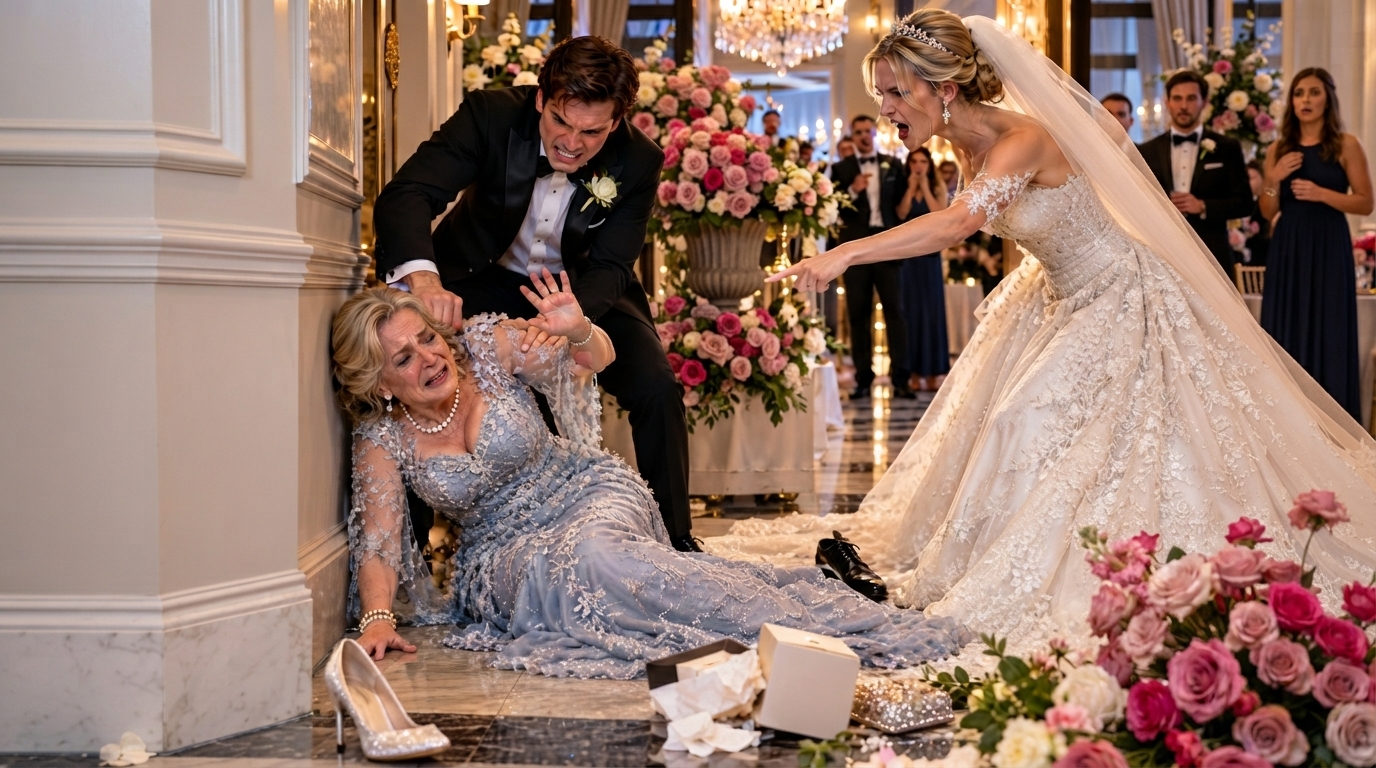
Michael came into the bridal suite about
twenty minutes before the ceremony,she began.
“He said he needed me to sign something.”
“What?”
“A document confirming that we intended to transfer the lake house to him.”
My jaw tightened.
“We already told him no.”
“I know.”
She swallowed.
I told him the same thing.
I said the lake house was our retirement property, that we’d worked too hard to give it away.
I remembered that conversation.
Three weeks before the wedding, Michael had come over for dinner with Cassandra.
We’d been eating roast chicken when Cassandra casually mentioned that the lake house would make a wonderful wedding gift.
At first, I thought she was joking.
Then Michael explained that they wanted to renovate it into a luxury vacation rental.
They’d already spoken to contractors.
Already calculated potential income.
Already imagined how much money they could make.
There was only one problem.
The property belonged to us.
Ellen and I had purchased it twenty-three years earlier.
It was a modest cedar-sided house beside a quiet Pennsylvania lake, with a wooden dock and a screened porch.
We’d saved for twelve years to afford it.
It was where we’d celebrated anniversaries, spent summers with Michael, and imagined growing old together.
When Michael asked for the deed, I’d laughed.
Then I’d realized he was serious.
“Son, that’s not happening,” I’d told him.
Cassandra had smiled.
But I remembered the way she’d tightened her grip on her wineglass.
Ellen continued.
“At the wedding, Michael said Cassandra’s parents had already made financial commitments based on the transfer.”
I stared at her.
“What commitments?”
“He wouldn’t explain.”
She rubbed her forehead.
“He kept saying we were embarrassing him. That Cassandra’s family thought we were giving them the property.”
I felt anger rising.
“And when you refused?”
“Cassandra came into the hallway.”
Ellen’s voice became smaller.
“She told me I’d humiliated her in front of her parents.”
I reached for my wife’s hand.
“Then what?”
“She said they had another way to get the house.”
Ellen looked at me.
“I asked what she meant. Michael told me not to worry about it.”
Her eyes filled.
“Then Cassandra grabbed the gift box.”
I glanced toward the kitchen counter.
The empty velvet case sat beside Ellen’s purse.
The antique watch we’d purchased for Michael had been damaged when it hit the floor.
Ellen had picked it up after the confrontation.
Even then, she’d been worried about ruining his wedding present.
“She called it a pathetic gift,” Ellen whispered.
My chest tightened.
“That watch cost nearly four thousand dollars.”
Ellen shook her head.
“It wasn’t the money, Robert.”
I knew.
She’d chosen that watch because it reminded Michael of his grandfather.
He’d spent childhood afternoons listening to the old man’s stories while turning the watch over in his small hands.
Ellen had searched for months to find the same model.
And Cassandra had knocked it onto the floor as though it were garbage.
I took a slow breath.
“Did Michael know she was going to hurt you?”
Ellen began crying.
“He was the one who grabbed my arm.”
I closed my eyes.
“And pushed you.”
She nodded.
“I tried to walk away. He said I wasn’t leaving until I agreed to help them.”
Her voice broke.
“I told him he was hurting me.”
I looked at the bruise on her arm.
Finger-shaped.
Darkening.
My son’s fingerprints might as well have been written across her skin.
“And he didn’t stop?”
She shook her head.
“When I pulled away, he pushed me.”
For a moment, I couldn’t breathe.
I remembered teaching Michael to ride a bicycle.
Holding the back of his seat while he pedaled down our driveway.
I remembered his first baseball game.
His high school graduation.
The night he cried after his first girlfriend broke his heart.
I’d spent thirty-two years believing I understood the man my son had become.
But the footage had shown me someone I barely recognized.
Someone capable of watching his mother hit a wall and fall to the floor.
Someone who could walk away without helping her.
I reached for my phone.
Ellen immediately grabbed my wrist.
“Robert, please.”
I looked at her.
“I’m not calling Michael.”
She exhaled.
“I’m calling your doctor.”
She blinked.
“Why?”
“Because your knee is swollen, your arm is bruised, and you’ve been in pain for two days.”
She looked down.
“I didn’t want to make things worse.”
I squeezed her hand.
“Ellen, getting medical care doesn’t make anything worse.”
Tears rolled down her cheeks.
“You don’t understand. He’s our son.”
“I know.”
My voice cracked.
“That’s what makes this so terrible.”
The following morning, I took Ellen to her physician.
Her knee had suffered a significant sprain, and the doctor recommended further imaging to rule out additional injury.
He documented the bruising on her arm and asked how it happened.
Ellen looked at me.
I said nothing.
This was her story to tell.
After a long silence, she whispered, “My son pushed me.”
The doctor’s expression changed.
He gently asked whether she felt safe.
Ellen began crying.
I held her hand while she explained what happened.
The doctor documented her account and provided information about support services and reporting options.
On the drive home, Ellen stared out the window.
“I never thought I’d have to say those words.”
“What words?”
“My son pushed me.”
I swallowed.
Neither had I.
That afternoon, I called our attorney.
Her name was Margaret Ellis.
She’d handled our estate planning for nearly fifteen years.
I told her everything.
The wedding.
The footage.
The property demand.
Cassandra’s threat.
Margaret listened without interrupting.
Then she asked a question that made my stomach turn.
“Robert, have you checked the county property records recently?”
I frowned.
“Why?”
“Because if Michael and Cassandra believe they’ve found another way to acquire the lake house, we need to determine whether they’ve attempted anything involving the title.”
My blood ran cold.
“Are you saying they could have transferred our property without permission?”
“I’m saying we should verify that nobody has tried.”
She paused.
“Bring me copies of your deeds, estate planning documents, and anything Michael may have had access to.”
I looked toward Ellen.
She was sitting beside the window, holding a cup of tea with both hands.
“Margaret,” I said quietly, “I want to know exactly what they’ve done.”
Two days later, we had our answer.
Margaret called me at nine in the morning.
“Robert, can you come to my office?”
I felt my stomach tighten.
“Did you find something?”
“Yes.”
“What?”
She hesitated.
“I’d rather explain it in person.”
I closed my eyes.
That was the second time in one week someone had asked me to come somewhere because of something my son had done.
Margaret’s office was on the third floor of an old brick building.
She had several documents spread across her desk.
I sat opposite her.
“Tell me.”
She pointed to a copy of a recorded document.
“Someone submitted a deed purporting to transfer your lake property into a limited liability company.”
I stared at the page.
The company name was printed near the top.
CAVALIER LAKE HOLDINGS LLC.
I didn’t recognize it.
“Who owns that?”
Margaret looked at me.
“According to the company filings, Cassandra is the managing member. Michael is listed as another member.”
I felt sick.
I looked down at the deed.
There were two signatures.
Mine.
And Ellen’s.
I stared at them.
Then I whispered, “We never signed this.”
Margaret nodded.
“That’s what I suspected.”
I examined my signature.
It was close.
Very close.
But the final stroke was wrong.
Ellen’s signature looked even less convincing.
“How did they get these?”
Margaret folded her hands.
“We don’t know yet. But Michael had copies of your estate planning documents, correct?”
I nodded.
We’d given him copies years earlier so he would know where everything was if something happened to us.
I had trusted him.
Of course I had.
He was our son.
Margaret continued.
“The document includes a notarial acknowledgment. We’re verifying the notary information and obtaining the submission records.”
I looked up.
“Does this mean they’ve stolen our house?”
“Not necessarily. A recorded document can create a serious title problem, but recording doesn’t make a forged deed valid.”
I exhaled shakily.
“We need to act quickly,” she continued. “We’ll formally dispute the purported transfer, notify the appropriate parties, and pursue the legal remedies necessary to clear the title.”
I stared at the company name.
Cavalier Lake Holdings.
Cassandra had been planning to name the vacation rental business after her grandmother.
She’d mentioned it at dinner.
I remembered smiling politely.
Now the name made my stomach turn.
Margaret slid another paper toward me.
“And there’s something else.”
I looked at her.
“What?”
“Two weeks before the wedding, the company submitted an application for a commercial loan using the lake property as proposed collateral.”
I sat perfectly still.
“How much?”
“Six hundred and fifty thousand dollars.”
I stared at her.
Six hundred and fifty thousand dollars.
Against a property Ellen and I owned outright.
Margaret continued.
“The lender had requested additional verification. We have no indication the loan was funded.”
I closed my eyes.
Cassandra hadn’t been exaggerating.
They had found another way.
Or at least they thought they had.
That evening, I told Ellen everything.
She listened without speaking.
When I finished, she looked toward the framed photograph of Michael on our mantel.
He was seven years old in the picture.
Missing his front teeth.
Grinning beneath a crooked baseball cap.
“Robert,” she whispered, “what happened to our boy?”
I sat beside her.
“I don’t know.”
She began crying.
“I keep thinking I must have done something wrong.”
I took her face gently between my hands.
“Ellen, listen to me.”
She looked at me.
“You did not make Michael grab you.”
Her lip trembled.
“You did not make him push you.”
I swallowed.
“And you did not make him try to take our property.”
She closed her eyes.
I pulled her into my arms.
For a long time, we sat together.
Then she whispered something I hadn’t expected.
“I don’t want revenge.”
I nodded.
“Neither do I.”
She looked at me.
“I just want him to understand what he’s done.”
I stared toward the dark window.
“So do I.”
But I was beginning to realize that understanding might come too late to prevent the consequences.
Margaret helped us take the next steps.
We provided the venue footage and medical documentation to the appropriate authorities.
We submitted a formal complaint regarding the disputed deed.
We contacted the lender through counsel.
And we secured our financial records, identification documents, and estate planning materials.
Everything was documented.
Every communication.
Every signature.
Every suspicious transaction.
I didn’t post accusations online.
I didn’t call Cassandra’s parents.
I didn’t drive to Michael’s house and scream at him.
I wanted the truth established through evidence.
Not anger.
A week later, Michael finally called.
I stared at his name on the screen.
Ellen sat beside me.
“Are you going to answer?”
I looked at her.
“Do you want me to?”
She hesitated.
Then nodded.
I put the phone on speaker.
“Hello, Michael.”
“Dad, what the hell is going on?”
No greeting.
No concern about his mother’s injuries.
Just anger.
“What do you mean?”
“Some attorney contacted our lender. They’re freezing everything!”
I looked toward Ellen.
She lowered her eyes.
“Michael,” I said calmly, “did you submit a deed transferring our lake house into Cassandra’s company?”
Silence.
Then he laughed nervously.
“Dad, it’s complicated.”
“Did you?”
“Dad—”
“Answer the question.”
His voice hardened.
“We were going to explain everything after the honeymoon.”
I closed my eyes.
“Explain what?”
“That the house could generate income for all of us.”
“Without our permission?”
He sighed.
“You and Mom were being unreasonable.”
Ellen flinched.
I looked at her.
Then I asked the question that had been burning inside me since Daniel showed me the footage.
“Michael, why did you push your mother?”
The line went silent.
For several seconds, I heard nothing.
Then he whispered, “She told you?”
I looked at the flash drive on the table.
“No, son.”
My voice trembled.
“The camera did.”
And for the first time, Michael had absolutely nothing to say.
PART 4
The silence lasted so long that I thought Michael had hung up.
Then I heard him breathing.
“Dad,” he whispered, “you don’t understand what happened.”
I stared at the phone.
“Then explain it.”
He hesitated.
“Mom was making a scene.”
Ellen covered her mouth.
I felt my hands curl into fists.
“A scene?”
“She was threatening to ruin the wedding.”
I took a slow breath.
“Michael, I watched you grab your mother’s arm.”
He said nothing.
“I watched you push her into a wall.”
Silence.
“I watched her fall.”
His breathing changed.
“And I watched you walk away.”
“Dad, Cassandra was upset—”
I interrupted.
“Your mother was lying on the floor.”
He fell silent.
I continued.
“She was injured. She was frightened. And instead of helping her, you followed your wife.”
His voice cracked.
“I didn’t mean for her to fall.”
I closed my eyes.
“Then why didn’t you help her get up?”
No answer.
I looked toward Ellen.
Tears were streaming down her face.
Finally, Michael whispered, “I don’t know.”
That was the first honest thing he’d said.
But it wasn’t enough.
“Michael,” I continued, “did you sign our names on the lake house deed?”
He began speaking quickly.
“Dad, Cassandra handled the paperwork. She said it was just a temporary arrangement until the loan went through.”
I felt sick.
“You knew we hadn’t agreed.”
He hesitated.
“We thought you’d come around.”
I stared at the phone.
“So you tried to transfer our property before we could stop you?”
“Dad, you’re making it sound criminal.”
I looked at Ellen.
“Michael, you used signatures we didn’t authorize on a document involving property you don’t own.”
His voice rose.
“We were trying to build a future!”
“And you thought the way to build your future was to take ours?”
Silence.
Then he said something I will never forget.
“You and Mom don’t even use the lake house that much anymore.”
I closed my eyes.
For a moment, I saw Ellen sitting on that screened porch, watching the water.
I remembered the summer Michael learned to swim.
The evenings we roasted marshmallows.
The morning Ellen and I celebrated our thirtieth anniversary with coffee on the dock.
The lake house wasn’t merely a piece of real estate.
It was part of our marriage.
Part of our history.
Part of the life we’d built together.
And our son had reduced it to something we weren’t using enough.
I took a slow breath.
“Michael, we’re handling this through our attorney.”
His voice changed.
“Dad, please. You can’t do that.”
“It’s already happening.”
“Cassandra’s family invested money!”
“Then they’ll need to discuss that with Cassandra.”
He sounded panicked.
“Dad, if this falls apart, we could lose everything.”
I looked at Ellen.
Her injured knee was resting on a pillow.
The bruise on her arm had begun turning yellow around the edges.
“Michael,” I said quietly, “your mother nearly lost her ability to walk without pain because you were angry about money.”
He began crying.
“Dad…”
I swallowed.
“I love you. But I will not protect you from the consequences of hurting her.”
Then I ended the call.
For the next several weeks, our lives became a series of appointments.
Lawyers.
Investigators.
Medical follow-ups.
Document reviews.
The lender cooperated with the inquiry into the disputed transfer.
The notarial information was examined.
The signatures were compared.
And Michael and Cassandra were questioned about the paperwork.
I won’t pretend the process was easy.
It wasn’t.
Every new document felt like another small betrayal.
Every phone call reminded me that our own son had been involved.
But Margaret Ellis kept reminding us of something important.
“Your responsibility is to tell the truth. You don’t have to decide the outcome of every legal process.”
So that was what we did.
We told the truth.
The investigation revealed that Cassandra had been under significant financial pressure long before the wedding.
Her event-planning business had accumulated debts.
She’d borrowed money from relatives.
She’d promised investors that a luxury vacation rental would soon begin generating income.
And she’d represented the lake house as an asset she and Michael were in the process of acquiring.
The proposed six-hundred-and-fifty-thousand-dollar loan was supposed to help fund renovations and repay several obligations.
But there was a problem.
The property wasn’t theirs.
And the owners had refused to transfer it.
Rather than reconsider the plan, they had pushed ahead.
Michael had supplied old documents containing our signatures.
Cassandra had arranged the preparation and submission of the disputed deed.
Both had participated in the plan.
That was the part that hurt most.
I could have understood my son being foolish.
I could have understood him being manipulated.
But the evidence showed that he knew we hadn’t agreed.
He wasn’t merely standing beside Cassandra while she made terrible decisions.
He was making them too.
One afternoon, Ellen asked me to take her to the lake house.
Her knee was healing, though she still walked carefully.
I drove us out along the familiar winding road.
The trees were turning gold.
The lake was quiet.
And the little cedar house stood exactly where it had for twenty-three years.
Ellen stepped onto the porch.
She looked toward the water.
Then she began crying.
I wrapped my arms around her.
“I thought we’d lost it,” she whispered.
I kissed her forehead.
“We’re working to make sure we don’t.”
She shook her head.
“Not just the house.”
I understood.
She was talking about Michael.
Our son.
The boy who used to run barefoot down the dock.
The teenager who begged us to let him invite friends for summer weekends.
The young man who once promised he’d take care of us when we were old.
Ellen sat in her favorite chair.
“Robert, do you remember when he was ten and fell off the dock?”
I smiled sadly.
“He tried to rescue that ridiculous plastic boat.”
She laughed through tears.
“You jumped in after him wearing your good shoes.”
I nodded.
“Ruined them.”
She looked toward the water.
“He cried because he thought we’d be angry.”
I remembered.
I’d wrapped him in a towel and told him that no toy was worth risking his life.
Ellen stared at the lake.
“How did that little boy become someone who could hurt me?”
I sat beside her.
“I don’t know.”
She reached for my hand.
“Do you think he’ll ever understand?”
I watched the water.
“I hope so.”
Then I looked at her.
“But understanding doesn’t erase what he did.”
She nodded.
“I know.”
Three months after the wedding, the legal dispute over the lake house reached an important turning point.
Through counsel, Michael and Cassandra acknowledged that we had not authorized the transfer.
They agreed not to assert ownership based on the disputed deed and cooperated with the steps needed to correct the property records.
Our attorney continued working to clear the title and protect the property against any claims arising from the attempted financing.
The authorities handled the separate investigation into the documents.
I won’t claim that everything was resolved with one dramatic courtroom speech.
Real life doesn’t work that way.
There were procedures.
Delays.
Expenses.
And consequences that unfolded over time.
But one thing became clear.
Michael and Cassandra would not be using our lake house to finance their plans.
Their marriage began falling apart almost immediately.
At first, Michael blamed Cassandra.
He told relatives she’d pressured him.
That she’d made promises he couldn’t keep.
That she’d pushed him into decisions he regretted.
But eventually, even he had to confront the truth.
He’d agreed.
He’d provided documents.
He’d threatened his mother.
And he’d physically hurt her.
Cassandra filed for separation before their first wedding anniversary.
By then, the luxury vacation rental business existed only on paper.
The proposed loan had never been funded.
Several people who’d expected repayment were demanding answers.
And Michael was living in a small apartment above a hardware store.
I knew these details because his uncle told me.
Not because Michael called.
For a long time, he didn’t.
Ellen struggled more than she admitted.
Her knee healed.
The bruises faded.
But the fear lingered.
Sometimes her phone would ring, and she’d freeze.
Sometimes she’d wake in the night after dreaming about the hallway.
Sometimes she’d look at Michael’s childhood photographs and begin crying without warning.
I encouraged her to speak with a counselor.
Eventually, she agreed.
She also began attending a support group for people who had experienced violence from family members.
At first, she was embarrassed.
“I’m not that kind of person,” she whispered.
I looked at her.
“What kind?”
She couldn’t answer.
I held her hand.
“Ellen, you don’t have to fit anyone’s idea of a victim to deserve help.”
She began crying.
That was one of the hardest lessons of the entire ordeal.
My wife had spent her life caring for other people.
Now she needed permission to care for herself.
Six months after the wedding, Michael sent his first letter.
It arrived on a rainy Tuesday.
I recognized his handwriting immediately.
Ellen sat beside me while I opened it.
The letter was four pages long.
At first, I expected excuses.
Blame.
Accusations.
But the first sentence stopped me.
Mom and Dad, I don’t know how to ask forgiveness for something I can’t forgive myself for doing.
I read it aloud.
Michael wrote about the wedding.
About the pressure he’d felt.
About his fear of disappointing Cassandra.
About the financial promises they’d made.
Then he wrote something that made Ellen cover her mouth.
None of those things excuse what I did.
He continued.
I grabbed Mom because I wanted her to stop saying no.
I pushed her because I was angry.
And when she fell, I walked away because helping her would have meant admitting what I’d done.
I stopped reading.
Ellen was crying.
I waited until she nodded for me to continue.
I’ve spent months telling myself Cassandra made me do things.
But she didn’t move my hands.
She didn’t make me hurt Mom.
That was me.
My throat tightened.
Then came the final paragraph.
I don’t expect you to trust me again.
I don’t expect money.
I don’t expect the lake house.
I don’t even expect you to answer.
I just want you to know that I finally understand why you stopped speaking to me.
I’m sorry.
Michael.
Ellen took the letter from my hands.
She read it again.
Then again.
Finally, she folded it carefully.
“Do you believe him?” she asked.
I looked at her.
“I believe he’s beginning to understand.”
She nodded.
“Is that enough?”
I thought for a long moment.
“No.”
She looked down.
“Neither do I.”
We placed the letter in a drawer.
And we didn’t respond that day.
Or the next.
Forgiveness wasn’t something we owed him on a schedule.
Several weeks later, Ellen surprised me.
“I want to see Michael,” she said.
I looked up from my newspaper.
“Are you sure?”
She nodded.
“But not at our house.”
I set the paper down.
“Where?”
“Somewhere public.”
We arranged to meet at a quiet café.
Michael arrived twenty minutes early.
When we walked in, he stood so quickly his chair scraped against the floor.
He looked thinner.
Older.
His face was pale.
“Mom.”
Ellen stopped.
For a moment, neither of them moved.
Then Michael began crying.
“I’m sorry.”
Ellen looked at him.
“I know.”
He took a step forward.
She instinctively stepped back.
I saw the pain cross his face.
But he stopped immediately.
That mattered.
For once, he respected her boundary without arguing.
We sat down.
Michael kept his hands folded on the table.
He didn’t ask for money.
He didn’t ask about the lake house.
He didn’t mention Cassandra until Ellen asked.
Instead, he talked about the counseling he’d begun.
The work he was doing.
The people he’d disappointed.
And the responsibility he was learning to accept.
Then Ellen asked the question I’d been dreading.
“Michael, when you pushed me, did you think about what would happen if I hit my head?”
His face crumpled.
“No.”
She nodded slowly.
“That’s what frightens me.”
He began crying.
“I know.”
She looked at him.
“You were so angry about a house that you forgot I was your mother.”
Michael covered his face.
Ellen’s voice trembled.
“And even if I hadn’t been your mother, you had no right to hurt me.”
He nodded.
“You’re right.”
For several seconds, nobody spoke.
Then Ellen reached into her handbag.
She removed the damaged antique watch.
Michael stared at it.
“I bought this for you,” she said.
His eyes filled.
“It was supposed to remind you of your grandfather.”
She placed it on the table.
“When Cassandra knocked it out of my hands, I thought the broken watch was the worst thing that had happened.”
Michael looked down.
“But then you pushed me.”
His shoulders shook.
Ellen continued.
“I can repair a watch.”
She swallowed.
“I don’t know yet how to repair what happened between us.”
Michael whispered, “I’ll do whatever it takes.”
She shook her head gently.
“Don’t promise me anything.”
He looked up.
“Just keep doing the work.”
That meeting didn’t fix our family.
But it changed something.
Michael stopped asking when things would return to normal.
He began accepting that normal was gone.
He continued counseling.
He complied with the legal obligations arising from the property matter.
He found steady work.
And he stopped blaming Cassandra for choices he’d made himself.
Months passed before Ellen agreed to another meeting.
Then another.
Sometimes we talked for an hour.
Sometimes only fifteen minutes.
There were difficult questions.
Awkward silences.
Moments when Ellen cried.
And moments when Michael couldn’t look her in the eyes.
But slowly, cautiously, we began learning whether a different relationship might be possible.
Not the relationship we’d had before.
Something built on truth instead of assumptions.
A year after the wedding, Ellen and I returned to the lake house for our anniversary.
We arrived just before sunset.
I carried our bags inside while Ellen walked toward the dock.
Her knee was stronger now.
She no longer needed the brace.
I watched her stand at the water’s edge.
The breeze moved through her hair.
She looked peaceful.
I joined her.
“Happy anniversary,” I whispered.
She smiled.
“Happy anniversary, Robert.”
I handed her a small velvet box.
She laughed.
“Another piece of jewelry?”
“Open it.”
Inside was a new pearl bracelet.
Not identical to the one broken at the wedding.
This one had a tiny silver charm shaped like a heart.
Ellen stared at it.
“Robert…”
I fastened it around her wrist.
“The old one was broken because someone hurt you.”
She looked at me.
“I wanted this one to remind you that you’re loved.”
Tears filled her eyes.
She wrapped her arms around me.
For a long time, we stood together beside the lake.
Later that evening, we sat on the screened porch.
The same porch where we’d spent so many summers.
The same porch Michael had wanted to turn into part of a luxury rental.
Ellen leaned against my shoulder.
“Do you ever wish we’d just given him the house?” she asked.
I looked at her.
“No.”
She nodded.
“Neither do I.”
I took her hand.
“If we’d given him the house, it wouldn’t have taught him to respect us.”
She looked toward the water.
“And if we’d stayed silent about what happened…”
I squeezed her fingers.
“He might never have faced what he’d done.”
She rested her head against me.
“I still love him.”
“I know.”
“Sometimes I hate that I do.”
I turned toward her.
“You don’t have to stop loving your son to protect yourself from him.”
She began crying softly.
I held her until the tears passed.
Today, nearly two years have passed since Michael’s wedding.
Ellen is sixty-six.
I’m sixty-eight.
The lake house still belongs to us.
The title dispute has been resolved.
The attempted financing never went through.
And we’ve updated our estate plans with Margaret’s help.
Not because we want to punish Michael.
But because we finally understand that love and financial responsibility are not the same thing.
Michael visits occasionally.
Only when Ellen agrees.
He calls before coming.
He doesn’t demand access to our home.
He doesn’t ask for money.
And he knows that rebuilding trust may take years.
Perhaps the rest of our lives.
There are still days when Ellen looks at him and remembers that hallway.
I can see it in her eyes.
Michael can too.
And when that happens, he doesn’t tell her to forget.
He doesn’t ask her to move on.
He simply gives her space.
It’s a small thing.
But after everything, small things matter.
Last Sunday, Michael came to the lake house to help repair the dock.
Ellen had invited him.
I was replacing a loose board when he arrived.
He carried a toolbox.
“Need a hand, Dad?”
I looked at him.
“Sure.”
We worked together for two hours.
At one point, Michael stopped and stared toward the water.
“Remember when I fell off this dock?”
I smiled faintly.
“You were ten.”
He nodded.
“You jumped in after me.”
“Ruined my shoes.”
He laughed softly.
Then his expression changed.
“You didn’t even hesitate.”
I looked at him.
“Of course not.”
He swallowed.
“I’ve thought about that a lot.”
I waited.
He stared at the lake.
“You spent my whole life protecting me.”
His voice broke.
“And when Mom needed me to protect her, I was the one she needed protection from.”
I set down my hammer.
For a long moment, neither of us spoke.
Then I said, “Michael, you can’t change that day.”
He nodded.
“I know.”
“But you can decide what kind of man you’ll be tomorrow.”
He wiped his eyes.
“I’m trying, Dad.”
I looked at him.
“I can see that.”
It wasn’t forgiveness wrapped in a perfect bow.
It wasn’t a promise that everything would be all right.
But it was honest.
And honesty was where we had to begin.
That evening, Ellen made dinner.
Nothing elaborate.
Roast chicken.
Mashed potatoes.
Green beans.
The same meal she’d cooked for Michael’s birthdays when he was little.
We ate at the old wooden table.
Michael helped clear the dishes.
Then he stood beside the sink, looking uncertain.
“Mom?”
Ellen turned.
“Yes?”
He swallowed.
“Thank you for letting me come.”
She looked at him for a long moment.
Then nodded.
“You’re welcome.”
He didn’t ask for a hug.
He didn’t reach for her.
He simply picked up another plate and began washing it.
I watched Ellen’s expression soften.
Just slightly.
But enough for me to notice.
After Michael left, Ellen and I sat on the porch.
The lake was dark.
Crickets sang in the trees.
And the little silver heart on her bracelet caught the porch light.
She looked at me.
“Robert?”
“Yes?”
“Thank you for believing me.”
My throat tightened.
I turned toward her.
“Ellen, I wish you’d never had to wonder whether I would.”
She squeezed my hand.
“I was so afraid you’d make me choose between you and Michael.”
I shook my head.
“I wasn’t going to ask you to stop loving our son.”
She leaned against me.
“I know that now.”
I looked toward the water.
“But I was never going to let anyone convince you that what happened was acceptable.”
She nodded.
For a while, we sat quietly.
Then she whispered, “I think I’m finally beginning to feel safe again.”
Those words meant more to me than anything else.
More than the property.
More than the legal outcome.
More than the apologies.
My wife was beginning to feel safe.
People sometimes ask why I didn’t call Michael immediately after watching the wedding footage.
They assume I wanted revenge.
They imagine I was planning some dramatic confrontation.
But the truth is simpler.
I didn’t call because I finally understood that anger wasn’t going to protect my wife.
Evidence would.
Medical care would.
Legal advice would.
And most importantly, listening to Ellen would.
For forty-one years, she’d stood beside me through every difficult season of our marriage.
When I lost my job.
When my father died.
When money was tight.
When life became frightening.
She’d always been there.
And when she came home from our son’s wedding shaking, injured, and ashamed, I knew one thing.
This time, she needed me to stand beside her.
Not beside our son.
Not beside appearances.
Not beside the comfortable lie that families should keep every painful secret hidden.
Beside her.
The night I watched that footage, I thought I’d lost my son forever.
Maybe part of the boy I remembered really was gone.
But I also learned something important.
You can love someone deeply and still hold them accountable.
You can hope they change without pretending they haven’t hurt you.
And you can forgive slowly, cautiously, or not at all, without surrendering your right to peace.
Michael’s wedding was supposed to mark the beginning of his new life.
Instead, it exposed choices that nearly destroyed our family.
But it also forced us to stop confusing silence with love.
Because love doesn’t demand that someone hide bruises.
Love doesn’t require a mother to surrender her home.
And love doesn’t mean protecting the person who caused harm at the expense of the person who suffered it.
This morning, Ellen and I had coffee on the dock.
The sun was rising over the lake.
She wore her silver bracelet.
Her knee no longer hurt.
And when she laughed at something I said, I heard the same laugh I’d fallen in love with more than forty years ago.
I reached for her hand.
She smiled.
“What?”
I shook my head.
“Nothing.”
She leaned closer.
“Robert, you have that look.”
“What look?”
“The one you get when you’re thinking too much.”
I laughed.
Then I kissed her forehead.
“I was just thinking how lucky I am.”
She smiled.
“After everything?”
I nodded.
“Especially after everything.”
Because the most important thing I saved that year wasn’t our lake house.
It wasn’t our savings.
It wasn’t even the truth hidden inside a security recording.
It was the woman who came home from her son’s wedding believing she had to hide her pain to keep her family together.
And if I could go back to that night, when she stood trembling in our kitchen and whispered that she’d only fallen, I would tell her one thing sooner.
“Ellen, you don’t have to protect everyone else from the truth. This time, we’re going to protect you.”
THE END THANK YOU FOR READING !!!



