PART 3
For a moment,
I couldn’t understand what Meredith had said.
Dad.
My father.
The same man who had organized
search parties when Tobin disappeared.
The man who had stood beside me at press conferences,
holding my son’s photograph while begging strangers to bring him home.
The man who had spent fourteen months telling me not to lose hope.
“What did you just say?” I whispered.
Meredith’s eyes darted toward the front window.
“Daniel, please. You need to listen to me.”
I grabbed her shoulders.
“Is my son underneath this house?”
She began crying.
“Yes.”
That single word destroyed fourteen months of uncertainty.
My knees nearly buckled.
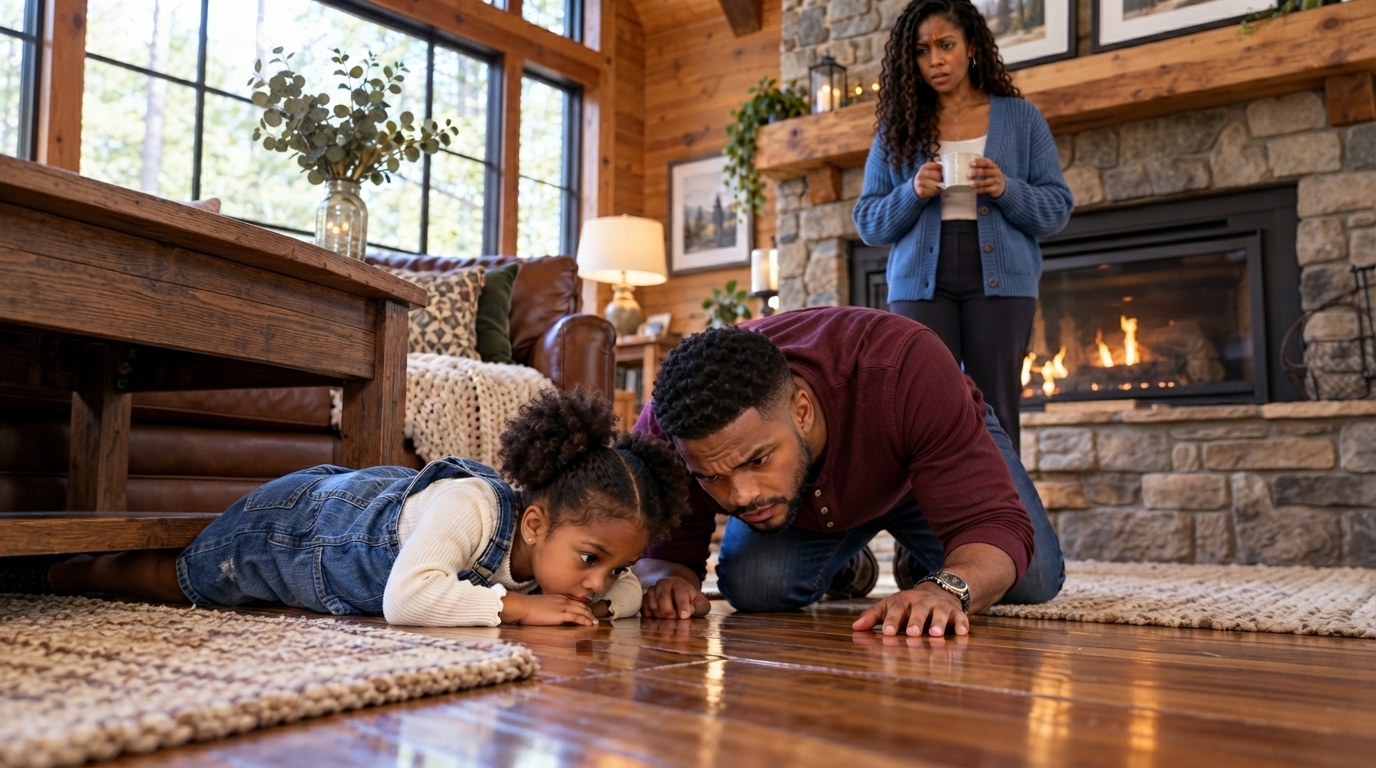
Behind me, Birdie whispered, “I told you, Daddy.”
I turned toward the fireplace.
Three more taps came from beneath the floor.
My son was alive.
Somewhere below us, my little boy was alive.
I dropped to my knees.
“Tobin!” I shouted. “Buddy, it’s Daddy! Can you hear me?”
A muffled sound answered.
Then three weak knocks.
I pressed my palms against the boards.
“I’m here, son! I’m right here!”
Meredith grabbed my arm.
“Daniel, stop shouting!”
I turned on her.
“Why?”
“Because Dad has cameras.”
I stared at her.
“What?”
“Outside. In the basement. He can see when someone enters the house.”
My stomach tightened.
“Then he’s already seen us.”
She shook her head.
“I disconnected the internet twenty minutes ago. I knew you were coming.”
I looked at her.
“You knew we’d find him?”
Her face crumpled.
“I hoped Birdie would remember.”
I felt something cold spread through my chest.
“Remember what?”
Meredith looked toward my daughter.
“She heard him once before.”
Birdie moved closer to me.
I pulled her into my arms.
“When?”
Meredith swallowed.
“At Christmas. When your parents brought everyone here.”
I remembered that Christmas.
The first Christmas without Tobin.
My wife, Claire, had barely been able to get out of bed.
I’d brought Birdie to Meredith’s house because I thought being around family might help.
Birdie had spent most of the afternoon sitting beside the fireplace.
When we got home, she’d told me she heard Tobin singing.
I’d thought she was remembering him.
I’d held her while she cried.
Now I understood.
She hadn’t been remembering anything.
She’d been listening.
I looked at Meredith.
“You let my daughter leave this house knowing her brother was underneath it?”
She covered her mouth.
“I was afraid.”
“Of what?”
She pointed toward the kitchen.
“There’s a door behind the pantry shelves. It leads to the old storm cellar.”
I stood.
“Move.”
“Daniel—”
“Now.”
I took Birdie’s hand and hurried toward the kitchen.
Meredith followed us, crying.
Behind the pantry, a tall wooden shelving unit stood against the wall.
I shoved it aside.
There was a narrow steel door.
A keypad glowed beside the handle.
My heart hammered.
“What’s the code?”
Meredith shook her head.
“Dad changes it every week.”
I pulled at the handle.
Locked.
I kicked the door.
Nothing.
From somewhere beneath us came a faint metallic sound.
Then a voice.
“Daddy?”
I stopped breathing.
“Tobin!”
“Daddy, please.”
My son’s voice was thin.
Weak.
But unmistakable.
I pressed my forehead against the door.
“I’m coming, buddy.”
Then I turned toward Meredith.
“Give me your phone.”
She handed it over.
I dialed 911.
When the dispatcher answered, I said the words I’d been waiting fourteen months to say.
“My missing son is alive. He’s being held underneath my sister’s house. We need police and an ambulance immediately.”
The dispatcher asked for the address.
I gave it.
Then I told her my father might be involved.
Meredith started shaking.
“Daniel, please don’t tell them that yet.”
I stared at her.
“You knew my son was here.”
She looked away.
“You don’t understand.”
“Then explain it.”
Her voice dropped to a whisper.
“Dad told me Tobin would be killed if I said anything.”
I felt sick.
“Who would kill him?”
She began sobbing.
“Dad.”
The dispatcher instructed us to remain somewhere safe and not confront anyone.
I told her my son was trapped behind a locked door.
She assured me officers were on their way.
I wanted to tear the entire kitchen apart.
But I had Birdie beside me.
And Tobin somewhere below.
I couldn’t risk doing something that might hurt either of them.
I knelt in front of my daughter.
“Birdie, sweetheart, I need you to listen carefully.”
She nodded.
“You’re going to stay right beside me. Okay?”
“Is Tobin coming home?”
I swallowed.
“Yes, baby. We’re going to do everything we can to bring him home.”
She looked toward the steel door.
“He’s hungry.”
My heart broke.
“What?”
“He told me.”
Meredith covered her face.
I turned toward her.
“How long has he been down there?”
She whispered, “Since September.”
I stared at her.
September.
Three months after he disappeared.
“Where was he before that?”
Meredith shook her head.
“I don’t know everything.”
“Tell me what you know.”
She sank into a kitchen chair.
“Dad brought him here after I bought the house.”
I looked at her.
“You bought this house?”
She nodded.
“With Dad’s money.”
The truth began forming in my mind.
The farmhouse wasn’t a fresh start after Meredith’s divorce.
It was a hiding place.
A carefully chosen building with an old storm cellar and enough distance from neighbors to keep secrets.
My father had financed it.
My sister had lived above it.
And my son had been imprisoned underneath.
I felt like I might vomit.
“Why?” I whispered.
Meredith looked at me.
“I don’t know why Dad took him.”
I stared at her.
“You’re lying.”
She shook her head.
“I swear I don’t know what happened that first night.”
“But you know something.”
Her silence told me everything.
I stepped closer.
“Meredith.”
She began crying again.
“Tobin saw something.”
“What?”
“Something at the farmhouse.”
My parents’ farmhouse.
The place where he’d disappeared.
I felt the room spin.
“What did he see?”
Meredith looked toward the window.
Then she whispered, “Dad hurting someone.”
Before I could ask another question, headlights swept across the kitchen wall.
Meredith screamed.
“He’s here.”
I grabbed Birdie and moved toward the back hallway.
Outside, a truck engine stopped.
I recognized the sound immediately.
My father’s old blue pickup.
The truck he’d driven during every search for Tobin.
The truck with my son’s missing-person poster still taped inside the rear window.
My hands shook as I spoke into the phone.
“He’s here. My father just arrived.”
The dispatcher told me officers were close and instructed me to avoid confronting him.
I pulled Birdie into the laundry room and closed the door.
Meredith stood frozen in the kitchen.
The front door opened.
“Meredith?”
Dad’s voice.
Ordinary.
Familiar.
The same voice that had taught me to ride a bicycle.
The same voice that had read bedtime stories to Tobin.
“Why’s Daniel’s car outside?”
Meredith didn’t answer.
I heard his footsteps.
Then his voice changed.
“What happened to the pantry?”
Silence.
“Meredith.”
I held Birdie tighter.
She pressed her face against my chest.
Then my father’s voice rose.
“Where is he?”
I heard Meredith begin crying.
“Dad, I can’t do this anymore.”
A sharp sound followed.
Something struck the kitchen counter.
Then Dad shouted, “You stupid girl!”
I started toward the door.
Birdie grabbed my sleeve.
“Daddy, don’t.”
I stopped.
She was trembling.
I knelt beside her.
“You’re right.”
I stayed.
Because she needed me alive.
And Tobin needed help more than he needed me to fight my father.
Outside the laundry room, footsteps moved quickly.
Then the handle turned.
I braced myself.
The door opened.
My father stood there.
For a second, he looked almost relieved.
“Daniel.”
Then he saw Birdie.
His expression changed.
“What are you doing hiding in here?”
I stepped in front of her.
“Where’s Tobin?”
He stared at me.
“What?”
“Don’t.”
My voice shook.
“Don’t lie to me.”
His eyes moved toward the phone in my hand.
“Who are you talking to?”
“The police.”
For the first time in my life, I saw real fear on my father’s face.
He took a step backward.
“Daniel, listen carefully. There’s something you don’t understand.”
I felt tears burning my eyes.
“Then tell me why my son is locked beneath your daughter’s house.”
His mouth opened.
No words came.
And then, from outside, came the sound of sirens.
My father turned toward the front door.
He ran.
The police arrived before he reached his truck.
I heard shouting.
Then the sound of someone being ordered onto the ground.
I stayed with Birdie until an officer entered the house.
He identified himself as Deputy Ramirez.
I explained everything as quickly as I could.
The hidden door.
The tapping.
Tobin’s voice.
Meredith’s confession.
Ramirez immediately called for additional officers and emergency responders.
Within minutes, the house was filled with people.
Someone escorted Birdie outside.
She cried when they tried to separate us.
I promised I wasn’t leaving.
Then I stood beside the kitchen doorway as firefighters worked to open the locked entrance.
The metal door finally gave way.
Cold air rushed out.
There was a narrow staircase descending into darkness.
A flashlight beam swept across concrete walls.
Then someone shouted from below.
“We’ve got a child!”
My legs nearly collapsed.
Another voice called out.
“He’s breathing. We need medical down here!”
I grabbed the doorframe.
“Tobin!”
There was a pause.
Then a tiny voice answered.
“Daddy?”
I began crying.
“I’m here, son!”
An officer stopped me from rushing down the stairs.
“They need room to get him out.”
I understood.
But every second felt unbearable.
Fourteen months.
Fourteen months of searching.
Fourteen months of imagining the worst.
Fourteen months of looking at my son’s empty chair.
Then I heard footsteps on the stairs.
Two paramedics emerged carrying a small figure wrapped in a thermal blanket.
And there he was.
My Tobin.
His hair was longer.
His face was painfully thin.
His cheeks were hollow.
But his eyes—
Those were my son’s eyes.
The same brown eyes that used to light up when I brought home strawberry ice cream.
He looked toward me.
His lips trembled.
“Daddy?”
I fell to my knees.
“Buddy.”
He reached one hand toward me.
I took it.
And for the first time in fourteen months, I touched my son.
He began crying.
So did I.
“I’m sorry,” he whispered.
I stared at him.
“Sorry?”
He nodded weakly.
“Grandpa said I made everybody sad.”
Something inside me shattered.
I pressed his hand against my cheek.
“No, Tobin. No, sweetheart.”
He began shaking.
“I tried to be good.”
I couldn’t speak.
I could only hold his hand while the paramedics carried him toward the ambulance.
Then I leaned close enough for him to hear me.
“You didn’t do anything wrong.”
He looked at me.
“Promise?”
I kissed his forehead.
“I promise.”
And for the first time in fourteen months, my son closed his eyes without looking afraid that I’d disappear.
PART 4
Claire arrived at the hospital forty minutes later.
I’d called her from the ambulance.
I still remember the sound she made when I told her Tobin was alive.
It wasn’t a scream.
It wasn’t a word.
It was something between a gasp and a sob.
She kept asking the same question.
“Are you sure?”
“Yes.”
“Daniel, are you sure?”
“Claire, I’ve seen him. I’ve held his hand.”
Then she began crying so hard she couldn’t speak.
By the time she reached the emergency department, her face was swollen and her hair was falling out of its clip.
She ran toward me.
“Where is he?”
I pointed toward the treatment room.
A doctor met us at the door.
He explained that Tobin was dehydrated, underweight, and exhausted.
He had bruises and other injuries that needed evaluation.
But he was alive.
He was conscious.
And the medical team was doing everything necessary to stabilize him.
Claire covered her mouth.
“Can I see him?”
The doctor nodded.
We entered together.
Tobin was lying in a hospital bed beneath a warm blanket.
He looked impossibly small.
For a moment, Claire couldn’t move.
Then he turned his head.
“Mommy?”
She made a sound I will hear for the rest of my life.
She crossed the room and dropped beside his bed.
“Oh, baby.”
He reached for her.
She held him carefully, mindful of the medical equipment.
“My baby. My sweet boy.”
Tobin began crying.
“I thought you forgot me.”
Claire shook her head fiercely.
“Never.”
He looked at me.
“Grandpa said you stopped looking.”
I moved closer.
“No, buddy. We never stopped.”
Claire kissed his hair.
“We looked for you every day.”
He stared at us.
Then he whispered, “I waited.”
Those two words nearly broke me.
The next several days were filled with doctors, investigators, counselors, and questions.
Tobin was frightened by sudden noises.
He became distressed when doors closed.
He hid food beneath his pillow.
The first night, a nurse found him awake at three in the morning, sitting upright and staring at the hallway.
When she asked what was wrong, he whispered, “I don’t want to go downstairs again.”
The hospital arranged for a specialist experienced in helping children recover from trauma.
We were advised not to pressure Tobin for details.
Investigators would conduct carefully planned interviews when he was medically ready.
Our job was to reassure him.
Feed him.
Comfort him.
Let him sleep.
And help him understand that he was safe.
But the truth about what happened still had to come out.
And when it did, I learned that my father had been hiding something far worse than anyone imagined.
Three days after Tobin was rescued, Detective Sarah Collins asked Claire and me to meet with her.
We sat in a small conference room at the hospital.
She placed a folder on the table.
“Before I begin,” she said, “I want you to know that your son has been incredibly brave.”
Claire gripped my hand.
Detective Collins continued.
“We’ve recovered evidence from the cellar and from your parents’ property. We also have statements from Meredith.”
I swallowed.
“Why did my father take Tobin?”
She opened the folder.
“Because Tobin witnessed an assault.”
My heart pounded.
“Who did Dad hurt?”
“A man named Victor Hale.”
I recognized the name.
Victor had worked with my father for years.
He helped maintain farm equipment and occasionally handled cash purchases for livestock.
I hadn’t seen him in almost two years.
Dad told everyone Victor had moved to Kentucky.
Detective Collins looked at me.
“Victor never moved to Kentucky.”
Claire covered her mouth.
The detective explained that investigators believed my father and Victor had been involved in a financial dispute.
Victor had discovered that Dad was diverting money from a jointly operated equipment business.
On the evening Tobin disappeared, Victor came to the farmhouse demanding repayment.
They argued near the old machinery shed.
Tobin had wandered over while looking for his missing baseball.
He saw my father strike Victor with a heavy tool.
Victor collapsed.
My father noticed Tobin standing nearby.
And everything changed.
I stared at the detective.
“Did Dad kill Victor?”
She hesitated.
“We’ve found evidence suggesting Victor died from his injuries. Investigators are still working to establish the full sequence of events.”
Claire began crying.
I couldn’t move.
My father had taken my son because an eight-year-old boy had witnessed something he wasn’t supposed to see.
Detective Collins continued.
“Your father initially concealed Tobin in an unused outbuilding on a property he controlled. Later, after Meredith purchased the house, he moved him into the cellar.”
I shook my head.
“Why keep him alive?”
The detective paused.
“Based on Meredith’s statement, your father believed he could eventually convince Tobin to say he’d run away and become lost.”
I stared at her.
“He kept my son locked up for fourteen months because he wanted him to lie?”
“That appears to have been part of his plan.”
Claire whispered, “He’s a child.”
The detective nodded.
“Yes.”
And that was the part I could never understand.
Tobin was eight when he disappeared.
He was afraid of thunderstorms.
He still slept with a stuffed dinosaur.
He believed adults when they made promises.
My father had taken that trust and used it against him.
Meredith’s role was complicated.
She had known Tobin was being held beneath the house for months.
She’d provided food.
She’d cleaned the cellar.
She’d heard him cry.
And she had said nothing.
When investigators questioned her, she claimed Dad had threatened to kill Tobin and harm her if she went to the police.
Evidence supported that he’d intimidated her.
But she had also helped conceal the crime.
She faced criminal charges.
I didn’t attend her first hearing.
I couldn’t bear to look at her.
Then, two weeks after Tobin came home, she sent a letter through her attorney.
I almost threw it away.
Instead, I read it.
Daniel,
I know there is no excuse for what I did.
I told myself I was protecting Tobin by keeping Dad calm. I told myself that if I stayed close, I could make sure he had food and blankets.
But the truth is that I was afraid of losing my own life, and I let your son lose fourteen months of his.
I should have called the police the first day I knew.
I should have found a way.
I am sorry.
I read it twice.
Then I folded it and placed it in a drawer.
I didn’t respond.
Not because I wanted revenge.
But because I had no words left for the woman who had lived above my son’s prison.
Birdie struggled too.
At first, she was delighted.
She wanted to sit beside Tobin constantly.
She brought him drawings.
She showed him her favorite books.
She told him everything he’d missed.
But sometimes Tobin needed quiet.
Sometimes he didn’t want anyone touching him.
Sometimes he became frightened when Birdie spoke too loudly.
One afternoon, she came into the kitchen crying.
“Tobin doesn’t like me anymore.”
I knelt beside her.
“Why do you think that?”
“He told me to go away.”
I held her hands.
“Sweetheart, Tobin went through something very scary.”
She nodded.
“I know.”
“Sometimes people who’ve been frightened need extra space while they feel safe again.”
Her lip trembled.
“Did I do something wrong?”
“No.”
She stared at me.
“Then why doesn’t he want to play?”
I hugged her.
“Because healing takes time.”
She thought about that.
Then she whispered, “Can I still love him?”
I kissed her forehead.
“Always.”
That evening, Birdie drew a picture.
It showed our family standing beneath a giant yellow sun.
She placed it outside Tobin’s bedroom door.
Underneath, she’d written in crooked letters:
YOU DON’T HAVE TO PLAY. I STILL LOVE YOU.
Tobin kept that drawing beside his bed.
Bringing him home wasn’t like the endings in movies.
There was no magical moment when everything became normal.
There were nightmares.
Medical appointments.
Difficult questions.
There were days when Tobin refused to leave the house.
Days when he became frightened by the sound of a truck engine.
Days when Claire cried in the laundry room because she didn’t want him to see.
And there were days when I felt so angry that I had to go outside and walk until I could breathe again.
We worked with professionals.
We learned how to help Tobin feel secure without forcing him to talk.
We established routines.
We told him what would happen before it happened.
We let him make small choices.
Which shirt to wear.
Whether his bedroom door stayed open.
What he wanted for breakfast.
Things most children took for granted.
For Tobin, those choices mattered.
Because for fourteen months, someone else had controlled almost everything.
One night, about three months after his rescue, I heard footsteps in the hallway.
I looked up from the living room sofa.
Tobin stood in the doorway holding his stuffed dinosaur.
“Hey, buddy.”
He looked nervous.
“Can I sit with you?”
“Of course.”
He climbed beside me.
For a while, we watched an old cartoon.
Then he asked, “Daddy?”
“Yeah?”
“Did you think I was dead?”
My throat tightened.
I looked at him.
“I was scared that you might be.”
He stared at his dinosaur.
“Did you cry?”
“Every day.”
He nodded slowly.
Then he whispered, “I cried too.”
I put my arm around him, leaving enough space for him to move away if he wanted.
He leaned against me.
After a few minutes, he said, “Grandpa told me you were angry because I saw what happened.”
I closed my eyes.
“Tobin, listen to me.”
He looked up.
“You did nothing wrong.”
His lip trembled.
“But I went near the shed when I wasn’t supposed to.”
“That doesn’t matter.”
“I should’ve stayed by the apple trees.”
I shook my head.
“No, buddy. The person who hurt someone was responsible for what happened. Not you.”
He began crying.
I held him while he cried.
Then he whispered, “I thought you wouldn’t want me anymore.”
I kissed the top of his head.
“There is nothing you could ever do that would make me stop wanting you home.”
He held on to me.
And for the first time since his rescue, he fell asleep against my chest.
My father’s trial began the following year.
The evidence against him was extensive.
Investigators had recovered records, photographs, and physical evidence connecting him to Victor’s death and Tobin’s confinement.
Meredith testified under a cooperation agreement.
Several witnesses described inconsistencies in my father’s account of the night Tobin disappeared.
The prosecution also presented evidence that my father had deliberately misled search teams.
He had joined volunteer searches.
Distributed posters.
Appeared on television.
And comforted Claire while knowing exactly where our son was being held.
I sat through much of the trial.
Not because I wanted to see my father.
But because I wanted to understand how someone who had once loved us could do something so terrible.
During one hearing, my father looked directly at me.
For a moment, he seemed like the man I remembered.
The man who taught me to fish.
The man who carried Birdie on his shoulders.
The man who always carved the Thanksgiving turkey.
Then I remembered Tobin whispering that Grandpa had told him we stopped looking.
I looked away.
The jury ultimately found my father guilty of multiple serious offenses, including kidnapping and crimes connected to Victor’s death.
He received a lengthy prison sentence.
Meredith was also sentenced for her involvement, though the court considered her cooperation and the threats against her.
When the proceedings ended, I felt no triumph.
Only exhaustion.
The legal system had answered some questions.
But it couldn’t return the fourteen months Tobin had lost.
The following June, we held a small family gathering in our backyard.
Not at my parents’ farmhouse.
We sold that property after the legal proceedings allowed the estate and ownership issues to be resolved.
I couldn’t bear the thought of returning.
Instead, we invited a few close friends.
People who had searched for Tobin.
People who had brought meals when Claire couldn’t cook.
People who had sat beside us through the worst months of our lives.
There were hamburgers.
Strawberry shortcake.
And a little table beneath the maple tree where the children could draw.
Tobin was ten now.
He had gained weight.
His cheeks had filled out.
He still had difficult days.
But he laughed more often.
And that afternoon, I heard something I hadn’t heard in almost two years.
My children arguing over a board game.
“Birdie, that’s cheating!”
“No, it isn’t!”
“You moved two spaces!”
“Because you counted wrong!”
I stood at the kitchen window, listening.
Claire came beside me.
“Are you going to stop them?”
I shook my head.
“Not a chance.”
She laughed.
Then she began crying.
I wrapped my arm around her.
We watched our children bicker beneath the maple tree.
And for the first time in a long time, the sound of an ordinary family disagreement felt like a miracle.
A few weeks later, Tobin asked if we could visit the place where he was found.
I was terrified.
I didn’t want him anywhere near that house.
But his therapist helped us understand that he was trying to make sense of what had happened.
We discussed it carefully.
Eventually, we arranged a brief visit to the property with appropriate support.
The house was empty.
The cellar entrance had been secured.
We didn’t go inside.
Tobin stood beside me in the yard.
Birdie held his hand.
For several minutes, he said nothing.
Then he looked at his sister.
“How did you know?”
Birdie shrugged.
“I heard you.”
He stared at her.
“But everybody said you didn’t.”
She squeezed his hand.
“I knew it was you.”
Tobin’s eyes filled.
Then he hugged her.
Birdie looked surprised.
For a second, she stood perfectly still.
Then she wrapped her arms around him.
I turned away because I couldn’t stop crying.
Claire took my hand.
And we stood there together while our children held each other.
I’m writing this three years after that Saturday morning.
Tobin is thirteen now.
Birdie is nine.
They still fight over the television remote.
They still steal each other’s snacks.
And sometimes Tobin still needs reassurance that we’re not going anywhere.
Healing hasn’t been a straight line.
There are difficult anniversaries.
Unexpected fears.
Moments when something ordinary brings back a terrible memory.
But there is also laughter.
There are birthday parties.
School projects.
Soccer games.
And Sunday mornings when both children pile into our bed demanding pancakes.
Tobin has become fascinated with astronomy.
He wants a telescope for his next birthday.
Birdie says she wants to become a detective.
When I asked why, she looked at me as though the answer were obvious.
“Because sometimes grown-ups don’t listen.”
I didn’t know what to say.
She was right.
Fourteen months after my son disappeared, a six-year-old girl put her ear against a wooden floor and told me something impossible.
And for one terrible moment, I almost dismissed her.
I almost told her she was imagining things.
I almost let grief convince me that hope was dangerous.
But then I heard those three taps.
And everything changed.
Last night, I found Tobin and Birdie sitting on the living room rug.
They were building a cardboard spaceship.
Tobin was drawing the control panel.
Birdie was cutting stars from yellow construction paper.
I stood in the doorway watching them.
Then Tobin looked up.
“Dad?”
“Yeah, buddy?”
“Do you think we’ll ever go to space?”
I smiled.
“Maybe someday.”
Birdie grinned.
“I’m going first.”
Tobin rolled his eyes.
“You always say that.”
“Because I’m the captain.”
“Who made you captain?”
She pointed at herself.
“Me.”
They started laughing.
I laughed too.
And as I watched them, I thought about the last ordinary words I’d spoken to Tobin before he disappeared.
Leave room for Grandma’s strawberry shortcake.
For fourteen months, I’d carried those words like a punishment.
I’d wished I’d said something more important.
Something meaningful.
Something that would have told him how much I loved him.
But now I understand something I didn’t understand then.
Love isn’t measured by the importance of the last words you say.
It’s measured by the thousands of ordinary moments you keep showing up for.
The breakfasts.
The bedtime stories.
The arguments over board games.
The hugs in the hallway.
The quiet promises you keep.
And the willingness to listen when someone small tells you something the rest of the world refuses to believe.
That night, before bed, Birdie came into my room.
“Daddy?”
“Yes, sweetheart?”
“Are you glad I heard Tobin?”
I knelt beside her.
I took her little hands in mine.
And I told her the truth.
“Birdie, your brother is home because you listened when nobody else could hear him.”
She smiled.
Then she asked, “Does that make me a hero?”
I pulled her into my arms.
“It makes you his sister.”
She hugged me tightly.
And from the hallway, Tobin called, “She’s definitely not a hero! She stole my cookies!”
Birdie burst out laughing.
I laughed until tears ran down my face.
Because after everything we’d survived, there was no sound more beautiful than my children arguing about cookies.
For fourteen months, the world told us our son was gone. But one little girl refused to stop listening. And because she did, our family finally found its way home.
THE END THANK YOU FOR READING !!!



