PART 3
For several seconds,
I couldn’t hear anything except
the quiet breathing of my newborn daughter.
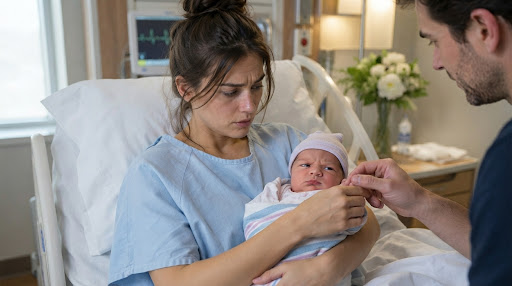
Colin sat beside my hospital bed,
staring at his phone as though it
might disappear if he looked at it long enough.
“What do you mean she wasn’t the only person you lied to?” I asked.
He swallowed.
Tessa, you’re exhausted.
You just gave birth.
Please, can we talk about this when you get home?
I almost laughed.
Eight weeks earlier, when I’d discovered his affair,
he’d told me we should talk when I was calmer.
When I cried, he said I was too emotional.
When I asked questions,
he said I was making things worse.
And now, holding our daughter less than three hours after giving birth,
I was apparently too exhausted to hear the truth.
“No,” I said. “You’re going to tell me now.”
Colin rubbed his face.
“Vanessa thought I was leaving you.”
“I know.”
His head snapped up.
“What?”
I saw the messages, Colin.
I saw you telling her you’d figure out how to leave after Annie was born.
He closed his eyes.
“I didn’t mean it.”
“You wrote it.”
“I was confused.”
“You were married.”
He flinched.
I looked down at Annie.
She was sleeping with one tiny fist tucked beneath her chin,
completely unaware that the two people responsible for
protecting her were sitting in the wreckage of their marriage.
“What happened the night I went into labor?”
Colin hesitated.
Then he whispered, “Vanessa came to the house.”
“Why?”
“She wanted to talk.”
“About what?”
He stared at the floor.
“She said she was pregnant.”
The room seemed to tilt.
I tightened my hold on Annie without realizing it.
“What?”
“She told me she was pregnant.”
I stared at him.
My husband had spent the last eight weeks promising that the affair was over.
He had attended two counseling sessions.
He had slept on the sofa.
He had brought me flowers, cooked dinners, and cried while begging for another chance.
And all that time, he’d been keeping another secret.
“Is it yours?”
“I don’t know.”
“Colin.”
“I swear, I don’t know.”
My voice became strangely quiet.
“How far along is she?”
“About nine weeks, she says.”
I did the calculation automatically.
Nine weeks.
The affair hadn’t ended when he claimed it had.
At least, not in the way he’d described.
I turned my face toward the window.
Outside, November rain was running down the glass.
I remembered standing in our kitchen eight weeks earlier, thirty-one weeks pregnant, begging him to tell me whether there was anything else I needed to know.
He’d taken my hands.
Looked me directly in the eyes.
And said, “Tessa, you know everything.”
Now I understood that he’d been lying even then.
“Get out,” I whispered.
Colin looked up.
“Please.”
“Get out of my room.”
“Tessa, she’s my daughter too.”
I looked at him.
“And I have never denied that. But right now, I need you to leave.”
He glanced toward Annie.
“Can I at least hold her?”
Something inside me broke.
Not because I wanted to punish him.
Not because I believed our newborn understood his betrayal.
But because he was asking me for another act of trust while refusing to give me the truth.
“Not right now.”
His eyes filled.
“Tessa—”
“Please don’t make me ask again.”
He stood slowly.
For one terrible moment, I thought he might argue.
Instead, he picked up his phone and walked toward the door.
Before leaving, he turned around.
“I love you.”
I looked down at our daughter.
“Then why did you keep hurting me?”
He had no answer.
When the door closed, I began crying.
Not the quiet tears I’d learned to hide during pregnancy.
I cried so hard that my shoulders shook.
Annie stirred against my chest.
I immediately tried to stop.
“I’m sorry, baby,” I whispered. “I’m sorry.”
A nurse named Rebecca came in to check my blood pressure.
She found me sitting upright, holding Annie with tears streaming down my face.
“Oh, honey.”
I tried to smile.
“I’m fine.”
She pulled a chair beside the bed.
“You don’t have to be fine.”
Those six words undid me.
I told her enough to explain why I was upset.
Not every detail.
Just that my husband had betrayed me, that I’d learned something painful, and that I needed privacy.
Rebecca listened without judgment.
Then she asked, “Would you like us to limit visitors for now?”
I nodded.
“Please.”
She explained that the staff could help manage visitors and that I could speak with the hospital social worker if I wanted support.
I agreed.
Before leaving, she adjusted Annie’s blanket.
“One more thing,” she said gently.
I looked up.
“Your baby’s movements earlier weren’t a judgment about her father. Newborns startle, cry, and turn away for all sorts of reasons.”
I stared at her.
She smiled sadly.
“But I understand why it felt personal to you.”
I nodded.
Because that was exactly what it had felt like.
For one irrational moment, I’d imagined Annie somehow knew what Colin had done.
But she didn’t.
She was a newborn.
She didn’t know betrayal.
She didn’t know marriage.
She didn’t know promises.
All she knew was warmth, hunger, unfamiliar sounds, and the comfort of being held.
I kissed her forehead.
“I won’t put this on you,” I whispered.
And that became the first promise I made to my daughter after she was born.
Whatever happened between her father and me, she would never be responsible for carrying it.
An hour later, Linda appeared at my door.
Rebecca stopped her.
I heard raised voices in the hallway.
“I’m her grandmother!”
“Mrs. Sutton needs rest.”
“That’s my son’s child!”
I closed my eyes.
Of course Linda would make this about herself.
A moment later, my phone buzzed.
It was a message from her.
Tessa, I understand you’re upset, but shutting Colin out of his daughter’s life is cruel. Whatever happened between you two, he’s still her father.
I stared at the screen.
Then another message appeared.
You need to think about your marriage before you destroy it over one mistake.
One mistake.
I looked at Annie.
Then I typed a reply.
Your son had an affair, lied about ending it, and concealed a possible pregnancy. I am recovering from childbirth. I am not discussing my marriage with you.
I pressed send.
Then I silenced my phone.
For the first time in months, I didn’t feel obligated to explain myself any further.
My mother arrived that afternoon.
She took one look at my face and set her handbag down.
“What happened?”
I tried to speak.
Instead, I started crying again.
Mom crossed the room and wrapped her arms around me.
I hadn’t realized how badly I needed her.
During the final weeks of pregnancy, I’d avoided telling her everything.
She knew about the affair.
But she didn’t know how frightened I’d become.
I was terrified of being a single mother.
Terrified of losing our house.
Terrified that Annie would someday ask why her parents weren’t together.
Most of all, I was terrified that I still loved Colin enough to believe him again.
When I finally told Mom about Vanessa’s pregnancy, she went very quiet.
Then she asked, “What do you want to do?”
I looked at her helplessly.
“I don’t know.”
“Then you don’t have to decide today.”
“But Annie—”
“Annie needs food, warmth, medical care, and people who love her.”
I looked down at my daughter.
Mom touched my cheek.
“And you need time to recover.”
I started crying again.
“I thought I could forgive him.”
“Maybe someday you will.”
“How?”
Mom shook her head.
“I don’t know, sweetheart. But forgiveness and staying married aren’t the same thing.”
That sentence stayed with me.
Because for eight weeks, I’d been acting as though I had only two choices.
Forgive Colin and stay.
Or leave and become the person who destroyed our family.
For the first time, I considered another possibility.
Maybe our family had already changed.
And maybe protecting Annie meant accepting that change instead of pretending it hadn’t happened.
That evening, Colin sent me a long message.
He admitted he’d known about Vanessa’s pregnancy since the previous night.
He claimed she’d threatened to tell me unless he agreed to meet her.
He said he hadn’t slept with her since I discovered the affair.
He said he didn’t know whether the baby was his.
And he begged me not to make a permanent decision while I was hurting.
I read the message twice.
Then I noticed something.
He still hadn’t explained why Vanessa had written:
Did you tell Tessa what happened the night she went into labor?
I called him.
He answered immediately.
“Tessa?”
“What else happened?”
Silence.
“Colin, I’m asking once.”
He exhaled shakily.
“She showed me something.”
“What?”
“A document.”
My stomach tightened.
“What document?”
He whispered, “A lease.”
I stared at the wall.
“What lease?”
“An apartment.”
“Whose apartment?”
Another silence.
Then he said, “Mine.”
I felt cold all over.
“You rented an apartment?”
“It was before you found out.”
“With Vanessa?”
“Yes.”
I closed my eyes.
He continued quickly.
“I never moved in. I changed my mind. I told her it was over.”
“Then why did she come to our house?”
“Because she wanted me to sign paperwork removing her from the lease. She said she couldn’t afford it alone.”
I swallowed.
“How long were you planning to leave me?”
“Tessa—”
“How long?”
He whispered, “Since July.”
July.
The month we’d painted Annie’s nursery.
The month Colin had assembled her crib.
The month he’d kissed my stomach and told our daughter he couldn’t wait to meet her.
He’d been planning a life with another woman while building a nursery for our baby.
I couldn’t speak.
Then Colin said something that made everything worse.
“I was going to tell you after the birth.”
I stared at the wall.
“Tell me what?”
“That I wanted a separation.”
My heart seemed to stop.
He began crying.
“But I changed my mind, Tessa. I swear I did. When you found the messages, I realized what I was throwing away.”
I closed my eyes.
For weeks, I’d believed he’d made a terrible mistake and then chosen our family.
Now I knew he’d been preparing to abandon it.
And the only reason he’d stopped was that I’d discovered his plans before he could carry them out.
“Colin,” I whispered, “I need you to understand something.”
“Anything.”
“You didn’t come back because you chose me.”
“That’s not true.”
“You came back because I caught you leaving.”
He began protesting.
But I ended the call.
And for the first time since discovering his affair, I knew I couldn’t go home and pretend our marriage was healing.
PART 4
I left the hospital two days later.
Colin arrived with flowers.
He was standing beside our car when Mom wheeled me toward the entrance.
He looked exhausted.
His hair was uncombed.
His eyes were red.
For a moment, I remembered the man I’d married.
The man who used to bring me coffee in bed.
The man who sang terribly while cooking spaghetti.
The man who cried when he saw our daughter’s heartbeat on the ultrasound screen.
And I hated how much I missed him.
“Tessa,” he said softly.
I stopped.
He looked at Annie sleeping in her car seat.
“Can I see her?”
I nodded.
He crouched beside the seat.
For a long moment, he simply looked at her.
“Hi, sweetheart,” he whispered.
Annie moved her lips in her sleep.
Colin began crying.
I felt tears rise in my own eyes.
But I didn’t reach for him.
When he stood, he looked at me.
“Are you coming home?”
I shook my head.
“I’m staying with Mom for a while.”
His face crumpled.
“Please don’t do this.”
“I’m not doing anything to punish you.”
“Then why can’t we work through it together?”
I took a slow breath.
“Because every time I think I’ve heard the whole truth, another piece appears.”
He looked down.
“I know.”
“And I can’t recover from childbirth while waiting for the next lie.”
He wiped his face.
“What about Annie?”
I looked at our daughter.
“You’re her father. We need to work out how you’ll be involved. But that doesn’t mean I have to remain your wife.”
He stared at me.
For the first time, I think he understood that I meant it.
The first month was harder than anything I’d imagined.
Annie slept in short stretches.
I was sore, exhausted, and overwhelmed.
Some mornings, I cried because I couldn’t find a clean burp cloth.
Other mornings, I cried because I remembered how happy Colin and I had been before everything fell apart.
Mom helped without making me feel helpless.
She brought me water during feedings.
She held Annie while I showered.
She reminded me to eat.
And when I admitted that I sometimes wanted Colin to come through the door and tell me the entire nightmare had been a mistake, she didn’t judge me.
She simply said, “Missing someone doesn’t mean you have to return to what hurt you.”
I began seeing a therapist who specialized in postpartum adjustment and relationship trauma.
At first, I felt embarrassed.
I thought I should be stronger.
But my therapist explained that I was recovering from childbirth while processing betrayal and major uncertainty.
Those were enormous things to carry at once.
She helped me understand that I didn’t need to make every decision immediately.
I needed sleep.
Support.
Accurate information.
And space to recognize what I actually wanted.
Colin started visiting Annie regularly.
We arranged the visits carefully, with help from a family-law attorney so that we could establish a stable parenting plan.
At first, Mom stayed nearby.
Not because I believed Colin would hurt our daughter.
He was gentle with her.
He learned how to support her head, change diapers, prepare bottles when needed, and soothe her when she cried.
But I wasn’t emotionally ready to spend long periods alone with him.
During one visit, Annie began crying as soon as he lifted her.
Colin froze.
His face changed in that familiar way.
“She hates me,” he whispered.
I looked at him.
“She’s hungry.”
He blinked.
“What?”
“She ate two hours ago. She’s probably hungry again.”
I reached for her.
He handed her over.
Within minutes, she settled.
Colin watched silently.
Then he said, “I thought it was because of me.”
I looked down at Annie.
“Colin, she’s a baby. She doesn’t know what happened between us.”
His eyes filled.
“I know.”
“Then don’t make her responsible for your guilt.”
He lowered his head.
That was one of the hardest conversations we’d ever had.
But it was also necessary.
I wanted Annie to know her father.
I wanted him to become someone she could depend on.
But I refused to let him interpret every cry, every restless movement, and every ordinary baby reaction as punishment for his affair.
Our daughter deserved to be a child.
Not a symbol of our broken marriage.
Six weeks after Annie was born, Vanessa contacted me.
I nearly deleted the message.
But something made me open it.
Tessa, I know I’m the last person you want to hear from. I’m not asking you to forgive me. There’s something I need to tell you, and Colin knows I’m contacting you.
I stared at the screen.
Then I replied.
What?
Her response came ten minutes later.
I wasn’t pregnant.
I read the sentence three times.
Then another message appeared.
I told Colin I was because I wanted him to come back. I was angry when he ended things. I thought if he believed there was a baby, he wouldn’t leave me.
I felt sick.
For weeks, I’d been imagining another child.
Another family.
Another future Colin had created without me.
And now Vanessa was telling me the pregnancy had been a lie.
I called Colin.
He answered immediately.
“Did you know?”
He sighed.
“She told me yesterday.”
“Yesterday?”
“I was going to tell you.”
I closed my eyes.
There it was again.
The same sentence.
The same excuse.
The same belief that he could decide when I deserved the truth.
“Colin, do you understand what you’ve done?”
“I didn’t want to upset you.”
“You don’t get to control what I know because you’re afraid of how I’ll react.”
He was silent.
Then he whispered, “You’re right.”
I sat on the edge of Mom’s bed.
For the first time, I didn’t feel angry.
I felt finished.
Not because Vanessa’s lie erased the affair.
Not because Colin had somehow become innocent.
But because I finally understood that my marriage had become a place where I was constantly waiting for someone else to decide what truth I could handle.
And I couldn’t live that way anymore.
I filed for divorce when Annie was four months old.
Colin didn’t fight the decision.
He asked whether we could continue counseling.
I agreed to counseling focused on communication and co-parenting, but I made it clear that I wasn’t promising reconciliation.
He accepted that.
Linda did not.
She called me one afternoon while Annie was sleeping.
“I hope you’re proud of yourself,” she said.
I closed my eyes.
“Linda, I’m not doing this.”
“Colin has apologized. He’s trying. How long are you going to punish him?”
I took a breath.
“I’m not punishing him. I’m making a decision about my marriage.”
“Marriage means forgiving mistakes.”
“Marriage also means honesty.”
She scoffed.
“You’re going to make that little girl grow up without a father.”
Something inside me hardened.
“No, Linda. Annie has a father. Whether he shows up consistently is his responsibility.”
“You’re breaking up a family.”
I looked toward Annie’s bassinet.
“No. I’m making sure our daughter grows up in a family where the adults don’t teach her that love means accepting repeated dishonesty.”
Linda began arguing again.
I ended the call.
Then I sat quietly for several minutes.
My hands were shaking.
But I didn’t regret what I’d said.
The divorce was finalized the following winter.
We sold the house.
I cried the day I packed Annie’s nursery.
Not because I wanted to stay married.
But because I remembered the woman I’d been when we painted those walls.
She’d believed that love and loyalty were enough to protect a marriage.
She’d believed that if she worked hard enough, cared deeply enough, and forgave generously enough, everything would turn out the way she’d imagined.
I wanted to tell her that she’d done nothing wrong by believing in her husband.
But I also wanted to tell her that she was allowed to change her mind when the truth changed.
I packed Annie’s tiny yellow blanket into a box.
Then I turned off the nursery light.
And walked out.
Two years passed.
Not quickly.
Not easily.
But they passed.
I returned to work as a graphic designer.
I rented a small house with a fenced backyard.
Mom helped me find a daycare I trusted.
And Annie grew into a fearless little girl with dark curls, enormous brown eyes, and a laugh that could make an entire room stop.
She loved strawberries.
She hated wearing socks.
She insisted that every stuffed animal needed a blanket.
And she called the moon “the night balloon.”
Colin remained involved.
He attended pediatric appointments when he could.
He paid child support.
He showed up for scheduled parenting time.
He learned how to braid Annie’s hair after watching approximately forty instructional videos.
Sometimes he still looked at me with sadness.
Sometimes I still felt a small ache when I remembered our marriage.
But we learned how to be parents without pretending we were still husband and wife.
It wasn’t perfect.
We disagreed about schedules.
We occasionally argued about holidays.
There were moments when old resentment surfaced.
But we kept working on it.
Because Annie deserved adults who could put her needs ahead of their history.
One afternoon, when Annie was almost three, Colin came to pick her up.
She ran toward him wearing a purple dress and mismatched shoes.
“Daddy!”
He crouched.
She threw herself into his arms.
He lifted her and spun her around.
She laughed so loudly that our neighbor looked over the fence.
Watching them, I remembered the hospital.
The first time Colin had reached for her.
The way she’d pushed his hand away.
The way he’d looked devastated.
For years, that moment had lived in my memory like a warning.
Now I saw it differently.
Annie hadn’t been rejecting her father.
She’d been a newborn reacting to touch.
The meaning had come from us.
From our fear.
Our guilt.
Our heartbreak.
And seeing her now, laughing in her father’s arms, I realized how grateful I was that we’d never made her responsible for those feelings.
Colin lowered her to the ground.
She ran toward the car, excited about their trip to the zoo.
He turned toward me.
“Thank you, Tessa.”
I frowned.
“For what?”
“For not letting what I did become the only thing Annie knows about me.”
I studied him.
“I didn’t do that for you.”
He nodded.
“I know.”
“I did it for her.”
He smiled sadly.
“I know that too.”
For a moment, we stood quietly.
Then he said, “I’m sorry I wasn’t the husband you deserved.”
I looked at him.
There had been a time when those words would have broken me.
Now they simply felt true.
“I’m sorry too,” I said.
He looked surprised.
“For what?”
“For the life we thought we were going to have.”
His eyes filled.
Then he nodded.
And that was enough.
Annie turned five last spring.
We held her birthday party at a park near our house.
There were pink balloons, a butterfly cake, and approximately fifteen children running in every direction.
Colin came early to help set up.
Mom brought sandwiches.
Linda attended too.
Our relationship had improved slowly, mostly because she’d learned that criticizing me meant I would end the conversation.
We weren’t close.
But we were civil.
And Annie loved her grandmother.
That afternoon, I watched my daughter climb onto a picnic bench beside Colin.
She was holding a paper crown.
“Daddy, put this on.”
Colin laughed.
“Sweetheart, it’s pink.”
“So?”
He put it on immediately.
Annie clapped.
Then she ran toward me with another crown.
“Mommy! You too!”
I placed it on my head.
She stepped back and studied us.
Then she smiled.
“Perfect!”
For a second, my heart tightened.
Colin and I weren’t standing together as husband and wife.
We weren’t the family I’d pictured when I first learned I was pregnant.
But Annie was smiling at both of us.
And neither of us was asking her to choose.
That mattered more than the photograph I’d once imagined hanging above our fireplace.
Later that evening, after everyone had gone home, Annie curled beside me on the sofa.
She was exhausted.
Her cheeks were sticky from frosting.
Her paper crown sat crooked on her head.
“Mommy?”
“Yes, baby?”
“Why don’t you and Daddy live together?”
I’d known the question would come someday.
Still, my chest tightened.
I brushed a curl away from her forehead.
“Because sometimes grown-ups decide they can be better parents living in different houses.”
She considered that.
“Did Daddy do something bad?”
I paused.
I wasn’t going to lie.
But I also wasn’t going to give a five-year-old details she couldn’t understand.
“Daddy and I had grown-up problems we couldn’t fix together.”
She frowned.
“Was it because of me?”
My heart broke.
I pulled her into my arms.
“Oh, Annie. Never.”
“Promise?”
I kissed her forehead.
“I promise. You didn’t cause any of it.”
She rested her head against my shoulder.
“Do you still love Daddy?”
I thought carefully.
“I care about Daddy because he’s your father. And we both love you very much.”
She smiled sleepily.
“Good.”
A moment later, she was asleep.
I held her for a long time.
And I thought about the woman I’d been in that hospital room.
Thirty-one years old.
Exhausted.
Heartbroken.
Terrified.
Holding a newborn daughter while wondering whether her marriage could survive.
I wished I could go back and sit beside her.
I wished I could take her hand and tell her that she didn’t have to solve everything before leaving the hospital.
That she was allowed to grieve.
Allowed to be angry.
Allowed to love someone and still decide not to stay with him.
Most importantly, I wished I could tell her that her daughter’s future wasn’t ruined.
It was simply going to look different.
Today, Annie is six.
She’s learning to read.
She wants to become a veterinarian, a firefighter, and a princess, preferably all at once.
She has my stubbornness and Colin’s ridiculous sense of humor.
Sometimes she spends weekends with her father.
Sometimes we all attend school events together.
And sometimes I still catch myself thinking about that first morning in the hospital.
The tiny hand.
The startled cry.
The look on Colin’s face.
Back then, I thought it meant something terrible.
Now I understand that Annie wasn’t born knowing her father’s mistakes.
She wasn’t born to judge him.
She wasn’t born to save our marriage.
And she certainly wasn’t born to carry the pain he’d caused me.
She was simply born.
A little girl who deserved to be loved without conditions.
And I was a mother who deserved to raise her without surrendering my dignity.
I used to believe that a happy ending meant keeping the family I’d imagined.
Now I know that sometimes a happy ending means finding the courage to build a different one.
One where the truth is spoken.
Where apologies are followed by changed behavior.
Where boundaries are respected.
And where a child never has to wonder whether she was responsible for the choices adults made.
Last night, Annie climbed into my lap while I was reading.
She took my face between her little hands.
“Mommy?”
“Yes, sweetheart?”
“Are you happy?”
I looked around our small living room.
At the books scattered across the floor.
At the purple blanket draped over the sofa.
At the family photographs on the mantel.
Then I looked at my daughter.
And for the first time in years, the answer came without hesitation.
“Yes, Annie.”
She smiled.
“Me too.”
Then she kissed my cheek and ran off to find her favorite stuffed rabbit.
I watched her disappear down the hallway.
And I realized something.
The first time my daughter pushed her father’s hand away, I thought she was telling me my marriage was broken. But she wasn’t telling me anything about my marriage. She was teaching me, without even knowing it, that her life was separate from our mistakes.
My job wasn’t to make her choose between her parents. It was to make sure she never had to.
And the greatest gift I could give her wasn’t a perfect family. It was a childhood where she felt safe, wanted, and completely loved.
THE END THANK YOU FOR READING !!!



