PART 3
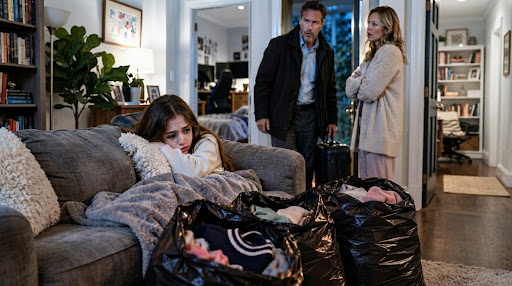
The room went completely silent after Trent spoke.
“Mom, don’t tell him.”
My father slowly turned toward him.
“What exactly shouldn’t she tell me?”
Trent looked at Candace, then at the floor.
For the first time since he’d arrived,
he seemed to realize that my father wasn’t going to
accept whatever explanation they offered.
Candace stepped forward.
Russell, please. This is getting ridiculous.
It’s a jewelry box, not some priceless family treasure.
My father stared at her.
“That box belonged to Hallie’s mother.”
“I know that.”
“Then you know why it matters.”
Candace folded her arms.
I was only trying to organize the room.
Trent needed space, and Hallie has so many sentimental things lying around.
Dad looked toward the wastebasket where my mother’s photograph had been placed.
Then he looked at me.
“Hallie, when did you last see the box?”
I swallowed.
“Monday morning. Before school.”
“And when did you notice it missing?”
“Tuesday night.”
“Did you ask Candace?”
I nodded.
“What did she say?”
I stared at my hands.
“She said I needed to stop being so attached to things that belonged to someone who wasn’t coming back.”
My father went perfectly still.
Candace’s face changed.
“That’s not what I meant.”
Dad didn’t look at her.
“Hallie, sweetheart, look at me.”
I raised my eyes.
“Did she say those words?”
I nodded again.
Dad took a slow breath.
Then he turned toward his wife.
“Where is the box?”
Candace glanced at Trent.
“It was taking up space.”
“Where?”
“I put it with some other things.”
“Where, Candace?”
Finally, Trent muttered, “It’s not here anymore.”
My stomach dropped.
“What?”
He rubbed the back of his neck.
“I sold it.”
For a moment, I couldn’t understand the words.
The box had been made of dark cherrywood, with a tiny brass key and a carved sunflower on the lid.
My mother had received it from her grandmother when she turned eighteen.
Inside were a silver bracelet, her wedding earrings, a small pearl necklace, and several letters she’d written for me during the last months of her illness.
Dad had given it to me on my tenth birthday.
He’d said, “Your mom wanted you to have something you could open whenever you missed her.”
I opened it almost every Sunday.
Sometimes I read the letters.
Sometimes I just held the bracelet.
Now Trent was telling me he’d sold it.
“Where?” I whispered.
He looked irritated.
“Some antique place downtown. It wasn’t worth much.”
My father stepped between us.
“Which antique place?”
Trent shrugged.
“I don’t remember.”
Dad’s voice grew colder.
“Then you’re going to remember.”
Candace immediately intervened.
“Russell, he needed money. He’s been under tremendous pressure. He thought it was an old box nobody was using.”
I looked at her.
“You knew?”
She hesitated.
That hesitation answered everything.
Dad noticed it too.
“You let your son sell my daughter’s belongings?”
“Don’t twist this!”
“Did you know?”
Candace’s eyes filled with tears.
“Yes, but I was going to replace it.”
I felt something inside me collapse.
Replace it.
As though another wooden box could hold my mother’s handwriting.
As though a stranger’s bracelet could replace the one she’d worn while brushing my hair.
As though memories were furniture that could be moved around whenever someone needed more space.
I began crying.
Not quietly.
Not politely.
For three nights, I’d swallowed every complaint because I didn’t want to cause trouble.
Now I couldn’t stop.
Dad wrapped his arms around me.
“I’m sorry, sweetheart.”
I buried my face in his shirt.
“I just want Mom’s letters.”
“I know.”
“She wrote them for me.”
“I know, baby.”
His voice cracked.
Then he looked at Trent.
“Get your receipt.”
Trent stared at him.
“What?”
“The receipt from wherever you sold it.”
“I don’t have it.”
“Then show me the transaction on your phone.”
Candace stepped forward again.
“Russell, enough. You’re humiliating him.”
Dad looked at her with an expression I’d never seen before.
“No, Candace. I’m holding him accountable.”
Ten minutes later, Trent admitted he’d sold the box to a secondhand dealer on West Broad Street.
He’d received $340.
He had already spent most of it.
My father asked him to call the shop.
Trent refused.
So Dad called himself.
I sat at the kitchen table while he explained the situation.
He spoke carefully, telling the owner that property belonging to a minor had been sold without permission.
The owner listened.
Then he said something that made Dad’s shoulders relax slightly.
The box was still there.
It hadn’t been placed on the sales floor yet.
Dad closed his eyes.
“Thank you. We’ll be there first thing tomorrow.”
When he hung up, I looked at him.
“Really?”
He nodded.
“Really.”
I started crying again.
But this time, there was relief mixed into it.
Dad sat beside me.
“We’ll get it back.”
Candace stood near the refrigerator.
She looked furious.
“Are we seriously going to spend the whole night talking about a box?”
Dad turned toward her.
“No. We’re going to talk about something much bigger.”
She crossed her arms.
“What now?”
“My daughter was sleeping on a sofa while your adult son occupied her bedroom. Her belongings were stuffed into trash bags. Her mother’s photograph was placed beside a wastebasket. And something precious to her was sold without permission.”
“You’re making me sound like a monster.”
“I’m describing what happened.”
Candace’s eyes narrowed.
“I’ve done everything for this family.”
Dad shook his head.
“No. You’ve been asking my daughter to give up pieces of her life so you and Trent can be comfortable.”
She opened her mouth.
He raised his hand.
“I’m not finished.”
I’d never heard him speak to her that way.
“When I married you, I promised Hallie that this house would always be her home. I trusted you to help me protect that promise.”
Candace began crying.
“I was trying to make room for everybody.”
Dad looked toward my three black trash bags.
“Everybody except Hallie.”
Nobody answered.
Then Dad turned to Trent.
“You need to pack your equipment.”
Trent laughed nervously.
“Seriously?”
“Yes.”
“Where am I supposed to go?”
“You’re twenty-four years old. You can make arrangements.”
Candace gasped.
“Russell!”
Dad continued.
“You were invited to sleep on the sofa for one week. Instead, you took over a child’s bedroom and sold her property.”
Trent’s face reddened.
“I didn’t know it meant that much.”
“You knew it wasn’t yours.”
That ended the conversation.
By midnight, Trent’s monitors were disconnected.
His office chair was back in his car.
Dad carried my mattress out of the garage.
It smelled faintly of motor oil, so he refused to let me sleep on it until it had been cleaned.
Instead, he brought the guest air mattress from the basement and placed it in my bedroom.
Then he carried my clothes inside.
One black bag at a time.
I stood in the doorway watching him.
“Can I help?”
He shook his head.
“You’ve done enough.”
“But—”
“Hallie, sweetheart, you don’t have to earn your bedroom.”
I stared at him.
Something about that sentence hurt more than I expected.
Because I hadn’t realized that was what I’d been trying to do.
Earn my place.
Earn the right to keep my desk.
Earn the right to sleep behind a closed door.
Earn the right to be inconvenient.
Dad placed the last bag beside my dresser.
Then he picked up my mother’s photograph.
The frame had a small crack in one corner.
He touched it gently.
“Your mom took this picture the summer before she got sick.”
I nodded.
“We were at the lake.”
“You remember?”
“She made me wear that ridiculous yellow hat.”
Dad smiled sadly.
“She loved that hat.”
“She said I looked like sunshine.”
His eyes filled.
“She was right.”
He placed the photograph back on my dresser.
Then he sat beside me on the air mattress.
“Hallie, I need to ask you something.”
I looked at him.
“Has Candace treated you like this before?”
My stomach tightened.
I wanted to say no.
It would have been easier.
But then I remembered the yellow mixing bowl.
The photograph disappearing from the mantel.
The Saturdays when Dad stopped making pancakes because Candace said they were childish.
The times she’d told me to eat leftovers while she and Trent ordered food.
The school art competition she’d refused to drive me to because Trent needed her car.
I nodded.
Dad’s expression changed.
“How long?”
I stared at the floor.
“Since before you married her.”
He covered his mouth.
Then he whispered, “Why didn’t I see it?”
I didn’t know how to answer.
Finally, I said, “You were happy.”
He looked at me.
I continued.
“You were so sad after Mom died. Then Candace came, and you started smiling again.”
My voice shook.
“I didn’t want you to be sad because of me.”
Dad pulled me into his arms.
“Oh, Hallie.”
I began crying against his shoulder.
“I thought if I complained, you’d think I didn’t want you to be happy.”
He held me tighter.
“Your happiness matters too.”
I couldn’t remember anyone saying that to me in a very long time.
The next morning, Dad took me to the secondhand shop.
The owner, a gray-haired man named Mr. Alvarez, had already placed the jewelry box behind the counter.
When he saw me, he smiled gently.
“Is this yours, young lady?”
I nodded.
He opened the lid.
Everything was still inside.
The bracelet.
The pearl necklace.
The wedding earrings.
And beneath the velvet lining, the bundle of letters tied with a faded yellow ribbon.
I touched them with trembling fingers.
Mr. Alvarez looked at Dad.
“I had a feeling there was a story behind this.”
Dad offered to reimburse him for the money he’d paid Trent.
The man accepted only the documented purchase amount.
Then he looked at me.
“Take good care of it.”
“I will,” I whispered.
Outside, I held the box against my chest.
Dad opened the passenger door.
But before I climbed in, I noticed something.
One of the letters had slipped loose from the ribbon.
It was an envelope I’d never opened.
On the front, in my mother’s handwriting, were five words.
For Hallie, when she feels forgotten.
My hands began shaking.
Dad stared at the envelope.
Then he whispered, “I didn’t know she wrote that one.”
I opened it carefully.
Inside was a letter dated three weeks before my mother died.
And the first sentence made me start crying before I could read another word.
My beautiful girl, if someday someone makes you feel like there isn’t room for you, I want you to remember that you were never an inconvenience to me.
PART 4
I read my mother’s letter sitting in the passenger seat of Dad’s truck.
He didn’t start the engine.
He simply waited.
The handwriting was familiar.
Some letters leaned slightly to the right.
Others were shaky, probably because her hands had grown weak during treatment.
But every word felt like hearing her voice again.
My beautiful Hallie,
There may come a day when the world makes you feel too loud, too sensitive, or too difficult.
There may come a day when someone asks you to make yourself smaller so they can be comfortable.
Please don’t.
You were never too much.
You were the best part of every day I was given.
I pressed the paper against my chest.
Dad wiped his eyes.
“Can I read it?”
I handed it to him.
He read silently.
Then he reached the final paragraph.
And if your father ever forgets how to listen, remind him that the bravest thing he can do is believe you.
Dad stopped.
His shoulders began shaking.
For a moment, I didn’t know what to do.
I’d seen my father cry at Mom’s funeral.
I’d seen him cry when we packed away her hospital equipment.
But I hadn’t seen him cry like that since.
He carefully folded the letter.
Then he looked at me.
“Your mother knew me better than anyone.”
I nodded.
“She knew I could get so busy trying to fix things that I’d forget to notice what was happening right in front of me.”
He took my hand.
“Hallie, I failed you.”
I shook my head immediately.
“No, Dad.”
“Yes.”
His voice was gentle but firm.
“I asked whether everything was okay, but I didn’t make sure you felt safe enough to tell me when it wasn’t.”
Tears rolled down my cheeks.
“I didn’t want to ruin your marriage.”
He looked at me for a long time.
Then he said something I’ll never forget.
“Sweetheart, a marriage that requires my daughter to suffer quietly isn’t a marriage worth protecting.”
When we returned home, Candace was sitting at the kitchen table.
Her eyes were swollen.
A suitcase stood beside the front door.
Trent was gone.
Dad asked me to take my jewelry box upstairs.
I hesitated.
He noticed.
“You don’t have to worry about what happens next. I’ll handle the adult decisions.”
I nodded.
But as I climbed the stairs, I heard Candace speak.
“You’re really choosing her over me?”
I stopped.
Dad answered immediately.
“I’m choosing to protect my daughter.”
Candace’s voice rose.
“She’s manipulating you!”
“No.”
“She’s always resented me!”
“She’s thirteen.”
“That doesn’t mean she can’t lie!”
Dad’s voice became quiet.
“Hallie told me the truth. You lied to my face.”
There was a long silence.
Then Candace began crying again.
I sat on the stairs, clutching my mother’s jewelry box.
Part of me felt guilty.
I knew Candace had nowhere nearby to stay except with Trent.
I knew Dad had loved her.
I knew our house would feel different without her.
But another part of me felt something unfamiliar.
Relief.
For the first time in eighteen months, I wasn’t waiting for someone to tell me I was taking up too much space.
Candace left that afternoon.
Dad didn’t shout.
He didn’t throw her belongings outside.
He helped carry her suitcase to the car.
Then he came back inside and sat beside me on the sofa.
For a while, neither of us spoke.
Finally, I asked, “Are you getting divorced?”
He took a breath.
“I don’t know exactly what the legal process will look like yet. But Candace won’t be living here while we work through it.”
I looked down.
“Because of me?”
He turned toward me.
“No, Hallie. Because of the choices she made.”
“But if I hadn’t told you—”
“Then I would have kept failing to see what was happening.”
He put his arm around my shoulders.
“You didn’t cause this by telling the truth.”
I leaned against him.
For the first time in months, I believed him.
The following Monday, Dad took the day off work.
He called my school and arranged a meeting with my guidance counselor.
I was terrified.
I thought everyone would find out.
I imagined teachers whispering about my family.
But Dad explained that I didn’t have to tell anyone more than I wanted.
He simply wanted someone at school to know I’d been under stress.
My counselor, Mrs. Bennett, listened without interrupting.
When I finished explaining the sleeping arrangements and the missing jewelry box, she said, “Hallie, you’ve been carrying responsibilities that were never yours.”
I looked at her.
“What responsibilities?”
“Keeping adults happy. Avoiding conflict. Protecting your father’s feelings.”
I stared at my shoes.
She continued.
“Children should be able to tell the truth without fearing they’ll lose their place in the family.”
That sentence stayed with me.
For weeks afterward, I thought about it whenever I caught myself saying I was fine.
Dad began making changes.
Not dramatic ones.
Not expensive ones.
Small, ordinary changes that somehow meant everything.
He started coming home for dinner whenever possible.
When work required travel, he arranged for my Aunt Laura to stay with me.
He made sure I could call him privately.
He asked questions and waited for real answers.
Sometimes I still said, “Everything’s okay.”
But now he’d smile and ask, “Okay because it really is, or okay because you don’t want to bother me?”
At first, I didn’t know how to respond.
Eventually, I learned to tell him.
One Tuesday, I admitted I was nervous about a science presentation.
He helped me practice.
Another evening, I told him I missed Mom so badly that my chest hurt.
He sat beside me and told stories about her until midnight.
Sometimes he cried too.
We learned that being honest didn’t always make sadness disappear.
But it made sadness easier to carry together.
A month after Candace moved out, Dad surprised me.
I came home from school and found him standing in my bedroom.
My drawing desk was back beneath the window.
My books were arranged on their shelves.
My mother’s photograph stood on the dresser in a new frame.
And the walls had been painted a soft yellow.
The exact color of our old kitchen window.
I stared.
“Dad?”
He smiled nervously.
“I thought the room could use a fresh start.”
I walked toward the desk.
On it sat a small wooden shelf.
Dad had built it himself.
It held my mother’s jewelry box.
Above it, he’d placed a little brass plaque.
HALLIE’S ROOM. ALWAYS.
My eyes filled.
“Dad, you didn’t have to do all this.”
He knelt beside me.
“I know.”
“Then why?”
He smiled sadly.
“Because I wanted you to come home from school and know, without asking, that you belong here.”
I hugged him.
He hugged me back.
And for the first time since Mom died, my bedroom felt completely mine again.
The divorce was finalized the following year.
It wasn’t simple.
Candace accused Dad of being unreasonable.
Trent insisted the whole situation had been exaggerated.
There were arguments about belongings and finances.
But Dad never asked me to defend his decisions.
He never made me sit through adult conversations.
And he never suggested that I should apologize for what happened.
Once, Candace sent me a birthday card.
Inside, she’d written:
I hope someday you understand that families require compromise.
I showed Dad.
He read it.
Then he handed it back.
“What do you think?”
I considered the question.
Finally, I said, “I think compromise means everybody gives something. Not just one person.”
Dad smiled.
“That’s exactly right.”
I placed the card in a drawer.
I didn’t answer.
Two years later, when I was fifteen, my art teacher announced a statewide competition.
The assignment was simple.
Create something that represented the meaning of home.
Most students painted houses.
Some drew families around dinner tables.
One boy made a sculpture of his dog.
I spent three weeks working on mine.
I painted our old living room.
The crooked maple tree was visible through the window.
Three black trash bags sat beside the sofa.
A little girl slept beneath a thin blanket.
At first glance, the painting looked sad.
But near the doorway stood a man holding a suitcase.
He wasn’t looking at the furniture.
He wasn’t looking at the television.
He was looking at the little girl.
And behind him, sunlight poured through the open door.
I titled it:
The Night Someone Finally Saw Me.
When Dad saw the painting, he stood silently for several minutes.
Then he asked, “Is that how you remember it?”
I nodded.
He wiped his eyes.
“I’m sorry you had to remember a night like that.”
I took his hand.
“But I remember what happened afterward too.”
He looked at me.
“You came home,” I said.
He hugged me.
And this time, neither of us apologized for crying.
My painting won first place.
The award ceremony was held at a small gallery in downtown Columbus.
Dad sat in the front row.
Aunt Laura sat beside him.
When my name was announced, I walked onto the stage with shaking knees.
The judges asked me to explain the meaning behind my work.
I looked toward Dad.
He nodded encouragingly.
Then I turned toward the audience.
“I used to think home was a place where you had to be easy to love.”
The room became quiet.
“I thought if I didn’t complain, didn’t ask for much, and didn’t make anybody uncomfortable, then nobody would have a reason to send me away.”
I swallowed.
“But I learned that a real home isn’t somewhere you earn your place by being quiet.”
I looked at the painting.
“It’s somewhere people notice when you’re hurting. Somewhere they listen when you say something is wrong.”
My voice trembled.
“And sometimes, home is a person who realizes they’ve made a mistake and decides to do better.”
When I finished, the audience applauded.
But I barely heard them.
Because Dad was standing.
Clapping with tears running down his face.
That evening, we celebrated with pancakes for dinner.
It had become our tradition again.
Dad made them too large, just like he used to.
I added strawberries.
He burned the first batch.
We laughed until my stomach hurt.
After dinner, I carried my trophy upstairs.
I placed it beside my mother’s jewelry box.
Then I opened the box and took out her letter.
I’d read it so many times that the folds had begun to soften.
But one sentence still made my eyes fill.
You were never an inconvenience to me.
I sat on my bed, thinking about how close I’d come to believing the opposite.
How easily I’d accepted sleeping on a sofa.
How quickly I’d packed my clothes into trash bags.
How I’d convinced myself that asking for my own bedroom was selfish.
Then I thought about Dad standing in the doorway.
About his suitcase wheels stopping.
About the moment he asked whose idea it had been.
And how, for the first time, someone waited long enough to hear my answer.
I’m twenty-six now.
I work as an illustrator.
My paintings have appeared in children’s books, magazines, and galleries.
Dad retired last spring.
He still lives in the little house outside Columbus.
The maple tree is older and more crooked than ever.
The kitchen window is still yellow.
And my bedroom is still there.
Whenever I visit, Dad insists I stay in it.
The shelves hold some of my old books.
My art competition trophy still sits beside the jewelry box.
And above the desk is the little brass plaque he made all those years ago.
HALLIE’S ROOM. ALWAYS.
Sometimes I think about Candace and Trent.
I don’t spend much time wondering whether they regret what happened.
For years, I believed that healing meant getting an apology from everyone who hurt me.
But I’ve learned that sometimes healing means no longer needing their permission to feel hurt.
Dad and I still talk about that November night occasionally.
He doesn’t pretend he was a perfect father.
He admits he missed things.
He admits he trusted the wrong person.
And he admits that he should have noticed sooner.
But he also did something that mattered.
He changed.
He listened.
He protected me.
And he never again made me feel that his happiness depended on my silence.
Last Thanksgiving, I found him standing in my old bedroom, looking at the painting I’d made when I was fifteen.
“The Night Someone Finally Saw Me.”
He smiled when I entered.
“Still your best work, if you ask me.”
I laughed.
“Dad, I’ve illustrated twelve books.”
“I know.”
“And won three national awards.”
“I know that too.”
“Then why this one?”
He looked at the little girl sleeping beside the trash bags.
Then at the man standing in the doorway.
“Because that painting reminds me of the most important decision I ever made.”
I walked beside him.
“Coming home early?”
He shook his head.
“Listening when you finally told me the truth.”
For a moment, neither of us spoke.
Then he reached for my hand.
“I wish I’d protected you sooner.”
I squeezed his fingers.
“I know, Dad.”
He looked at me.
“Do you forgive me?”
I smiled through tears.
“I forgave you a long time ago.”
He hugged me.
And standing there, surrounded by the familiar yellow walls, I realized something.
The thirteen-year-old girl who had fallen asleep on the sofa wasn’t gone.
She was still part of me.
But she no longer had to be afraid.
She no longer had to hide her feelings.
She no longer had to make herself smaller to keep everyone else comfortable.
Because the night my father came home early, he didn’t simply give me my bedroom back.
He gave me something I’d almost forgotten I deserved.
The right to belong.
The right to be heard.
The right to take up space.
And most importantly, the certainty that love should never require a child to disappear.
My stepmother thought she was teaching me to make room for other people. But my father taught me something far more important: in a family that truly loves you, there should always be room for you, too.
THE END THANK YOU FOR READING !!!



