PART 3
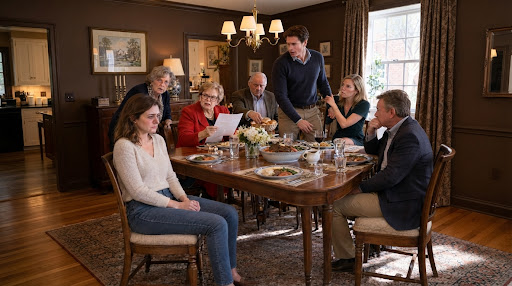
Jared stood beside the dinner table,
staring at me as though he had
just discovered that the woman
he’d known for six years was a stranger.
My mother still held my bank statement.
“Well?” she demanded. “Would somebody explain what’s going on?”
I looked at Jared.
“Please sit down.”
He didn’t move.
“Tessa,” he said quietly,
“I heard about the Ashford incident when I was at submarine school.”
My stomach tightened.
“Then you know there are things I can’t discuss.”
“I know.”
His voice softened.
“But I also know that three sailors didn’t come home.”
The room went completely silent.
Mom lowered the paper.
“What?”
Jared looked at her.
“Three sailors died during an emergency aboard the USS Ashford in 2022.”
Aunt Ruth covered her mouth.
Uncle Glenn stopped chewing.
Allison looked from her husband to me.
I stared at the tablecloth.
For four years, I had tried to keep that day in a place where it couldn’t follow me into ordinary life.
But there it was.
Sitting beside the gravy boat.
Between the mashed potatoes and the rolls.
In the middle of my mother’s dining room.
Jared continued carefully.
“There was a major equipment failure during submerged operations. An internal flooding casualty followed. The crew fought to contain it.”
I closed my eyes.
I could still hear the alarms.
The metallic shriek.
The voices calling compartment numbers.
The sound of water striking steel where water was never supposed to be.
“Tessa,” Jared said, “you don’t have to explain anything.”
I opened my eyes.
“Then don’t ask me to.”
He nodded immediately.
My mother frowned.
“But what does that have to do with her money?”
I looked at her.
Even now.
Even after hearing that sailors had died.
She was still thinking about the number at the bottom of my statement.
Jared’s expression hardened.
“Mrs. Ror, the Tillery name is associated with one of the sailors who died.”
Mom glanced down.
“The family she’s sending money to?”
“Yes.”
She looked at me.
“Why?”
I took a slow breath.
“Because I made a promise.”
“To whom?”
“Someone who isn’t here anymore.”
Mom stared.
Then she gave a small, dismissive laugh.
“So you’re giving away fifteen hundred dollars every month because of a promise?”
I felt something inside me go still.
“Mom.”
“What? I’m asking a reasonable question.”
“No,” I said. “You’re asking a question you have no right to demand an answer to.”
She stiffened.
“I’m your mother.”
“And I’m thirty-five years old.”
The words came out louder than I’d intended.
Everyone looked at me.
I lowered my voice.
“You opened my mail. You read my bank statement in front of twelve people. And now you’re demanding details about people who lost someone they loved.”
Mom’s cheeks reddened.
“I was worried about you.”
I looked at the statement in her hand.
“Worried people ask questions privately.”
She opened her mouth.
I continued.
“Worried people don’t invite an audience.”
Allison shifted in her chair.
“Okay, Tess, I think everybody needs to calm down.”
I turned toward her.
“You knew she was going to do this?”
She looked startled.
“What?”
“Did you know Mom had opened my mail?”
She hesitated.
That hesitation answered me.
“Allison.”
She sighed.
“She mentioned finding a statement.”
“And you didn’t tell her to put it away?”
“I didn’t think she’d read it out loud!”
I looked down.
Of course.
Nobody ever expected Mom to go quite as far as she did.
But nobody stopped her either.
Jared pulled out his chair.
He sat down slowly.
Then he looked at my mother.
“Ma’am, I need you to understand something.”
Mom crossed her arms.
“I’m listening.”
“Your daughter is preparing to serve as the executive officer of a submarine.”
“I know she’s getting some promotion.”
Jared’s jaw tightened.
“It’s not just some promotion.”
I gave him a warning look.
He continued anyway.
“An executive officer is second in command. It’s a position of enormous responsibility. Her commanding officer will rely on her judgment, her leadership, and her ability to keep people safe under extraordinary pressure.”
Mom looked uncomfortable.
Jared leaned forward.
“And whatever Tessa can or cannot discuss about her service, she has earned the right to be treated with respect at her own family’s dinner table.”
I swallowed hard.
Nobody had ever said anything like that in my mother’s house.
Not about me.
Mom stared at Jared.
Then she said, “Well, if she’s so successful, why does she have only two hundred dollars?”
I almost laughed.
Jared didn’t.
“Because a checking account balance doesn’t tell you someone’s financial position.”
Mom frowned.
“What does that mean?”
“It means you’re looking at one account, on one day, without understanding the rest of her finances.”
I nodded.
“Exactly.”
He turned toward me.
“I’m sorry, Tess. I shouldn’t have said as much as I did.”
I shook my head.
“You were trying to help.”
He looked at the statement again.
“Still, you shouldn’t have had to defend yourself.”
I looked toward the window.
Outside, the March afternoon had turned gray.
Rain was beginning to tap against the glass.
I wanted to leave.
But I knew if I walked out now, Mom would tell everyone I had stormed away because I was embarrassed.
She would turn my silence into another confession.
So I stayed.
And I asked her one question.
“Mom, do you remember Dad’s funeral?”
She blinked.
“Of course I remember your father’s funeral.”
“Do you remember how much it cost?”
She looked confused.
“What does that have to do with anything?”
“Please answer.”
She shrugged.
“Allison handled it.”
I looked at my sister.
Allison stared at her plate.
“Did she?”
Mom frowned.
“Yes. She made all the arrangements.”
I nodded.
“She helped choose the service. She spoke with the funeral director. She handled the flowers.”
I paused.
“But who paid the bill?”
Mom looked toward Allison.
“Your sister did.”
I waited.
Allison didn’t speak.
My chest tightened.
“Tell her,” I said.
Allison looked up.
“Tess—”
“Tell Mom who paid the eleven thousand four hundred dollars.”
Mom’s expression changed.
“Eleven thousand?”
Allison swallowed.
Then she whispered, “Tessa did.”
Silence.
Mom looked at me.
“What?”
“I paid it,” I said. “From an airport parking lot in Norfolk, before I flew home.”
Mom stared.
I continued.
“I put it on my credit card. It took me eight months to pay it off.”
Aunt Ruth slowly lowered her napkin.
Uncle Glenn looked at Allison.
“And you let your mother believe you paid?” he asked.
Allison began crying.
“Tessa told me not to make a big deal about it.”
I nodded.
“I asked you not to announce it.”
My voice tightened.
“I didn’t ask you to take credit.”
Allison covered her face.
Mom looked between us.
“Why didn’t you tell me?”
I stared at her.
“Because you had just lost your husband.”
She said nothing.
“I didn’t want you worrying about money while you were burying Dad.”
I looked down at my hands.
“I thought protecting your peace was more important than getting credit.”
Mom’s face softened slightly.
But then she said, “Well, you should have told me later.”
I felt a familiar exhaustion settle over me.
Even now, it was somehow my fault.
Jared leaned back in his chair.
“Mrs. Ror,” he said quietly, “your daughter just told you she paid for her father’s funeral, and your response is that she should have informed you sooner?”
Mom glared at him.
“Jared, don’t speak to me like that.”
He nodded.
“Then please stop speaking to her like this.”
Allison looked at her husband.
“Jared!”
He turned toward her.
“What?”
“That’s my mother.”
“And Tessa is your sister.”
Allison fell silent.
I looked at Jared.
He wasn’t angry in the loud, theatrical way my mother became angry.
He was disappointed.
And somehow, that was more powerful.
I reached for my statement.
“Mom, give me my mail.”
She held it tighter.
“We haven’t finished discussing this.”
“Yes,” I said. “We have.”
She stared at me.
I held out my hand.
After a long moment, she pushed the paper across the table.
I folded it carefully.
Then I placed it inside my bag.
My mother watched me.
“You’re really going to leave over a little embarrassment?”
I stood.
“No.”
I picked up my coat.
“I’m leaving because you violated my privacy and tried to humiliate me.”
Mom’s eyes widened.
“After everything I’ve done for you?”
I looked at her.
“Mom, I appreciate what you’ve done for me.”
I paused.
“But gratitude doesn’t mean you own every part of my life.”
Aunt Ruth nodded slowly.
Mom saw it.
Her expression hardened.
“So now I’m the villain.”
I shook my head.
“No. You’re my mother.”
My throat tightened.
“And I wish you could just be proud of me.”
For one second, her face changed.
I thought she might apologize.
Instead, she looked away.
“Well, perhaps if you were more open with your family—”
I didn’t let her finish.
“Goodbye, Mom.”
I walked toward the door.
Jared followed me into the hallway.
“Tessa.”
I stopped.
He looked genuinely ashamed.
“I’m sorry.”
“For what?”
“For not recognizing the name sooner. For letting this happen.”
I shook my head.
“You didn’t open the envelope.”
He nodded.
Then he hesitated.
“Can I ask you one thing?”
I almost smiled.
“You already know the answer.”
He looked down.
“Right. Some things aren’t mine to ask.”
I put on my coat.
Then he said, “For what it’s worth, the people who taught us about that incident spoke about the crew with enormous respect.”
I swallowed.
“Thank you.”
He paused.
“And I don’t know what happened inside that compartment.”
I nodded.
“But I know enough to understand that someone has been carrying more than the rest of us realized.”
My eyes burned.
I looked away.
“Take care of Allison,” I whispered.
He gave a sad smile.
“I will. But she needs to learn to take responsibility for herself too.”
I stepped outside.
The rain had grown heavier.
I walked to my car without opening my umbrella.
By the time I reached the driver’s seat, my uniform shoes were soaked.
I closed the door.
And finally, I cried.
Not because Mom had called me poor.
Not because Allison had accepted credit for something I’d done.
But because for fourteen years, I’d kept hoping that one day my mother would look at me and see someone worth being proud of.
Instead, she’d opened my mail.
And turned my private sacrifices into entertainment.
I sat there until the rain blurred the windshield.
Then my phone buzzed.
A message from Jared.
Tess, I didn’t say this inside because it wasn’t my story to tell. But I know the Tillery name. My instructor was close to that family. There’s something I think you should know.
I stared at the screen.
A second message appeared.
They’ve been trying to find the person behind the education trust contributions for almost two years.
My heart stopped.
Because there was a reason I’d kept my name hidden.
And it had nothing to do with being humble.
It had everything to do with a promise I’d made to a dying man.
PART 4
I didn’t answer Jared immediately.
I sat in my car outside my mother’s house, staring at his message.
They’ve been trying to find the person behind the education trust contributions for almost two years.
My fingers trembled.
I knew exactly why the Tillery family wanted to find me.
Or at least, I thought I did.
They wanted answers.
Answers about the day their son died.
Answers I wasn’t sure I could give them.
I closed my eyes.
And suddenly, I was back aboard the Ashford.
It was October 2022.
We had been conducting submerged operations when an equipment casualty developed into an emergency.
At first, there was confusion.
Then alarms.
Orders.
People moving quickly through narrow passageways.
I remembered the smell of hot electrical insulation.
The vibration beneath my boots.
The sharp voices reporting flooding.
And the terrible realization that men were trapped in a compartment where conditions were deteriorating.
Petty Officer First Class Daniel Tillery had been one of them.
He was thirty-one.
He had a wife named Rebecca and two children.
A boy, Matthew, who was seven.
And a little girl, Sophie, who had just turned four.
Daniel carried their photographs inside a waterproof sleeve.
He showed them to anyone willing to listen.
Matthew had recently lost his first tooth.
Sophie had insisted on wearing a princess costume to the grocery store.
Daniel talked about them constantly.
Sometimes the younger sailors teased him.
“Chief, do you ever talk about anything besides your kids?”
He would grin.
“Nope.”
He wasn’t actually a chief.
But everyone called him that because he had a way of taking care of people.
He noticed when someone was exhausted.
He knew who was struggling.
He always seemed to have an extra packet of coffee.
And he could make a frightened junior sailor feel as though the entire submarine was going to be all right.
During the emergency, Daniel helped direct others toward safety.
He stayed behind when he could have moved sooner.
I was part of the response team trying to contain the casualty and account for personnel.
We did everything our training had prepared us to do.
And there were moments when training wasn’t enough.
I won’t describe every detail.
Some of it belongs to the Navy’s official records.
Some of it belongs to the men who were there.
And some of it still visits me in dreams.
But I remember reaching Daniel.
I remember trying to help him.
I remember his hand gripping my sleeve.
And I remember what he said.
“Tell Rebecca I tried.”
Four words.
I heard them as clearly as if he were sitting beside me.
I told him he could tell her himself.
I told him we were getting him out.
I kept talking because I couldn’t bear the thought of silence.
But Daniel didn’t come home.
Neither did two other sailors.
For months afterward, I carried those losses like stones in my chest.
There were investigations.
Memorial services.
Official reports.
Counseling.
The Navy did what it could to support the families.
But none of it could give three children their fathers back.
I attended Daniel’s memorial.
I stood near the back.
I saw Rebecca holding Sophie’s hand.
Matthew wore a little navy-blue suit.
He kept looking toward the front of the chapel as though his father might appear.
I wanted to walk over.
I wanted to tell them about Daniel’s courage.
About the way he talked about his children.
About how hard everyone had tried.
But I couldn’t find the words.
So I stayed silent.
A few months later, I learned that Rebecca had established an education trust for Matthew and Sophie.
I contacted the administrator.
I arranged a monthly contribution.
Fifteen hundred dollars.
Every month.
I asked that my name remain confidential.
At first, I told myself it was simply the right thing to do.
But if I’m being truthful, there was another reason.
I felt guilty.
Not because I’d caused the emergency.
Not because anyone had blamed me.
But because I was alive.
Because I could call my family.
Because I could go home.
Because I could stand in my mother’s dining room and listen to her complain about my checking account.
And Daniel couldn’t do any of those things.
For a long time, the money was the only way I knew how to live with that fact.
I opened Jared’s message again.
Then I called him.
He answered immediately.
“Tess?”
“Who told you they’re looking for me?”
He hesitated.
“My former instructor, Commander Ellis. He knows the family.”
I swallowed.
“Why are they looking?”
“Because the trust administrator told them there was a recurring anonymous contribution from someone connected to the Navy. Nothing more.”
I stared through the windshield.
Jared continued.
“Rebecca Tillery wanted to thank the person. She apparently wrote a letter and asked the administrator to forward it, if possible.”
I closed my eyes.
“A letter?”
“Yes.”
I pressed my hand against my forehead.
For years, I’d imagined the Tillery family wanting explanations.
Wanting to know why their husband and father hadn’t come home.
I had never considered that they might simply want to say thank you.
Jared’s voice softened.
“Tessa, you don’t have to do anything.”
I nodded, though he couldn’t see me.
“I know.”
“And you don’t owe anyone details about that day.”
I swallowed.
“I know.”
He paused.
“Can I tell you something?”
“Go ahead.”
“I think your family has mistaken your silence for emptiness.”
My eyes filled.
He continued.
“But silence isn’t emptiness. Sometimes it’s respect.”
I looked down.
“Thank you, Jared.”
We ended the call.
That night, I drove back to my apartment in Norfolk.
I didn’t turn on the television.
I didn’t unpack.
I sat at my kitchen table and opened my laptop.
Then I wrote a letter.
Not to my mother.
Not to Allison.
To Rebecca Tillery.
I wrote about Daniel.
Not about the classified or operational details.
Not about the final moments I still struggled to remember.
I wrote about the man he had been.
How he kept pictures of Matthew and Sophie close.
How he made people laugh during difficult days.
How he looked after younger sailors.
How proud he was of his family.
I told her that the contributions came from a place of gratitude and respect.
I explained that I had never wanted the money to feel like compensation for a life that could never be replaced.
And I wrote one sentence that took me nearly an hour to finish.
Your husband mattered to us, Rebecca, and he still matters to me.
I read it three times.
Then I sent it through the trust administrator, asking that my contact information remain private unless Rebecca wished to respond.
For the first time in years, I felt as though I’d taken a small step toward facing something I’d been avoiding.
The next morning, my mother called.
I let it go to voicemail.
She called again.
Then Allison.
Then Aunt Ruth.
By lunchtime, I had six missed calls.
Finally, I listened to Mom’s message.
“Tessa, this has gone far enough. Your aunt says I embarrassed you, and Jared is acting like I committed some terrible crime. I was only trying to understand why you never help this family. Call me.”
I stared at the phone.
There it was again.
No apology.
No acknowledgment that she’d opened my mail.
Just another demand that I explain myself.
I didn’t call back.
Instead, I sent one message.
Mom, opening my private mail and reading it aloud was unacceptable. I need some space. Please don’t open or keep any more of my correspondence.
Then I changed my mailing address.
It was a small thing.
But it felt enormous.
For fourteen years, I’d allowed important mail to go to my mother’s house because my assignments and deployments made permanent addresses complicated.
I’d told myself it was convenient.
I’d told myself it kept us connected.
Now I realized it had also given her access to a part of my life she believed she was entitled to control.
I updated my records.
Changed account notifications.
And arranged for secure delivery of sensitive documents.
Then I went back to work.
Three weeks passed.
I prepared for my new assignment.
I completed training requirements.
I attended meetings.
I packed my apartment.
I tried to focus on the future.
Then one Friday afternoon, I received an email from the trust administrator.
The subject line read:
Message from Rebecca Tillery
I stared at it for a long time before opening it.
The letter was short.
Dear Tessa,
I don’t know how to thank you for what you’ve done for my children.
For years, I wondered who was helping us. I imagined a wealthy donor or an organization. I never imagined someone who had served alongside Daniel.
Matthew is thirteen now. Sophie is ten. They know their father loved them, but they’re still learning what kind of man he was.
Your letter gave them stories I had never heard.
Matthew laughed when he read about Daniel keeping extra coffee for everyone. Sophie cried when she learned he carried their photographs everywhere.
I want you to know that we don’t blame you.
I stopped reading.
My vision blurred.
I read the sentence again.
We don’t blame you.
Then I continued.
I don’t know everything that happened aboard the Ashford, and I don’t need you to relive it for us. I know Daniel served with people who cared about him.
You have honored him more than you realize.
But please don’t spend your life believing you owe us a debt that can never be paid.
I covered my mouth.
Tears fell onto my desk.
At the bottom, Rebecca had written:
Daniel would have wanted you to live, too.
I cried for a long time.
Not because the grief was gone.
It wasn’t.
But because someone had finally said the words I hadn’t known I was waiting to hear.
I was allowed to live.
I was allowed to be happy.
I was allowed to have a future.
And honoring Daniel didn’t require me to punish myself forever.
I wrote back.
We exchanged several letters over the following months.
Eventually, Rebecca invited me to meet the children.
I hesitated.
Then I accepted.
We met at a small park in Maryland.
Matthew was tall and serious, with his father’s dark eyes.
Sophie had curly hair and an enormous smile.
Rebecca hugged me before I could say anything.
“Thank you for coming.”
I swallowed.
“Thank you for inviting me.”
We sat at a picnic table.
At first, the children were shy.
Then Sophie asked whether her father really used to sing badly.
I laughed.
“Oh, terribly.”
She giggled.
“Mom says he sang in the shower.”
“He sang everywhere.”
Matthew smiled.
“Was he funny?”
I nodded.
“Very.”
We spent two hours talking.
I told them about Daniel’s kindness.
His jokes.
His pride in them.
And the way he made people feel safe.
I didn’t tell them about the worst day of my life.
That wasn’t what they needed.
They needed their father.
And I gave them every good memory I could.
Before we left, Matthew handed me a small envelope.
Inside was a drawing Sophie had made.
It showed a submarine beneath blue waves.
Above it were three stars.
At the bottom, in careful handwriting, she had written:
THANK YOU FOR REMEMBERING OUR DAD.
I held the paper against my chest.
For the first time in four years, remembering didn’t feel like something that could destroy me.
It felt like something that could connect us.
Meanwhile, my relationship with my family remained complicated.
Allison called several times.
At first, she tried to explain Mom’s behavior.
“She worries about you, Tess.”
I told her I understood that.
But worry didn’t excuse humiliation.
Eventually, Allison stopped defending her.
One evening, she called and said something unexpected.
“I need to apologize.”
I sat down.
“For what?”
“For Dad’s funeral.”
I closed my eyes.
She continued.
“I let Mom think I paid because I liked being the responsible daughter.”
My throat tightened.
“I know.”
“I told myself you didn’t care about the credit.”
“I didn’t.”
She began crying.
“But that didn’t make it right.”
I said nothing.
She took a shaky breath.
“I’ve spent years letting Mom compare us because I was always the one she praised.”
I looked out the window.
“And I never thought about how much that hurt you.”
My eyes filled.
“Thank you for saying that.”
Allison sniffled.
“Jared says I need to stop confusing being close to Mom with always agreeing with her.”
I smiled faintly.
“Jared’s a smart man.”
She laughed through her tears.
“He can be annoying about it.”
For the first time in years, we laughed together without bitterness.
It wasn’t a complete repair.
But it was a beginning.
My mother took longer.
Much longer.
She sent messages accusing me of turning the family against her.
She told relatives I was being dramatic.
She complained that Jared had disrespected her.
But Aunt Ruth had witnessed the dinner.
So had Uncle Glenn.
And for once, Mom couldn’t control the entire story.
Three months later, she sent a handwritten letter.
I almost didn’t open it.
But something about seeing her familiar handwriting made me pause.
Inside, she wrote:
Tessa, I have spent a long time thinking about that Sunday.
I opened your mail because I believed I had a right to know what was happening in your life.
I read it aloud because I was angry that you kept so much from me.
I told myself I was worried about you.
But the truth is that I wanted to embarrass you into explaining yourself.
I stopped reading.
My hands trembled.
Then I continued.
I was wrong.
I have compared you and Allison for years. I made her presence feel like proof of love and your absence feel like proof that you didn’t care.
I didn’t understand what your service required of you. Worse, I didn’t try.
I am sorry I made you feel like a disappointment.
I pressed the letter against my chest.
For fourteen years, I’d waited to hear those words.
And now that they were finally there, I didn’t know what to do with them.
At the bottom, Mom had written:
I don’t expect you to forgive me immediately. I only hope that someday you’ll let me learn how to be your mother without making you defend your life.
I cried.
Then I folded the letter and placed it inside my desk.
I didn’t call her that day.
Or the next.
But two weeks later, I did.
We talked for twenty minutes.
Not about money.
Not about Allison.
Not about what I owed the family.
We talked about the weather.
About Dad’s old rosebushes.
About my upcoming assignment.
Then Mom said quietly, “Tessa?”
“Yes?”
“I’m proud of you.”
I closed my eyes.
For a moment, I couldn’t speak.
Then I whispered, “Thank you, Mom.”
It wasn’t enough to erase everything.
But it was something.
And for the first time, I believed our relationship might become something healthier.
The following year, I reported aboard my new submarine as executive officer.
On my first morning, I stood on the pier watching the crew prepare for the day’s work.
The submarine rested against the dock.
Sailors moved along the brow.
The air smelled of saltwater and diesel.
I felt the familiar mixture of responsibility and anticipation.
Fourteen years in the Navy.
Fourteen years of deployments, training, sacrifice, and service.
Fourteen years of learning that leadership wasn’t about being the loudest person in the room.
It was about showing up when people needed you.
My commanding officer approached.
“Ready, XO?”
I looked toward the submarine.
Then I smiled.
“Ready, Captain.”
As I walked aboard, I thought about Dad.
He had always told me to read the statement, not the speech.
For years, I thought that meant staying quiet and letting people believe whatever they wanted.
But I understood him differently now.
He hadn’t meant that truth should remain hidden forever.
He meant that actions mattered more than appearances.
My mother’s speech at Sunday dinner had been loud.
Cruel.
Confident.
But it had been built on one number.
Two hundred and eleven dollars.
She had looked at that balance and decided it represented the value of my life.
She hadn’t seen the funeral bill.
The education trust.
The years of service.
The families I carried in my heart.
The responsibilities I was preparing to accept.
She had mistaken what was visible for everything that existed.
And I had spent too many years believing I needed her approval to know my own worth.
That evening, after my first full day aboard, I returned to my quarters and opened a small folder.
Inside were three things.
Dad’s photograph.
Rebecca Tillery’s letter.
And Sophie’s drawing of a submarine beneath three stars.
I placed them carefully in my desk.
Then I looked at the little drawing.
Three stars.
Three men who hadn’t come home.
I touched the paper gently.
“I remember,” I whispered.
And I always would.
But I no longer believed remembering required me to disappear inside my grief.
I could honor the dead by caring for the living.
By doing my job well.
By supporting the families who needed help.
And by allowing myself a life worth living.
A few months later, I received a photograph from Rebecca.
Matthew was holding a certificate for an academic achievement award.
Sophie stood beside him, grinning.
On the back, Rebecca had written:
They are growing into wonderful people. Thank you for being part of their story.
I smiled.
Then I placed the photograph beside their father’s picture.
I still contributed to the education trust.
But the meaning had changed.
It was no longer a payment toward an impossible debt.
It was a gift.
A way of helping two children build futures their father had wanted them to have.
And that made all the difference.
Sometimes I think about that Sunday dinner.
The smell of pot roast.
The sound of Mom tapping her glass.
The torn envelope beside the gravy boat.
The way she laughed when I said my finances were private.
And the moment Jared stood up.
“Mrs. Ror, do you know what happened aboard the Ashford?”
My mother couldn’t answer.
But that wasn’t the most important thing she didn’t know.
She didn’t know how much I loved my father.
She didn’t know why I lived simply.
She didn’t know what it felt like to carry the memory of sailors who never came home.
She didn’t know that my silence was sometimes the only way I knew to protect other people’s pain.
And she didn’t know that the daughter she called a disappointment had spent years trying to be someone her father would have been proud of.
I used to wish she’d understood all of that sooner.
Now I simply hope she keeps learning.
Because I have learned something too.
My worth was never sitting in a checking account.
It wasn’t measured by how often I came home for dinner.
It wasn’t determined by whether my mother understood my career.
And it certainly wasn’t defined by the balance she read aloud to embarrass me.
My life was bigger than that number.
My service was bigger than that table.
And my father’s love had never depended on whether I could explain myself to everyone who questioned me.
The last time I visited Richmond, Mom didn’t ask to see my bank statement.
She didn’t ask how much I earned.
She didn’t compare me to Allison.
Instead, she opened the front door, hugged me, and said, “I’m glad you’re home.”
For once, that was enough.
And when we sat down for Sunday dinner, she raised her glass.
I felt my stomach tighten for a moment.
Then she smiled.
“To my daughters,” she said. “I’m lucky to have both of you.”
I looked at Allison.
She smiled back.
Jared lifted his glass.
And somewhere inside me, a weight I’d carried for fourteen years finally began to loosen.
I didn’t need a speech about my accomplishments.
I didn’t need applause.
I didn’t need anyone to announce what I’d done for the Tillery family.
I just needed my mother to understand that I was her daughter, whether I was sitting beside her or serving thousands of miles away.
And this time, she did.
Fourteen years in the Navy had taught me how to serve my country.
One painful Sunday dinner taught me that I didn’t have to sacrifice my dignity to earn my family’s love.
And the two hundred and eleven dollars in my checking account?
That was never the measure of what I had.
It was simply the number my mother saw before she finally learned to look deeper.
THE END THANK YOU FOR READING !!!