PART 3
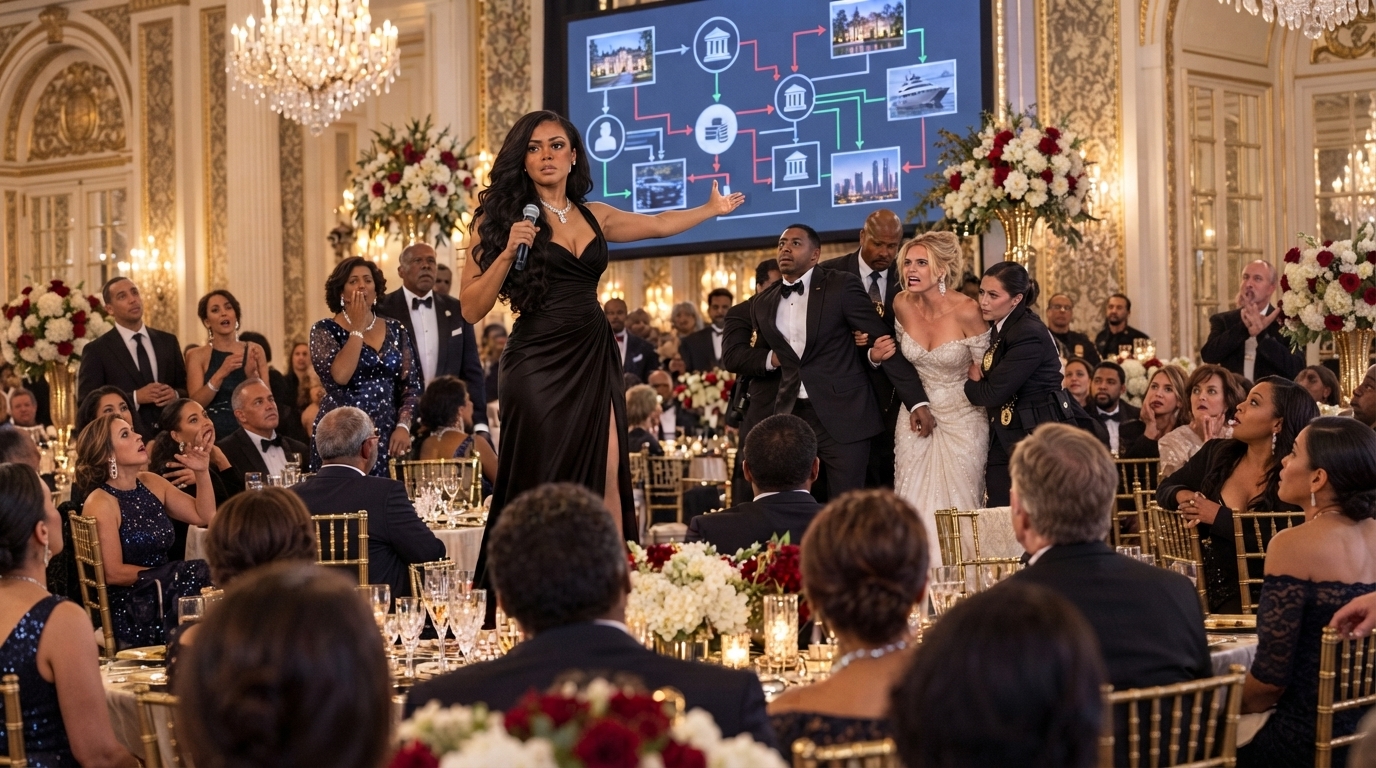
The first document filled the television screen.
It was a property record.
The room became so quiet that
I could hear the fireplace crackling behind us.
At the top of the page was the legal description of
the Buckhead mansion where we were sitting.
Under “Owner,” there was a name.
Not Sterling.
Not Carter.
Not Michael Sterling.
Not my parents.
It was a company.
Meridian Family Holdings, LLC.
My mother stared at the screen.
My father slowly lowered himself into his chair.
Khloe looked at MJ.
“What is Meridian?”
MJ didn’t answer.
I pressed play.
The next document appeared.
A bank transfer.
Then another.
Then another.
Twenty-three monthly payments.
The amounts were different, but the recipient was always the same mortgage servicing company.
The source account was mine.
I heard my aunt whisper, “Naomi…”
My father looked at me.
“You’ve been paying the mortgage?”
“Not exactly.”
“Then what are those?”
“Payments I made to prevent the house from going into default.”
My mother’s face tightened.
“We own this house.”
“No.”
Her eyes widened.
“You’ve always lived here.”
“That isn’t ownership.”
“But your father bought this property.”
I looked at him.
“Did he?”
My father said nothing.
That was when everyone around the table finally noticed the date on the first transfer.
Almost three years earlier.
The same week my father’s restaurant business had quietly collapsed.
The same month MJ had come home promising that his investment fund would solve the family’s financial problems.
The same month I had started receiving calls from creditors asking questions no one in my family would answer.
I pressed another button.
A loan agreement appeared.
Then an amendment.
Then a collateral schedule.
My father leaned forward.
“Where did you get those?”
“Your lender.”
He looked at me.
“How?”
“Because I was the person who paid to cure the default.”
My mother looked horrified.
“You don’t understand.”
“I understand everything.”
MJ finally found his voice.
“You had no right to put this on the television.”
I turned toward him.
“You had no right to tell everyone I was useless while I was quietly keeping your parents in their home.”
He looked down.
Khloe stared at him.
“You told me your father owned the house.”
“He did,” MJ said.
I answered before he could continue.
“Until he pledged it as collateral for a line of credit.”
My father’s face tightened.
“That was temporary.”
“Temporary?”
I swiped to the next page.
The original loan.
The maturity date.
The extension.
The missed payments.
The default notice.
Then my payment confirmation.
Three times.
I had paid the lender using money from a reserve account I had established for family emergencies.
I had never told them.
Why?
Because my mother had begged me.
Not with warmth.
Not with gratitude.
She had done it the only way she knew how.
She had called me selfish.
She had said, “If you have any love for your family, you won’t let your father lose this house.”
So I had paid.
Not because I thought they deserved the house.
Because I couldn’t stomach the thought of my parents being evicted.
And because, despite everything, they were still my parents.
That was the part I had kept from myself.
I had spent years telling people I didn’t care what they thought.
But I had continued rescuing them.
Silently.
Over and over.
MJ stood.
“This is private family business.”
“No.”
I shook my head.
“This is financial business.”
He glared at me.
“Where did you get the records?”
“You left them everywhere.”
I changed the screen again.
This time, a ledger appeared.
A general ledger from MJ’s investment company.
Khloe leaned toward the television.
“What am I looking at?”
I pointed to a line.
“Investor money.”
Then another.
“Family transfers.”
Then another.
“Personal spending.”
Then another.
“Mortgage payments.”
My father looked at MJ.
“What is she talking about?”
MJ finally snapped.
“She doesn’t know how investment businesses work.”
I almost smiled.
“That’s funny.”
I took a sip of water.
“I’m a forensic accountant.”
He said nothing.
“I know exactly how they work.”
Khloe turned toward him.
“MJ.”
He wouldn’t look at her.
“How much of the fund was invested in the mansion?” she asked.
“None.”
I changed the screen.
A property lien appeared.
Then a transfer from one of his investor accounts to a personal account.
Then a payment to a jewelry store.
Then another to a dealership.
Then a wire transfer to an account belonging to Khloe’s fashion company.
Khloe’s face went white.
“That money was from my business.”
“No.”
I looked at her.
“That was money from MJ’s fund.”
Her eyes shifted toward him.
“What?”
“I told you there was a capital contribution.”
He gave her a sharp look.
“You don’t need to get involved.”
“You gave me twenty-five thousand dollars.”
“I gave you an investment.”
“From where?”
He didn’t answer.
Khloe stood up.
“What did you do?”
I pressed play.
The audio recording began.
It had been recorded in my office nearly two years earlier.
I hadn’t been physically present.
But my former assistant had been.
The first voice belonged to MJ.
“We move it now, then replace it next quarter.”
My mother’s voice followed.
“And if the quarter doesn’t come?”
“Then we use the next investor.”
My father spoke.
“This isn’t stealing.”
MJ laughed.
“No. It’s temporary.”
The room changed.
Everyone stopped breathing.
The recording continued.
My mother asked:
“Does Naomi know?”
MJ replied:
“She knows nothing.”
Then my father asked:
“And the house?”
MJ’s voice was calm.
“It’s covered.”
My mother sighed.
“Good.”
I stopped the recording.
No one spoke.
My father looked at me.
“You recorded us?”
“No.”
“Then who did?”
“Does it matter?”
He turned toward MJ.
“M.J., what did you do?”
MJ’s face had gone completely blank.
He looked like a man trying to remember which lie would work best.
Khloe was already crying.
“You told me this fund was clean.”
“It is.”
I laughed.
“That depends on your definition of clean.”
He glared at me.
“You’ve been waiting to do this.”
“No.”
“I knew you hated me.”
“I didn’t hate you.”
“You’re humiliating me.”
I looked around the room.
“You humiliated me first.”
My mother stood.
“You don’t have to do this.”
I turned toward her.
“Yes, I do.”
She shook her head.
“No.”
“You called me useless.”
“I was angry.”
“You told me to surrender my chair.”
“I shouldn’t have.”
“You told me I didn’t contribute.”
Her voice cracked.
“I was wrong.”
I pointed to the screen.
“But you knew.”
She looked down.
“About the house?”
“About everything.”
She didn’t answer.
That was enough.
I pressed another file.
It showed an internal email exchange between MJ and a private lender.
The email said:
Naomi continues to cover the family obligations. Do not contact her directly.
Khloe looked at him.
“You knew she was paying for the house?”
MJ stared at me.
“How long have you been doing this?”
“Two years, eight months.”
His jaw tightened.
“And you never told us?”
“You never asked.”
My mother burst into tears.
“You could have told us.”
“I tried.”
“When?”
“When I asked why Dad’s accounts were behind.”
She shook her head.
“I don’t remember.”
“I do.”
I pulled up a photograph.
It was a screenshot of an email I had sent to my father.
Subject:
URGENT — PLEASE CALL ME ABOUT THE MORTGAGE
He had never replied.
Instead, my mother had sent me a text.
Stop trying to make everything dramatic. MJ is handling it.
I looked at her.
“I believed you.”
She covered her face.
The room stayed silent.
Then my father said the sentence that would haunt me.
“We thought MJ had fixed it.”
I looked at him.
“With what money?”
He didn’t know.
That was the problem.
Nobody had asked where the money came from.
They had just been grateful that the lights stayed on.
That was how MJ had survived.
Not because he was brilliant.
Because everyone loved the story more than the numbers.
I changed the screen again.
This time, there was a spreadsheet titled:
LIABILITIES — Q4
At the bottom was a figure.
A number large enough to make my father’s hands shake.
I looked at MJ.
“Your fund’s obligations exceed its liquid assets by more than fourteen million dollars.”
Khloe whispered, “What?”
He shook his head.
“That’s not accurate.”
“It is.”
“You manipulated the numbers.”
“I rebuilt them from bank statements.”
“You don’t understand our valuations.”
“I don’t need to.”
I pointed to the transfers.
“Cash is cash.”
My brother’s face was pale.
“Naomi.”
I waited.
“Turn this off.”
“No.”
“Please.”
There was something different in his voice now.
Not anger.
Fear.
“Please, Naomi.”
I shook my head.
“You should have thought about that before you called me useless.”
My mother looked at me.
“What do you want?”
I stared at her.
“I wanted you to stop lying.”
She cried.
“I’ll apologize.”
“To whom?”
“To you.”
“And Noah?”
She didn’t understand.
Then my aunt explained.
My mother had not only humiliated me at the table.
She had also mocked my son earlier that afternoon for being “too soft,” because he had challenged MJ when MJ tried to use one of his college accounts to cover a family expense.
My mother looked down.
“I didn’t mean it.”
“That doesn’t matter.”
I turned off the television.
But the damage had already been done.
Nobody touched the food.
The Thanksgiving meal that had started with laughter ended with eight people sitting around a table afraid to speak.
Then MJ stood.
“You think you’ve won.”
I looked at him.
“I didn’t do this to win.”
“Yes, you did.”
“No.”
I pointed toward the television.
“I did it because every number eventually tells the truth.”
He walked toward me.
My father stepped between us.
“Enough.”
MJ stopped.
For the first time in my life, my father wasn’t protecting him.
He was stopping him.
That night, I went home.
I expected to feel relieved.
Instead, I felt sick.
I had spent years protecting those people.
Now I’d exposed them.
Part of me wondered whether I had gone too far.
Then my phone rang.
It was an investigator from a financial regulator.
“Ms. Sterling?”
“Yes.”
“We need to meet with you tomorrow.”
My stomach tightened.
“Why?”
“We received documents from an internal whistleblower.”
“What documents?”
He paused.
“Your brother’s fund.”
“What about it?”
“There may be a second set of books.”
I sat down.
“How serious?”
His voice became careful.
“Serious enough that I would not move, delete, or alter anything.”
I stared into the dark window.
“What did you find?”
“We haven’t found it yet.”
“Then what made you call me?”
“We found a reference to a hidden ledger.”
“Where?”
He said one sentence.
“The family office.”
My blood ran cold.
Because I knew exactly where that was.
My father’s study.
And the last time I had seen the key to it, it was hanging from MJ’s key ring.
PART 4
The next morning, I met the investigators in a conference room downtown.
Two women and a man.
No drama.
No raised voices.
Just files stacked in neat folders.
One of them introduced herself as Elena Ruiz.
She slid a document across the table.
“This was recovered from a deleted cloud directory associated with MJ’s company.”
I looked at the file name.
B-BOOKS_FINAL2
I opened it.
It contained transaction references that didn’t match the official statements submitted to investors.
There were amounts.
Dates.
Initials.
And one repeated notation.
N.S.
My initials.
I frowned.
“What does this mean?”
“We don’t know yet.”
I read the lines.
Some of the transactions were marked with dates from before I ever worked with MJ.
One was a transfer involving a company in Delaware.
Another involved a property in Florida.
Another involved a private lender.
Then I found something much worse.
A notation beside one transaction:
N. will cover family exposure.
I sat back.
“They thought I’d pay.”
Elena nodded.
“That’s what it appears to say.”
I looked at another page.
There were notes about my accounting background.
She notices inconsistencies. Keep her outside the reporting chain.
Another line:
Use mother to manage emotional pressure.
I stopped reading.
That sentence hurt more than the money.
Because it meant my brother had studied me.
He knew exactly how to keep me away from the truth.
He knew my mother would shame me.
He knew my father would dismiss me.
He knew I would eventually step in and pay because I couldn’t watch the family fall apart.
The investigators showed me another document.
A draft agreement.
My name appeared on it.
I had never signed it.
It would have made me personally responsible for certain obligations if MJ’s company failed.
I stared at the signature.
It looked convincing.
But it wasn’t mine.
“How many?”
“Three,” Elena said.
“Three what?”
“Potentially forged documents involving you.”
I closed my eyes.
The room went quiet.
One investigator asked:
“Do you want to know who authorized them?”
“Yes.”
He slid over a copy of an email.
The sender was MJ.
The recipient was my mother.
The subject line:
Need her signature.
My mother had replied:
She won’t give it willingly.
MJ wrote:
Then we’ll make her think she already agreed.
I felt something inside me go numb.
I had suspected betrayal.
I hadn’t expected strategy.
This was not a brother who had made desperate mistakes.
This was a brother who had planned around me.
They hadn’t simply used my money.
They had planned to make me responsible for their debt.
That was the point of the hidden documents.
If the fund collapsed, creditors could come after assets linked to me.
The woman they called useless had been the shield.
And they had never intended to tell me.
I asked Elena:
“What happens next?”
“That depends on what the evidence establishes.”
“Can I access the family office?”
“We will need the records preserved.”
“I can get them.”
She looked at me.
“How?”
“My father still has the key.”
I called him.
He answered immediately.
“Naomi.”
“Dad.”
Silence.
“I need access to your study.”
“No.”
“Why?”
“Because this has gone far enough.”
I laughed.
“No, Dad.”
“What?”
“This is exactly why it hasn’t gone far enough.”
He sighed.
“What do you think you’ll find?”
“The second ledger.”
Silence.
Then:
“How do you know about that?”
My heart stopped.
“You know what I’m talking about.”
He didn’t answer.
“Dad?”
“I don’t know where it is.”
“You knew it existed.”
“I heard MJ talk about it.”
“What did he say?”
He hesitated.
“He said it was a backup.”
“Backup of what?”
“I don’t know.”
I sat back.
“You can lie to the investigators.”
“I am not lying.”
“You kept your hand around that crystal glass while Mom called me useless.”
His voice broke.
“I was trying to keep peace.”
“You have called everything peace.”
He was quiet.
“Do you know what peace looks like to me?”
No answer.
“It looks like me paying your mortgage.”
Silence.
“It looks like me fixing your accounts.”
Silence.
“It looks like me sitting at a Thanksgiving table while my mother tells me I’m worthless.”
I heard him inhale.
“I’m sorry.”
It was the first apology my father had ever given me without attaching a condition.
I almost softened.
Then he said:
“Come tomorrow.”
I knew immediately something was wrong.
“Why not today?”
“Because I need to talk to MJ first.”
“No.”
I hung up.
We went to the house that afternoon.
My father opened the door himself.
He looked exhausted.
I walked directly to the study.
The key was no longer on the hook.
“Where is it?”
He looked down.
“M.J. has it.”
Of course.
The study was locked.
My father said, “He took it after the board meeting.”
I stared at him.
“Why didn’t you stop him?”
“Because I was afraid.”
“Of him?”
He nodded.
That admission changed me.
My father, who had spent years presenting himself as the strongest man in the family, was afraid of his own son.
We called a locksmith.
The investigators stayed outside while we entered.
The study looked ordinary.
Bookshelves.
Old ledgers.
A desk.
Framed photographs.
My father’s military medals.
I searched the obvious places.
Nothing.
Then I remembered something.
My father had always kept important documents behind a false panel in the bottom drawer.
I pulled it open.
The panel moved.
Behind it was a metal box.
Inside was a USB drive.
A handwritten notebook.
And a key.
Not to the study.
To a storage unit.
I looked at my father.
He whispered:
“M.J. doesn’t know about that.”
We went to the storage facility.
The unit contained boxes of financial documents.
Some belonged to my father.
Some belonged to MJ.
One contained old family tax returns.
Another contained investment agreements.
Then I found the ledger.
It was handwritten.
No software.
No cloud.
No digital trail.
A private ledger.
The second set of books.
I opened it.
Every transfer was there.
Every payment.
Every hidden liability.
Every personal purchase.
Every family obligation charged to MJ’s fund.
And beside several transactions was a single letter.
N.
Mine.
I kept turning pages.
Then I saw something that made me freeze.
A transfer to an account in my mother’s name.
$480,000.
Date: eighteen months earlier.
Purpose:
ADVANCE — FAMILY SECURITY
I looked at my mother.
She wasn’t there.
My father was.
“What’s this?”
He stared at it.
“I didn’t know.”
I flipped the page.
Another transfer.
$220,000.
Then another.
$150,000.
All to my mother.
I stared at the pattern.
“This money didn’t go into the family.”
My father looked confused.
“Where did it go?”
I traced the receiving account.
It belonged to a trust.
The beneficiary wasn’t my mother.
It was MJ.
I closed the ledger.
“He was moving investor money through Mom.”
My father sat down.
“Oh God.”
There was more.
The trust had purchased securities.
Then the securities had been liquidated.
The proceeds had gone toward personal debts.
The fund had been using the family as a maze.
Money went through one account.
Then another.
Then another.
By the time anyone asked where it came from, the trail looked like ordinary family transfers.
But numbers don’t forget.
Neither do bank records.
Then we found an audio recording.
It wasn’t mine.
It had been made by my father.
He had recorded a conversation with MJ six months earlier.
The recording started mid-sentence.
MJ said:
“If Naomi finds out, we’re finished.”
My mother answered:
“She won’t.”
MJ said:
“She always notices numbers.”
My mother’s voice was calm.
“Then give her something else to notice.”
There was a pause.
“What?”
“Make her feel insulted.”
My stomach turned.
MJ laughed.
“That’s easy.”
My mother replied:
“She’ll walk away angry.”
The recording ended.
I sat in silence.
My father covered his face.
“They planned it,” he whispered.
“Yes.”
“I didn’t know.”
I looked at him.
“You knew enough.”
He didn’t argue.
Then he said:
“I thought the embarrassment would pass.”
I shook my head.
“No.”
“What?”
“They didn’t embarrass me because they were careless.”
I looked at the ledger.
“They embarrassed me because it was a strategy.”
My father started crying.
Not quietly.
Not elegantly.
He broke.
“I should have protected you.”
“Yes.”
“I should have asked what was happening.”
“Yes.”
“I was proud of him.”
“I know.”
He looked at me.
“I thought you were okay.”
“I wasn’t.”
He nodded.
“I know that now.”
The investigators collected the ledger.
They secured the storage unit.
They copied the recordings.
They preserved the original devices.
By the next week, the financial inquiry had expanded.
MJ’s firm was no longer just facing questions about poor performance.
There were questions about hidden transfers.
Undisclosed liabilities.
Potential misuse of funds.
Potential forged documents.
And family members who had benefited from transactions they had not properly understood.
Khloe separated from MJ.
That part happened quickly.
She called me herself.
“I should have listened.”
“To what?”
“To the way you talked about his books.”
I sighed.
“I wasn’t trying to ruin you.”
“I know.”
She started crying.
“I thought you were jealous.”
I almost smiled.
“Everybody did.”
She was silent.
Then she asked:
“Did he use my company too?”
I answered honestly.
“Yes.”
“How much?”
“I don’t know yet.”
She whispered:
“I want to cooperate.”
I gave her Elena’s contact information.
Three days later, Khloe handed over emails, account statements, and messages showing that MJ had used her company as another layer in the money trail.
The case grew.
My mother’s attorney called.
Then my father’s.
Then MJ’s.
Everyone suddenly wanted to negotiate.
Everyone suddenly wanted privacy.
Everyone suddenly wanted the family to “heal.”
The same people who had laughed at me now wanted quiet.
But quiet was exactly how we had gotten there.
I refused every request to suppress the records.
Not because I wanted revenge.
Because I had finally learned that protecting people from consequences is sometimes the thing that keeps them from changing.
Then one morning, I received a call from Elena.
“Naomi.”
“Yes?”
“We found the transfer that ties everything together.”
My heart raced.
“What transfer?”
“The one that explains why they were so determined to control your assets.”
She paused.
“You were never the backup plan.”
“What do you mean?”
“You were the exit strategy.”
I sat down.
“How?”
“They had planned to move enough liabilities onto you that when the fund failed, your personal assets would absorb the loss.”
I stared at the wall.
“That’s why the forged documents existed.”
“Yes.”
“They wanted me legally connected.”
“Yes.”
“And the house?”
“Collateral.”
“The mortgage?”
“Part of the same structure.”
“The family?”
She hesitated.
“Leverage.”
I closed my eyes.
Then I said:
“I want every document.”
“You’ll get them.”
I hung up.
For the first time, I didn’t cry.
I simply sat there and understood.
They hadn’t been trying to take my seat at the Thanksgiving table.
They had been trying to take my future.
And they had assumed I would apologize while they did it.
That was their final mistake.
PART 5
The hearing took place months later.
There were no reporters outside.
No television cameras.
No dramatic music.
Just paperwork.
That was appropriate.
Because paperwork was where the truth had been hiding all along.
MJ sat at one table with his attorneys.
My mother sat behind him.
My father sat alone.
Khloe was not there.
I sat across from them with my attorney and the forensic team.
The judge reviewed the records.
The official statements.
The reconstructed statements.
The mortgage documents.
The hidden ledger.
The email trails.
The forged agreements.
The recordings.
The transfers.
The property records.
One page at a time.
No shouting.
No theatrics.
Just numbers.
My attorney presented the evidence showing that the Buckhead mansion had been placed under Meridian Family Holdings after my father’s original financing collapsed.
The payments I had made were documented.
Every transfer.
Every date.
Every amount.
Then came the investment fund records.
The official books.
The hidden books.
The discrepancy.
The judges don’t decide these cases by watching someone’s face.
They look at documents.
They compare timelines.
They ask what happened.
That was why I had always trusted numbers.
Numbers don’t care who is sitting at the table.
They don’t care whose child you are.
They don’t care who wears designer clothes.
They don’t care who tells the better story.
They show what moved.
Where it went.
And when.
An expert testified about the accounting reconstruction.
She explained that several personal expenses had been recorded as business expenses.
She explained the hidden liabilities.
She explained the movement of money through multiple accounts.
She explained the discrepancies between the investor statements and the underlying transactions.
Then my attorney introduced the recordings.
My mother’s voice filled the room.
“Make her feel insulted.”
My brother’s voice followed.
“She’ll walk away angry.”
The room went silent.
My mother stared at the floor.
The recording continued.
Then the judge asked:
“Who made this recording?”
My father raised his hand.
The judge looked at him.
“You understand the significance of this evidence?”
“Yes.”
My father spoke quietly.
“I do now.”
Then it was my turn.
I took the witness stand.
My attorney asked only a few questions.
Who paid the mortgage?
I did.
Why?
“To prevent the house from going into default.”
Did you know you were being positioned as responsible for your brother’s liabilities?
“No.”
Did you authorize the documents bearing your name?
“No.”
Did you ever agree to those financial obligations?
“No.”
Why did you remain silent for so long?
I thought about that.
Then I answered:
“Because I believed I was protecting my family.”
My attorney asked:
“What changed?”
I looked across the room.
“My mother told me I was useless.”
A few people shifted.
I continued.
“And I realized that the person who had been protecting them was me.”
My attorney nodded.
“No further questions.”
The opposing attorney cross-examined me.
“You were aware your brother had financial difficulties?”
“Yes.”
“You continued assisting him?”
“Yes.”
“You gave him money?”
“No.”
“You paid family obligations?”
“Yes.”
“So you willingly supported the family’s finances?”
“Yes.”
“Then why are you claiming you were deceived?”
I looked at him.
“Because paying a bill is not consenting to fraud.”
Silence.
He moved on.
“You have admitted you wanted to expose your brother.”
“I wanted the truth documented.”
“You displayed private records publicly.”
“At the Thanksgiving table?”
“Yes.”
I thought about that night.
Twenty people.
One chair.
One insult.
One sentence.
The useless daughter.
I answered:
“I showed documents after being publicly humiliated and accused of contributing nothing. The records explained why I reacted the way I did.”
He nodded.
“You could have handled this privately.”
“I tried for years.”
No one spoke.
He sat down.
Then something unexpected happened.
My father asked to testify.
His attorney objected.
The judge allowed it.
He walked to the witness stand slowly.
He looked at me before sitting.
“I need to tell the truth.”
The judge asked him what he knew.
He began with the mortgage.
Then the investment fund.
Then the pressure.
Then the lies.
Then the recordings.
He admitted that he had suspected something was wrong but had chosen not to confront MJ because he was afraid of losing his son.
That statement caused my mother to start crying.
The judge asked:
“Did you know that your daughter was covering the mortgage?”
“Yes.”
I looked at him.
He swallowed.
“I knew she had been helping.”
“How long?”
“Almost three years.”
That hurt.
Even though I already knew.
He had known.
And still, at Thanksgiving, he had watched my mother call me useless.
The judge asked:
“Why didn’t you intervene?”
My father looked at me.
“Because I had convinced myself she could handle it.”
The courtroom was silent.
Then he said:
“That was wrong.”
My mother eventually testified too.
She denied knowing every detail.
She admitted knowing enough.
She admitted receiving money.
She admitted she had pressured me emotionally.
She admitted she had helped create the appearance that MJ was financially successful.
She admitted that she had treated me as though my role was to rescue everyone else.
Then she looked at me.
“I am sorry.”
I didn’t respond.
Not because I didn’t hear her.
Because some apologies are too late to fix what they are apologizing for.
The financial case continued after the hearing.
There were negotiations.
There were recoveries.
There were disputes.
Some money was traced.
Some assets were sold.
Some obligations were restructured.
The outcome was not simple.
Real life rarely is.
But the biggest thing changed immediately.
The family narrative ended.
MJ was no longer the golden son who had everything under control.
He was a man answering serious questions about decisions he had made.
My father stopped pretending not to know.
My mother stopped pretending my silence was consent.
And I stopped pretending I was responsible for keeping everyone comfortable.
The Buckhead mansion was eventually sold.
Not because I wanted it.
Because the family couldn’t maintain it under the existing financial structure.
The sale satisfied the legitimate debt tied to the property.
Whatever remained was divided according to the legal ownership and obligations established through the proceedings.
I did not take the house.
I didn’t need it.
I had my own home.
My own work.
My own life.
What mattered to me was that nobody could ever again say I had contributed nothing.
Because the records showed otherwise.
For years, I had paid bills no one thanked me for.
I had protected assets no one respected.
I had found problems no one wanted to hear about.
And when I finally stopped doing it, everything collapsed into view.
A few months after the case settled, I returned to the restaurant where I had worked during college.
It was smaller than I remembered.
The tables were scratched.
The lights were old.
The coffee tasted exactly the same.
I sat at the counter with a notebook.
The owner recognized me.
“Naomi?”
I smiled.
“Hi.”
“Look at you.”
I laughed.
“Look at me.”
He brought me coffee.
“No charge.”
I raised an eyebrow.
“You still haven’t learned.”
He laughed.
“I remember when you used to check my inventory numbers.”
“I was seventeen.”
“You were terrifying.”
I smiled.
“I’m still terrifying.”
He laughed.
But this time, I understood something.
I had spent years measuring my worth by what my family thought.
I had thought that if I became successful enough, they would eventually admit they were wrong.
They didn’t.
Not until they had no choice.
And by then, I didn’t need them to.
That was the real lesson.
Not that I was smarter than them.
Not that I had more money.
Not that I had the better career.
It was that I had finally stopped asking people who benefited from my silence to validate my voice.
My mother occasionally calls now.
Sometimes we talk.
Sometimes we don’t.
My father sends messages on holidays.
We are rebuilding something slowly.
But it isn’t the old family.
I don’t want the old family.
The old family required me to disappear whenever someone more important walked into the room.
The old family called cruelty honesty.
The old family called manipulation protection.
The old family called silence peace.
I don’t live there anymore.
MJ and I haven’t spoken privately since the hearing.
Maybe someday.
Maybe not.
I don’t know.
And for once, I don’t feel guilty about not knowing.
Khloe moved away.
She started rebuilding her own business.
She returned money she could verify wasn’t hers.
She also sent me a letter.
“I spent years believing the person who looked successful must be honest.”
That line stayed with me.
Because it was exactly what my family had believed.
They had mistaken presentation for character.
Income for integrity.
Confidence for competence.
And appearances for truth.
At the next Thanksgiving, I hosted dinner at my own house.
There were twelve people.
Not twenty.
No marble table.
No giant chandelier.
No performance.
Just good food and people who actually wanted to be there.
My father came.
My mother came.
My aunt came.
A few friends came.
I set my own place at the table.
Then I looked around.
Nobody was waiting to see who deserved the chair.
Nobody was measuring anyone’s contribution.
Nobody was keeping score.
My father raised his glass.
“To family.”
I smiled.
“To honest family.”
He nodded.
My mother looked at me.
“I deserve that.”
“Yes,” I said.
We all laughed.
Later that night, after everyone had gone, I sat alone at the table.
I thought about that Thanksgiving years ago.
My mother’s finger pointing toward the kitchen.
Her voice telling me to give up my chair.
The laughter.
MJ’s silence.
Khloe’s smile.
My father’s wine glass.
And then my own voice.
“It feels great. Especially since I just stopped paying your rent.”
At the time, I thought that sentence was the beginning of the end.
It wasn’t.
It was the beginning of the truth.
Because the moment I stopped paying was the moment I stopped hiding what was happening.
The moment I stopped covering their bills was the moment their numbers became visible.
The moment I stopped protecting their image was the moment their reality finally had to stand on its own.
And I learned something I wish I’d understood when I was twenty-three.
You can love your family without financing their lies.
You can forgive someone without giving them control of your life.
You can walk away without becoming cruel.
And you can sit at your own table without asking anyone whether you’re worthy of the chair.
I opened my accounting notebook.
On the first page, I had written something Aunt Denise used to say:
Every imbalance leaves a trail.
I added another sentence beneath it.
So does every betrayal.
Then I closed the book.
The house was quiet.
The dishes were done.
The lights were low.
For the first time in years, I wasn’t wondering what my family thought of me.
I wasn’t wondering whether they were proud.
I wasn’t wondering whether I had done enough.
I was just grateful.
Grateful that I had learned to trust facts.
Grateful that I had stopped confusing silence with peace.
Grateful that I had finally realized my worth didn’t come from being needed.
And most of all, grateful that when my mother told me to give up my chair for someone who “actually contributes to this family,” I finally understood what she had been asking me to do for years.
Disappear.
Make room.
Stay quiet.
Keep paying.
Keep protecting.
Keep swallowing.
I had done that long enough.
So I stood.
I walked away from the table.
And this time, nobody could tell me where to sit.
Because I had built my own table.
And I knew exactly what every seat was worth.
THE END THANK YOU FOR READING !!!