PART 2
The paramedic stood in front of us,
holding the elderly woman’s worn brown purse.
His expression was strange,
almost as though he couldn’t decide whether to smile or cry.
“Are you Marcus Bennett?” he asked.
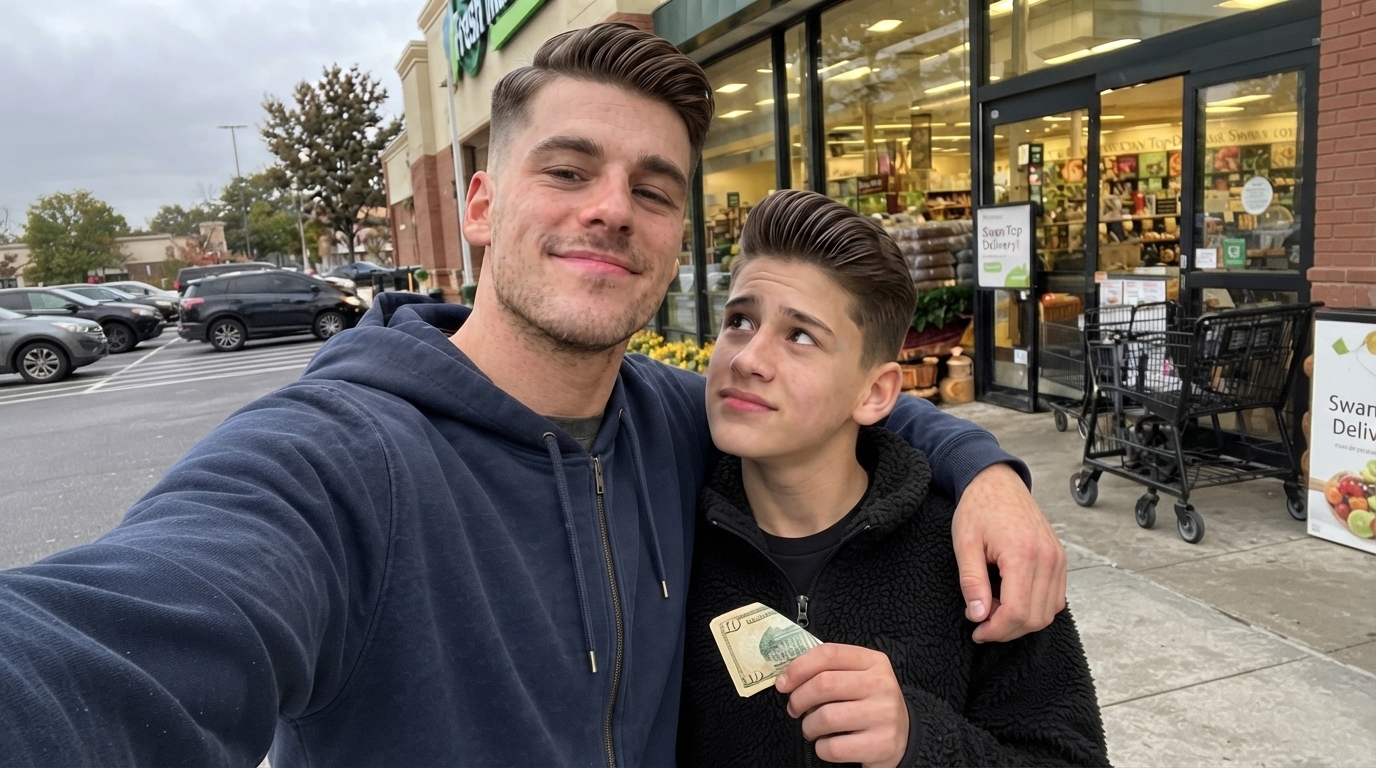
I tightened my arm around Theo’s shoulders.
“Yes. Why?”
He glanced toward the ambulance,
where the elderly woman was being examined.
Her name is Eleanor Whitmore.
SHE’S seventy-eight years old.
And before we brought her outside, she asked me to make sure you and your brother didn’t leave.”
I frowned.
“Does she need something?”
The paramedic shook his head.
“Apparently, she recognized your brother.”
I looked down at Theo.
He was rubbing the corner of his grocery list between his fingers, a habit he had whenever too many people were talking around him.
“Theo,” I asked gently, “do you know that woman?”
He nodded.
“Mrs. Whitmore.”
My stomach tightened.
“How do you know her?”
“Blue house. White fence. Three streets from our apartment. She feeds birds at seven fifteen every morning.”
I blinked.
“You’ve spoken to her?”
“Fourteen times.”
Fourteen.
My little brother had apparently been having conversations with a stranger, and I knew absolutely nothing about it.
Before I could ask another question, the paramedic continued.
“She also said your brother has been helping her for months.”
I stared at him.
“That can’t be right.”
Theo looked up.
“It’s right, Marcus.”
His voice was so matter-of-fact that I almost laughed.
Except nothing about this situation felt funny.
“Theo, what exactly have you been doing?”
He hesitated.
Then he reached into his jacket pocket and pulled out a folded piece of paper.
It was covered in his neat handwriting.
At the top were three words.
MRS. WHITMORE’S SCHEDULE.
Underneath was a list.
Monday: Trash cans.
Wednesday: Mailbox.
Friday: Grocery bags.
Every morning: Check birds.
I read it twice.
“Theo, you’ve been helping her with all this?”
He nodded.
“She has arthritis. Her hands hurt. The trash cans are heavy.”
I felt something twist inside my chest.
“How did you even meet her?”
“She dropped oranges.”
“What?”
“Six months ago. On Maple Street. The bag broke. Eleven oranges rolled onto the sidewalk. I picked up ten. One went under a car. She said thank you.”
I remembered that afternoon.
Theo had come home seventeen minutes later than usual after walking with me from his school bus stop.
When I’d asked why, he’d said he had been helping someone.
I’d assumed he meant a teacher or another student.
I hadn’t asked anything else.
Now I wished I had.
“She was sad,” Theo added.
“How do you know?”
“She cried when she thought nobody was looking.”
The paramedic lowered his eyes.
Theo continued.
“She said her husband died. She said her son doesn’t visit. She said the house is too quiet.”
I swallowed.
“And what did you say?”
Theo looked confused by the question.
“I told her quiet houses need clocks.”
The cashier standing beside us let out a small, broken laugh.
Theo continued.
“Then I told her she could talk to me when we walked past. She said she would like that.”
For a moment, nobody spoke.
Then the paramedic gently touched my shoulder.
“She wants to thank him herself. Can you wait a few minutes?”
I nodded.
But before we could move, Theo asked something that made my heart ache.
“Marcus, am I in trouble?”
I turned toward him immediately.
“No. Absolutely not.”
“I didn’t follow the instructions.”
“What instructions?”
“Chocolate. Pay. Receipt. Come back.”
He stared at the floor.
“I didn’t buy the chocolate. I didn’t get the receipt. I stayed inside too long.”
His voice began trembling.
“I made a mistake.”
I knelt in front of him.
“Theo, look at me.”
He kept his eyes on my shoulder, which was how he often listened when direct eye contact felt uncomfortable.
“You didn’t make a mistake. Someone needed help, and you helped her.”
“But the list—”
“The list was practice. Helping someone in an emergency was more important.”
He considered that carefully.
“Can we change the list?”
I smiled through tears.
“Yes, buddy. We can change the list.”
He unfolded the paper, borrowed my pen, and wrote a new instruction beneath the others.
If someone is hurt, get help first.
I couldn’t speak.
For six years, I’d been terrified that the world would swallow my brother whole.
I’d worried about people laughing at him.
About strangers misunderstanding him.
About employers rejecting him someday.
About what would happen if I got sick, lost my job, or simply wasn’t there when he needed someone.
And while I’d been worrying about whether Theo could handle the world, he’d quietly been making one lonely woman’s world a little easier.
A few minutes later, the paramedic returned.
“She’s stable enough to speak briefly before we take her to the hospital.”
We followed him toward the ambulance.
Mrs. Whitmore lay on the stretcher with a blanket pulled over her legs.
Her face was pale, but when she saw Theo, her entire expression changed.
“There he is,” she whispered.
Theo stepped forward.
“Your blood pressure was low.”
She smiled.
“So they tell me.”
“You should drink water when the doctor says it’s okay.”
“I will.”
“And don’t stand up too fast.”
She laughed softly.
“I promise.”
Then she reached for his hand.
“Sweetheart, you were very brave.”
Theo looked uncomfortable.
“I wasn’t brave. I was scared.”
Mrs. Whitmore squeezed his fingers.
“Being scared doesn’t mean you weren’t brave.”
He thought about that.
Then he nodded.
“Okay.”
She turned toward me.
“You must be Marcus.”
“Yes, ma’am.”
Her eyes filled.
“Your brother talks about you all the time.”
I glanced at Theo.
“He does?”
“Oh, yes. He tells me you’re the person who makes pancakes shaped like dinosaurs. That you work two jobs. That you never forget to put his headphones in his backpack.”
I felt my throat tighten.
“And he tells me,” she continued, “that you stayed when everyone else left.”
My breath caught.
Theo stared at the ambulance floor.
Mrs. Whitmore looked at him with extraordinary tenderness.
“He once told me he didn’t understand why his parents stopped wanting him.”
I closed my eyes.
Those words hit harder than anything I’d heard in years.
Because Theo had never asked me that question directly.
Not once.
I’d assumed he had accepted what happened.
I’d mistaken silence for healing.
Mrs. Whitmore continued quietly.
“He said maybe he was too much work. Maybe he asked too many questions. Maybe people would like him more if he were different.”
I felt tears spill down my cheeks.
“Theo,” I whispered.
He pressed his lips together.
“I didn’t want to make you sad, Marcus.”
I crouched beside the stretcher.
“Buddy, listen to me. You were never too much work.”
He looked away.
“Mom said I was.”
The words landed like stones.
I remembered our mother standing in the kitchen six years earlier, holding a brochure for a residential facility.
I remembered her saying she deserved a normal life.
I remembered Theo sitting on the stairs, listening.
I’d told myself he was too young to understand.
But he’d understood every word.
I took his hand.
“Mom was wrong.”
He didn’t answer.
“She was wrong about you then, and she’s wrong about you now. You never had to earn the right to be loved.”
Theo’s fingers tightened around mine.
Mrs. Whitmore watched us with tears shining in her eyes.
Then she said something I would remember for the rest of my life.
“Marcus, your brother didn’t save me today because he’s different from other people. He saved me because he paid attention when someone needed him. That’s something the world could use more of.”
The paramedic gently interrupted.
“We need to get moving.”
Mrs. Whitmore nodded.
But before they closed the ambulance doors, she caught my sleeve.
“Please come visit me when I’m better.”
“Of course.”
“And Marcus?”
“Yes?”
“There’s something in my house I want to show you.”
I frowned.
“What is it?”
She smiled faintly.
“Something your brother helped me find again.”
Then the doors closed.
The ambulance pulled away.
And I stood in the parking lot with Theo beside me, wondering how many parts of my little brother’s life I’d never really seen.
That evening, I made Theo’s favorite dinner.
Chicken nuggets, mashed potatoes, and sliced apples arranged in three separate sections of his plate.
He sat at the kitchen table wearing his noise-canceling headphones.
I sat across from him.
For a while, neither of us spoke.
Then he removed one side of his headphones.
“Marcus?”
“Yeah?”
“Was Mrs. Whitmore telling the truth?”
“About what?”
“Being brave.”
I set down my fork.
“Absolutely.”
He stared at his plate.
“People at school say I’m stupid.”
My stomach turned.
“Who says that?”
“Different people.”
“Why didn’t you tell me?”
He shrugged.
“You get tired.”
I froze.
“What?”
“You work at the warehouse in the morning. Then the restaurant at night. Sometimes you fall asleep sitting up. I didn’t want to give you another problem.”
I pushed my chair back and moved beside him.
“Theo, you’re not a problem.”
He nodded, but I could tell he wasn’t convinced.
So I told him something I’d never said aloud.
“When Mom left, I was scared every single day.”
He looked at me.
“I didn’t know how to raise a nine-year-old. I didn’t know how to pay rent. I didn’t know what I was doing half the time.”
“You made mistakes?”
“So many.”
“You burned spaghetti.”
I laughed.
“Three times.”
“You forgot picture day.”
“Twice.”
“You cried in the bathroom.”
My smile disappeared.
I stared at him.
“You knew?”
Theo nodded.
“The walls are thin.”
I covered my face.
All those nights when I’d turned on the shower so he wouldn’t hear me crying.
All those mornings when I’d smiled and pretended everything was fine.
He had known.
He had always known.
Theo leaned closer.
“You were scared, but you stayed.”
I looked at him through my tears.
Then he repeated Mrs. Whitmore’s words.
“Being scared doesn’t mean you weren’t brave.”
I pulled him into my arms.
And for the first time in six years, I let myself cry without hiding it.
Three days later, Mrs. Whitmore called.
She was home from the hospital, recovering, and wanted us to visit.
Theo insisted we bring something.
“Flowers?” I suggested.
“No. Flowers die.”
“Cookies?”
“She has diabetes.”
“What about a card?”
He considered that.
Then he disappeared into his bedroom.
An hour later, he emerged holding a small wooden birdhouse.
He’d built it in school.
The roof was crooked, and one side had too much blue paint.
But he’d written something on the bottom.
FOR MRS. WHITMORE. SO YOUR HOUSE IS NEVER TOO QUIET.
I almost cried again.
We arrived at her house on Sunday afternoon.
The white fence needed painting.
The front steps were cracked.
A wind chime hung beside the porch.
Mrs. Whitmore opened the door slowly, leaning on a cane.
When she saw the birdhouse, she pressed one hand against her chest.
“Oh, Theo.”
“It’s not waterproof yet,” he explained. “Marcus can help me seal it.”
She smiled.
“I would love that.”
We followed her inside.
The house smelled of cinnamon and old books.
Photographs covered the walls.
There were pictures of a younger Eleanor with her husband, wedding photographs, holiday dinners, and a little boy with dark curly hair.
But what caught my attention was the dining room.
A large table stood near the window.
And on that table were dozens of envelopes.
Every envelope had a name written on it.
I recognized one immediately.
THEO BENNETT.
I stopped walking.
“Mrs. Whitmore?”
She turned.
“Yes, dear?”
“What are these?”
Her smile faded into something more serious.
“Letters.”
“To whom?”
“People who helped me remember why I still wanted to be here.”
I looked at Theo.
He was studying a photograph of a cardinal.
Mrs. Whitmore picked up the envelope with his name.
“Your brother has done more for me than either of you realizes.”
Then she handed it to me.
“Read this when you get home.”
I accepted it carefully.
But before I could thank her, she added something that made my heart stop.
“And Marcus, there’s one more thing.”
She pointed toward the hallway.
“My son is coming tomorrow. He hasn’t spoken to me properly in eleven years.”
I frowned.
“Why now?”
Her eyes filled with tears.
“Because the hospital called him. And because I told him what your brother did.”
She took a trembling breath.
“He said he wanted to meet Theo.”
I glanced at my brother.
He was smiling at the bird photograph, completely unaware of the conversation.
Then Mrs. Whitmore whispered:
“I’m hoping your brother can help me do something I’ve been afraid to do for a very long time.”
PART 3
The following afternoon, my phone rang while I was folding laundry.
It was Mrs. Whitmore.
“Marcus, I’m sorry to bother you.”
“You’re not bothering me. Is everything okay?”
There was a long silence.
Then I heard her crying.
“My son came.”
I stopped folding.
“Is he still there?”
“Yes.”
“What happened?”
“He brought his daughter.”
I frowned.
“Your granddaughter?”
“Yes. Her name is Lily. She’s sixteen.”
Mrs. Whitmore’s voice trembled.
“And she wants to meet Theo.”
I looked toward the living room.
Theo was sitting on the floor, organizing his collection of model trains by color.
“Why?”
Mrs. Whitmore hesitated.
Then she whispered, “Because she’s autistic too.”
I sat down slowly.
For a moment, I couldn’t find the right words.
“My son and I stopped speaking after my husband died,” she explained. “We argued about the house, about money, about things that seem so foolish now. I was stubborn. He was angry. Neither of us knew how to apologize.”
She took a shaky breath.
“Then Lily was diagnosed when she was eleven. My son said he didn’t know how to help her. He said he was frightened about her future.”
I closed my eyes.
I knew that fear.
I knew it better than almost anything.
“He told me he’d spent years trying to make everything easier for her,” Mrs. Whitmore continued. “But lately she’s been refusing to leave the house because some girls at school have been bullying her.”
My heart sank.
“He told her about Theo saving my life. And now she wants to ask him how he learned to be brave.”
I looked at my little brother.
Six years ago, I’d held his hand while he cried because our mother had left.
Three days ago, he’d held a stranger’s hand while she waited for an ambulance.
And now another frightened teenager wanted to meet him.
“Let me ask Theo,” I said.
When I explained the situation, Theo listened without interrupting.
Then he asked, “Does Lily like trains?”
“I don’t know.”
“Does she like birds?”
“I’m not sure.”
He frowned.
“What does she like?”
“I can ask.”
He thought for a moment.
“Tell her she doesn’t have to talk if she doesn’t want to.”
I smiled.
“Okay.”
“And tell her I don’t like people touching my trains without asking.”
I laughed.
“I’ll mention that too.”
He nodded.
“Then she can come.”
Lily arrived at our apartment the next Saturday with her father, David Whitmore.
David was a tall man in his forties, wearing an expensive jacket and an expression that reminded me of myself after a long night shift.
Exhausted.
Worried.
Trying desperately not to show it.
Lily stood slightly behind him.
She had dark hair, oversized headphones, and a small notebook pressed against her chest.
Theo opened the door before I could reach it.
“Hello,” he said.
Lily nodded.
“Hello.”
“Do you like trains?”
She blinked.
“Not really.”
“Okay.”
He stepped aside.
“I have birds too.”
Lily looked at him.
“What kind?”
“Mostly drawings. But I know forty-three bird calls.”
For the first time, she smiled.
“Can you do an owl?”
Theo immediately made an astonishingly accurate owl sound.
Lily laughed.
It was a small laugh.
But David turned toward me so quickly that I knew it was something he hadn’t heard in a long time.
Within ten minutes, the two teenagers were sitting at our kitchen table.
Theo showed Lily his bird sketches.
Lily showed him her notebook.
It was filled with beautiful drawings of buildings.
Libraries.
Museums.
Train stations.
Entire imaginary cities.
“You made these?” Theo asked.
She nodded.
“They’re not very good.”
Theo frowned.
“That’s incorrect.”
Lily looked startled.
He pointed to a drawing.
“Your perspective is accurate. The windows are symmetrical. The stairs would need a railing, but the building is good.”
Lily stared at him.
Then she laughed again.
“You’re very literal.”
“Yes.”
“Me too.”
“Good.”
They went back to drawing.
David watched from the doorway.
His eyes were wet.
“I haven’t seen her this relaxed around someone new in years,” he whispered.
I nodded.
“They understand each other.”
He looked at me.
“Eleanor told me you’ve been raising Theo since you were nineteen.”
“Yes.”
“Alone?”
“Mostly.”
He shook his head.
“That must have been hard.”
I smiled faintly.
“Some days.”
David looked toward the kitchen.
“I’ve spent five years wondering whether I’m doing enough for Lily.”
I understood immediately.
“I’ve spent six years wondering the same thing.”
He looked surprised.
“But Theo saved my mother’s life.”
“That doesn’t mean I never get things wrong.”
I leaned against the wall.
“Sometimes I protect him too much. Sometimes I forget that he’s fifteen, not nine. Sometimes I worry so much about what might happen that I forget to let him experience what actually could happen.”
David was quiet.
Then he said, “I think I do that with Lily.”
We stood there watching our younger siblings and children talk.
Two adults who loved them.
Two adults who were terrified of failing them.
And two teenagers who, at that very moment, were doing perfectly well without our interference.
A month later, something unexpected happened.
Mrs. Whitmore invited us to dinner.
When we arrived, David and Lily were already there.
The dining table was covered with homemade food.
There were chicken nuggets for Theo.
Plain pasta for Lily.
And a chocolate cake with no frosting because Theo disliked the texture.
Mrs. Whitmore had remembered everything.
After dinner, she stood slowly and tapped her glass.
“I have something to say.”
Theo immediately looked up.
“Is it a speech?”
She smiled.
“Yes.”
“How long?”
“About three minutes.”
He checked his watch.
“Okay.”
Everyone laughed.
Mrs. Whitmore looked around the table.
“Six months ago, I was a lonely old woman who barely spoke to anyone. My husband was gone. My son was gone. I had convinced myself that the best years of my life were behind me.”
David lowered his head.
“Then one afternoon, a little boy helped me pick up eleven oranges.”
“Ten,” Theo corrected.
Mrs. Whitmore smiled.
“Ten. The eleventh escaped under a car.”
Theo nodded approvingly.
She continued.
“That boy began saying hello to me. He remembered when my garbage needed collecting. He asked whether I’d eaten breakfast. He noticed when my bird feeder was empty.”
Her voice broke.
“And he never once made me feel like I was a burden.”
I felt my chest tighten.
Mrs. Whitmore looked directly at Theo.
“Sweetheart, you gave me something I thought I’d lost.”
Theo tilted his head.
“What?”
“A reason to look forward to tomorrow.”
The room went silent.
Then she turned toward David.
“And when I nearly died, you came back.”
David stood and embraced his mother.
They held each other for a long time.
Lily wiped her eyes.
I looked at Theo.
He was carefully cutting his chicken nugget into four equal pieces.
And somehow that made the moment even more beautiful.
Because he wasn’t trying to impress anyone.
He wasn’t performing kindness for applause.
He was simply himself.
Then Mrs. Whitmore handed me a folder.
I stared at it.
“What’s this?”
“A proposal.”
I opened it.
Inside were documents describing a small community program.
The Whitmore Friendship Project.
Its purpose was simple.
To connect older adults who needed companionship with young volunteers who wanted opportunities to practice independence, communication, and everyday life skills.
The program would have trained adult supervisors, background checks, clear safety rules, and voluntary participation.
There would be no pressure for anyone to socialize in ways that made them uncomfortable.
And nobody would be treated like a charity case.
I read the pages slowly.
“Mrs. Whitmore, this is incredible.”
She smiled.
“I’ve been speaking with a local community center. They’re interested in helping us organize it.”
David leaned forward.
“My company has agreed to cover the first year’s operating expenses.”
I looked at him.
“What?”
He nodded.
“We want to start small. Five older adults. Five teenagers. Supervised visits. Activities they choose together.”
I stared at the folder.
“Why are you telling me this?”
Mrs. Whitmore reached across the table.
“Because I want you to help us.”
I almost laughed.
“Me?”
“Yes.”
“I don’t have a degree in social work.”
“We’ll have qualified professionals overseeing the program.”
“I work two jobs.”
“David has offered to fund a part-time coordinator position, with training and proper support.”
I looked down at the papers.
For years, my life had been a careful balancing act.
Rent.
Groceries.
School meetings.
Medication.
Electric bills.
Overtime shifts.
I hadn’t thought seriously about my own future since I was nineteen.
And now someone was offering me the chance to do meaningful work while building something that might help other families.
“I don’t know what to say,” I whispered.
Mrs. Whitmore smiled.
“Say you’ll think about it.”
I nodded.
“I will.”
Then Theo raised his hand.
Everyone turned toward him.
“Yes, sweetheart?” Mrs. Whitmore asked.
“Can I ask a question?”
“Of course.”
“Do people have to be friends?”
She blinked.
“What do you mean?”
“If someone doesn’t want to talk, do they have to?”
“No.”
“If someone wants to leave, can they leave?”
“Absolutely.”
“If someone doesn’t like hugs, do they have to hug?”
“Never.”
Theo considered this.
“Then it’s a good program.”
Mrs. Whitmore laughed through her tears.
“I think that’s the best approval we could receive.”
Three months later, the Whitmore Friendship Project opened its doors.
The community center gave us two rooms.
One was bright and cheerful, filled with puzzles, books, and art supplies.
The other was quieter, with soft lighting and comfortable chairs for anyone who needed a break.
Our first gathering was small.
Five teenagers.
Four older adults, including Mrs. Whitmore.
Three trained volunteers.
And me, standing by the entrance with a clipboard, trying not to look terrified.
Theo stood beside me.
“You’re nervous,” he observed.
“A little.”
“Your hands are shaking.”
“Thanks for noticing.”
“You should breathe slowly.”
I laughed.
“Good advice.”
He checked his watch.
“People arrive in four minutes.”
“Then we’d better be ready.”
He nodded.
And just before the doors opened, he reached for my hand.
“Marcus?”
“Yeah?”
“You don’t have to do everything alone anymore.”
I stared at him.
Then I squeezed his hand.
“No,” I whispered. “I guess I don’t.”
The program wasn’t perfect.
Some days were difficult.
Some teenagers needed to leave early.
Some older adults had trouble understanding different communication styles.
We learned to ask rather than assume.
We adjusted activities.
We listened.
And slowly, something beautiful began happening.
A retired carpenter taught a seventeen-year-old girl how to build wooden shelves.
A shy sixteen-year-old boy helped an elderly man organize decades of family photographs.
Lily designed a model of a new community garden.
And Theo?
Theo became friends with a retired firefighter named Harold.
Harold was seventy-three, had hearing loss, and loved model trains.
Their friendship began with an argument about steam engines.
It lasted forty-five minutes.
At the end, Harold shook Theo’s hand and said, “You’re a stubborn young man.”
Theo replied, “You’re wrong about the locomotive.”
Harold laughed so hard he nearly dropped his cane.
They became inseparable.
But the moment that changed my life came almost six months after the grocery store incident.
It was a Tuesday evening.
I had just finished helping Theo with his homework when my phone rang.
The caller ID made my stomach turn.
MOM.
I hadn’t heard her voice in nearly two years.
I stared at the screen.
Then I answered.
“Hello?”
“Marcus.”
Her voice sounded older.
“Hi, Mom.”
There was an awkward silence.
“I saw the article.”
I closed my eyes.
A local newspaper had recently written about the Whitmore Friendship Project.
The headline read:
TEEN’S QUICK THINKING INSPIRES COMMUNITY FRIENDSHIP PROGRAM.
There was a photograph of Theo standing beside Mrs. Whitmore.
I knew our mother would eventually see it.
I just hadn’t expected her to call.
“He looks so grown up,” she whispered.
“He is.”
“And you… you’ve done so much.”
I said nothing.
She cleared her throat.
“I was wondering if I could come see him.”
My grip tightened around the phone.
“Why now?”
“Marcus, please.”
“Why now, Mom?”
She began crying.
“I made mistakes.”
I looked toward the living room.
Theo was arranging his school supplies for the next morning.
Six years.
Six years of birthdays she hadn’t attended.
Six years of school concerts.
Six years of doctor appointments.
Six years of nightmares, milestones, laughter, and tears.
And now she wanted to return because she’d seen a newspaper article.
“Mom,” I said quietly, “Theo isn’t a success story you get to claim because strangers are applauding him.”
She sobbed.
“I know.”
“Do you?”
“I was overwhelmed. I didn’t know how to handle everything.”
I swallowed hard.
“You were the adult.”
“I know.”
“He was nine.”
“I know.”
“You made him believe he was unwanted.”
Silence.
Then she whispered, “I’m sorry.”
I closed my eyes.
I’d imagined hearing those words for years.
I’d thought they would make me feel better.
Instead, I felt exhausted.
“I can’t decide this for him,” I finally said.
“What?”
“If you want to see Theo, I’ll ask him. But you don’t get to walk back into his life and expect him to act like nothing happened.”
“I understand.”
“And if he says no, you respect that.”
She hesitated.
Then she answered.
“Okay.”
After I hung up, I sat beside Theo.
“Buddy, can we talk?”
He removed his headphones.
“About what?”
“Mom called.”
He went completely still.
For several seconds, he didn’t speak.
Then he asked, “Why?”
“She saw the newspaper article.”
“Oh.”
“She wants to see you.”
Theo looked at his hands.
“Does she want me now because I saved Mrs. Whitmore?”
The question nearly broke me.
I swallowed.
“I don’t know why she called now. But I do know you don’t have to do anything you don’t want to.”
He thought for a long time.
Then he asked, “If I don’t see her, will you be angry?”
“No.”
“Will she be angry?”
“She might be disappointed. But her feelings are her responsibility.”
He nodded.
Then he said something that made me realize how much he’d grown.
“I don’t want to see her yet.”
“Okay.”
“Maybe later.”
“That’s okay too.”
He looked at me.
“Marcus?”
“Yeah?”
“Do you think she knows I’m not broken?”
I felt my eyes burn.
“Theo, you were never broken.”
He nodded slowly.
Then he leaned against my shoulder.
“I know.”
Two simple words.
But after six years of trying to help him believe them, they meant everything.
One year after that Saturday at the grocery store, Theo turned sixteen.
We celebrated at Mrs. Whitmore’s house.
There were balloons.
Chocolate cake.
His favorite music playing quietly.
Harold brought him a model locomotive.
Lily gave him a drawing of the community center.
David brought a new birdwatching guide.
And Mrs. Whitmore gave him a small silver keychain shaped like a cardinal.
On the back were engraved four words.
YOU HELPED ME FLY.
Theo studied it carefully.
“Birds don’t need people to fly,” he observed.
Mrs. Whitmore smiled.
“Sometimes people do.”
He thought about that.
Then he hugged her.
It was the first time I’d ever seen Theo initiate a hug with someone outside our family.
Mrs. Whitmore froze for a second.
Then she wrapped her arms around him.
I turned away because I couldn’t stop crying.
Later that evening, when everyone had gone home, Theo and I sat on our apartment balcony.
The sky was turning orange.
Cars passed below us.
Somewhere in the distance, a dog barked.
Theo held his new keychain.
“Marcus?”
“Yeah, buddy?”
“Do you remember the grocery store?”
I smiled.
“How could I forget?”
“I was scared.”
“I know.”
“I thought I would do something wrong.”
“You didn’t.”
He looked at the keychain.
“I did forget the chocolate.”
I laughed.
“You sure did.”
He was quiet for a moment.
Then he asked, “Can I go again tomorrow?”
I turned toward him.
“To the grocery store?”
“Yes.”
“Alone?”
He nodded.
“I want to buy chocolate. Pay. Get the receipt. Come back.”
I smiled.
“Of course.”
He looked at me seriously.
“But you don’t have to wait right outside anymore.”
My chest tightened.
“Where should I wait?”
“At home.”
I stared at him.
Our apartment was only a few blocks from the store.
We’d practiced the route dozens of times.
He knew how to cross safely, ask for help, use his phone, and return home.
We’d already been discussing that next step.
But hearing him ask for it still frightened me.
“What if something happens?” I asked.
Theo tilted his head.
“Then I’ll follow the plan. And if I need help, I’ll call you.”
I smiled through tears.
He reached over and placed his hand on mine.
“You taught me, Marcus.”
I couldn’t speak.
For six years, I’d believed my job was to hold his hand so he wouldn’t fall.
But maybe my real job had always been to teach him that he could take a step without holding it.
The next morning, Theo stood at our front door.
Ten dollars in his pocket.
Phone fully charged.
Shopping list folded neatly.
His favorite blue headphones around his neck.
I checked everything twice.
He rolled his eyes.
“Marcus.”
“What?”
“You already checked.”
“I know.”
“Three times.”
I laughed.
“Okay. Okay.”
He opened the door.
Then he stopped.
Turned around.
And said something I will carry with me for the rest of my life.
“You don’t have to worry about me every second.”
I swallowed.
“I know.”
He smiled.
“You can worry every five minutes.”
I burst out laughing.
Then he walked down the hallway.
Alone.
I stood at the doorway until he disappeared around the corner.
Every instinct in my body wanted to follow him.
But I didn’t.
I went inside.
Sat at the kitchen table.
And waited.
Twelve minutes later, my phone buzzed.
A message from Theo.
I bought chocolate. I have the receipt. Coming home.
I stared at the screen.
Then another message arrived.
Also, I helped a man find the cereal aisle. He said thank you.
I laughed through my tears.
A few minutes later, the front door opened.
Theo stepped inside, holding a small grocery bag.
He placed a chocolate bar on the table.
Then he handed me the receipt.
“Mission completed,” he announced.
I smiled.
“Mission completed.”
He reached into the bag again.
And pulled out a second chocolate bar.
“This one’s for you.”
I stared at it.
“Theo, you didn’t have to buy me anything.”
“I know.”
“Then why did you?”
He shrugged.
“Because you always remember what I like.”
I felt my throat close.
“And I wanted you to know I remember what you like too.”
I pulled him into a hug.
This time, I wasn’t crying because I was afraid.
I was crying because I finally understood.
My brother had never needed me to make him normal.
He’d needed someone to believe that his life belonged to him.
Someone to give him the tools, the time, and the freedom to grow.
And while I was busy teaching him how to navigate the world, he had been teaching me something just as important.
That kindness doesn’t require perfect words.
That courage doesn’t mean being fearless.
That independence doesn’t mean never needing help.
And that love isn’t measured by how tightly we hold someone.
Sometimes, it’s measured by whether we’re willing to let go.
That afternoon, I placed Theo’s very first grocery receipt in a small wooden frame.
Beside it, I put a photograph from the day he saved Mrs. Whitmore.
In the picture, Theo wasn’t smiling for the camera.
He was looking at the elderly woman beside him, making sure she was comfortable.
Underneath the frame, I wrote one sentence.
“The world told my brother he couldn’t do enough. He showed me that being himself was always enough.”
And every time I look at that photograph, I remember the terrified nineteen-year-old boy who took his nine-year-old brother’s hand and promised never to abandon him.
I remember thinking I was giving up my future.
I remember wondering whether I would ever be enough.
But now, looking at the sixteen-year-old young man who had built friendships, helped save a life, and learned to walk into the world with confidence, I understand something I couldn’t have understood back then.
I didn’t lose my future when I chose my brother.
We built one together.
And the most beautiful part?
For the first time in his life, Theo wasn’t asking whether someone would stay.
He was deciding where he wanted to go.
THE END THANK YOU FOR READING !!!