PART 3
I stared at the handwriting on the envelope for so long that the room seemed to disappear around me.
My father’s handwriting had always been unmistakable.
Tight, slanted letters.
Heavy pressure on the downstrokes.
The kind of handwriting that made every grocery list look like a legal document.
Seeing it now, three years after his death, made something inside me ache.
My mother’s attorney, Mr. Vale, sat across from me with his hands folded.
He had been Dad’s attorney for almost twenty years.
I had met him only a handful of times.
He slid the sealed envelope toward me.
“Your father left this with instructions.”
“For me?”
“Yes.”
“When?”
“Five months before he died.”
I looked at my mother.
She was sitting beside the window in her wheelchair.
Her eyes were fixed on the floor.
“Why didn’t you give it to me then?”
She swallowed.
“Because I wasn’t ready.”
My voice hardened.
“Ready for what?”
She didn’t answer.
Mr. Vale spoke instead.
“Your father included a condition.”
“What condition?”
“The letter was to remain sealed unless one of two things happened.”
“What two things?”
He looked at my mother.
“Either you were financially secure enough to receive what he left you without being pressured…”
He paused.
“Or your mother believed the family had become unable to protect itself from internal conflict.”
I laughed once.
There was nothing funny about it.
“That doesn’t make sense.”
“It will.”
My mother finally looked at me.
“I was wrong.”
It was such a small sentence.
Almost insignificant.
Yet I had spent three years waiting to hear words like that.
“About what?”
“About you.”
I didn’t respond.
She looked toward the window.
“I thought you would always come back.”
I felt a coldness move through my chest.
“After you threw me out?”
“I thought you’d forgive me.”
“I did forgive you.”
She looked at me.
“I just didn’t come back.”
Her eyes filled.
Mr. Vale cleared his throat.
“There is something you need to understand before you read your father’s letter.”
He opened a second folder.
“Your father had reason to believe Astrid was financially dependent on the family.”
I frowned.
“Astrid?”
“Yes.”
“Her business?”
“Several businesses.”
I stared at him.
“What does that have to do with me?”
“Everything.”
He pushed a document toward me.
It was a bank statement.
The account holder was a company I didn’t recognize.
The beneficial owner was Astrid.
My stomach tightened.
“Where did this money come from?”
Mr. Vale pointed to the transfer history.
“Your father’s holding company.”
I looked closer.
There were dozens of transfers.
Some small.
Some very large.
They had been made over several years.
I looked at my mother.
“You knew?”
She nodded.
I felt suddenly tired.
“Tired” wasn’t the right word.
I felt hollow.
“Why?”
“She said she needed help.”
“She always needs help.”
My mother closed her eyes.
“She was your sister.”
“And I was your daughter.”
The room went silent.
Mr. Vale lowered his gaze.
Then he said something that made me sit up.
“Your father was worried the two of you would eventually fight over the assets.”
“He knew?”
“He wrote extensively about it.”
I looked at the envelope again.
“Then open it.”
Mr. Vale handed me a letter opener.
I cut through the seal.
Inside was one sheet of paper.
Only one.
I unfolded it.
My father’s first line read:
“My dearest Winslet, if you’re reading this, then I was right to worry.”
My throat tightened.
I continued.
“I know what happened in the family house.”
I stopped.
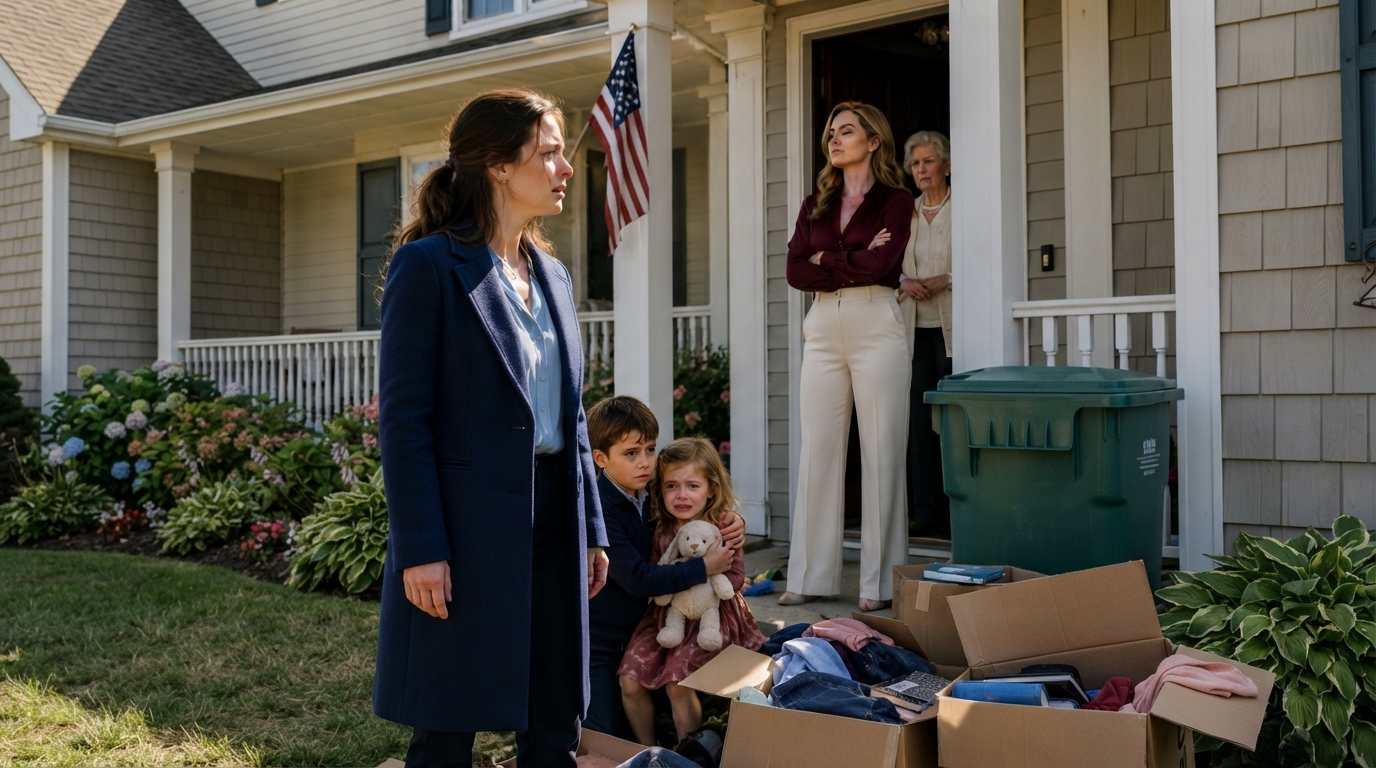
The porch appeared in my mind.
My children’s toys in the dirt.
Renlay crying.
Beckett asking if we had somewhere to go.
Astrid standing in the doorway.
“Get out.”
My father’s letter continued.
“I knew your mother was allowing Astrid to believe she had authority over the property.”
My hands trembled.
He knew.
Before he died.
He knew.
“I did not intervene immediately because I needed to know whether you would choose yourself and your children when the time came.”
I stared at that sentence.
“What?”
My mother’s face crumpled.
“He wanted to know whether you’d ever stop apologizing for surviving.”
I kept reading.
“My daughter, you have spent too many years confusing endurance with loyalty.”
My eyes filled.
“Your mother loves you. But love does not make every decision wise.”
I looked at Mom.
She was crying now.
Dad’s final paragraph was shorter.
“If you are reading this after leaving the family house, then understand this: what was taken from you was never what mattered most. What matters is what you build next. I have already made arrangements.”
I looked up.
“What arrangements?”
Mr. Vale sat straighter.
“That is where the second file comes in.”
He slid another folder toward me.
It had my name on it.
Inside was a copy of a trust instrument.
I read the first paragraph.
My father’s estate had not been divided the way my mother had told us.
The family believed Dad left the bulk of his holdings to her.
He hadn’t.
He had placed them into a family trust.
The beneficiaries included me.
My children.
A charitable foundation.
And a small provision for my mother.
Astrid was not listed as a beneficiary.
Not directly.
I looked at Mr. Vale.
“So Astrid didn’t inherit anything?”
“Not directly.”
“Then why did she think the family would belong to her?”
He looked at me.
“Because your mother gave her the impression she would.”
My mother flinched.
“I thought she needed something.”
“You gave her my father’s house?”
“No.”
“You gave her authority over it.”
My mother said nothing.
That distinction didn’t matter to the children who had slept on the porch.
It mattered legally.
But emotionally, it was the same betrayal.
I turned to Mr. Vale.
“What did Dad leave me?”
He pushed another document across the table.
I nearly stopped breathing.
The value of the trust was far greater than I had ever understood.
Commercial properties.
Investment accounts.
A minority stake in two private companies.
And a parcel of land outside the city that had been untouched for decades.
My father had been worth more than anyone in the family ever admitted.
And he’d quietly transferred control to me.
I looked at my mother.
“Why didn’t you tell me?”
She wiped her eyes.
“Because Astrid was desperate.”
“That isn’t an answer.”
“She was drowning.”
“So you threw me in the water.”
She looked away.
Mr. Vale interrupted gently.
“There is another issue.”
“What?”
“Your father had reason to believe some trust assets had already been misused.”
I stared at him.
“By whom?”
He didn’t answer.
He handed me another folder.
Inside were accounting records.
Transfers.
Withdrawals.
Loans.
Payments.
And one repeated name.
Astrid.
My stomach dropped.
“How much?”
He gave me the figure.
I stared at him.
“It was supposed to be reimbursed.”
“Was it?”
“No.”
I turned toward my mother.
“You let her take it.”
“She promised she would repay it.”
“She promised you?”
“Yes.”
“And you believed her?”
“She was my daughter too.”
I laughed bitterly.
“No.”
I closed the folder.
“She was your daughter.”
My mother looked crushed.
“I loved you both.”
“You loved us differently.”
She didn’t deny it.
That hurt more than if she had argued.
Mr. Vale reached for another document.
“There is more.”
I looked at him.
“Astrid didn’t just take money from the trust.”
“What did she do?”
“She used your identity in several financial applications.”
The room went silent.
“What?”
“Credit applications.”
“Mine?”
“Yes.”
“When?”
“Before she moved into your mother’s house.”
I felt sick.
“That can’t be right.”
Mr. Vale showed me the records.
My Social Security information.
My employment details.
My old address.
The signatures didn’t match exactly.
But they were close.
I remembered something.
A credit inquiry from years earlier.
I had ignored it.
Then another.
A strange lender calling me.
A rejected application.
I had thought it was fraud.
It had been.
I looked at my mother.
“Did you know?”
She shook her head.
“No.”
“Did Dad?”
“Yes.”
“Why didn’t he tell me?”
“He was investigating.”
That sounded like him.
Quiet.
Methodical.
Never assuming.
Never acting without proof.
I looked back at his letter.
Then I saw one final sentence I’d missed because my tears had blurred the ink.
“If anyone tells you that what happened was because you were not family enough, remember who showed up when it mattered.”
I pressed my hand against the page.
Mr. Vale waited.
After a long silence, I asked:
“What am I supposed to do now?”
He answered carefully.
“That depends on what you want.”
I looked toward my mother.
She looked smaller than I remembered.
Then I thought about my children.
Their emergency bags.
Their questions about whether someone could throw them out again.
I knew.
“I want the truth.”
Mr. Vale nodded.
“Then we begin with the property.”
The next morning, we drove to the house where I had grown up.
My mother’s name was still on the mailbox.
Astrid had moved into the master bedroom.
The rest of the house looked different.
More luxurious.
More polished.
As if someone had been trying to turn a family home into a monument.
I stood at the front gate.
Mr. Vale handed me a packet.
“According to your father’s trust, the property was never transferred.”
“Then why does Astrid think it belongs to her?”
“Because she believed your mother could give it to her.”
I walked to the front door.
Astrid opened it.
Her expression changed immediately when she saw me.
“What are you doing here?”
I held up the papers.
“Remember the house?”
She stared at the documents.
“You can’t do this.”
“I haven’t done anything.”
“You can’t take this away from me.”
“This was never yours.”
She laughed.
“Mom gave it to me.”
“No.”
“She said it was mine.”
“She didn’t own it to give.”
Astrid’s face hardened.
“You always thought you were better than me.”
I looked at her.
“No.”
“Then why are you doing this?”
“Because my children deserve somewhere they can never be thrown out of again.”
She stepped toward me.
“Your children?”
I nodded.
“Your sister’s children.”
She sneered.
“You think having kids makes you special?”
“No.”
I looked directly at her.
“I think protecting them does.”
She tried to slam the door.
Mr. Vale stopped it.
“We are not here to argue.”
Astrid stared at him.
“Who are you?”
“Your sister’s counsel.”
Her face went pale.
“You hired a lawyer?”
“Yes.”
“Against me?”
“No.”
I took a breath.
“Against the lies.”
That night, Astrid called my mother.
I didn’t hear the whole conversation.
But I heard enough.
“You said she couldn’t do this!”
“I didn’t know.”
“You told me the house would be mine.”
“I thought—”
“You always said she wouldn’t fight.”
My mother began crying.
Astrid hung up.
Then my mother called me.
“I’m sorry.”
I sat in my car outside the house.
“I know.”
“She hates you.”
“I know.”
“She thinks you stole her future.”
I looked at the house.
“No.”
I turned on the engine.
“She built her future on something that wasn’t hers.”
The next day, my father’s trust filed a formal notice concerning the property.
It wasn’t an eviction in the simple sense.
It was a title and possession dispute complicated by years of informal arrangements and undocumented claims.
Astrid responded with attorneys of her own.
She claimed she had been promised permanent residence.
She claimed she had invested in the property.
She claimed my mother had represented that the house would eventually be transferred to her.
The case became messy.
But there was one thing Astrid hadn’t counted on.
My father had kept records.
Every property tax payment.
Every insurance bill.
Every repair receipt.
Every mortgage payment.
Every trust statement.
And almost all of them showed the same thing.
The house was never transferred.
Astrid had never owned it.
My mother had never owned it outright either.
It belonged to the trust.
And I was the trustee.
That single fact changed everything.
But Astrid wasn’t finished.
Neither was my mother.
Because one week after the property notice was filed, I received a letter from a lawyer representing my mother.
It claimed I was abusing my position as trustee.
It accused me of trying to control family assets.
It demanded an accounting.
I read it twice.
Then I laughed.
They wanted an accounting?
Fine.
I gave them one.
Every dollar.
Every transfer.
Every transaction.
Every receipt.
And that’s when we found something even bigger.
A transfer from the trust to a company owned by Astrid.
Seven years earlier.
The amount was large enough that my father had personally approved a repayment agreement.
The repayment never happened.
Instead, the debt had been rolled into another company.
Then another.
Then another.
My father’s notes showed he had suspected Astrid of using new companies to hide old obligations.
The trail continued.
By the end of the week, we had a dozen entities.
And they were all connected.
Astrid hadn’t simply borrowed money.
She had built a network.
A network funded largely by assets she never owned.
When I showed the records to Warren’s successor, Mr. Vale, he looked at me.
“Your father was preparing for exactly this.”
I shook my head.
“How did he know?”
“Because he knew your sister.”
I sat back.
“No.”
He corrected himself.
“He knew what she became when she was given too much access.”
That distinction mattered.
People don’t wake up one morning and decide to betray everyone.
Sometimes they get rewarded for small betrayals until the betrayals become normal.
Astrid had learned that.
My mother had enabled it.
My father had seen it.
And I had been the last person to accept it.
Until now.
The case moved forward.
Then came the bank.
A representative called to notify me that several accounts connected to Astrid had been flagged after an investigation into the trust transfers.
I asked:
“What happens next?”
“They may be restricted.”
“Will the trust recover its funds?”
“That depends on the proceedings.”
I thanked her.
Then sat in silence.
It didn’t feel like revenge.
It felt like a puzzle finally showing its edges.
Three days later, an envelope arrived at my office.
Inside was a photograph.
My father.
Standing in the garden.
On the back was a note.
“Never let them convince your children that they belong outside.”
I stared at it.
I cried.
Because that was what my father had understood.
The thing I had needed most was not the house.
Not the money.
Not the trust.
It was the certainty that my children deserved a place inside.
PART 4
The hearing regarding the property was set for the following month.
By then, the story had become larger than our family.
The financial records had revealed transactions involving multiple businesses.
The trust’s accounting required extensive review.
Astrid had begun fighting on several fronts.
She argued that my father’s original intentions had been misunderstood.
She argued that my mother had authority to manage the property.
She argued that I had acted unfairly.
And she told anyone who would listen that I was trying to destroy her.
I stopped responding.
That was difficult.
I had spent years explaining myself.
Now I realized something.
You don’t need to explain the truth to everyone.
You need to preserve it.
The first hearing lasted four hours.
Astrid’s attorney argued that she had relied on representations made by my mother.
That she had invested money.
That removing her would cause hardship.
Our attorney presented the deed.
Then the trust agreement.
Then the tax records.
Then my father’s notes.
The judge reviewed each document.
Finally, the judge looked at Astrid.
“Do you have evidence of a transfer of title?”
Her attorney stood.
“Not title, Your Honor.”
“Then what are we discussing?”
“An understanding within the family.”
The judge looked at him.
“Understanding is not ownership.”
Silence.
The hearing was continued for another round of evidence.
Afterward, Astrid approached me outside.
“You’re enjoying this.”
“No.”
“Yes, you are.”
I shook my head.
“I don’t enjoy seeing what happened.”
“Then stop.”
“Stop what?”
“Stop taking everything from me.”
I looked at her.
“You took things from me first.”
“I was desperate.”
“So was I.”
She laughed bitterly.
“You always had Dad.”
I froze.
“You had his money.”
I looked at her.
“You had his trust.”
She shook her head.
“He chose you.”
I understood then.
This had always been about Dad.
Astrid had spent years believing he loved me more.
Maybe he trusted me more.
Maybe he saw something in me she believed she deserved.
That resentment had become the fuel behind everything.
I asked:
“Did you ever ask him why?”
She stared at me.
“No.”
“Did you ever talk to him?”
“Not near the end.”
“Why?”
“Because he wouldn’t give me what I wanted.”
I shook my head.
“There it is.”
She crossed her arms.
“You think you’re better.”
“No.”
I took a breath.
“I think you wanted what he had without becoming the person he trusted to manage it.”
She looked away.
I left.
The next day, an investigator called.
They had found a dormant account.
It contained funds that appeared to be connected to one of Astrid’s companies.
The account had been opened using information linked to my mother’s identity.
My mother’s name.
Astrid’s company.
The same mailing address.
I asked:
“When was it opened?”
The investigator gave me the date.
Two months after my father died.
I closed my eyes.
That explained so much.
Dad dies.
Astrid’s business grows.
Money starts disappearing.
My mother becomes the gatekeeper.
Then I become the problem.
The system had been built immediately after his death.
I hadn’t just been pushed out of the house.
I had been pushed out of the inheritance structure.
The porch was the visible part.
The financial plan was the invisible part.
That was why my mother needed me to believe I was temporary.
Why she wanted me paying rent.
Why she told me I should be grateful.
Why she gave Astrid the master suite.
She had been preparing me to accept less.
To leave quietly.
To never look at the records.
To never ask who owned what.
My throat tightened.
I called Mr. Vale.
“I know why she did it.”
“Why?”
“She wanted me to leave the family house before I could understand what Dad left me.”
There was silence.
“I think you’re right.”
The court ordered a full accounting.
That was the turning point.
Every transaction had to be disclosed.
Every asset.
Every debt.
Every transfer between related entities.
Astrid’s attorneys objected.
Then they requested more time.
Then more.
But eventually, the records arrived.
And the truth was worse than I had imagined.
There had been unauthorized withdrawals from the trust.
A series of loans without proper documentation.
Property acquired with funds that should have remained in the trust.
And personal expenses disguised as business costs.
My mother’s name appeared as an approver on many of them.
Astrid appeared as a recipient on even more.
I wasn’t the only person betrayed.
There were contractors who hadn’t been paid.
Employees who had been promised compensation.
Business partners who had been left with debts.
Astrid’s companies were in far worse shape than she had admitted.
She wasn’t wealthy.
She had been borrowing against the appearance of wealth.
The house had been part of the appearance.
The jewelry.
The parties.
The expensive cars.
Everything depended on the same thing.
The family trust.
And when that access disappeared, the structure began to collapse.
I didn’t celebrate.
I couldn’t.
People were affected.
Employees.
Tenants.
Vendors.
My own family.
Consequences aren’t clean.
They spread.
The bank began freezing certain accounts tied to the disputed transfers.
Then property notices arrived.
Some assets could no longer be refinanced.
Some transactions were suspended.
One morning, my mother called me.
“I’m going to lose the house.”
“You don’t own it.”
“I lived there.”
“I know.”
“You’re doing this to punish me.”
“No.”
“Then why?”
“Because my children were put outside.”
She began crying.
“I made one mistake.”
“No.”
I shook my head even though she couldn’t see me.
“You made hundreds of decisions.”
Silence.
“You just didn’t think I’d ever add them together.”
She whispered:
“I was scared.”
“Of what?”
“Of you becoming the head of the family.”
I closed my eyes.
“Mom, that’s what Dad wanted.”
She began crying harder.
“I know.”
That admission changed something.
I had spent my childhood trying to earn my mother’s approval.
Now I understood I never could.
Not because I wasn’t good enough.
Because she had defined love as control.
And control can never be satisfied.
The property case was settled first.
The court confirmed the trust’s ownership.
Astrid was given a period to leave.
She could collect her belongings.
Nothing more.
When I returned to the house, the rooms were nearly empty.
The master bedroom had been stripped.
The walls looked pale where furniture had been.
The garden was neglected.
The roses were dying.
I walked into the children’s old rooms.
The rooms where my mother had once allowed us to stay.
Everything was gone.
Of course.
Astrid had emptied them.
Even now, seeing those empty walls made my chest hurt.
Then I noticed something.
A tiny blue mark on the doorframe.
Beckett had drawn it with a crayon when he was three.
I touched it.
I remembered him asking:
“Can I put my bed here?”
I remembered saying yes.
I remembered thinking we had finally found somewhere safe.
And then the porch.
Everything outside.
The trash can.
The crying.
Astrid at the door.
Get out.
I sat on the floor.
For a moment, I cried.
Not for the house.
For the version of me who had thought she needed permission to stay.
Then I heard footsteps.
My mother.
She stood in the doorway.
She looked around.
“It used to be different.”
“Yes.”
She touched the wall.
“I remember when you were little.”
I looked at her.
“You remembered me then.”
She nodded.
“Then somewhere along the way, I became someone you had to sacrifice.”
She started crying.
“I didn’t know how to stop.”
“You could have chosen me.”
“I know.”
She sat down.
For the first time in years, we were both on the same floor.
No lawyer.
No paperwork.
No shouting.
Just mother and daughter.
She told me things I had never known.
My father had wanted me to become trustee because he believed I was steady.
Astrid had wanted control over the business.
My mother had believed Astrid deserved it because she was “the one who stayed.”
She said she had resented me for leaving town for college.
For becoming successful.
For building a life that didn’t require them.
She had mistaken independence for rejection.
And when I returned after Julian died, she had felt powerful again.
That was why she allowed Astrid to dominate the house.
She had believed the two of us could keep me from becoming independent again.
I listened.
Then I said:
“You were right about one thing.”
She looked at me.
“I did leave.”
She nodded.
“But you were wrong about why.”
“Why?”
“I didn’t leave because I didn’t need you.”
I took a breath.
“I left because you made staying unsafe.”
She cried.
I didn’t comfort her.
Not that day.
Some truths need to be allowed to sit where they land.
The next week, my mother signed a new agreement.
She relinquished any claim to trust-controlled property.
She agreed to independent financial oversight.
She also agreed to no unsupervised contact with my children until we decided it was safe.
Astrid challenged everything.
Her attorneys threatened further action.
But the records were stronger than her claims.
Eventually, the remaining disputes were consolidated.
The court approved the trust accounting.
Several assets were recovered.
Some were sold.
Some debts were settled.
Astrid was left with far less than she had believed she would inherit.
My mother retained a modest, protected interest consistent with Dad’s actual plan.
And I became the person my father had intended me to be.
Not the richest.
Not the most powerful.
The trustee.
The protector of what he built.
The person responsible for making sure his grandchildren had a future.
That responsibility felt heavier than money.
It felt like a promise.
PART 5
The first thing I did after the final ruling was not celebrate.
I went to the backyard.
The garden had become overgrown during the years Astrid lived there.
I brought my children.
Renlay walked slowly through the gate.
Beckett stood beside her.
They had been here only once since we left.
They both looked around.
“This is Grandpa’s garden,” Renlay said.
“Yes.”
Beckett touched the old stone path.
“Why didn’t we stay here?”
I took a breath.
“Because the adults made a bad choice.”
“Who?”
I looked at both children.
“Adults you trusted.”
They nodded.
That was enough.
I didn’t tell them everything.
They didn’t need court records.
They didn’t need financial details.
They needed to know one thing.
None of it had been their fault.
I knelt beside them.
“You both remember the night we left?”
Renlay nodded.
“You told us it was an adventure.”
“It was.”
“Even though I was scared?”
“Especially then.”
Beckett looked at me.
“Are we safe now?”
“Yes.”
“Really?”
“Yes.”
He hugged me.
I held him.
That was the moment the house stopped being a property.
It became a home.
I didn’t move back immediately.
I didn’t want the children to think the building itself was the answer.
Instead, we kept our house.
The one I had worked so hard to buy.
The one with the small kitchen and squeaky floors.
The one where my children had learned to sleep without worrying about being thrown out.
Eventually, we restored my father’s house.
Not as a monument to wealth.
As a place for the future.
Part of the property became a small community legal clinic.
I used trust funds to support housing assistance for families dealing with eviction and financial abuse.
I never forgot what it felt like to have children crying on a porch while an adult told me I was being dramatic.
I wanted other families to have someone who knew what the paperwork meant.
Someone who could say:
“You have rights.”
Someone who could help before the boxes reached the sidewalk.
Astrid’s life changed completely.
Her businesses were dismantled.
Some were sold.
Some were closed.
She paid certain debts.
She lost others.
She moved to a smaller home.
For a while, she blamed me.
Then she stopped.
One day, a letter arrived.
It was from Astrid.
I almost threw it away.
Instead, I opened it.
“I thought you were the favorite.”
That was the first line.
“I thought Dad chose you because he loved me less.”
The next line:
“I spent my life trying to prove I deserved what you had.”
I kept reading.
“I didn’t realize that by trying to take your place, I had destroyed my own.”
She admitted to the financial shortcuts.
She didn’t admit everything.
But she admitted enough.
She said she regretted the night on the porch.
“I see those children in my head every time it rains.”
I folded the letter.
I didn’t call her.
Not yet.
My mother continued rehabilitation.
Her recovery was slow.
She learned to walk again with assistance.
During one visit, she asked:
“Do they still remember the porch?”
“Yes.”
She looked down.
“I’m sorry.”
“I know.”
“Will they ever forgive me?”
“I don’t know.”
She nodded.
For once, she didn’t demand an answer.
That mattered.
Months later, my children asked if their grandmother could visit.
I was surprised.
“Why?”
Renlay shrugged.
“She wrote sorry.”
Beckett looked at me.
“Maybe she means it.”
I sat with them.
“We can try a short visit.”
They agreed.
The visit happened at my house.
My mother sat in the living room.
No servants.
No grand dining room.
No expensive decorations.
Just an ordinary woman.
My children entered slowly.
She cried immediately.
Not loudly.
Just tears.
Renlay walked over.
“Hi, Grandma.”
My mother reached for her hand.
“Hi.”
Beckett stayed beside me.
My mother looked at him.
“You don’t have to come closer.”
He nodded.
She respected that.
That mattered more than any apology.
They talked for twenty minutes.
About school.
About cartoons.
About a science project.
Nobody mentioned money.
Nobody mentioned the house.
Nobody mentioned inheritance.
When the children left the room, my mother looked at me.
“That was more than I deserved.”
“Yes.”
She nodded.
“But thank you.”
I didn’t answer.
Forgiveness, I learned, isn’t a switch.
It isn’t a gift you owe someone because they apologize.
It’s a process.
Sometimes it means allowing someone to change.
Sometimes it means letting them go.
Sometimes it means both.
My relationship with my mother became cautious.
Not close.
Not hostile.
Just careful.
She began sending birthday cards.
Sometimes the children answered.
Sometimes they didn’t.
I never forced them.
My relationship with Astrid remained distant.
She occasionally wrote.
I responded rarely.
But I no longer carried rage.
Rage had been useful once.
It helped me leave.
It helped me fight.
It kept me awake when I needed to protect my children.
But eventually, you have to put it down.
Otherwise, the people who hurt you remain in your life even after they’ve left it.
Three years after the porch, I returned to the old house with the children for Christmas.
The dining room was full.
Not two hundred people.
Not wealthy relatives.
Just our family.
My children.
My mother.
My aunt.
A few close friends.
The table was set with my father’s china.
The same china my mother had once guarded like it belonged to the most important people in the family.
Now, Renlay was helping set the plates.
Beckett was carrying napkins.
My mother watched from her chair.
“Which plate goes where?” Renlay asked.
My mother smiled.
“Anywhere you like.”
Renlay laughed.
“That’s not a rule.”
“Tonight it is.”
I looked at my mother.
She looked back at me.
There was no triumph in it.
Just understanding.
The house wasn’t a prize.
It wasn’t proof that I had won.
It was proof that what had been taken emotionally could be reclaimed differently.
Not by possessing the building.
By changing what happened inside it.
After dinner, the children went to the garden.
Snow had started falling.
Very lightly.
My mother sat beside me on the porch.
She looked outside.
“They’re happy.”
“Yes.”
“You did that.”
“No.”
She looked at me.
“They did.”
I smiled.
“They helped.”
She nodded.
After a long silence, she asked:
“Do you ever wish you’d stayed?”
I thought about the question.
“No.”
She looked down.
“I was afraid you’d say that.”
I put my hand on the railing.
“I don’t wish I had stayed.”
She nodded slowly.
“But I wish you had been someone safe to stay with.”
That made her cry.
She didn’t defend herself.
She didn’t explain.
She simply cried.
And somehow, that was the closest thing to an apology that felt real.
I stayed beside her.
Not because I had to.
Because I chose to.
There was a difference.
Later that night, after the children fell asleep upstairs, I walked through the house alone.
The old rooms had been repainted.
The garden was restored.
The children’s rooms were warm.
Their old toys were not the ones thrown on the lawn.
These were new toys.
Chosen by them.
Bought by me.
Placed where they wanted.
No one could take them away.
I opened the desk drawer in my father’s old study.
His photograph was there.
I picked it up.
Behind it was the same note he’d left.
Never let them convince your children that they belong outside.
I smiled.
“I’m trying, Dad.”
The house was quiet.
For a moment, I imagined him sitting in the chair by the window.
I thought about what he had seen.
What he had known.
What he had trusted me to do.
I finally understood why he had waited.
He hadn’t wanted to rescue me.
He wanted me to rescue myself.
He couldn’t stop Astrid from becoming what she became.
He couldn’t force my mother to choose differently.
He could only leave me the tools.
The records.
The trust.
The letter.
The truth.
The rest had to be mine.
And that was the most important inheritance of all.
Not property.
Not money.
Agency.
The ability to decide that the cycle ended with me.
That my children would never grow up believing love required surrender.
That generosity would come with boundaries.
That helping family would never again mean abandoning ourselves.
A few months later, I received one final letter.
This one was from my mother.
The handwriting was shaky.
She wrote:
“I spent years believing family meant keeping everyone under one roof.”
I read on.
“I understand now that a house cannot hold a family together.”
Then:
“Only trust can.”
I stopped.
That sentence felt like the opposite of everything I had known.
My mother had tried to keep everyone close by controlling them.
My father had tried to keep us safe by giving us freedom.
I understood at last which one had been love.
That evening, my children were playing in the garden.
Renlay was carrying flowers.
Beckett was trying to catch a butterfly.
I sat on the porch and watched them.
No one was counting rent.
No one was watching the clock.
No one was threatening to put our belongings beside a trash can.
No one was saying:
Get out.
Instead, there was laughter.
Messy, loud, ordinary laughter.
The kind I had once thought was too expensive to risk.
I realized then that I had not rebuilt my life to prove my family wrong.
I had rebuilt it because my children needed somewhere safe to grow.
The money helped.
The house helped.
The trust helped.
But none of those things mattered as much as the choice I had made that night.
I took my children and left.
I didn’t know where we would sleep.
I didn’t know how I would pay the bills.
I didn’t know whether I would ever feel secure again.
But I knew they were coming with me.
And sometimes that’s the entire beginning.
Not a plan.
Not certainty.
Just one decision.
Stay with your children.
Protect them.
Move forward.
The rest comes later.
Years after everything, Beckett asked me one evening:
“Dad, why do you still have Grandpa’s old house?”
I smiled.
“Because he left it to us.”
“Us?”
“Yes.”
He thought for a second.
“Then we should use it for something good.”
I looked at him.
“What do you have in mind?”
“Let families stay there if they need somewhere.”
I laughed softly.
“You mean like a shelter?”
“Maybe.”
I looked toward the house.
My father would have loved that.
So we did it.
We converted one of the guest wings into temporary housing for families in transition.
Not forever.
Just long enough to breathe.
Long enough to find work.
Long enough to find another home.
Long enough for children to sleep without worrying about the porch.
We put a small sign at the entrance.
It said:
NO ONE BELONGS OUTSIDE.
I didn’t tell my mother about it.
She noticed eventually.
She cried when she saw it.
I let her.
The sign wasn’t for her.
It was for the families who walked through that door.
For the children who thought being poor meant being less worthy.
For the parents who had been told they should be grateful for cruelty.
For people who had spent too long believing they had nowhere else to go.
The house became what my father had wanted.
Not a monument.
A refuge.
And every time I saw a family arrive with boxes, I remembered my own children on that lawn.
I remembered how small they looked.
How terrified I felt.
How angry I was.
And how little I knew about what would come next.
Sometimes I wish I could go back and tell that younger version of myself something.
You won’t lose everything.
You will lose people.
You will lose the illusion that family always protects you.
You will lose the need to make everyone happy.
But you will not lose yourself.
You will build something better.
And someday, your children will run through a garden without wondering whether anyone will tell them to leave.
That was enough.
That was more than enough.
The last time I spoke to Astrid, she asked me:
“Do you still think I ruined your life?”
I shook my head.
“No.”
“What do you think?”
I looked at her.
“I think you revealed it.”
She didn’t understand.
“Revealed what?”
“What was never safe.”
She was quiet.
Then she nodded.
Maybe she finally understood.
The porch had not destroyed my family.
It had exposed it.
The trust had not made me powerful.
It made the truth harder to hide.
The money had not saved me.
The records did.
The lawyers did.
My father’s foresight did.
But most of all, my willingness to leave did.
I once thought walking away meant losing.
Now I know it can mean choosing what comes next.
My children are grown now.
Renlay is studying design.
Beckett is training to become a teacher.
They both remember the old house.
They both remember the porch.
But they remember something else too.
They remember that I picked them up.
I didn’t leave them there.
I didn’t ask them to wait while I argued.
I didn’t tell them to apologize.
I didn’t tell them to earn their way back inside.
I took them with me.
That is the part I hope they remember forever.
Not the inheritance.
Not the court.
Not the money.
Not Astrid.
Not even the house.
The moment I chose them.
Because that’s what family should be.
Not the people who demand that you stay.
The people who make it safe for you to.
So when I look back at the day Astrid stood in the doorway and said, “Get out,” I don’t remember her voice first.
I remember my daughter crying.
I remember my son asking whether someone could make us leave again.
I remember the keys in my hand.
I remember the engine starting.
And I remember the first time I drove away without apologizing.
That was the moment my life changed.
Everything else came after.
The lawyer.
The files.
The trust.
The property.
The court.
The money.
The garden.
The house.
The healing.
All of it came after one choice.
I chose my children.
And years later, when I stand on the porch of that old house and watch them walk through the garden their grandfather planted, I understand what my father meant all along.
He wasn’t trying to leave me a house.
He was trying to leave me a way out.
A way out of guilt.
A way out of fear.
A way out of the belief that family had the right to decide where I belonged.
And the best part?
I didn’t use that inheritance to build a wall around myself.
I used it to open a door.
For my children.
For other families.
For the people who once stood where I stood.
Outside.
With everything they owned beside a trash can.
Wondering whether anyone would let them in.
Now they don’t have to wonder.
Because the door is open.
And no one asks whether they deserve the right to cross the threshold.
They simply do.
That is the home I built.
Not the one Astrid took.
Not the one my mother tried to control.
Not even the one my father left.
The one I chose.
And this time, nobody gets to tell us to leave.
THE END THANK YOU FOR READING !!!