PART 3
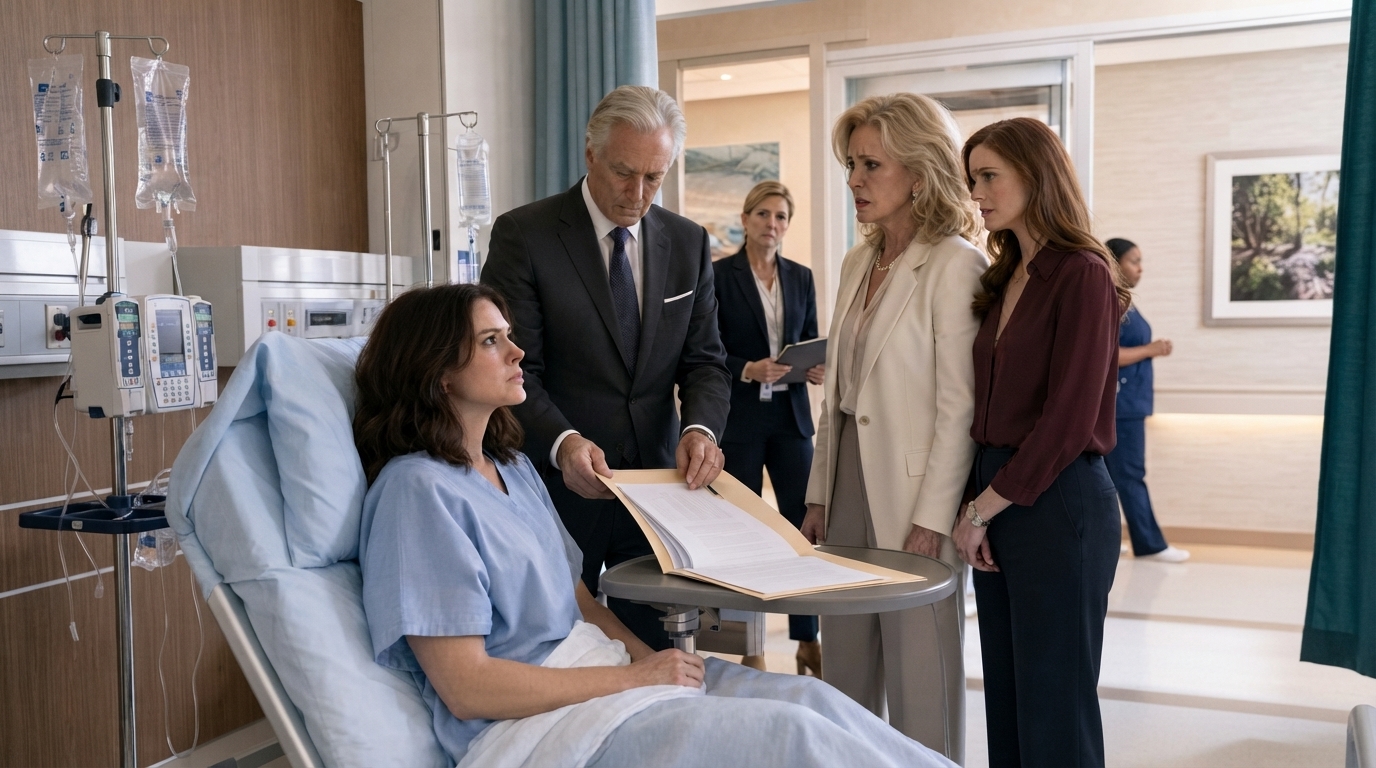
“This,” Warren said, “is only the first problem.”
My mother, Roberta, didn’t move.
Neither did Tessa.
The document on the tray looked innocent enough.
A standard trust authorization.
A signature.
A date.
A witness line.
Except the signature was mine, and I had never seen the document before.
I looked at Warren.
“What is it?”
He didn’t answer immediately.
Instead, he turned the first page around so my mother could see it.
“Why don’t you tell us?”
She stared at the paper.
“I have no idea what that is.”
Tessa stepped closer.
“Maybe she signed it before the hospitalization.”
I shook my head.
“I didn’t.”
Tessa’s eyes flicked toward me.
“You were very sick.”
“I remember what I signed.”
My mother folded her arms.
“This is absurd.”
The hospital administrator standing beside Warren spoke calmly.
Mrs. Roberta Hale, this document was submitted to the hospital’s records office
yesterday along with your request for expanded authority concerning Ms. Hale’s care.
My mother’s expression changed.
“I was only trying to help my daughter.”
The administrator nodded.
“That’s understood.”
“Then why are you questioning me?”
“Because the documentation contains inconsistencies.”
Warren opened another folder.
I could hear the slow rhythmic beeping from the monitor beside my bed.
My mother hated that sound.
I knew because every time it started, she looked at the machine rather than at me.
Warren placed the second document on the tray.
“This authorization was dated six days ago.”
My mother frowned.
“And?”
“I was unconscious six days ago,” I said.
My mother said nothing.
Tessa stepped forward.
“She could have signed it before she lost consciousness.”
Warren looked at her.
“She didn’t.”
“How do you know?”
“Because the notary listed on the document has already provided a statement.”
I watched Tessa’s face.
“What statement?”
“That she never witnessed this signature.”
Silence.
My mother reached for the document.
Warren pulled it back.
“Please don’t.”
She looked at him.
“Why?”
“Because we need to preserve it exactly as received.”
That sentence changed the atmosphere.
Until then, my mother had still been pretending this was a misunderstanding.
Now she knew there were records.
Records that existed outside our family.
Records that couldn’t be rewritten by a conversation at the kitchen table.
She looked at me.
“Brianna, I have no idea what he’s talking about.”
I almost laughed.
For the first time in my life, I wasn’t trying to decide whether she was telling the truth.
I already knew.
And suddenly, another memory came back.
Two months earlier, when I had asked about the family trust.
My mother had said:
“Your father left everything in your hands, but he always intended the family to benefit.”
At the time, I hadn’t questioned the wording.
Now I did.
“What exactly did Dad intend?”
She looked away.
“He wanted the family taken care of.”
“That’s not what I asked.”
“What are you trying to do?”
“I want to know what Dad’s plan actually was.”
Warren answered for her.
“We’ll get to that.”
He opened the folder.
“Right now, we’re dealing with three separate issues.”
He held up one finger.
“Possible forged documents.”
A second.
“Potential misuse of your medical proxy.”
A third.
“And unauthorized activity concerning the family trust.”
My mother stared at him.
“You’re accusing me of stealing from my daughter.”
“No.”
Warren looked directly at her.
“We’re examining records.”
“After everything I’ve done for her.”
I finally spoke.
“Mom.”
She looked at me.
“You were outside my curtain.”
Her face changed.
“I don’t know what you think you heard.”
“I heard enough.”
Tessa stepped in.
“Bri, you were heavily medicated.”
“I was conscious.”
“You could have misunderstood.”
“I didn’t.”
She stared at me.
“You’re making this worse than it is.”
That sentence.
Exactly that sentence.
It was the same sentence my mother had used my entire childhood whenever something uncomfortable happened.
Don’t make it worse.
Don’t ask questions.
Don’t embarrass us.
Don’t cause problems.
For years, those words had worked.
Not anymore.
Warren closed the folder.
“Mrs. Hale, I recommend you don’t discuss financial matters with your daughter without counsel present.”
My mother’s face hardened.
“She is my daughter.”
“And she is an adult.”
The hospital administrator stepped forward.
“Effective immediately, Ms. Hale’s medical decisions will be reviewed independently. Her current proxy remains under examination.”
My mother’s eyes widened.
“You can’t remove me.”
“I can,” I said.
She looked at me.
“You don’t trust me?”
“No.”
The word was quiet.
But it landed harder than shouting would have.
My mother sat down.
Tessa crossed her arms.
“This is ridiculous.”
Warren ignored her.
“I’ve already contacted the trust’s financial institution.”
My mother looked at him sharply.
“What did you do?”
“Requested an immediate hold on discretionary distributions pending review.”
Her face turned pale.
“You had no authority.”
“I do.”
“Based on what?”
“Based on the trust documents.”
She looked at me.
“But I told you—”
“You told me nothing.”
Her mouth closed.
Warren continued.
“And I’ve also notified the trustee bank that no significant transfer should occur without independent approval.”
My mother stared at him.
For the first time, she looked less like a grieving mother and more like someone calculating an escape.
Tessa noticed it too.
She looked at Mom.
“Did you transfer anything?”
“Don’t be ridiculous.”
“That wasn’t an answer.”
My mother snapped.
“Enough.”
Then the room went quiet again.
I looked at Tessa.
“You asked about the house.”
She froze.
Earlier, I had overheard them.
The house.
Our family trust.
The account.
They had been discussing all of it.
Now the question was out in the open.
Tessa looked at my mother.
“Mom?”
My mother glared at her.
“You need to leave.”
Tessa didn’t move.
I spoke.
“No.”
Everyone looked at me.
“I want her to answer.”
My mother laughed.
“You’re interrogating me in a hospital?”
“No.”
I looked at Warren.
“I’m asking questions.”
He nodded.
“That is your right.”
I turned back to my mother.
“Why did you tell Tessa everything would become yours when I died?”
Her face went white.
Tessa looked at me.
Then at Mom.
“You told her that?”
My mother stood.
“This conversation is over.”
Warren said:
“Sit down.”
She stared at him.
“I don’t take orders from you.”
“No.”
He paused.
“But you may want to hear what comes next.”
My mother slowly sat.
Warren removed another document.
It was a trust distribution schedule.
The document listed several future beneficiaries.
My name was there.
Tessa’s name was there.
Several charitable organizations were there.
My father’s grandchildren were there.
My mother was not.
She stared at the page.
“I don’t understand.”
“I think you do.”
“No.”
“The original trust doesn’t transfer everything to you when Brianna dies.”
Tessa looked at him.
“Then what happens?”
“The assets remain within the trust and pass according to the distribution schedule.”
My mother whispered:
“How?”
Warren looked at her.
“Through staged distributions over time.”
Tessa’s face changed.
“Then why did Mom say—”
She stopped.
I watched the realization spread across her face.
My mother had lied to her too.
Not about everything.
But enough.
Tessa had believed she would inherit immediately.
Now she understood that much of what she had been counting was not actually hers.
My mother stood again.
“I need to speak with my daughter alone.”
“No,” I said.
She stopped.
“Not today.”
She stared at me.
“I carried you.”
“And I am still your daughter.”
“Exactly.”
“No.”
I shook my head.
“You don’t get to use motherhood as a weapon.”
Her eyes filled.
“I gave you everything.”
“You gave me life.”
I took a breath.
“You didn’t buy the right to control me.”
That was the first time she cried.
Real crying.
Not theatrical.
Not angry.
Just a woman whose story was collapsing.
Tessa suddenly looked at me.
“Did you know about this before you got sick?”
“Yes.”
“You knew Dad’s trust worked differently?”
“I knew enough to investigate.”
“Then why didn’t you tell me?”
I looked at her.
“Because you had already started asking about dates.”
She went still.
“I heard you.”
Her eyes filled.
“I was scared.”
“You were counting.”
“I didn’t mean it the way it sounded.”
“What did you mean?”
She couldn’t answer.
Warren finally stood.
“The meeting is over.”
My mother objected.
“No.”
He looked at the administrator.
“I’ll handle counsel communication from here.”
My mother glared at me.
“This is what happens when you trust lawyers.”
I smiled weakly.
“Good thing Dad trusted one.”
She left.
Tessa followed.
At the doorway, she turned.
“I didn’t know about the documents.”
I believed her.
That didn’t erase what she had said.
She walked out.
The door closed.
I exhaled.
I hadn’t realized I’d been holding my breath.
Warren sat beside me.
“You okay?”
“No.”
He nodded.
“Good.”
I frowned.
“Why is that good?”
“Because anyone who tells you this doesn’t hurt is lying.”
I looked at the ceiling.
“How bad is it?”
He waited.
Then:
“Worse than I wanted.”
I turned toward him.
“How bad?”
“Your father’s trust lost nearly two million dollars over eighteen months.”
I felt numb.
“Where did it go?”
“We’re tracing it.”
“Who had access?”
“Your mother. Your sister. A former trust administrator. Possibly others.”
“Tessa?”
“Possibly.”
“Do you think she stole?”
“I think we need evidence.”
I appreciated that answer.
No guesses.
No accusations.
Just facts.
“And the forged document?”
“That could be very serious.”
“What was it designed to do?”
“Give your mother broader authority.”
“Over the trust?”
“Over you first.”
I looked at him.
“And then?”
He hesitated.
“Eventually, financial decisions.”
The room felt colder.
I looked toward the curtain.
The same curtain behind which I’d heard them.
Once she’s gone, everything becomes ours.
They hadn’t been talking about grief.
They had been talking about access.
I closed my eyes.
“I want every record.”
“You’ll get them.”
“I want everything.”
“You will.”
Two days later, the hospital cleared me to leave.
Not because I was suddenly healthy.
Because my condition had stabilized enough that recovery could happen at home with monitoring.
I hated leaving the hospital.
Not because of the building.
Because the hospital had become the first place where everyone around me was required to follow rules.
At home, my mother had always been able to bend rules by making people feel guilty.
But now there were lawyers.
Doctors.
Banks.
Records.
There were witnesses.
I moved into a small recovery apartment near the medical center.
I didn’t return to the family house.
Not yet.
The first thing Warren did was arrange an independent financial review.
The forensic accountant’s name was Julian Mercer.
He was quiet.
Very quiet.
He didn’t react much when he spoke.
That worried me more than anger would have.
He came to my apartment with two boxes.
“Your father kept excellent records.”
I smiled sadly.
“He liked paper.”
“He also liked redundancy.”
Julian placed files across the table.
“He maintained paper records even after everything moved digital.”
“That’s why he was hard to surprise.”
Julian looked at me.
“You’re his daughter.”
“Yes.”
“I can see it.”
I looked at him.
“How?”
“You both assume the worst and prepare anyway.”
That sounded exactly like Dad.
He showed me the first discrepancy.
A transfer for $75,000.
Listed as a property repair expense.
But there was no property repair.
Another.
$32,500.
A consultant.
No consultant.
Another.
$140,000.
A trust management fee.
The fee was four times the contracted amount.
I stared at the numbers.
“Who approved these?”
Julian showed me.
Initials.
My mother’s.
My sister’s.
A former administrator’s.
Some had been entered electronically.
Others had handwritten signatures.
“What about mine?”
“Used on two documents.”
“I didn’t sign them.”
“We know.”
“How?”
“The ink date.”
I looked at him.
He explained that one signature had been copied from an older document.
The handwriting was identical.
But the pen pressure and surrounding notation indicated it had been reproduced.
My stomach turned.
“So someone was copying my signature.”
“Yes.”
“When?”
“At least fourteen months ago.”
I looked out the window.
Fourteen months.
That was around the time I first noticed the withdrawals.
I thought I had overlooked something.
I hadn’t.
Someone had been working around me.
The review continued.
The money had gone through several paths.
Some to Tessa’s company.
Some to my mother’s personal expenses.
Some to a property investment.
Some to debts.
And some to an account I didn’t recognize.
Julian traced that account.
It belonged to a holding company.
The registered agent was a private wealth management firm.
The beneficial owner was hidden behind a trust.
Warren looked at the document.
“I know this entity.”
“Who owns it?”
“It’s connected to the Elder family.”
My blood ran cold.
“The Elder family?”
“Yes.”
“Why?”
“I don’t know yet.”
Julian opened another file.
“This may tell us.”
Inside was a letter from my father.
Dated months before his death.
It wasn’t addressed to me.
It was addressed to Warren.
I recognized Dad’s handwriting immediately.
I read the first line.
“If Brianna becomes seriously ill, do not allow Roberta access to the trust without independent oversight.”
I stopped.
The room went silent.
I read it again.
Then again.
My father had predicted this.
Not specifically.
But enough.
Warren looked at me.
“He was worried.”
“About my mother?”
“Yes.”
“Why?”
“He never told me everything.”
“Then what did he tell you?”
Warren closed the folder.
“He said your mother had been asking questions about the succession structure.”
“For how long?”
“About a year.”
I felt sick.
“So Dad knew.”
“He suspected something.”
“And he never told me?”
“He wanted evidence.”
That sentence was almost unbearable.
Because it sounded familiar.
I had inherited my father’s instinct.
Watch.
Document.
Wait.
The next file contained correspondence between my mother and a trust consultant.
They had asked about what would happen “in the event of Brianna’s incapacity.”
Not death.
Incapacity.
I was thirty-three when those emails were sent.
Healthy.
Working.
No known serious illness.
My mother had been planning for the possibility that I would become unable to manage my own affairs.
I looked at Warren.
“Why?”
“We need to keep following the money.”
Three days later, we found it.
The missing funds were being moved toward a property acquisition.
The property was registered through a shell company.
The company had one director.
Tessa.
I stared at the document.
“Why would she need a shell company?”
Warren shook his head.
“Maybe she didn’t.”
“What do you mean?”
“The question is who was using her name.”
We discovered that Tessa’s company had purchased a commercial property using funds that originated from the family trust.
Tessa couldn’t explain it.
She claimed my mother had told her it was part of an investment.
That might have been true.
But the transaction documents included signatures from Tessa too.
The question became whether she had known where the money came from.
Then Julian found another transfer.
It went to an account controlled by my mother.
The description was:
“Medical contingency.”
The date was two months before my diagnosis.
I stared at it.
That was impossible.
My mother had known I might become sick?
No.
That was too speculative.
We checked the source account.
It came from an insurance-related company.
Then we found a policy.
A life insurance policy on me.
The beneficiary was my mother.
The policy had been taken out without my knowledge.
I felt the room tilt.
Warren immediately closed the file.
“We’re going to take this step by step.”
I could barely speak.
“How long?”
“Three years.”
Three years.
My mother had secretly taken out a life insurance policy on me three years earlier.
I hadn’t known.
She had paid the premiums.
The beneficiary was her.
And the policy was unusually large.
I looked at Warren.
“What happens if someone takes out life insurance on you without telling you?”
“It depends on the circumstances and jurisdiction.”
“Would that be criminal?”
“Not automatically.”
“But combined with everything else?”
He didn’t answer.
That was answer enough.
We notified the appropriate authorities.
The investigation widened.
And with it came another discovery.
My mother had been talking to a private probate consultant.
She had asked how quickly assets could be consolidated following my death.
The consultant had warned her against attempting to bypass the trust terms.
She apparently hadn’t listened.
Then came the worst document of all.
An email.
From Tessa to my mother.
Subject:
“Three Days.”
It had been sent the morning after my admission.
The body contained one sentence.
“If she doesn’t make it, we have to move before Warren does.”
I stared at the screen.
That was the moment I understood something.
They weren’t counting down three days because of what doctors had said.
They were counting down three days because they were waiting for the window in which they thought I would die before the lawyers could react.
I called Warren.
He looked at the message.
Then he said:
“Now we have motive.”
I swallowed.
“And evidence.”
“Yes.”
For the first time since my illness began, I stopped wondering whether I was imagining things.
I wasn’t.
They had planned for me to disappear.
And they were already preparing for what came afterward.
PART 4
The investigation moved quickly after that.
The life insurance policy was examined.
The trust was placed under heightened oversight.
Banks received notices.
The private consultant was interviewed.
The former trust administrator was located.
His name was Alan Pierce.
He agreed to speak.
We met in Warren’s conference room.
Alan looked nervous.
He carried a binder.
“I should have told your father.”
“Told him what?”
“That the distributions weren’t matching the trust plan.”
I waited.
“How long?”
“About a year before his death.”
My hands tightened.
“Why didn’t you?”
He looked down.
“Your mother threatened to fire me.”
Warren leaned forward.
“Did she ever threaten anything else?”
Alan hesitated.
“She said my family would lose our house.”
My stomach turned.
“How?”
“I had a mortgage with a bank where your family’s holding company had influence.”
I understood.
Fear.
Again.
Different person.
Same mechanism.
Alan opened the binder.
“These are the original records.”
He slid them over.
The copies I had were incomplete.
These were complete.
Every transfer.
Every amendment.
Every instruction.
And there was a pattern.
Funds left the trust.
They passed through a consulting company.
Then into Tessa’s business.
Then into the shell entity.
Then into the property company.
Then eventually back to an account controlled by my mother.
It was circular.
Designed to obscure the trail.
I asked:
“How much?”
Alan named the total.
I closed my eyes.
Nearly two million dollars.
Not missing.
Moved.
And almost all of it traceable.
Warren looked at Alan.
“Why bring this now?”
Alan answered quietly.
“Because I’m tired of being afraid.”
Those words stayed with me.
Everyone had been afraid of my mother.
Employees.
Family.
Professionals.
Even my father.
And fear had allowed the structure to grow.
Alan wasn’t the only one who came forward.
The insurance broker did.
A former accountant did.
A property manager did.
A private consultant did.
Each person had one small piece.
Together, the pieces formed the same picture.
My mother wasn’t acting alone.
Tessa had participated.
Maybe not at the beginning.
But eventually.
And there was something else.
My mother’s relationship with a former business partner of Dad’s.
A man named Victor Sloane.
Victor had been involved in several property deals.
He and my mother had been communicating for years.
Messages showed discussions about buying assets from my father’s companies at discounted prices.
The plan appeared simple.
If the trust ever needed cash, my mother could push assets into the property company.
The company would purchase them below market value.
Then the family would later sell them for profit.
Except the trust would lose the difference.
My father had noticed the pattern before he died.
That’s why he had begun restricting my mother’s access.
He had intended to tell me.
Then he died before he could.
And I, trusting my family, had continued operating under the assumption that my mother wanted the best for me.
That was the hardest part.
Not the fraud.
The betrayal.
My mother had been the person I called when I was sick.
The person who knew where every important document was.
The person who had held me as a baby.
And she had quietly built a plan for what would happen when I no longer existed to object.
One afternoon, she asked to see me.
Warren advised against meeting alone.
So I agreed to a recorded conference with attorneys present.
She entered the room in a dark coat.
She looked older.
Much older.
She sat across from me.
For several minutes, she said nothing.
Then:
“I never wanted you to suffer.”
I looked at her.
“You prepared for me to die.”
“I was scared.”
“You took out insurance on me.”
“I wanted the family protected.”
“You forged my signature.”
“I didn’t forge anything.”
I looked at Warren.
He placed the document on the table.
“Your signature appears here.”
My mother stared at it.
Then said:
“I thought she had approved it.”
I laughed softly.
“Who?”
She didn’t answer.
“Mom.”
She looked at me.
“Who did you think approved it?”
Silence.
That silence told me everything.
She had no explanation.
I continued.
“You told Tessa everything would become ours.”
“I was speaking emotionally.”
“No.”
“You don’t understand.”
“I understand exactly.”
She began crying.
“I was terrified of losing everything.”
“You weren’t.”
She looked at me.
“You already had everything.”
I pointed at her.
“You had a home.”
A second gesture.
“Money.”
Another.
“Family.”
I shook my head.
“You weren’t afraid of losing everything.”
“You were afraid of losing control.”
She looked down.
And for the first time, she didn’t deny it.
“Yes.”
The word barely escaped.
I felt no satisfaction.
Only sadness.
“How long?”
She didn’t answer.
“How long have you been planning around me?”
“Years.”
The room went quiet.
“Why?”
“Because your father trusted you more than me.”
I stared at her.
“So you punished me for that?”
“He favored you.”
“He trusted me because I worked.”
Her face tightened.
“You always thought you were better.”
“No.”
I shook my head.
“I thought you loved me.”
She started crying harder.
“I did.”
“Then why?”
“Because love wasn’t enough.”
I waited.
She looked at me.
“I wanted security.”
“You had security.”
“Not control.”
There it was.
The whole truth in one word.
Control.
That was what she had wanted.
She wanted the trust.
The house.
The businesses.
The family.
And she wanted those things without having to answer to anyone.
I asked:
“Did Tessa know?”
“She knew some.”
“Did you tell her I was dying?”
“I told her the doctors were concerned.”
“Did you tell her you expected to inherit everything?”
She didn’t answer.
“Tessa believed you.”
“I wanted her to help.”
“To do what?”
Silence.
Warren slid another document forward.
“Would you like to explain this?”
It was the “Three Days” email.
My mother looked at it.
Then at me.
“I didn’t send that.”
“Your account did.”
“Someone must have accessed it.”
I almost smiled.
“Like my signature?”
She looked away.
Tessa had been called to testify.
Her testimony was different.
She admitted she had known about the trust transfers.
She admitted my mother had told her about the insurance.
She admitted she believed I would not survive.
But she denied knowing about the forged documents.
She cried through much of it.
At one point, the investigator asked:
“Why did you ask how many days your sister had left?”
Tessa said:
“Because I was scared.”
“Of what?”
“My mother.”
The investigator paused.
“Why?”
Tessa looked down.
“Because once my father died, she started saying the family would fall apart if we didn’t stay together.”
She swallowed.
“She said Brianna was going to take everything.”
I was stunned.
“Take everything?”
Tessa nodded.
“She said Dad’s trust was unfair.”
“Unfair to whom?”
“To us.”
I thought about that.
My father had divided his assets fairly.
But my mother had convinced my sister that fairness was theft.
Tessa continued.
“Mom said if Brianna became trustee, she’d cut us off.”
I couldn’t believe it.
“Did I ever do that?”
“No.”
“Then why believe her?”
Tessa began crying.
“Because she’s Mom.”
There it was.
The sentence that explained the whole family.
Because she’s Mom.
As if being someone’s parent made lies true.
As if blood canceled evidence.
As if fear was a valid reason to betray someone.
The investigation eventually resulted in multiple civil and regulatory actions.
Some conduct was referred for further review.
The trust was placed under independent management.
Unauthorized transactions were challenged.
The life insurance policy was canceled.
Certain assets were recovered.
Some couldn’t be recovered fully.
Not everything comes back.
Money is one thing.
Trust is another.
You cannot audit your way back into trust.
You cannot issue a court order restoring innocence.
You cannot force a person to forget hearing their own mother discuss life after their death.
My mother was no longer allowed to control my medical decisions.
She was removed from trust-related authority.
Tessa had to disclose her financial involvement.
My relationship with her became distant.
Not hateful.
Distant.
Because she had not been the architect.
But she had walked willingly into the room.
That mattered.
My health improved slowly.
The doctors never promised certainty.
Some days were better.
Some were terrible.
But I stopped letting my family’s panic dictate how I felt about my own future.
One morning, I woke up and realized something.
I had been spending too much energy trying to prove I wasn’t dying.
I didn’t need to prove anything.
I needed to live.
So I returned to work.
Part time at first.
Then more.
My employees had kept the company running.
They had been loyal without asking me for anything.
I started rebuilding my strength.
I changed my routines.
I traveled.
I went to the park.
I read novels.
I ate terrible dessert.
I laughed again.
And one afternoon, I opened the blue fireproof box Warren had kept under his desk.
Inside were the documents that had started everything.
The forged signature.
The trust schedule.
The life insurance policy.
The Three Days email.
The original letter from my father.
I looked at Dad’s handwriting.
Then I read his words again.
“If Brianna becomes seriously ill, do not allow Roberta access to the trust without independent oversight.”
He had known.
Maybe not exactly what would happen.
But enough to protect me.
I cried that day.
Not because he was gone.
Because he had believed me before I even needed him.
And that was what I had needed from my mother.
Not money.
Not control.
Belief.
PART 5
The final court hearing came nearly a year after I first heard the whisper through the curtain.
By then, the family trust had been restructured.
Some assets were returned.
Some properties were sold.
The shell company was dissolved.
The disputed transfers were resolved through a combination of recovery and settlement.
The exact legal consequences varied across the different proceedings, but one thing was clear.
The plan to quietly take control of my estate had failed.
Completely.
The hearing wasn’t dramatic.
There was no shouting.
No grand confession.
Just documents.
Pages.
Numbers.
Timelines.
That was enough.
The judge reviewed the evidence and confirmed that my original trust instructions remained valid.
My mother had no authority over the assets.
My sister’s involvement was documented.
The disputed documents were invalidated.
The fraudulent transfers were addressed.
And my medical decisions remained mine.
When it was over, I walked outside.
Warren came with me.
“You did it.”
I shook my head.
“No.”
He looked at me.
“We did.”
“Not really.”
I thought about Ethan from another story I’d once read.
About children.
About families.
About people believing money was the same thing as love.
“I survived.”
Warren smiled.
“That too.”
We stood on the courthouse steps.
The same city moved around us.
Cars.
People.
Phones.
Coffee.
Life.
It was strange how ordinary the world looked after something enormous ended.
Then my phone rang.
It was Tessa.
I almost didn’t answer.
I did.
“Hello.”
She cried immediately.
“I heard the order.”
“Yes.”
“It’s over.”
“Mostly.”
“I don’t know what to do now.”
I looked down at the sidewalk.
“Start with the truth.”
“I am sorry.”
“I know.”
“Do you hate me?”
“No.”
She exhaled.
“Do you forgive me?”
I thought carefully.
“I don’t know yet.”
She went quiet.
Then:
“That’s fair.”
I appreciated that.
No pressure.
No demand.
No guilt.
Just acceptance.
We ended the call.
For the first time, forgiveness wasn’t a performance.
It was something I could decide in my own time.
A month later, my mother asked to see me.
I said yes.
We met in a quiet garden.
She looked small.
Not physically.
Emotionally.
For years, she had seemed larger than life.
Now she looked like someone who had finally discovered that control has an expiration date.
She sat across from me.
“I don’t expect you to forgive me.”
“Good.”
She smiled sadly.
“I deserve that.”
I looked at her.
“Why did you really do it?”
She stared at the flowers.
“Because your father made you his successor.”
“He made me trustee.”
“You had access to everything.”
“I had responsibility.”
“I saw no difference.”
I shook my head.
“There is a huge difference.”
She nodded.
“I know now.”
I wasn’t sure she did.
But I let her continue.
“I thought if I controlled the assets, I could keep the family together.”
“You broke it.”
“Yes.”
“You didn’t keep it together.”
“No.”
She looked at me.
“I was afraid you would leave.”
“I didn’t.”
“You might have.”
“Maybe.”
She nodded.
“I couldn’t accept that.”
I understood.
Not enough to excuse her.
But enough to understand the source.
Fear.
Possession.
Control.
The three things she had confused with love.
“What about the insurance?” I asked.
She looked down.
“I thought it would protect everyone.”
“From what?”
“Uncertainty.”
“You insured me without telling me.”
“Yes.”
“You expected me to die.”
“No.”
I stared at her.
She closed her eyes.
“I expected that one day you would.”
We sat in silence.
Then she said:
“I was wrong.”
The words were so small.
They didn’t repair anything.
But they mattered.
I asked her one final question.
“Did you ever love me?”
She looked directly at me.
“Yes.”
I believed her.
And somehow, that made it more painful.
Because sometimes people can love you and still harm you.
Sometimes love without boundaries becomes possession.
Sometimes fear makes people do terrible things.
And sometimes understanding why someone hurt you doesn’t make the hurt disappear.
I stood.
“I hope you become better.”
She nodded.
“I hope you live.”
“I plan to.”
She smiled through tears.
“Good.”
That was our last meeting.
Not because we were enemies.
Because some relationships are not meant to return to what they were.
They need to become something else.
Or nothing.
I chose peace.
Tessa and I stayed in occasional contact.
She went to therapy.
She separated her finances from our mother’s.
She sold the property purchased through the disputed funds.
She eventually started her own business legitimately.
Once, she sent me a message.
“I finally understand what you meant when you said family doesn’t own you.”
I replied:
“I’m glad.”
That was enough.
My health continued improving.
I had setbacks.
Then improvements.
Then setbacks again.
But I stopped counting days.
That was one of the hardest things to unlearn.
I had spent months hearing other people count my life.
Three days.
Two days.
Maybe less.
They had turned my existence into a countdown toward inheritance.
I stopped doing that to myself.
I started counting experiences instead.
First day back at work.
First dinner out.
First weekend trip.
First morning I woke up and didn’t think about the hospital.
First time I walked through my father’s house without feeling afraid.
First time I laughed so hard I cried.
Those were the numbers that mattered.
One spring morning, I returned to that house.
The property had been left under my control.
I opened the front door.
Dust floated through the sunlight.
The hallway still smelled like cedar.
Dad’s desk was where he’d left it.
His old newspaper clippings were still stacked in the drawer.
I walked into his study.
On the desk was an old photograph of me as a child.
I picked it up.
There was a note behind it.
I had never seen it before.
Maybe Dad had written it years earlier.
It said:
“Don’t let people who fear your strength convince you it’s a flaw.”
I sat down.
I cried again.
Maybe he had written it for the future.
Maybe for me.
Maybe for himself.
I didn’t know.
But I kept it.
Then I walked through the house room by room.
The kitchen.
The library.
The hallway.
The guest room.
And finally, the bedroom where I had once cared for him.
I remembered sitting there at night.
Reading newspapers.
Changing blankets.
Listening to his breathing.
He had trusted me.
And in his final months, he had tried to protect me from the people closest to me.
I wished I’d listened more carefully.
But I couldn’t change the past.
I could only honor it.
So I made a decision.
I wasn’t going to sell the house.
I wasn’t going to use it as a battlefield.
I was going to open it.
Not literally to everyone.
But eventually, for the people who needed it.
I created a small scholarship fund through the trust.
I funded legal education for first-generation students.
I donated to organizations helping families with financial abuse.
I started speaking privately with young professionals about estate documents and financial safeguards.
Not because I wanted attention.
Because I had learned how easy it was for families to hide control inside love.
One day, a young woman came to my office.
Her mother handled all her accounts.
Her brother controlled the family property.
She was afraid she had no say.
I listened.
Then I showed her how to create records.
How to obtain independent advice.
How to preserve documents.
How to make sure someone she trusted wasn’t the only person with access.
At the end, she asked:
“Why do you do this?”
I thought about the hospital.
The curtain.
The three days.
My answer was simple.
“Because people should never have to choose between loving their family and protecting themselves.”
Years later, I still had the phone I used that morning in the hospital.
The screen had been replaced.
The case was scratched.
The battery barely held a charge.
But the recordings were still there.
I never played them.
I didn’t need to.
I remembered.
Sometimes memory is enough.
Sometimes evidence needs to be preserved for court.
Sometimes it only needs to remind you that you weren’t imagining what you heard.
One evening, I sat on the porch of my father’s house.
The sun was going down.
I had a blanket around my shoulders.
I wasn’t completely recovered.
Maybe I never would be in the way I had once imagined.
But I was alive.
I was working.
I was laughing.
I had friends.
I had purpose.
My life had become smaller in some ways.
And much larger in others.
My phone buzzed.
A message from Tessa.
“Mom sent me another letter.”
I typed:
“What does it say?”
Tessa replied:
“She says she finally understands that inheritance isn’t love.”
I stared at the words.
Then another message arrived.
“She wants you to have the last box from Dad.”
My heart stopped.
“What box?”
“I don’t know.”
The next week, Tessa brought it to my office.
A small wooden box.
Old brass latch.
Dad’s handwriting on the lid.
My name.
I opened it.
Inside was his watch.
A photograph.
And one final letter.
I unfolded it.
The first line said:
“Brianna, if you are reading this, something happened that I hoped never would.”
I sat down.
He continued.
“You may discover that people you trust want access to what you built.”
My hands shook.
“I cannot tell you who or when.”
“But I can tell you this.”
“Never confuse guilt with obligation.”
I stopped reading.
That sentence hit harder than anything else.
Because that had been my mistake.
I had felt guilty for being successful.
Guilty for being trusted.
Guilty for having control over the trust.
Guilty for questioning my mother.
Guilty for needing boundaries.
Guilty for surviving.
And guilt had almost convinced me to surrender things that were never hers.
Dad’s letter continued.
“If someone tells you that protecting yourself means you don’t love your family, remember that love without boundaries becomes a debt.”
I closed my eyes.
That was the sentence I needed.
Not “family comes first.”
Not “forgive everything.”
Not “blood is thicker than water.”
Love without boundaries becomes a debt.
And I had finally paid mine.
Not with money.
With truth.
My mother would live with what she had done.
Tessa would live with what she had participated in.
I would live with what I had learned.
And that was enough.
A year later, I stood in the same hospital corridor where I had once heard the whisper.
The walls looked different.
Or maybe I did.
The curtain was gone.
The room had been renovated.
New chairs.
New monitors.
Different nurses.
Different patients.
But the memory remained.
I had come back to thank Odessa.
The nurse who had noticed my mother asking strange questions.
I found her at the desk.
“Do you remember me?”
She looked at me.
Then smiled.
“Of course.”
I hugged her.
She laughed.
“How are you?”
“Still here.”
She squeezed my arm.
“That’s good.”
I looked down the hallway.
“Thank you.”
“For what?”
“For paying attention.”
She shrugged.
“That’s my job.”
“No.”
I smiled.
“Not everyone does it.”
She knew what I meant.
She nodded.
“Take care of yourself.”
“I am.”
And I meant it.
When I walked outside, the sun was setting.
I stood there for a moment.
Three.
That number had once sounded like an ending.
Three days.
Three nights.
Three chances.
Three things they were counting.
Now, I understood something.
They had been counting down because they thought death would transfer power.
But they had misunderstood the most important thing.
Power doesn’t come from what you inherit.
It comes from what you can no longer be manipulated into giving away.
My mother could not own my future.
My sister could not count my days.
No trust document could replace trust between people.
No amount of money could make betrayal disappear.
And no family title could turn cruelty into love.
I walked to my car.
Before getting in, I looked up at the hospital windows.
I remembered the blanket.
The phone beneath it.
The whisper.
Once she’s gone, everything becomes ours.
Then I smiled.
Because I was still here.
The house was still mine.
The trust was protected.
My name was still mine.
My choices were still mine.
And the life they had been waiting to inherit had become something they could never possess.
Not because I fought them harder.
Because I stopped letting them define the terms.
I stopped explaining.
I stopped apologizing.
I stopped thinking that surviving required permission.
And that became the real ending.
Not the court.
Not the frozen accounts.
Not the investigations.
Not the documents.
Not even the truth about my mother.
The real ending was much simpler.
I was alive.
And I had finally learned that I didn’t owe anyone an explanation for staying that way.
Three days.
That was what they thought I had left.
Three days before everything became theirs.
Instead, those three days became the beginning of the life they could never take.
And every morning after that, when I woke up, I remembered the same thing.
They counted days.
I counted reasons to live.
They counted assets.
I counted people who stayed.
They counted what they could take.
I counted what I could build.
And that was the difference.
They thought my death would be their inheritance.
They never imagined my survival would become the one thing they could never own.
THE END THANK YOU FOR READING !!!