PART 3
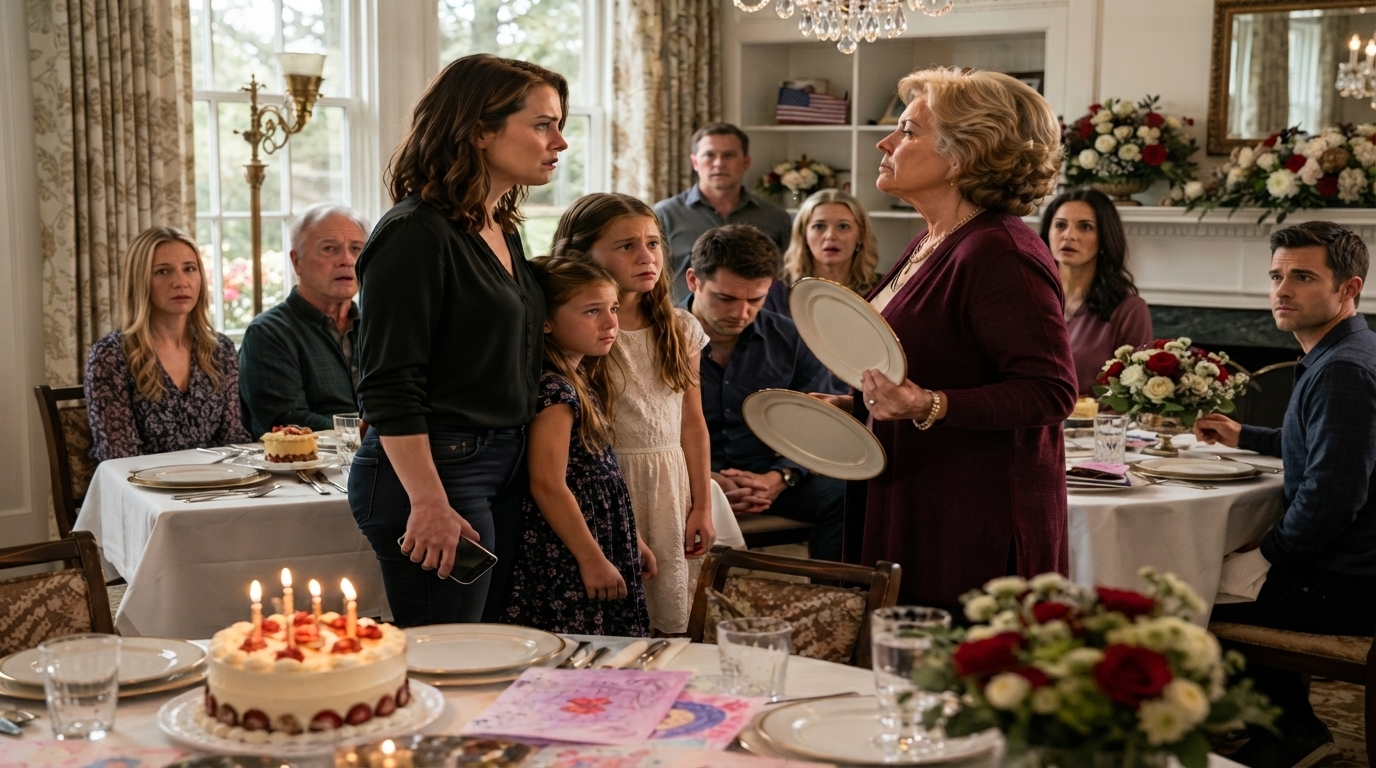
The first thing Elsa said when she saw the deed was my name.
Not “What is this?”
Not “Why did you send this?”
Just my name.
“Bri?”
Griffin was still holding the phone to his ear.
He heard the change in her voice immediately.
“What does it say?”
There was a long silence.
Then Elsa whispered, “She’s taking the house.”
Griffin looked at me.
I was standing in our kitchen, cutting strawberries for my daughters.
“Yes,” I said.
His face went blank.
“You knew she was doing this?”
“I told my attorney to proceed.”
“What does that even mean?”
“It means Elsa has been formally notified that she needs to vacate the property.”
Griffin lowered the phone.
“You’re evicting my mother?”
“No.”
I put the knife down.
“I’m reclaiming my property.”
He stared at me as if I had said something impossible.
“But you gave it to her.”
“I let her live there.”
“You said it was hers.”
“No. I said she could live there.”
Elsa was still listening through the phone.
“She has no right,” she suddenly shouted.
I almost smiled.
“That’s an interesting word coming from someone who has spent two years living in a house she never owned.”
“She’s my daughter-in-law!”
“That isn’t a title on a deed.”
Griffin closed his eyes.
“Mom, calm down.”
She ignored him.
“She promised me I could stay.”
“I promised you a place to live,” I said. “I never promised you ownership.”
“You’re cruel.”
“No.”
I picked up the strawberries again.
“I was generous.”
Her voice became sharper.
“And now you’re punishing me because I said something at dinner?”
“No, Elsa.”
I looked at my daughters sitting at the table nearby.
“I’m ending an arrangement that should never have lasted this long.”
Griffin put the phone on speaker.
“Can we just talk about this like adults?”
I looked at him.
“Which part?”
“The house.”
“Or the girls?”
He didn’t answer.
That silence was answer enough.
For nine years, Griffin had believed every family problem could be solved if I stayed quiet long enough.
He didn’t understand that silence only worked when both sides wanted peace.
I wanted safety.
My daughters wanted dignity.
And Elsa wanted control.
Those things couldn’t coexist anymore.
“Mom,” Griffin said into the phone, “you need to listen.”
“I am listening!”
“You cannot stay there without addressing this.”
“I’ve lived there for two years!”
“Yes.”
“And Bri said it was fine!”
“I know.”
“She can’t just change her mind.”
I finally looked at him.
“Actually, I can.”
The attorney had given Elsa thirty days.
Thirty days to remove her belongings.
Thirty days to arrange another residence.
Thirty days to stop telling people the property belonged to her.
And there was one more condition.
She could not enter the house without my written permission after the notice had been served.
That was the part Elsa couldn’t accept.
Because for two years, she had treated my father’s house like a throne.
Now she had to acknowledge it was never hers.
The next morning, the family group chat exploded.
Elsa posted a photograph of the envelope.
Then:
“After everything I’ve done for this family, this is how I’m treated.”
My sister-in-law replied:
“What happened?”
Elsa wrote:
“Bri is throwing me out of my own home.”
I stared at the screen.
My own home.
I saved the message.
Then another arrived.
“I raised Griffin.”
Saved.
“I sacrificed my life for this family.”
Saved.
“I opened my home to Bri.”
That one made me laugh.
She had never owned the house.
She had been given the privilege of living there.
Now she was rewriting the story in real time.
My daughter Mariset walked into the kitchen.
“Mom?”
“Yes?”
“Why is Grandma mad?”
I put my phone down.
“Because I told her she has to move.”
“Because of the plates?”
I hesitated.
“Yes.”
She looked confused.
“She doesn’t want girls there?”
I crouched.
“She was wrong.”
“But she said girls aren’t real family.”
I took her hands.
“Being family isn’t about being a boy or a girl.”
“Then why did she say it?”
“Because sometimes adults say hurtful things when they don’t know how to handle their feelings.”
Mariset thought about it.
Then she asked:
“Do you think she hates us?”
My chest tightened.
“No.”
It would have been easy to say yes.
But that wasn’t what my daughters needed.
“I think she believes boys are more important.”
“Are they?”
“No.”
She smiled.
“Okay.”
Then she hugged me.
Ten-year-old Tanzy stood behind her.
She didn’t say anything.
But when I looked at her, I saw tears in her eyes.
I opened my arms.
She came immediately.
For the first time, I realized the damage Elsa had done wasn’t in the sentence alone.
It was in the hesitation afterward.
My daughters had heard their grandmother define their value.
And nobody at the table had corrected her.
Not Griffin.
Not the relatives.
Not even me.
Not quickly enough.
That part would stay with me.
Three days after the notice arrived, Griffin came home late.
He sat across from me at the kitchen table.
“We need to talk.”
“Okay.”
“Mom says she can’t find another place.”
“She has thirty days.”
“That’s not enough.”
“It is.”
“You don’t understand.”
“I understand perfectly.”
He rubbed his forehead.
“She has medical appointments. She doesn’t know where to go.”
“Then help her find somewhere.”
“You’re making this difficult.”
I stared at him.
“I’m making it difficult?”
He sighed.
“That’s not what I meant.”
“It is exactly what you meant.”
He looked away.
Then he said:
“She didn’t mean what she said to the girls.”
I laughed softly.
“Of course she did.”
“She was angry.”
“She was smiling.”
“She was trying to make a point.”
“Her point was that our daughters are less valuable because they aren’t boys.”
“She doesn’t really believe that.”
“Then why has she treated them differently for years?”
He didn’t answer.
I leaned forward.
“Tell me something, Griffin.”
“What?”
“If Mariset and Tanzy had been boys, would you have defended them that night?”
He looked at me.
I waited.
He looked down.
I didn’t need another answer.
The following Saturday, I took my daughters to my father’s house.
Elsa opened the door before we reached it.
She looked surprised.
“You can’t just come here.”
I held up the key.
“I can.”
“This is my home.”
“No.”
I looked past her.
At the rose garden.
At the old brick walkway.
At the porch swing my father had built.
“This is my father’s home.”
Elsa stepped aside reluctantly.
I took my daughters into the backyard.
The roses were still there.
Overgrown.
Beautiful.
Exactly the way my father had left them.
Tanzy touched one carefully.
“Grandpa planted these?”
“Yes.”
“Did he know us?”
“He knew you were coming.”
Mariset smiled.
“Really?”
“He used to say he was going to build you two a garden.”
She looked at the flowers.
“But Grandma doesn’t bring us here.”
“No.”
Elsa appeared in the doorway.
“We don’t need to discuss this again.”
I stood.
“We aren’t discussing anything.”
I pointed toward the garden.
“They’re seeing their grandfather’s roses.”
Elsa folded her arms.
“I thought you said this was about the house.”
“It is.”
Then I looked directly at her.
“This house was supposed to remain a place where my children felt welcome.”
“They were always welcome.”
Mariset spoke before I could.
“No, we weren’t.”
The backyard went silent.
Elsa looked at her.
“What?”
Mariset’s voice trembled, but she kept going.
“You told us not to touch the roses.”
“They’re delicate.”
“You told us not to play in the yard.”
“Because you make a mess.”
“You said boys take better care of things.”
Elsa opened her mouth.
Nothing came out.
Tanzy looked at her.
“Why don’t you like girls?”
Elsa’s face hardened.
“That is not what I said.”
“Yes, it is.”
Tanzy’s eyes filled.
“You said boys make families stronger.”
I looked at my daughters.
Then at Elsa.
And I realized something.
They weren’t asking for permission anymore.
They were asking for truth.
I took both their hands.
“We’re leaving.”
Behind me, Elsa said:
“You are poisoning them against me.”
I turned.
“No.”
I looked at her.
“You did that yourself.”
That afternoon, I called Evelyn.
“I want everything handled formally.”
“Good,” she said.
“I don’t want another argument.”
“You won’t get one.”
“There’s something else.”
“What?”
“I want to know everything Elsa has changed.”
“On the property?”
“Yes.”
We discovered she had altered the landscaping.
Removed my father’s rose trellis.
Replaced several plants.
Painted two rooms without permission.
Installed locks on interior doors.
And most disturbing of all, she had attempted to change the mailing address on property-related correspondence.
She had begun receiving official notices as if she were the owner.
Evelyn filed the necessary documents to correct the records.
Then she found something else.
A county property inquiry filed eight months earlier.
Someone had asked about transferring the property.
I knew immediately who it was.
Elsa.
But the document had not been filed under her name.
It had been submitted through a real-estate service.
The service had been contacted by Griffin.
I looked at him when Evelyn told me.
“You tried to sell the house?”
He went pale.
“No.”
“Then why is your name on the inquiry?”
“I was just asking questions.”
“Questions about selling my house?”
He rubbed his hands together.
“Mom needed money.”
I stared at him.
“She was planning to sell it?”
“Not exactly.”
“Then what exactly?”
He didn’t answer.
I understood.
Elsa had convinced him that because he was her son, he had a right to manage the property.
And because he was my husband, he believed he could do it behind my back.
I asked Evelyn one final question.
“Can he legally do anything with it?”
“No.”
“Then what do I do?”
“Nothing.”
I almost laughed.
“That’s your advice?”
“For once, yes.”
She closed the folder.
“Let them keep talking.”
And they did.
For the next two weeks, Elsa called every relative she could reach.
She told them I was heartless.
That I was throwing out an elderly woman.
That I cared more about property than family.
That I had always been controlling.
That the girls had been manipulated by me.
What she didn’t know was that one of those relatives had begun forwarding me the messages.
My cousin Helena.
She had been at the dinner.
She had been one of the people who laughed.
Now she was sending screenshots.
“I feel terrible,” she wrote.
“I should have stopped it.”
I didn’t blame her.
But I didn’t excuse her either.
I asked her one question.
“Why didn’t you?”
She answered:
“Because everyone was afraid of Elsa.”
That sentence stayed with me.
Everyone was afraid.
My husband.
My sister-in-law.
My cousins.
Even grown adults.
They had built a whole family structure around avoiding one person’s anger.
And somehow, my daughters had been expected to fit inside it.
I decided they wouldn’t.
At the end of the second week, Griffin asked me to meet him alone.
We sat at a coffee shop.
He looked exhausted.
“Mom wants to apologize.”
“Okay.”
“She wants you to come to dinner.”
“No.”
“Bri.”
“No.”
“She says she didn’t realize how serious it was.”
“She realized when she took their plates.”
“She says she regrets it.”
I looked at him.
“Do you?”
He blinked.
“Do I what?”
“Regret doing nothing.”
He looked down.
“Yes.”
“Why?”
He took a long breath.
“Because when I saw them standing there, I knew it was wrong.”
“Then why didn’t you say something?”
He shook his head.
“I don’t know.”
I stared at him.
“You always know.”
He looked up.
“What does that mean?”
“It means you’ve spent nine years telling me you don’t know why you stay quiet.”
I leaned closer.
“You do know.”
He said nothing.
“You stay quiet because speaking up would mean choosing.”
His eyes reddened.
“And you’ve always been afraid to choose between your mother and me.”
“That isn’t fair.”
“Then tell me I’m wrong.”
He couldn’t.
I left first.
That night, Griffin slept in the guest room.
Not because I had ordered him there.
Because for the first time, he understood he had become a guest in the life he had helped build.
Three days later, Elsa did something I never expected.
She showed up at my office.
Without an appointment.
Without calling.
She walked past the receptionist and entered my conference room.
“You’re really going through with this?”
I stood.
“Yes.”
She looked around.
“This company wouldn’t exist if Griffin hadn’t supported you.”
I almost smiled.
“My father funded the first year.”
“I helped you with the girls.”
“You insulted them.”
“I babysat.”
“Twice.”
She frowned.
“You’re unbelievable.”
I sat down.
“Why are you really here?”
She hesitated.
Then she said:
“I need you to give me the house.”
I stared at her.
“What?”
“Transfer it to Griffin.”
“No.”
“Then put it in trust for the children.”
“No.”
“Why?”
“Because it’s mine.”
She slammed her hand on the table.
“They’re my grandchildren.”
“Yes.”
“And my son is your husband.”
“Yes.”
“So why can’t I have the house?”
I looked at her.
“Because neither relationship gives you ownership.”
Her eyes narrowed.
“You think money makes you better than me.”
“No.”
I paused.
“I think boundaries do.”
She stared at me.
Then her face changed.
“You’ve become just like your father.”
I went still.
My father had been dead for eight years.
“What does that mean?”
She smiled.
“You always thought he was the good one.”
“Wasn’t he?”
Elsa leaned closer.
“He wasn’t.”
She stood.
“You don’t know what really happened between us.”
Then she walked out.
I sat there long after she left.
That evening, I called my aunt.
My father’s sister.
I asked her one question.
“Was there something wrong between Dad and Elsa?”
She went quiet.
Then:
“Yes.”
“What?”
“I thought you knew.”
“I don’t.”
She sighed.
“Your father refused to let Elsa control the family finances.”
I frowned.
“What finances?”
“The inheritance.”
My aunt explained that years ago, my father had considered helping Elsa financially.
But she had wanted full control of the estate property.
He refused.
They fought.
After that, Elsa told the family my father was selfish.
But my aunt had copies of his notes.
He had written:
“I will help her, but I will not put my grandchildren’s future at risk.”
I closed my eyes.
My father had seen the problem before I did.
He had left me the house because he knew I might someday need a place that could never be taken away by family pressure.
And I had given it away.
Not legally.
But emotionally.
I had allowed someone else to act like the owner because I was afraid of being called selfish.
The next morning, Evelyn called.
“There’s something you need to see.”
She sent me a document.
It was my father’s handwritten will.
One sentence had been underlined.
“I leave the house to Brianna, my daughter, with the hope that she will preserve it for her children and never allow guilt to determine what she does with it.”
I cried.
Not because of the house.
Because my father had understood me.
He knew exactly what would happen.
And he had left me the answer.
I wasn’t supposed to preserve family at my own expense.
I was supposed to preserve something valuable for my children.
So I stopped apologizing.
The thirty-day notice continued.
And on day twenty-nine, Elsa still hadn’t moved.
Day thirty arrived.
At 9:00 a.m., the attorney’s representative met me at the property.
Elsa stood on the porch.
Griffin beside her.
Two relatives stood behind them.
She had invited witnesses.
Maybe she thought shame would make me back down.
It didn’t.
She held up a folder.
“You’re going to regret this.”
I looked at her.
“No.”
“You’ll lose Griffin.”
I looked at my husband.
Then back at her.
“I already lost him when he stopped protecting our children.”
Griffin flinched.
Elsa stared at him.
“Say something.”
He didn’t.
She turned toward him.
“Tell her she’s wrong.”
He looked at me.
Then at his mother.
“I can’t.”
Elsa’s face collapsed.
Not with sadness.
With disbelief.
For the first time, her son hadn’t obeyed.
She had spent his entire life teaching him to avoid her anger.
Now he had finally chosen something else.
Not me.
Not even himself.
His children.
He stepped toward me.
“I should have defended them.”
I nodded.
“Yes.”
“I should have stopped Mom.”
“Yes.”
“I was afraid.”
“I know.”
He looked at our daughters in the car.
“I don’t want them growing up like I did.”
That was the first time I believed he understood.
Elsa began crying.
“You’re choosing her.”
Griffin shook his head.
“No.”
Then he said something that silenced everyone.
“I’m choosing them.”
He pointed toward the car.
“Our daughters.”
Elsa stared at him.
Then she walked inside.
She packed her bags.
She left the house that afternoon.
She didn’t say goodbye.
I watched the car disappear.
Then I walked into the backyard.
Mariset and Tanzy followed me.
We stood in the rose garden.
Tanzy touched one of the flowers.
“Can we play here now?”
I smiled.
“Yes.”
“Whenever we want?”
“Yes.”
Mariset looked at me.
“Can we bring Grandpa’s garden back?”
I looked at the broken trellis.
“Yes.”
And that became our first project.
We repaired the rose garden.
Not all at once.
One section at a time.
We replanted the flowers Elsa had removed.
We rebuilt the trellis.
We painted the old bench.
We put a small sign near the entrance.
My father had once called the garden “a place for whoever needs somewhere safe to sit.”
I had the words restored.
My daughters chose the flowers.
They chose the colors.
They planted everything themselves.
And for the first time, the house sounded like children again.
Not arguments.
Not tension.
Laughter.
Real laughter.
The kind that didn’t come at anyone else’s expense.
PART 4
Elsa moved into a small apartment across town.
For several weeks, things were quiet.
Too quiet.
I should have known it wouldn’t last.
One Tuesday morning, I received a letter from her attorney.
She was contesting my decision.
She claimed I had verbally promised her permanent residence.
She claimed she had invested money in improvements.
She claimed the house had become her primary residence and that removing her would cause “undue hardship.”
Evelyn read the letter twice.
Then she smiled.
“What?”
“She thinks this is going to scare you.”
“Will it?”
“No.”
She opened a folder.
“Do you know why?”
“Why?”
“Because she signed receipts for every improvement she paid for.”
I stared at her.
“So?”
“She wrote ‘gift to Bri’s property’ on two of them.”
I laughed.
Elsa had documented her own mistake.
Every claim she made created another piece of evidence against her.
Then Evelyn showed me something else.
A bank statement.
Elsa had been paying bills from an account that listed my property as an asset.
She had already been telling financial institutions the house belonged to her.
This wasn’t just emotional.
She had been creating a paper trail.
I asked:
“Why?”
Evelyn looked at me.
“Because I suspect she thought eventually you would be too tired to fight.”
That sentence explained everything.
Elsa didn’t necessarily need to win immediately.
She only needed me to give up.
I had spent years doing exactly that.
But I didn’t anymore.
The legal battle continued.
And while it did, something unexpected happened.
My daughters changed.
Mariset started speaking more.
Tanzy stopped apologizing before asking for things.
They both began asking questions.
“What does consent mean?”
“What does ownership mean?”
“Can adults make children do things?”
“What happens if a family member is mean?”
I answered every question honestly.
I didn’t want them growing up afraid of authority.
But I also didn’t want them believing every authority figure was trustworthy.
So I taught them the difference between respect and obedience.
Respect someone.
Question what is wrong.
Speak up when someone is hurt.
Ask for help.
And never believe that being family gives someone permission to harm you.
Griffin joined us for dinner every night.
He was trying.
Not perfectly.
But trying.
He started therapy.
He stopped calling his mother.
He began setting boundaries.
One evening, after the girls went upstairs, he sat beside me.
“I need to tell you something.”
I looked at him.
“Okay.”
“When I was a kid, my mom used to make me choose.”
“Choose what?”
“Between her and everyone else.”
He stared at his hands.
“If Dad disagreed with her, she’d say he didn’t love us.”
I listened.
“If my sister wanted something, Mom said she was ungrateful.”
“And you?”
“I became the peacekeeper.”
I nodded.
“That explains why you stayed quiet.”
“Yes.”
“But it doesn’t excuse it.”
“I know.”
He looked at me.
“I’m not asking you to excuse it.”
“What are you asking?”
“I want to learn how to stop.”
I was quiet for a moment.
Then I said:
“Start by believing your daughters when they say something hurts.”
He nodded.
“I will.”
He did.
Slowly.
There was no dramatic overnight transformation.
He missed things.
Sometimes he still froze when his mother called.
Sometimes he struggled to say no.
But now he noticed.
And when he failed, he admitted it.
That mattered.
Two months into the legal dispute, Elsa made her biggest mistake.
She sent a message to Mariset.
Not to me.
To my ten-year-old daughter.
The message was short.
“Your mother is taking your grandmother’s home away.”
Mariset stared at it.
Then she brought me the phone.
“Mom?”
I read it.
My stomach turned.
“She said this to you?”
Mariset nodded.
“What should I say?”
“You don’t have to answer.”
“But I want to know why she’s mad.”
I sat beside her.
“Because adults sometimes try to make children carry things that belong to adults.”
“Like what?”
“Guilt.”
Mariset thought about it.
Then she typed:
“I love Grandma, but Mom says the house is hers.”
I gently took the phone.
“Don’t send that.”
“Why?”
“Because you don’t need to defend me.”
She looked at me.
“I want her to know she’s wrong.”
I smiled.
“She already knows.”
We didn’t respond.
Evelyn documented the contact.
And that became important.
The court extended the restrictions regarding direct contact with the children.
Elsa was furious.
She accused me of brainwashing them.
The irony was almost painful.
She had spent years trying to convince them that boys mattered more.
Now she was accusing me of influencing them because they no longer agreed with her.
One evening, I found Tanzy sitting in the rose garden.
She was holding a photograph of my father.
“Mom?”
“Yes?”
“Did Grandpa love girls?”
I sat beside her.
“Very much.”
“Then why did Grandma say boys make families stronger?”
“I don’t know.”
She frowned.
“Was she lying?”
I looked at the photograph.
“I think she believed it.”
Tanzy picked a fallen petal off the bench.
“That’s sad.”
“Yes.”
“I’m glad Grandpa didn’t.”
I hugged her.
“Me too.”
Then she smiled.
“I think girls can make families strong.”
I kissed her forehead.
“They can.”
A month later, my mother-in-law came to the house unexpectedly.
I saw her through the window.
She wasn’t angry.
She wasn’t carrying paperwork.
She stood there holding a small wooden box.
I went outside alone.
“What do you want?”
“I brought something.”
She handed me the box.
Inside was a photograph of my father.
He was standing in the rose garden.
Young.
Smiling.
Behind him were flowers.
I looked at her.
“Where did you get this?”
“He gave it to me.”
“When?”
“Years ago.”
“Why are you giving it to me now?”
She looked away.
“Because I should have.”
I waited.
She sat on the porch.
I remained standing.
“He told me once that you were the strongest person in the family.”
I looked at the photograph.
“He told you that?”
“Yes.”
“Then why did you treat me like I was weak?”
Her eyes filled.
“Because strong people frighten me.”
That was the closest she had ever come to telling the truth.
She admitted she had resented my independence.
She had hated that my father trusted me with the house.
She had believed Griffin should have more control.
She had believed sons carried family names while daughters eventually belonged elsewhere.
And when my daughters were born, she felt as though the family was losing something.
She wasn’t apologizing well.
But she was finally explaining.
I asked:
“Did you really believe what you said at dinner?”
She looked down.
“At the time.”
I nodded.
“At least you’re honest now.”
She cried.
“I don’t know how to fix this.”
“You can’t.”
She looked at me.
“The girls?”
“I don’t know.”
“I want to see them.”
“Not yet.”
She nodded.
For once, she didn’t argue.
She stood.
Before leaving, she touched the porch railing.
“Your father built this, didn’t he?”
“Yes.”
“I always liked this house.”
I said nothing.
She walked away.
The legal dispute ended six weeks later.
Elsa withdrew her claim.
The court records confirmed the property remained mine.
She was ordered to reimburse certain costs associated with the dispute.
The rest was over.
Or at least I thought it was.
Then Griffin received a letter.
A letter addressed to him from his father.
His father had been dead for years.
But the letter was one of several documents left in a safety deposit box.
The bank had finally released them after an old account was closed.
We sat at the table together.
He opened the envelope.
His father had written it shortly before his death.
It was addressed to Griffin.
“I know your mother will tell you family means never disagreeing with her.”
Griffin stopped reading.
His eyes filled.
He continued.
“That is not family.”
The next line was underlined.
“Family means protecting the person who cannot protect themselves, even when the person you are protecting is the one you’re afraid to disappoint.”
Griffin put the letter down.
He couldn’t continue.
I reached for his hand.
We sat quietly.
Two parents.
Two children upstairs.
And two generations of family mistakes sitting between us.
Griffin finally spoke.
“My father knew.”
“Yes.”
“He knew what she was like.”
“Yes.”
“Why didn’t he stop her?”
“I don’t know.”
He looked at me.
“Maybe he thought staying quiet was easier.”
I squeezed his hand.
“Maybe.”
He folded the letter.
“I don’t want to become him.”
That was the first time I knew the cycle might actually end.
Not because Elsa changed.
Because Griffin was finally choosing differently.
The family Christmas came three months later.
We didn’t invite Elsa.
We didn’t invite my father’s relatives who continued defending her.
It was small.
Me.
Griffin.
Mariset.
Tanzy.
My aunt.
The girls decorated the tree.
They made ornaments shaped like roses.
They put their grandfather’s photograph on the mantel.
Then Mariset looked at me.
“Mom?”
“Yes?”
“Can we make a new rule?”
“What rule?”
“No one gets better food because they’re a boy.”
I laughed.
“Agreed.”
Tanzy raised her hand.
“And nobody gets a bigger piece of cake just because they’re older.”
I smiled.
“Agreed.”
Griffin raised his hand.
“Can I add one?”
The girls looked at him.
“Everyone gets to speak.”
Mariset nodded.
“Good rule.”
That became our family rule.
Everyone gets a voice.
Everyone gets a seat.
Everyone gets to say when something hurts.
And nobody gets to decide another person’s worth.
Especially not based on whether they are a boy or a girl.
A few weeks later, Elsa called Griffin.
He answered.
I could hear her voice through the phone.
“I want to see the girls.”
Griffin looked at me.
I nodded.
He put the call on speaker.
“You can see them at the supervised visit.”
“I don’t need supervision.”
“Yes, you do.”
She went silent.
“I’ve changed.”
“I hope so.”
“You don’t trust me.”
“Not yet.”
That answer made me proud.
Not because it was cruel.
Because it was honest.
Trust isn’t a demand.
It’s something people rebuild.
Elsa agreed.
The first visit lasted forty-five minutes.
She brought gifts.
Books.
Art supplies.
Two identical bracelets.
No toys labeled “for boys.”
No comments about sons.
No insults.
She mostly listened.
At the end, Mariset hugged her.
Tanzy did too.
I stayed back.
When Elsa left, she turned to me.
“Thank you.”
I nodded.
“That doesn’t mean the past is erased.”
“I know.”
“And it doesn’t mean things go back to how they were.”
“I know.”
She hesitated.
“Could they ever?”
I thought about it.
“Maybe something different.”
She nodded.
Different.
That was enough.
Not forgiveness.
Not forgetting.
Different.
Months passed.
The girls continued seeing Elsa occasionally under the new boundaries.
Something unexpected happened.
Elsa started changing.
She asked questions instead of giving instructions.
She stopped comparing the girls to their cousin.
She admitted when she was wrong.
Not every time.
Not perfectly.
But enough to notice.
One afternoon, she brought the girls into the rose garden.
She had permission to visit.
She sat on the old bench.
“Your grandfather loved this garden,” she said.
Mariset looked at her.
“Did he?”
“Yes.”
“Then why did you take the roses away?”
Elsa looked at the ground.
“Because I was angry.”
“At Mom?”
“Yes.”
“Why?”
Elsa took a long breath.
“Because I thought she was taking something from me.”
“What?”
She looked at the girls.
“My place.”
Tanzy tilted her head.
“You don’t lose your place when other people get love.”
Elsa stared at her.
Then she cried.
My daughter didn’t understand how profound that sentence was.
She didn’t need to.
She was nine years old and already knew what my mother-in-law had spent a lifetime refusing to understand.
Love isn’t a limited supply.
A granddaughter does not take the place of a grandson.
A daughter does not reduce the value of a son.
There isn’t one chair.
There is a whole table.
And there is room for everyone.
The house became that table.
My father’s garden became the center.
We rebuilt the trellis together.
Elsa paid for some of the roses.
I planted them with my daughters.
Griffin repaired the bench.
It became a strange kind of memorial.
Not to the family we had lost.
To the family we were trying to build.
PART 5
Two years after that dinner, the house looked completely different.
Not because we changed its walls.
Because we changed what happened inside them.
The dining room became my favorite place.
The table that had once reminded me of humiliation became the place where our daughters did homework.
Where Griffin and I planned vacations.
Where birthdays were celebrated.
Where my aunt told stories about my father.
Where Elsa, occasionally, was invited to dinner.
And yes, she sat at the table.
Not because she had won.
Because she had finally learned that having a seat was not the same as having control.
One Sunday afternoon, I was setting out plates when Elsa arrived for dinner.
She looked at the table.
There were eight plates.
She smiled faintly.
“Good china?”
I looked at her.
“Every seat.”
She nodded.
Then she walked toward the girls.
Mariset handed her a folded card.
“What is this?”
“We made you something.”
Elsa opened it.
Inside was a drawing of the rose garden.
At the top, the girls had written:
GRANDMA’S GARDEN
Elsa covered her mouth.
“This is beautiful.”
Tanzy smiled.
“You can keep it.”
Elsa looked at me.
For a moment, neither of us spoke.
Then she said:
“Thank you.”
That simple sentence would once have seemed impossible.
But people can change.
Not always.
Not completely.
But sometimes.
And sometimes the most important change is not someone else becoming kinder.
It’s you becoming stronger about what you will and will not accept.
I never forgot that night.
Not the plates.
Not Elsa’s sentence.
Not Griffin looking away.
I didn’t want to forget.
Forgetting would have made it easier to repeat.
Instead, I remembered.
And remembering became a boundary.
A year later, Mariset had a school award ceremony.
Her grandmother attended.
Elsa sat beside me.
When Mariset walked onto the stage, Elsa stood first.
She applauded loudly.
Tanzy whispered:
“She’s proud.”
I smiled.
“Yes.”
Elsa looked at both girls.
“I am.”
I believed her.
After the ceremony, she pulled me aside.
“I’ve wanted to ask you something.”
“What?”
“Do you still hate me?”
I thought for a moment.
“No.”
She looked surprised.
“I don’t.”
“Then what do you feel?”
I watched my daughters laughing across the hallway.
“I feel careful.”
She nodded.
“I understand.”
That was enough.
Careful was not cruel.
Careful was earned.
There were still things Elsa would never have again.
Unsupervised access to the children.
Control over my house.
The ability to make decisions for our family.
The automatic assumption that everyone would obey.
Those things were gone.
But she had something else now.
A relationship with two granddaughters who chose to see her.
One that existed because it was built on respect rather than fear.
Sometimes I wondered what would have happened if she hadn’t taken those plates.
What if she had made another joke?
What if I had stayed quiet?
What if I had waited one more year?
Maybe the property issue would have remained hidden.
Maybe the house would eventually have been transferred.
Maybe my daughters would have continued believing they were somehow less important.
Maybe Griffin would have spent another decade looking away.
That was why I didn’t regret sending the message.
Proceed.
One word.
It contained everything.
The boundary.
The decision.
The beginning.
The end.
The house was mine.
The children were mine to protect.
The marriage was mine to evaluate.
And my dignity was mine to keep.
I had spent nine years waiting for Griffin to defend me.
He finally did.
But only after I stopped waiting.
That distinction mattered.
Because sometimes we tell ourselves we’re staying patient when we’re actually teaching other people that they can keep hurting us.
Patience is not the same as surrender.
Forgiveness is not the same as permission.
Family is not the same as entitlement.
And silence is not peace.
Those lessons changed every relationship in my life.
My daughters grew up speaking clearly.
When someone interrupted them, they finished their sentence.
When someone dismissed their feelings, they said so.
When something felt wrong, they asked questions.
They never had to wonder whether they deserved the good plates.
The good room.
The best seat.
They knew the answer.
They belonged.
One evening, years later, Tanzy asked me about the first time I stood up to Elsa.
We were sitting in the garden.
The roses had grown tall.
“Mom?”
“Yes?”
“Was Grandma really mean to you?”
I smiled.
“Sometimes.”
“Why didn’t you tell us?”
“You were little.”
“Were you scared?”
“Yes.”
“Of her?”
“No.”
I thought about it.
“Of what would happen if I stopped making everyone else happy.”
Tanzy looked at me.
“Did you stop?”
“Eventually.”
She smiled.
“Good.”
I looked at her.
“You know something?”
“What?”
“You don’t have to make everyone happy.”
She laughed.
“Even Grandma?”
“Especially Grandma.”
She laughed again.
Then Mariset ran into the garden.
“Dinner!”
We got up.
As we walked toward the house, I saw the dining room through the windows.
The table was full.
Plates everywhere.
No one was being measured by gender.
No one was being ranked.
No one was waiting for a boy to arrive before they felt complete.
There was enough food.
Enough room.
Enough love.
I stopped on the porch.
My father had once wanted grandchildren running through that yard.
Now they were.
Exactly as he had imagined.
Maybe not the way he expected.
But better.
Because the family standing at that table had finally learned something his old house had been trying to teach us all along.
A home is not defined by who owns the deed.
It’s defined by who feels safe inside it.
That night, after dinner, Elsa helped the girls clear the plates.
She held two of the good china dishes in her hands.
For a second, I watched her.
Then she looked at me.
A tiny smile appeared.
“Good china,” she said.
I smiled back.
“All family.”
She nodded.
And that was all.
No speech.
No dramatic apology.
No perfect ending.
Just a woman who once believed only women who gave birth to sons deserved a seat at her table, now carrying plates for two girls she had once told to eat in the kitchen.
Life has a funny way of returning things.
Not revenge.
Not punishment.
Perspective.
The same hands that once removed those plates now carried them to the table.
The same girls who once stood frozen now argued over dessert.
The same husband who once looked away now told his mother when she crossed a line.
And the house my father left me became what he intended it to be.
A place where his grandchildren knew they belonged.
A few weeks later, I found the old manila folder in my office.
The one labeled with Elsa’s name.
I opened it.
Inside were the deed.
The attorney’s notes.
The court documents.
The photographs.
The messages.
Proof of every moment that led us there.
I almost threw it away.
Then I kept it.
Not because I wanted to relive what happened.
Because sometimes a record is a reminder of how far you’ve come.
I wrote one sentence on the inside cover.
“Never again.”
Then I closed it.
And I understood something I wish I’d known nine years earlier.
The most dangerous lie in a family isn’t always the lie someone tells.
Sometimes it’s the lie you tell yourself.
That if you stay quiet, the cruelty will stop.
That if you give enough, people will become grateful.
That if you forgive quickly enough, people will become careful.
That if you love someone, they will eventually love you in the way you need.
Sometimes none of that happens.
Sometimes people take your patience as permission.
They take your kindness as weakness.
They take your silence as surrender.
And when that happens, the answer isn’t always a bigger argument.
Sometimes it’s one word.
Proceed.
Then you let the truth speak.
The deed spoke.
The records spoke.
The messages spoke.
My daughters spoke.
Even the silence spoke.
And once everyone finally heard it, there was nothing left to argue about.
The house stayed in my name.
The roses grew back.
The girls grew up.
Griffin changed.
Elsa learned, slowly, that she could be part of a family without controlling it.
And I finally learned that boundaries don’t destroy families.
They reveal them.
One evening, I was sitting at the dining table when Mariset came in holding an envelope.
“Mom?”
“What is it?”
She handed it to me.
Inside was a school essay.
The title was:
WHAT MAKES A FAMILY?
I read her first sentence.
“A family is not people who share the same last name. It is the people who make you feel safe enough to be yourself.”
I had to stop.
I looked up.
“Where did you learn that?”
She shrugged.
“From you.”
Then she hugged me.
I held her tightly.
Across the room, Tanzy was laughing with Griffin.
Elsa was in the kitchen cutting cake.
My aunt was telling another story about my father.
The garden lights had just come on.
And for a moment, I looked around the room and remembered the night a fork hit the floor.
I remembered Elsa taking the plates.
I remembered my husband looking away.
I remembered my daughters waiting for an adult to tell them they mattered.
They had been waiting for someone to choose them.
I had failed to do it quickly enough.
But eventually, I did.
And that changed everything.
Because sometimes one sentence can reveal a whole family.
Sometimes one decision can end years of silence.
And sometimes the person who thinks they controls the table forgets one important thing.
The table belongs to no one person.
It belongs to the people sitting around it.
And everyone who deserves a place gets one.
Not because they gave birth to a son.
Not because they have the loudest voice.
Not because they own the house.
Not because they are the oldest.
Not because everyone is afraid of them.
They get a seat because they know how to make room for someone else.
That was the lesson my daughters learned.
That was the lesson Griffin finally learned.
And, eventually, it was the lesson Elsa had to learn too.
The next birthday dinner was held in my father’s house.
The roses were blooming.
The table was full.
Mariset and Tanzy sat beside one another.
Elsa sat across from them.
Griffin sat next to me.
I put the plates down.
Elsa looked at them.
Then she looked at my daughters.
“Who wants the good china tonight?”
Both girls raised their hands.
Everyone laughed.
But this time, nobody was laughing at them.
They were laughing because the joke was finally harmless.
Because the wound had become a scar.
Because the house had survived.
Because the family had changed.
And because the two little girls who once stood in a kitchen eating from paper plates now sat at the center of the table they had always deserved.
I looked at Griffin.
He smiled.
Then he reached across the table and took my hand.
No words.
He didn’t need them.
For nine years, I had waited for him to look up.
That night, he finally did.
And I realized I was no longer asking anyone for permission to belong.
I belonged because I chose to.
My daughters belonged because they were loved.
And the home my father left me belonged exactly where it had always been meant to be.
In the hands of someone who would protect it.
In the garden where his grandchildren could run.
At a table where every child was welcome.
And beside two daughters who would never again wonder whether being born girls made them less worthy of the good china.
Because I had finally taught them the truth I had needed to learn myself.
Never let anyone convince you that you have to earn your seat at a table where you already belong.
And when someone tries to take your plate away because they think you are worth less than someone else?
Don’t beg for another plate.
Don’t argue about whether you deserve one.
Stand up.
Protect your children.
Protect yourself.
And remember that sometimes the most powerful thing you can say is only one word.
Proceed.
THE END THANK YOU FOR READING !!!