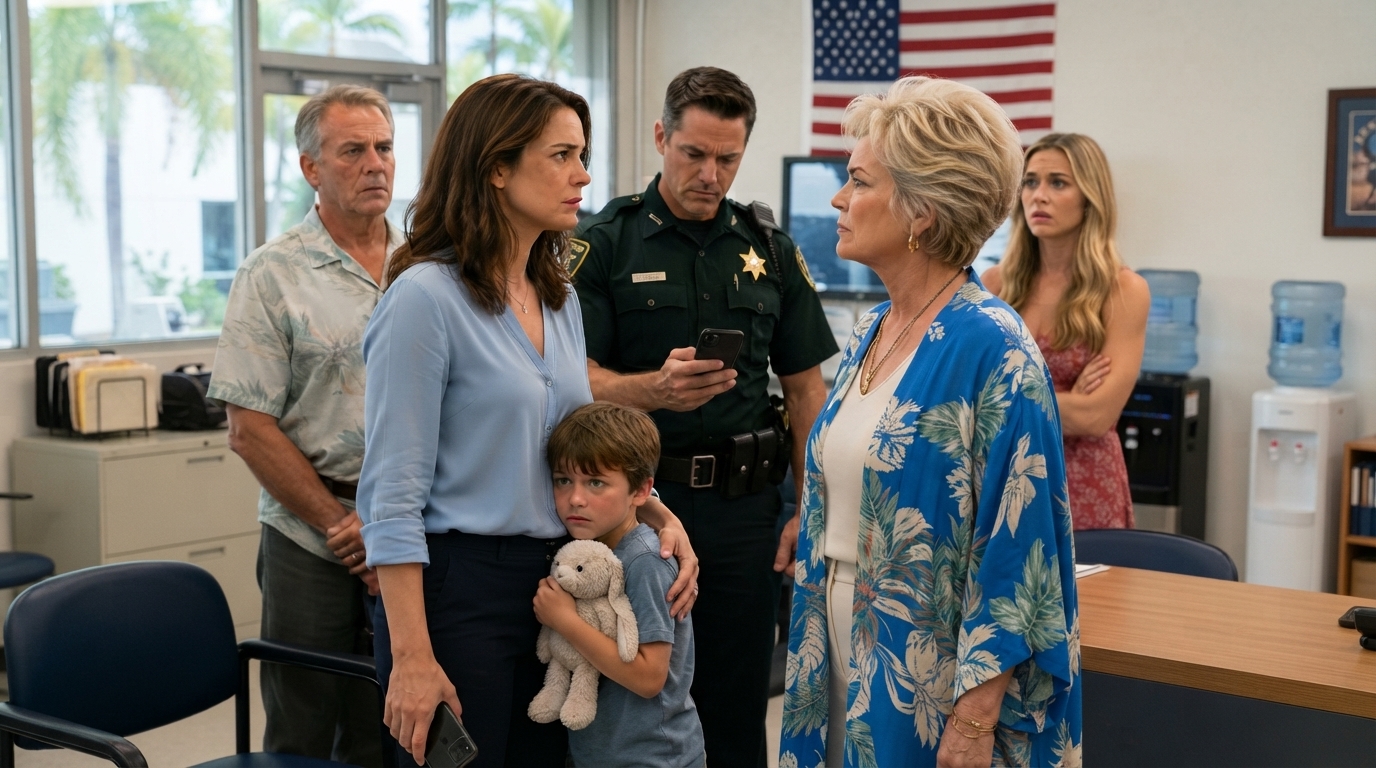
My son, Rhett, was curled into an oversized chair across the room, both arms wrapped around a stuffed character toy a staff member had given him. His eyes were swollen from crying. His sneakers didn’t touch the floor.
My mother stood the second I walked in.
“This has gone on long enough, Bri,” she said,
as if I were the one embarrassing the family.
A sheriff’s deputy calmly asked her to sit back down.
She did, but the look she gave me was the same one
I had known my entire life—the look that said she still believed
she was the adult in the room and I was the emotional
child who would eventually calm down and apologize.
I didn’t raise my voice.
I crossed the carpet, dropped to my knees in front of Rhett,
and pulled him into my arms.
“You came,” he whispered into my shoulder.
“I will always come.”
Behind me, my mother sighed.
That sound nearly broke something open inside me,
because less than six hours earlier, Rhett had walked out of a restroom and found his grandparents,
his aunt, and his cousins gone.
Not waiting near the bench.
Not looking for him.
Gone.
He had stood where I had always taught him to stand if we ever got separated,
trying not to wander farther into a crowd.
A stranger eventually noticed him crying.
Theme park staff found the laminated emergency card clipped inside his Spider-Man backpack and called me in Denver.
When I asked my mother what happened,
she answered over the sound of splashing water from the resort pool.
“He wouldn’t hurry up, Bri. The boys were hungry.”
Then she said the sentence I still hear with perfect clarity.
“We figured someone would help him.”
Someone did.
A stranger did.
My own family went back to the pool.
For most people, that would have been the whole story.
For me, it was only the moment thirty-one years of excuses finally stopped working.
My mother, Delphine, had always called herself practical.
Growing up, tears were “dramatic.”
Fear was “attention-seeking.”
Needing a break meant you were making everyone else’s life harder.
My father, Roland, rarely agreed with her out loud, but he almost never stopped her either.
He had perfected the art of standing close enough to witness
everything and far enough away to claim he had nothing to do with it.
My younger sister, Isolde, learned a different survival skill.
She became the kind of person my mother rewarded—fast, sharp,
competitive, never the one slowing everyone down.
And Rhett was nothing like that.
He was gentle.
Careful.
Watchful.
He noticed when strangers looked sad.
He got tired in crowds.
He asked for water when he was thirsty and bathroom breaks when he needed them.
My mother treated those things like character flaws.
During the first two days of the trip, the family group chat had filled with little comments.
Rhett needed three bathroom breaks before lunch.
Rhett keeps stopping for water.
The other boys know how to keep pace.
He makes everything take twice as long.
I read every message and did what I had been trained to do since childhood.
I minimized it.
I told myself she was only impatient.
I told myself he was safe.
Then Disney security called.
By the time I reached Orlando, I had done something my family never expected from me.
I had stopped arguing and started documenting.
Every message was saved.
Every joke.
Every timestamp.
Every comment written after they already knew Rhett had been found.
There was even a voice memo from my mother complaining that she refused to let her vacation be ruined over “a kid with a small bladder.”
I saved that too.
Now, standing inside that bright security office with fluorescent lights humming overhead, I had my phone in one hand and Rhett’s small fingers wrapped around the other.
My father leaned forward.
“It was one bad moment,” he said. “You’re acting like we did something unforgivable.”
I looked at him for a long second.
“The unforgivable part isn’t the moment,” I said. “It’s that you knew exactly what you were doing, and you were laughing about it afterward.”
My sister’s eyes flicked toward my mother.
Just once.
But I saw it.
The first crack.
Delphine saw it too.
“We were teaching him independence,” she said quickly. “Children need structure. Consequences.”
The deputy’s expression didn’t change.
I unlocked my phone.
My mother gave a short, dismissive laugh.
“Oh, please. Are we really going to turn family jokes into evidence now?”
I didn’t answer her.
I simply handed the deputy the phone.
The room changed almost immediately.
He scrolled once.
Then again.
My father stopped leaning forward.
My sister lowered her eyes.
My mother’s smile stayed in place, but only barely.
The deputy reached the message where she had joked that the park was “basically free supervision.”
He stopped scrolling.
For the first time that day, my mother looked uncertain.
The deputy lifted his eyes from the screen and looked directly at her.
Then he began to read her own words back to the room.
And before he reached the final line, my mother’s face had already started to change.
The message was dated that same morning.
8:41 a.m.
Delphine:
“He needs to learn that the world doesn’t stop for him.”
At 8:43, Isolde had replied:
“Exactly. We’re done babysitting.”
My mother wrote:
“Don’t worry. If he wanders, someone at the park will find him.”
Then my sister sent a laughing emoji.
Then my mother wrote the line that made the room go silent.
“Honestly, a little crying might teach him faster than anything we can say.”
The deputy read it once.
Then he looked up.
“Who wrote this?”
My mother didn’t answer.
My sister did.
“She did.”
Delphine turned toward her.
“What are you doing?”
Isolde’s face had gone pale.
The deputy asked, “Did you know the child would be alone?”
My father spoke.
“We didn’t intend for him to be alone.”
“That wasn’t the question.”
Silence.
My father looked down.
Then the deputy asked again.
“Did you know Mr. Hadley had separated from the group?”
My mother folded her arms.
“He went to the restroom.”
“Who was supposed to wait for him?”
My mother hesitated.
My sister answered quietly.
“I was.”
My head snapped toward her.
“What?”
She looked at me.
“I was supposed to wait.”
“Then why didn’t you?”
Her eyes filled with tears.
“I thought Mom would.”
My mother scoffed.
“Don’t put this on me.”
My father said, “Everyone misunderstood.”
I stared at all three of them.
Rhett was still tucked against my side.
His little fingers were clutching the fabric of my shirt.
I could feel him trembling.
And suddenly, something inside me settled.
Not rage.
Not panic.
Certainty.
This wasn’t a misunderstanding.
It wasn’t bad luck.
It wasn’t a crowded park.
It wasn’t a child being difficult.
Three adults had known my six-year-old needed help.
And they had chosen not to help him.
I looked at the deputy.
“I want a report.”
My mother sat straighter.
“Bri.”
“I want a report.”
“Do you hear yourself?”
“Yes.”
“You’re calling the police on your own family.”
“I called because my son was abandoned.”
Her face hardened.
“We are his family.”
I shook my head.
“Not in the way that matters.”
The deputy took my statement.
So did another officer.
Rhett’s statement was handled differently.
They didn’t interrogate him.
They had a child specialist speak to him privately, with me nearby.
He was too little to explain everything cleanly.
He repeated the same story several times.
“I came out.”
“They weren’t there.”
“I waited.”
“People kept walking.”
“I thought Grandma was hiding.”
Then he whispered:
“I didn’t know where you were.”
The specialist asked him what he did next.
He pointed at his backpack.
“I touched my card.”
The laminated card.
The one I had made two years earlier after getting separated from him for seven minutes at a crowded fair.
His name.
My name.
My phone number.
His allergies.
Emergency instructions.
He had followed every safety rule I ever taught him.
He hadn’t wandered.
He hadn’t run.
He hadn’t climbed into a stranger’s car.
He had stood still.
He had cried.
And a stranger had done what my own family refused to do.
She had stopped.
She had crouched to his level.
She had asked him where his mommy was.
And she had stayed until security arrived.
I later learned her name was Marissa.
She had been visiting with her daughter.
She saw Rhett standing alone near the restroom and thought at first he had simply lost sight of his group.
Then she noticed how long he had been waiting.
When she asked him if he knew anyone’s phone number, he shook his head.
But then he remembered the card.
That card saved him.
After I finished giving the deputy my statement, I asked whether Rhett could leave with me.
“Yes.”
I thanked him.
As I stood, my mother said quietly:
“This is ridiculous.”
I turned.
She whispered, “You’re making a permanent issue out of a temporary mistake.”
I looked at her.
“My son thought he had been abandoned.”
“He wasn’t abandoned.”
“He was left alone.”
“For twenty minutes.”
“Thirty-seven,” the deputy said.
My mother looked at him.
He continued.
“According to the timeline we have.”
Thirty-seven minutes.
Not five.
Not ten.
Thirty-seven.
Thirty-seven minutes for a six-year-old in a massive theme park surrounded by thousands of people.
Thirty-seven minutes while his grandparents were at a pool laughing.
I picked up my bag.
“I’m taking him home.”
My father stood.
“We’re all flying home tomorrow.”
“No.”
“What do you mean, no?”
“I mean you’re not coming with us.”
My mother laughed again.
“This is our family trip.”
“Not anymore.”
She stepped toward me.
“You don’t get to cut us off because you’re angry.”
I looked at her.
“This isn’t because I’m angry.”
She waited.
“I’m cutting you off because I’m no longer willing to confuse cruelty with family.”
Her face changed.
That was the first time I had ever seen my mother speechless.
I took Rhett’s hand.
We walked out.
The airport hotel was quiet.
Too quiet.
Rhett slept with the stuffed toy pressed against his chest.
I sat on the edge of the bed and watched him breathe.
Every few minutes, he shifted.
Once, his hand moved across the blanket as if searching.
I reached over and held it.
He relaxed.
I stayed there all night.
At 4:10 a.m., my phone buzzed.
Family group chat.
Mom:
“This has become completely insane.”
Dad:
“Everyone needs to calm down.”
Isolde:
“Bri is threatening to keep Rhett away from us.”
Mom:
“She is always looking for reasons to play victim.”
I took screenshots.
Then more messages appeared.
Mom:
“Imagine blowing up a whole family vacation over one bathroom incident.”
Isolde:
“Exactly.”
Dad:
“She has always been dramatic.”
Then my mother wrote:
“She’s been punishing us for years because we don’t treat that child like he’s fragile.”
I stared at the screen.
Fragile.
That was how they had rewritten it.
Not neglected.
Not abandoned.
Not frightened.
Fragile.
The next message came from my sister.
“At least somebody found him. It’s not like he was in danger.”
I saved that too.
Then I opened my email and forwarded everything to myself.
I didn’t know yet why I was collecting it all.
I only knew I had spent my entire life being told that my memory was wrong.
That I exaggerated.
That I misunderstood.
That things hadn’t happened the way I remembered them.
This time, I wanted a record that couldn’t be argued with.
At sunrise, I booked the next flight home.
Rhett woke at seven.
“Are we going home?”
“Yes.”
“Now?”
“Yes.”
He smiled.
For the first time since the call, I saw some color return to his face.
“Will you come with me?”
I pulled him into my arms.
“Always.”
He tucked his head under my chin.
“Mom?”
“Yes?”
“Did Grandma leave because I was bad?”
My heart broke.
“No.”
“But she said I was taking too long.”
“You were using the restroom.”
“I couldn’t make it faster.”
“You didn’t have to.”
He was quiet.
Then:
“Why did she leave me?”
I wanted to tell him everything.
I wanted to say because she is cruel.
Because she thinks your needs are inconveniences.
Because she treats vulnerability like weakness.
Because she has spent years teaching everyone around her that her comfort matters more than your safety.
But he was six.
He didn’t need the whole truth.
He needed one truth.
“It wasn’t because of you.”
He nodded.
“Okay.”
That word broke me more than his tears had.
Because children believe the explanations adults give them.
And somewhere inside that six-year-old heart, he had already started wondering whether being himself had caused the abandonment.
I promised myself I would never let him carry that blame.
When we returned home, I changed the locks.
My mother called.
I didn’t answer.
She called again.
I didn’t answer.
My father called.
I didn’t answer.
Then Isolde sent a message.
“I need to explain.”
I read it.
Then ignored it.
The next morning, a package arrived.
Inside was a small pair of pajamas Rhett had forgotten at the resort.
There was a note.
My mother’s handwriting.
“We should talk.”
I threw the note away.
Two hours later, someone knocked on the door.
It was my father.
He stood on the porch with his hands in his pockets.
“We need to work this out.”
“No.”
“Bri.”
“No.”
“You’re acting out of emotion.”
“No.”
He sighed.
“Your mother made a mistake.”
I looked at him.
“You watched.”
“I didn’t realize—”
“You were there.”
“I thought she was joking.”
“About leaving a six-year-old alone?”
He had no answer.
I stepped closer.
“Dad, you have spent your entire life saying you hate conflict. But conflict isn’t what scares you.”
He looked at me.
“Consequences do.”
His expression hardened.
“You don’t know what you’re talking about.”
“I know exactly what I’m talking about.”
He looked down.
Then he said something that would haunt me.
“You don’t understand your mother.”
I laughed softly.
“I understand her perfectly.”
“No.”
He shook his head.
“You don’t know what happens when she thinks she’s losing someone.”
I froze.
“What does that mean?”
He looked toward the street.
“Nothing.”
“Dad.”
“Just let things settle.”
Then he walked away.
That conversation sat in my mind for days.
What happens when she thinks she’s losing someone?
I had spent thirty-one years believing my mother was simply controlling.
But maybe there was more.
The first clue came from a box in my attic.
I wasn’t looking for it.
I was searching for Rhett’s old winter clothes when I found a plastic storage container with my name written across the top.
Inside were childhood things.
School papers.
Photographs.
A birthday card.
And underneath everything, an old legal envelope.
I opened it.
My birth certificate.
But the date was wrong.
Not the date.
The place.
I was born in a different county than the one I had always been told.
I called the county office.
They couldn’t tell me anything over the phone.
I ordered a certified copy.
Three days later, it arrived.
My mother’s name was listed.
My father’s name was listed.
But there was something else.
A handwritten annotation.
An amended filing.
I didn’t understand it.
So I took it to Evelyn, the attorney I had used years earlier for a business matter.
She read it.
Then looked at me.
“Where did you get this?”
“Why?”
“This indicates an adoption-related amendment.”
My heart stopped.
“Adoption?”
“I can’t tell from this alone.”
I stared at the page.
“My parents never told me I was adopted.”
“Then ask them.”
I couldn’t.
Not yet.
I went home and searched old photographs.
At six months.
One year.
Two years.
There were very few.
That had always seemed normal.
My parents weren’t sentimental.
Then I found an old birthday video.
I watched it.
I was five.
My mother was behind the camera.
I heard her voice.
“Come on, Bri. Smile.”
I froze.
Because when she said my name, there was something in her voice I’d never heard before.
Tenderness.
Not the version of my mother I knew.
Something softer.
I rewound it.
Then again.
I listened.
A week later, my aunt called me.
My mother’s younger sister.
She had never been close to us.
She lived in another state.
“Your father gave me your number,” she said.
I sat down.
“Why?”
“Because your mother is talking about going to court.”
“For what?”
“To get visitation with Rhett.”
I felt my jaw tighten.
“She has no right.”
“I know.”
There was a pause.
Then my aunt asked:
“Did you find the certificate?”
I went still.
“How do you know about that?”
She sighed.
“Because I was there.”
“Where?”
“The day your mother brought you home.”
I couldn’t breathe.
My aunt told me a story I had never heard.
I hadn’t been adopted in the traditional sense.
My mother had been my biological mother.
But there had been another woman involved.
My mother’s older sister, Elara.
Elara had been twenty-two when she had a baby she couldn’t care for.
The baby was me.
My mother had taken me.
Not immediately.
But after a period of instability, paperwork had been arranged.
My father had signed.
The family had kept the circumstances quiet.
I had grown up believing I was my parents’ biological daughter.
Technically, I wasn’t.
I was their niece.
My mother had raised me as her own.
And for most of my childhood, that distinction had meant nothing.
Until Rhett.
Until the day I began to see the same thing she had done to me in what she was trying to do to him.
Control.
Ownership.
Conditional love.
My aunt told me something else.
“She always said you owed her.”
My voice was barely a whisper.
“Owed her?”
“For taking you in.”
I closed my eyes.
There it was.
The sentence hidden beneath my entire childhood.
You should be grateful.
I fed you.
I raised you.
I gave you a home.
Every time I disagreed with her, I had been reminded of what she had supposedly done for me.
Every time I set a boundary, she treated it like betrayal.
Now I understood why.
My mother hadn’t only wanted obedience.
She wanted ownership.
And when she saw Rhett resisting her control, she treated him the same way.
But there was one difference.
I wasn’t six anymore.
And he had me.
My aunt ended the call with one warning.
“Your mother doesn’t like losing.”
“I know.”
“She’ll try to make you look unstable.”
I sat very still.
“Why?”
“Because that is what she does when people stop doing what she wants.”
The court filing came two weeks later.
My mother petitioned for grandparent visitation.
Her claim described her as a loving caregiver who had been “unfairly cut off.”
There was no mention of the restroom.
No mention of thirty-seven minutes.
No mention of the messages.
No mention of the investigation.
Instead, she described Rhett as a child who loved his grandparents and had supposedly been “confused by his mother’s emotional reaction.”
I laughed when I read that.
Not because it was funny.
Because it was familiar.
Every abuse of truth begins with a rewrite.
I sent everything to Evelyn.
The messages.
The timeline.
The police report.
The security report.
The witness statement from Marissa.
The screenshots.
The voice memo.
The hotel booking.
The flight records.
Every piece of evidence.
Evelyn reviewed it.
Then she said:
“She filed the wrong story against the wrong person.”
The hearing was held six weeks later.
My mother arrived dressed perfectly.
My father beside her.
Isolde sat behind them.
I walked in alone.
Then Evelyn leaned toward me.
“Look behind you.”
I did.
Marissa was sitting there.
The woman who had found Rhett.
I hadn’t asked her to come.
She had volunteered.
She gave me a small smile.
My eyes filled.
When the hearing began, my mother’s attorney spoke first.
He described the Disney incident as an “unfortunate misunderstanding.”
He said my family had been overwhelmed.
He said my mother had immediately expected the child to reconnect with the group.
He said there was no evidence of malicious intent.
Then Evelyn stood.
She didn’t argue.
She simply presented facts.
The first exhibit was the timeline.
The second was the security report.
The third was the group chat.
The fourth was the voice recording.
My mother shifted in her chair.
Then Evelyn played it.
My mother’s own voice filled the courtroom.
“He needs to learn the world doesn’t stop for him.”
Then:
“If he wanders, someone at the park will find him.”
Then:
“A little crying might teach him faster.”
There was silence.
My mother’s attorney whispered something to her.
She shook her head.
Evelyn continued.
Then came the message sent after Rhett had been located.
My mother:
“Honestly, a little embarrassment is good for him.”
The judge looked up.
“Was this written after the child had been reported missing?”
Evelyn answered.
“Yes.”
My mother’s attorney attempted to explain.
“Your Honor, the family was under stress.”
The judge looked at him.
“Stress does not explain this message.”
Then came the security officer’s report.
Thirty-seven minutes alone.
Six years old.
No adult supervision.
No one from the family nearby.
Then came Marissa.
She described finding Rhett.
She described him crying.
She described how he kept saying:
“I need my mommy.”
My mother covered her face.
For the first time, I saw fear.
Not regret.
Fear.
The judge asked me one question.
“Why did you initially agree to allow the family to travel with your son?”
I answered honestly.
“Because I believed they loved him.”
The judge was silent.
I continued.
“I know now that I confused being related to someone with being safe with them.”
That sentence was repeated in the final order.
My mother was denied unsupervised visitation.
There would be no overnight stays.
No solo trips.
No travel.
No taking Rhett anywhere without my written consent.
And, after reviewing the totality of the evidence, the court ordered that any future visitation be supervised.
When we walked outside, my mother was waiting.
“You did this to me.”
I stopped.
“No.”
“Yes, you did.”
“No.”
“You destroyed this family.”
I looked at her.
“You abandoned my son.”
“It was a mistake.”
“You laughed.”
“I was frustrated.”
“You left.”
“He was with people.”
“A stranger.”
She said nothing.
I took a breath.
“You keep saying I did this to you.”
I looked at my father.
“You did this yourselves.”
My mother began crying.
Then she said something I had never heard her say before.
“I was scared.”
I paused.
“Of what?”
She looked at me.
“Of being unnecessary.”
The words hit differently.
Not because they excused her.
They didn’t.
But because, for one second, I saw the truth beneath all the control.
My mother was terrified of being left behind.
Terrified of losing authority.
Terrified of no longer being needed.
And instead of learning how to love people who could leave her, she had spent her whole life trying to make them afraid to.
I understood her.
I did not forgive her.
Those are different things.
The family fractured slowly after that.
My father stopped attending holidays.
Isolde moved to another state.
My mother tried three different times to apologize.
The first apology blamed stress.
The second blamed me.
The third was different.
She wrote a letter.
No excuses.
No mention of family.
No mention of my childhood.
Just one page.
“I hurt your son.”
That was the first honest sentence she had written.
“I convinced myself that teaching him a lesson was more important than protecting him.”
Then:
“I was wrong.”
I folded the letter.
I didn’t answer.
Not yet.
Months passed.
Rhett started therapy.
He stopped asking whether he had done something wrong.
He began sleeping through the night.
He still checked exits when we entered crowded places.
He still held my hand tighter than before.
But slowly, he loosened his grip.
One Saturday, we went to a local amusement park.
He stopped at the entrance.
“Mom?”
“Yes?”
“What if we get lost?”
I crouched.
“Then what do we do?”
He thought.
“We stop.”
“And?”
“Find a worker.”
“And?”
“Tell them my name.”
“And?”
“Call you.”
I smiled.
“Exactly.”
He smiled too.
Then he took my hand.
We went inside.
Later that afternoon, he asked for the restroom.
“I’ll wait outside,” I said.
“You promise?”
“I promise.”
He looked at me.
“You’re really going to wait?”
I kissed his forehead.
“Always.”
He disappeared through the door.
I stood outside.
And for the first time since Disney, I realized my own heart was healing too.
Because I wasn’t standing there out of fear.
I was standing there because I had learned something simple.
Love waits.
Love notices.
Love doesn’t punish children for having needs.
Love doesn’t make them wonder whether they are inconvenient.
Love doesn’t leave.
A year after the incident, Rhett had a birthday party.
He wanted dinosaurs.
Twenty small children ran through our backyard wearing paper crowns.
There was cake.
There were balloons.
There were parents laughing.
I was carrying drinks when I noticed my mother standing near the sidewalk.
She wasn’t invited.
She didn’t come onto the property.
She just stood there.
I walked toward her.
“What are you doing here?”
“I wanted to see him.”
I shook my head.
“You can’t.”
“I know.”
She looked smaller than I remembered.
Older.
For the first time, she didn’t look like the unquestionable center of the universe.
She looked like an ordinary woman who had lost something.
“I brought him a gift.”
She held out a small wrapped package.
I didn’t take it.
“You can leave it with me.”
She handed it over.
Then she whispered:
“Does he hate me?”
I looked at the house.
Rhett was inside laughing.
“No.”
She looked relieved.
Then I finished.
“He barely thinks about you.”
That hurt her.
I saw it.
But it was true.
Children don’t hold grudges the way adults do.
They move toward safety.
They remember who came.
Who stayed.
Who listened.
Who made them feel small.
Who made them feel safe.
My mother stood quietly.
Then she said:
“I never understood that.”
“I know.”
She nodded.
“Happy birthday to him.”
Then she turned and walked away.
I watched until she reached the end of the street.
Inside, Rhett shouted:
“Mom!”
I turned.
“What?”
“Come see my dinosaur!”
I smiled.
“Coming.”
I went inside.
The gift from my mother stayed unopened for months.
Eventually, I put it in the back of a closet.
Some things don’t need to be returned.
They just need to stop having power over you.
Three years after Disney, Rhett was nine.
He had grown taller.
His hair had gotten darker.
He still loved dinosaurs.
He had also developed a strange obsession with maps.
Every trip we took, he wanted to know the route.
Every hotel, he wanted to see the exits.
Every airport, he wanted to know what happened if we got separated.
I never mocked him.
I understood.
One evening, he was drawing a map of our neighborhood at the kitchen table.
He looked up.
“Mom?”
“Yes?”
“Do you remember Disney?”
My hand stopped.
“Yes.”
“Grandma left me.”
It wasn’t a question.
I sat beside him.
“Yes.”
“Were you angry?”
“Yes.”
“Really angry?”
“Very.”
He kept drawing.
“Did you think you should be angry?”
I smiled.
“You never have to feel guilty for protecting yourself.”
He thought about that.
Then he asked:
“Did Grandma love me?”
I took a slow breath.
“I believe she did in the only way she knew how.”
He looked at me.
“But it wasn’t enough.”
“No.”
He nodded.
Then returned to his map.
After a moment, he said:
“I think love should make people feel safe.”
I stared at him.
“Yes.”
He smiled.
“Then you’re good at it.”
And that was the moment I finally allowed myself to cry.
Not because I was sad.
Because my six-year-old son had somehow understood in three words what it had taken me thirty-one years to learn.
Love should make people feel safe.
Not smaller.
Not scared.
Not guilty.
Safe.
A few weeks later, I received another letter from my mother.
I nearly threw it away.
But I opened it.
This time, she didn’t mention Disney first.
She mentioned me.
She wrote about childhood.
About how she had taught me to apologize before she taught me to explain.
About how she’d mistaken obedience for gratitude.
About how she had made me believe love could be withdrawn if I became inconvenient.
Then she wrote:
“When you became a mother, I expected you to raise Rhett the way I raised you.”
I stopped reading.
I looked at the sentence again.
Then continued.
“When you didn’t, I believed you were rejecting me.”
I folded the letter in half.
That part, at least, was honest.
She had wanted me to continue the system.
She wanted Rhett to learn the same lessons I had.
Be quiet.
Don’t slow people down.
Don’t cry.
Don’t ask for too much.
Don’t inconvenience adults.
Don’t question authority.
And when he failed, she abandoned him.
Maybe that was the most important thing I had learned.
The cycle didn’t end because my mother apologized.
It ended because I refused to continue it.
I wrote back.
Only four sentences.
“You hurt my son.
I will never allow that to happen again.
You are not entitled to access to him.
I hope someday you learn to love without controlling.”
I mailed it.
Then I closed the door on that chapter.
Not with hatred.
With clarity.
I never saw my mother again after that.
My father sent occasional messages.
Isolde eventually reached out.
We spoke once.
She apologized for laughing.
She admitted something I’d suspected.
“She told us before the trip that Rhett needed to learn consequences.”
“What consequences?”
Isolde hesitated.
“Your mother thought you were becoming too independent.”
I stared at the phone.
“Independent from what?”
“From her.”
There it was.
The real issue.
It was never the restroom.
Never the schedule.
Never the pool.
Never Rhett’s bladder.
She believed I had become too independent.
I had my own home.
My own job.
My own parenting decisions.
And I no longer asked for permission.
Rhett was proof of that.
He belonged to my future, not hers.
And she couldn’t control what she couldn’t reach.
Isolde continued.
“She was angry because you wouldn’t let her decide where he went to school.”
I hadn’t known.
“Dad knew?”
“Yes.”
“And you?”
“I knew some.”
“Why didn’t anyone tell me?”
She started crying.
“Because we were all scared of Mom.”
I closed my eyes.
For years, I’d thought I was the weak one.
But eventually I understood.
The family had simply been built around one person’s fear.
And everyone else had learned to survive it by sacrificing someone quieter.
Usually me.
Then Rhett.
Not anymore.
Two months later, I took him back to Disney.
He was older.
Confident.
Still curious.
We stood at the entrance.
He looked up at me.
“Are you sure?”
“Yes.”
“You’re not nervous?”
“A little.”
He smiled.
“Me too.”
We walked inside.
The same bright colors.
The same music.
The same crowds.
But it didn’t feel like the same place.
Because this time, he knew he wasn’t alone.
We rode rides.
Ate overpriced snacks.
Took ridiculous pictures.
He picked out another stuffed toy.
At lunch, we sat near the same area where he had once been found.
I hadn’t planned it.
It just happened.
He looked around.
“Mom?”
“Yes?”
“This is where I cried.”
I swallowed.
“Yes.”
“I’m not crying now.”
“No.”
He grinned.
“I’m hungry.”
I laughed.
“That’s progress.”
He took a bite.
Then he looked at me.
“Mom?”
“What?”
“Thanks for coming.”
I reached across the table and squeezed his hand.
“I told you.”
“What?”
“I will always come.”
That night, back in the hotel, he fell asleep in minutes.
I stood beside the bed for a long time.
Then I went to the window.
The park lights were glowing in the distance.
I thought about the phone call.
The pool.
My mother’s laughter.
The messages.
The deputy.
The report.
The judge.
The letters.
The years of silence.
And I realized the story I had been telling myself was wrong.
I had spent my whole life believing my mother had abandoned me emotionally.
But that wasn’t the worst part.
The worst part was that I had nearly allowed her to teach my son that same abandonment was normal.
That was the line.
That was the place I stopped negotiating.
The place I stopped explaining.
The place I stopped asking whether I was being too dramatic.
Because when your child is crying alone in a crowd and the people responsible for him are laughing by a pool, there is no misunderstanding.
There is only a choice.
Protect him.
Or protect the people who failed him.
I chose my son.
I would choose him every time.
And I would teach him something my mother never taught me.
You are not difficult because you need the bathroom.
You are not weak because you get scared.
You are not dramatic because you cry.
You are not a burden because you need someone to stay.
And you never have to earn the right to be treated with care.
The next morning, I woke before Rhett.
I sat on the balcony with a cup of coffee and watched the sky turn pink.
My phone buzzed.
A message from an unknown number.
“I’m proud of you.”
I almost ignored it.
Then I opened it.
It was from Marissa.
The woman who had found my son.
She had somehow kept my number from the incident.
Below her message was another.
“Your boy is lucky to have you.”
I looked through the glass door at Rhett sleeping.
I typed:
“He’s the lucky one.”
Then I deleted it.
Because I had learned not to minimize what children need.
So I wrote the truth.
“He saved me too.”
I sent it.
And that was the last time I ever spoke about my family as if they were something I needed to preserve at any cost.
They weren’t.
Family isn’t a title.
It’s behavior.
It’s who stays when things are inconvenient.
Who waits outside the restroom.
Who picks up the phone.
Who notices when a child is frightened.
Who kneels down.
Who says:
“I’m here.”
And means it.
My mother once believed leaving me behind would teach me independence.
Instead, I learned how to leave people behind when they weren’t safe.
She thought Rhett would cry himself quiet.
Instead, he learned that when something feels wrong, he can ask for help.
She thought we would eventually come crawling back.
Instead, we built a life where neither of us had to.
She thought the family would protect her.
Instead, the truth protected me.
And she thought one little boy getting lost at Disney was just a vacation mishap.
She never understood that the moment she walked away from him, she walked out of my life too.
The last picture I have from that trip is of Rhett sitting in the oversized chair in the security office.
He was exhausted.
His cheeks were wet.
His stuffed toy was tucked under his arm.
But his eyes were finally calm.
Because I had arrived.
That’s the picture I keep.
Not the family photos.
Not the pictures by the pool.
Not the group shot where everyone was smiling.
That one.
A frightened six-year-old who looked up and asked:
“You came.”
And a mother who answered:
“I will always come.”
Because in the end, that was the real lesson.
Not independence.
Not consequences.
Not punishment.
Just this:
A child should never have to wonder whether the people who love him will come back.
And if they do make him wonder once…
make sure he knows the answer the rest of his life.
Yes.
You came.
Yes.
You stayed.
Yes.
You were worth coming for.
Always.
THE END THANK YOU FOR READING !!!