I tightened the final section so the emotional payoff lands once, without repeating the same ideas about strength, home, and reclaiming her life.
Forty guests were watching.
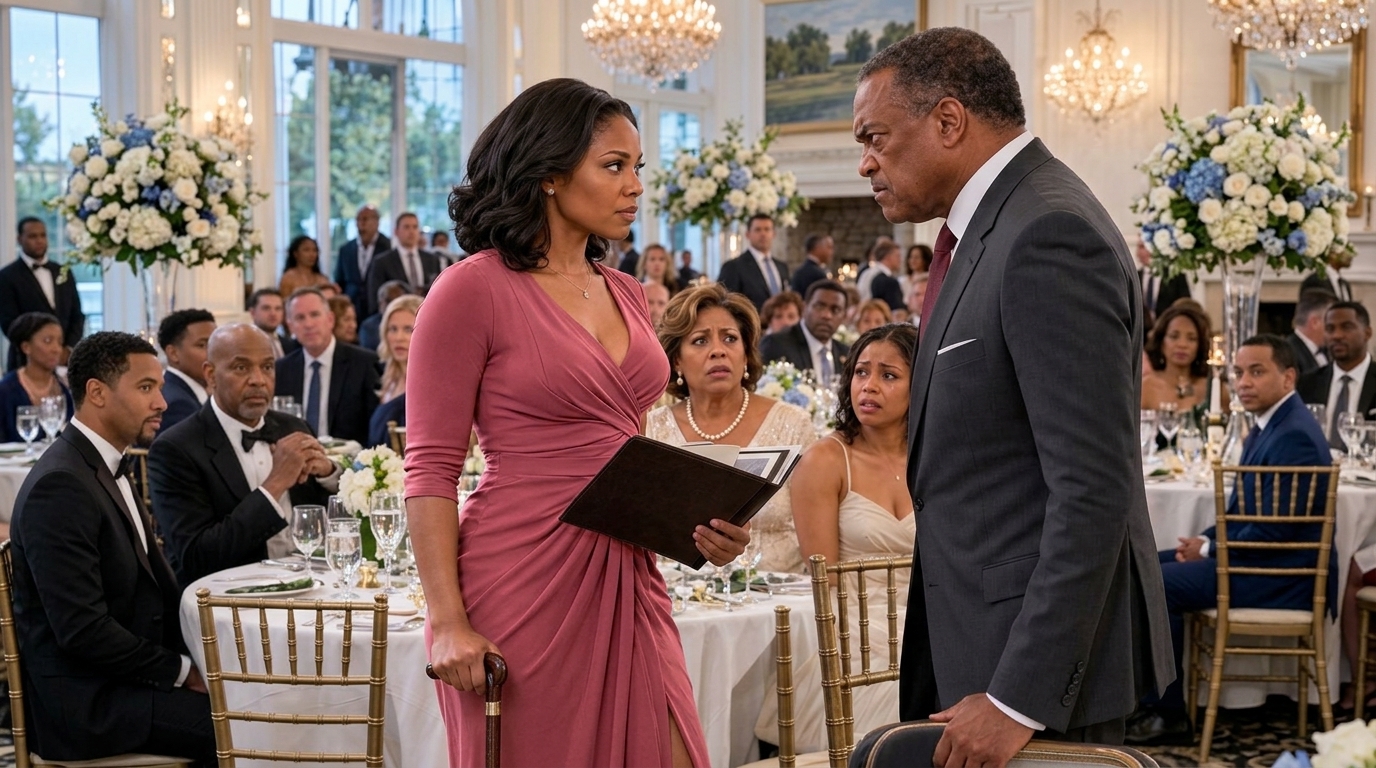
My sister’s future in-laws sat near the head table. My mother wore borrowed pearls. I stood across the room in a dark blue dress with a spinal brace hidden underneath, one hand on a cane and the other resting on a leather bag beside my chair.
“A family like ours knows how to sacrifice for each other,” my father said warmly.
Then he looked straight at me.
That was when I knew he still believed I was too weak to fight back.
Three weeks earlier, I had been unconscious on an operating table for nine hours.
When I woke up, my throat was raw from the breathing tube, half my body still belonged to anesthesia, and my phone showed 73 missed calls.
My father’s voicemail was almost cheerful.
“Baby, don’t get upset. We sold your condo to pay for your sister’s wedding. You were out cold, so we signed the papers for you. It’s handled.”
Handled.
That was the word he used for taking the home I had spent six years building.
I bought that condo after two Army deployments and years of working as a surgical nurse in Columbus. I packed lunches, worked doubles, skipped vacations, kept an old car longer than I should have, and put every extra dollar into the mortgage.
Third floor.
Plain brick building.
One maple tree outside that turned red early every fall.
The first night I owned it, I sat on the empty living-room floor with the key in my hand and cried because, for once, the door was mine.
My family knew what it meant.
They also knew I had nearly $300,000 in equity.
Four months before surgery, my father tested me over Sunday dinner.
My sister Brianna’s wedding binder sat beside the punch bowl.
“You ever think about pulling some equity out of that condo?”
“No.”
He smiled.
“Family helps family.”
“My condo is not part of anybody’s wedding budget.”
His jaw tightened for half a second.
I noticed.
Two days before surgery, I revoked an old power of attorney I had given him during my Army years. I signed it, scanned it, emailed copies, and handed him a paper copy across his kitchen table.
I thought I had protected myself.
Then I woke up and learned that while I was under general anesthesia, someone had still put my name on a deed.
After I was discharged, my mother arrived with grocery-store flowers and a foil-covered casserole.
Then she said the sentence I still hear clearly.
“Honey, it’s just a condo. Your sister only gets married once.”
Just a condo.
The same woman who had once stood in my empty kitchen telling me she was proud.
My father’s version was colder.
“You were always the strong one, Carmen. We knew you’d understand.”
I didn’t argue.
I asked one question.
“Who notarized my signature?”
For the first time, neither of them looked at me.
That was the first crack.
From the rental where I was recovering, I called attorney Leonard Brooks.
He listened, then gave me one instruction.
“Don’t fight with them. Listen. Write everything down.”
So I did.
Surgery time.
Closing date.
Voicemail.
Buyer.
Notary.
Every lie got its own line.
Then the documents started arriving.
The condo had not been sold for $425,000 like my father claimed.
It had been sold for $300,000 cash to Russell Monroe—my father’s longtime business partner.
The notary journal claimed I had personally appeared and signed the deed at exactly 1:47 p.m. on the day of my surgery.
Leonard asked for my anesthesia record.
I asked for the building security footage.
A neighbor agreed to write down what she had seen.
Piece by piece, his buried story turned into paper.
By the rehearsal dinner, I had one leather folder containing everything they believed I would never find.
My mother cornered me in the country club lobby before dinner.
She smiled at passing guests while gripping my arm.
“Whatever you’re doing with lawyers, this is not the night. If you embarrass us in front of the Colemans, you will lose this family for good.”
Then she leaned closer.
“Is a building worth that?”
A building.
Not my home.
Not six years of my life.
A building.
I gently removed her hand from my arm.
“I’m being calm,” I said. “You should be grateful for that.”
Twenty minutes later, my father stood beneath the chandelier giving his speech about sacrifice.
He looked polished.
Generous.
Proud.
He introduced me as “the strongest woman I know.”
I let him.
I let him stand inside that version of himself for one more minute.
Then I set down my napkin and slowly rose with my cane.
The room quieted.
My father’s smile stayed in place until his eyes dropped to the leather folder in my hand.
“Since we’re talking about sacrifice,” I said, “I’d like to say a few words.”
I opened the folder.
First came the deed.
Then the notary journal.
Then one hospital record with a timestamp printed in black ink.
My father’s smile disappeared.
I slid the pages across the white tablecloth toward the groom’s father.
“At 1:47 p.m.,” I said, “this document says I was standing in front of a notary signing away my home.”
Then I placed my hand on the final page.
“And this one shows exactly where I really was.”
The room went so quiet I could hear ice settling in someone’s glass.
My father pushed back his chair.
My mother stopped breathing.
And the groom’s father lowered his eyes to the timestamp.
He read it once.
Then again.
Finally, he looked at my father.
“What am I looking at?”
My father stood.
“It’s a family matter.”
The groom’s father, Richard Coleman, didn’t move.
“I understand that.”
His eyes remained on the papers.
“But your family matter appears to involve a property transaction connected to my son’s wedding.”
My father swallowed.
“The condo was legally transferred.”
I nodded.
“That is what the deed says.”
Richard looked at the deed again.
“Who purchased the property?”
I answered.
“Russell Monroe.”
Several people at the table turned toward the far end of the room.
Russell was sitting there.
He had barely spoken all evening.
Now every face turned toward him.
He looked uncomfortable.
Richard frowned.
“Russell?”
Russell stood slowly.
“I can explain.”
My father immediately said, “Russell doesn’t need to explain anything.”
Richard’s expression hardened.
“That isn’t your decision.”
Russell looked at me.
For a moment, neither of us spoke.
Then he sighed.
“I bought the condo.”
“For three hundred thousand dollars,” I said.
He nodded.
Richard looked at my father.
“But you told us the condo was worth four hundred and twenty-five thousand.”
My father shook his head.
“That’s not what happened.”
I reached into the folder.
“Actually, it is.”
I placed a printed appraisal on the table.
“Market valuation: approximately $425,000.”
Richard picked it up.
Then I placed another document beside it.
“The purchase agreement.”
The room became even quieter.
“Three hundred thousand dollars.”
Richard looked confused.
“Why would anyone sell a $425,000 property for $300,000?”
Russell rubbed his forehead.
“I was told Carmen was desperate.”
I stared at him.
“I wasn’t.”
“I know that now.”
“You knew me.”
“Yes.”
“You knew that condo was worth more.”
Russell looked away.
My father stepped forward.
“This is absurd. We are standing here celebrating Brianna.”
I looked at him.
“You used Brianna’s wedding to justify stealing my home.”
His face reddened.
“We didn’t steal anything.”
“Then why was I unconscious when the deed was signed?”
Nobody answered.
I turned toward the groom.
Evan had been silent the entire time.
He looked pale.
His bride, my sister Brianna, was sitting beside him with tears streaming down her cheeks.
“Carmen,” she whispered.
I looked at her.
“I’m sorry.”
“For what?”
“I didn’t know.”
I believed her.
At least, I wanted to.
“You should have known something was wrong when Dad told you the wedding was being paid for with my condo.”
She shook her head.
“He told me you wanted to help.”
I closed my eyes briefly.
That sentence hurt.
Not because I believed she had planned it.
Because it explained how easily my father had manipulated everyone.
He hadn’t told people he was taking my home.
He had told them I was generously giving it.
He had turned theft into sacrifice.
And somehow, I was supposed to be proud of myself.
Richard placed the papers on the table.
“Mr. Hayes.”
My father looked at him.
“Where did the three hundred thousand dollars go?”
My father didn’t answer.
Richard repeated the question.
“Where did the money go?”
My father looked toward Brianna.
My sister covered her mouth.
I already knew.
I had suspected it from the beginning.
But suspicion wasn’t evidence.
Now I wanted the truth.
My father finally said:
“It was used for wedding expenses.”
I laughed once.
Not because it was funny.
Because it was unbelievable.
“All of it?”
My father stared at me.
“Most of it.”
I pulled another document from the folder.
“Then perhaps you can explain why $112,000 went to an account belonging to Monroe Construction Consulting.”
Russell’s head snapped up.
“What?”
My father froze.
I looked at Russell.
“Your company.”
He stared at my father.
“What did you do with that money?”
My father didn’t answer.
Russell slowly sat down.
“You told me the entire amount was for the property.”
“I needed temporary working capital.”
Russell’s face changed.
“You lied to me.”
My father rubbed his forehead.
“I was going to replace it.”
“With what?”
Silence.
Richard stood.
“I think we should pause this dinner.”
Nobody argued.
Then Brianna suddenly stood.
“No.”
Everyone looked at her.
She was crying.
“No, we are not going to pause it.”
She looked at my father.
“I want to know.”
“Brianna…”
“I want to know what you did.”
My mother whispered, “This is not the time.”
Brianna turned toward her.
“Apparently it is.”
She wiped her face.
“You told me Carmen gave us the money.”
My mother didn’t respond.
“You told me she wanted me to have the wedding I dreamed about.”
Still nothing.
“Was that a lie?”
My father stepped toward her.
“Brianna, I did this for you.”
She stared at him.
“No.”
Her voice cracked.
“You did this because you couldn’t afford what you promised me.”
He looked stunned.
She continued.
“And instead of telling me, you took Carmen’s home.”
My father looked down.
I could see something breaking inside my sister.
Not her love for him.
Something more complicated.
Her belief that our family was safe.
She sat down.
“I don’t want this wedding.”
Evan reached for her hand.
She pulled it toward herself.
“I don’t want a wedding paid for like this.”
Richard looked at his son.
Evan nodded slowly.
“I agree.”
My mother began crying.
“Please. Everyone is emotional.”
I looked at her.
“No.”
She looked at me.
“What?”
“This isn’t emotion.”
I tapped the documents.
“This is evidence.”
My father finally snapped.
“You think because you’re a nurse and you have money saved up that you’re better than everyone?”
I stared at him.
“No.”
“You’ve always thought that.”
“No.”
“You think your military service makes you special.”
“No.”
“You think because you bought one condo you can judge us.”
I looked at him.
“I don’t care about being better than you.”
I pointed to the deed.
“I care about being the owner of my own home.”
He went silent.
Then he said the words that changed everything.
“We were desperate.”
I waited.
“For what?”
He looked around the room.
Then at Brianna.
Then at my mother.
“We owed money.”
“How much?”
He didn’t answer.
“How much?”
“More than you know.”
“That’s not a number.”
He swallowed.
“About two hundred thousand.”
The room erupted in whispers.
I felt something cold settle inside me.
Two hundred thousand dollars.
My father had been hiding debt.
My mother had been hiding it too.
And somehow my sister’s wedding had become the excuse to solve it.
I looked at Russell.
“Did you know?”
“No.”
He looked devastated.
“I thought your father was using the money to settle legitimate property expenses.”
My father sat down.
For the first time that night, he looked old.
Not powerful.
Not charming.
Just tired.
Leonard had warned me that there might be more than one motive.
There usually was.
Greed.
Fear.
Pride.
Desperation.
Sometimes all of them lived in the same room.
I closed the folder.
“I didn’t come here to destroy Brianna’s wedding.”
My sister looked at me.
“I came because I wanted my name back.”
She nodded through tears.
“I understand.”
Richard stood.
“Carmen, may I speak with you privately?”
I nodded.
We stepped into the hallway.
He lowered his voice.
“I am deeply sorry.”
“You don’t owe me an apology.”
“I do if my family benefited from something that wasn’t theirs.”
“You didn’t know.”
“No.”
He looked toward the ballroom.
“My son loves your sister.”
“I know.”
“We still intend to marry her.”
I nodded.
“But not this way.”
“I understand.”
“We’ll postpone the wedding.”
My eyes widened.
“You don’t have to do that.”
“We’re not punishing Brianna.”
He paused.
“We’re removing the pressure.”
I understood.
They would have a smaller ceremony later.
Without the country club.
Without the extravagant spending.
Without money that belonged to someone else.
Richard looked at me.
“Your sister should have the chance to start her marriage without a lie hanging over it.”
I agreed.
Then he said:
“And you should have the chance to recover.”
I smiled.
“I intend to.”
When I returned to the ballroom, my father was gone.
So was Russell.
My mother sat alone.
Brianna came to me.
“I am so sorry.”
I hugged her.
She cried into my shoulder.
“I didn’t know.”
“I believe you.”
“I should have asked.”
“Yes.”
“I thought you were helping.”
“I know.”
“I never wanted your condo.”
“I know.”
She pulled back.
“Will you ever forgive me?”
I looked into her eyes.
“You didn’t do what they did.”
“But I benefited.”
“That isn’t the same.”
She nodded.
“I’ll make it right.”
“You don’t have to make anything right tonight.”
“What do I do?”
“Tell the truth.”
She nodded.
“I will.”
The following morning, Leonard called.
“They filed the deed.”
My stomach tightened.
“But?”
“They didn’t record it properly.”
I sat up.
“What does that mean?”
“The county recorder flagged a discrepancy.”
“Why?”
“The notary information.”
I remembered the journal.
“The signature?”
“More than that.”
Leonard sounded almost amused.
“The notary license number listed on the deed belonged to a woman whose commission had expired six months earlier.”
I stared at the wall.
“So the notary couldn’t legally notarize it.”
“Correct.”
“Does that automatically invalidate the deed?”
“No. But it gives us another significant issue.”
“What else?”
“The notary’s journal.”
“What about it?”
“She claims you appeared in person.”
“I didn’t.”
“I know.”
“Then?”
“She also wrote that you showed a government-issued photo ID.”
I looked at my cane.
“I was in surgery.”
“I know.”
Leonard paused.
“Carmen, there is something else.”
“What?”
“The hospital records don’t just show you were under anesthesia at 1:47.”
“What do they show?”
“You were in recovery until 4:18.”
I closed my eyes.
There it was.
Not a gray area.
Not a misunderstanding.
Not a family favor.
A documented impossibility.
Leonard continued.
“I’ve already sent preservation requests for the building security footage and the notary records.”
“And the buyer?”
“Russell has retained counsel.”
“Against us?”
“Not necessarily.”
“What does that mean?”
“He is claiming he was deceived too.”
I leaned back.
“Was he?”
“That depends on what he knew.”
Two days later, Russell asked to meet me.
I almost refused.
Leonard said I should hear him.
So I met him in a coffee shop.
He looked exhausted.
“I owe you an apology.”
“You do.”
He nodded.
“I should have verified everything.”
“Yes.”
“I was told your father had authority.”
“He didn’t.”
“I know that now.”
He placed a folder on the table.
“What is this?”
“Bank records.”
I looked at him.
“I want you to see them.”
Inside were transfers from the $300,000 purchase.
I read them one by one.
$65,000 to a wedding venue.
$28,000 to a catering company.
$19,500 to a photography company.
$14,000 to a florist.
$11,000 to a jewelry store.
Then another transfer.
$112,000 to Monroe Construction Consulting.
I looked up.
“You didn’t receive the property.”
“No.”
“Your money went to my father.”
“Yes.”
“Why?”
“He told me he needed the condo as collateral for a business arrangement.”
“And you paid him?”
“I trusted him.”
I closed the folder.
“You trusted the wrong person.”
Russell nodded.
“I know.”
He looked down.
“I am willing to cooperate.”
That mattered.
Because now this wasn’t only about my family.
It was becoming a legal case involving records, money, signatures, and a property that had never been legitimately transferred.
Leonard filed the necessary action to challenge the deed and protect my ownership while the dispute was investigated.
The process wasn’t dramatic.
Real life rarely is.
There were forms.
Hearings.
Affidavits.
Phone calls.
Copies.
Waiting.
Lots of waiting.
But every document made me stronger.
The more my father tried to explain, the more contradictions appeared.
He said I had authorized the sale.
Then he admitted I hadn’t.
He said the condo sold for $425,000.
Then the purchase agreement showed $300,000.
He said the money was for the wedding.
Then bank records showed a substantial amount going into his business.
He said the notary was legitimate.
Her commission had expired.
He said I had signed in person.
Hospital records showed I was unconscious.
Eventually, even my father stopped trying to tell a convincing story.
He started trying to negotiate.
Leonard called me one afternoon.
“They want to settle.”
I stared at the window.
“What does that mean?”
“Your father wants to restore the property to you.”
“And the money?”
“That is separate.”
“Does he have it?”
“No.”
I laughed bitterly.
“Of course he doesn’t.”
“There may be a repayment agreement.”
“I don’t want an agreement that disappears in six months.”
“Then we structure it properly.”
I thought about the condo.
The maple tree.
The red leaves.
The empty living room where I had once sat on the floor holding my first set of keys.
I didn’t want revenge.
I wanted my home.
“Get it back,” I said.
Leonard did.
Months later, the deed was formally corrected.
The sale was undone.
The condo returned to my name.
The $425,000 number became important for another reason.
My father had used it to convince everyone that I had willingly sacrificed something valuable for my sister.
But the truth was simpler.
I had never agreed to sell anything.
Not for $425,000.
Not for $300,000.
Not for a million.
My home was never theirs to sell.
My father eventually admitted that he had convinced himself he could replace the money before I woke up.
He said he thought the wedding would create enough goodwill that I wouldn’t challenge him.
He had underestimated me.
But he had also underestimated something else.
Time.
Paperwork.
Records.
And the fact that truth doesn’t become less true because people tell a prettier story first.
Brianna’s wedding was postponed.
Three months later, she and Evan married at a small garden ceremony.
There were thirty-two guests.
No country club.
No enormous floral installation.
No borrowed money.
Brianna wore a simple dress.
I helped fasten the back.
Before she walked down the aisle, she looked at me.
“You okay?”
I smiled.
“Yes.”
“You sure?”
“Yes.”
She squeezed my hand.
“I wanted to tell you something.”
“What?”
“I don’t ever want to confuse your love with your wallet again.”
I laughed softly.
“Good.”
She smiled.
“And I’m going to save for my own house.”
“That would be wise.”
She laughed.
“Maybe someday I’ll ask you for advice.”
“Advice is free.”
“Money?”
“Different conversation.”
We both laughed.
My mother attended the wedding.
My father did not.
Not because I demanded it.
Because he chose not to come.
For months, he had been fighting the legal consequences of what he had done.
Eventually, he asked to meet me.
I agreed.
We sat across from each other in a small diner.
He looked older.
“I don’t expect forgiveness.”
“Good.”
He nodded.
“I deserve that.”
I stirred my coffee.
“Why did you do it?”
He stared at the table.
“I was afraid.”
“Of what?”
“Failing.”
I said nothing.
“I built a business. I wanted everyone to think I was successful.”
He laughed bitterly.
“Then the debts came.”
“You could have told me.”
“I couldn’t.”
“Why?”
“Because you were always the responsible one.”
I looked at him.
“So you stole from the responsible one?”
His eyes filled.
“Yes.”
That was the first honest answer he’d given me.
“I thought I could fix it.”
“You didn’t.”
“No.”
“You made it worse.”
“I know.”
We sat quietly.
Then he said:
“I’m sorry.”
I believed he was sorry.
But forgiveness isn’t the same as forgetting.
And trust isn’t restored by a sentence.
“I don’t hate you,” I said.
He looked at me.
“That may be the best I can offer right now.”
He nodded.
“I understand.”
I left the diner feeling strangely peaceful.
Not because everything was fixed.
It wasn’t.
Some things don’t go back to the way they were.
But I no longer needed them to.
I moved back into my condo.
The maple tree was turning red again.
I stood in the living room one evening with the windows open.
The city sounded distant.
For a moment, I thought about that first night six years earlier.
I had sat on the floor with my keys in my hand.
I had cried because the door was mine.
Then I remembered waking up after surgery.
Seventy-three missed calls.
My father’s cheerful voice.
“We sold your condo.”
The words still made my stomach turn.
But they no longer frightened me.
The condo was still mine.
And so was the life I had built inside it.
I had spent years believing strength meant enduring everything.
The pain.
The exhaustion.
The family emergencies.
The financial requests.
The guilt.
The expectations.
Now I understood something simpler.
I didn’t have to prove my love by allowing people to cross every boundary I had.
I could help without surrendering.
Forgive without forgetting.
Love without rescuing.
Brianna eventually understood that too.
One evening, she came over carrying two cups of coffee.
“Can I ask you something?”
“Sure.”
“Do you ever wish you had never found out?”
I thought about it.
“No.”
“Not even for a second?”
“No.”
“Why?”
I looked around my kitchen.
Because of what happened, I had changed.
I traveled more.
I retired from taking every extra shift.
I started volunteering with wounded veterans.
I bought better furniture without feeling guilty.
I learned how to say no.
I learned how to say yes when I actually wanted to.
“I wish they hadn’t done it,” I said.
“But I’m glad I finally stopped mistaking endurance for love.”
Brianna smiled.
“You’re different.”
“Yes.”
“Better?”
I smiled.
“Just more honest.”
She nodded.
Then she looked toward the window.
“The maple tree is turning red.”
“I know.”
“Dad used to love that tree.”
“He did.”
“Do you miss the old family?”
I thought about the question.
“I miss what I thought we were.”
She looked down.
“That’s sad.”
“It is.”
“But maybe you can build something new.”
I looked at her.
“Maybe.”
She smiled.
“That’s what we’re doing.”
She was right.
Families don’t always survive by pretending nothing happened.
Sometimes they survive by admitting exactly what happened.
Sometimes the only way forward is through the uncomfortable truth.
A few weeks later, Brianna called me before her anniversary.
“Carmen?”
“Yeah?”
“Remember when Dad said you were the strongest woman he knew?”
I laughed.
“Yes.”
“I think he was right.”
I smiled.
“But he didn’t understand why.”
I looked toward the maple tree outside my window.
“No.”
“He thought strength meant you’d tolerate anything.”
I was quiet for a moment.
“And now?”
“Now I know it means knowing what you won’t tolerate.”
I smiled.
“That’s a good lesson.”
“It’s one you taught me.”
She paused.
“Goodnight.”
“Goodnight, Brianna.”
I hung up and walked to the window.
The city lights stretched beyond the glass.
My cane rested against the wall.
My surgical scar still ached when the weather changed.
But I was standing.
I was home.
The deed with my name on it was locked safely in a drawer.
I didn’t keep it there out of fear anymore.
I kept it because it reminded me that some things are worth protecting, even when the people asking you to surrender them are the ones you love.
My father once told everyone that I was the strongest woman he knew.
For years, I thought he meant I could survive anything.
Now I knew better.
I didn’t need to survive everything.
I needed to decide what I would no longer accept.
I turned off the kitchen light and picked up my keys.
Their familiar weight settled into my palm.
Then I locked the door behind me.
This time, nobody was going to tell me where I belonged.
THE END THANK YOU FOR READING !!