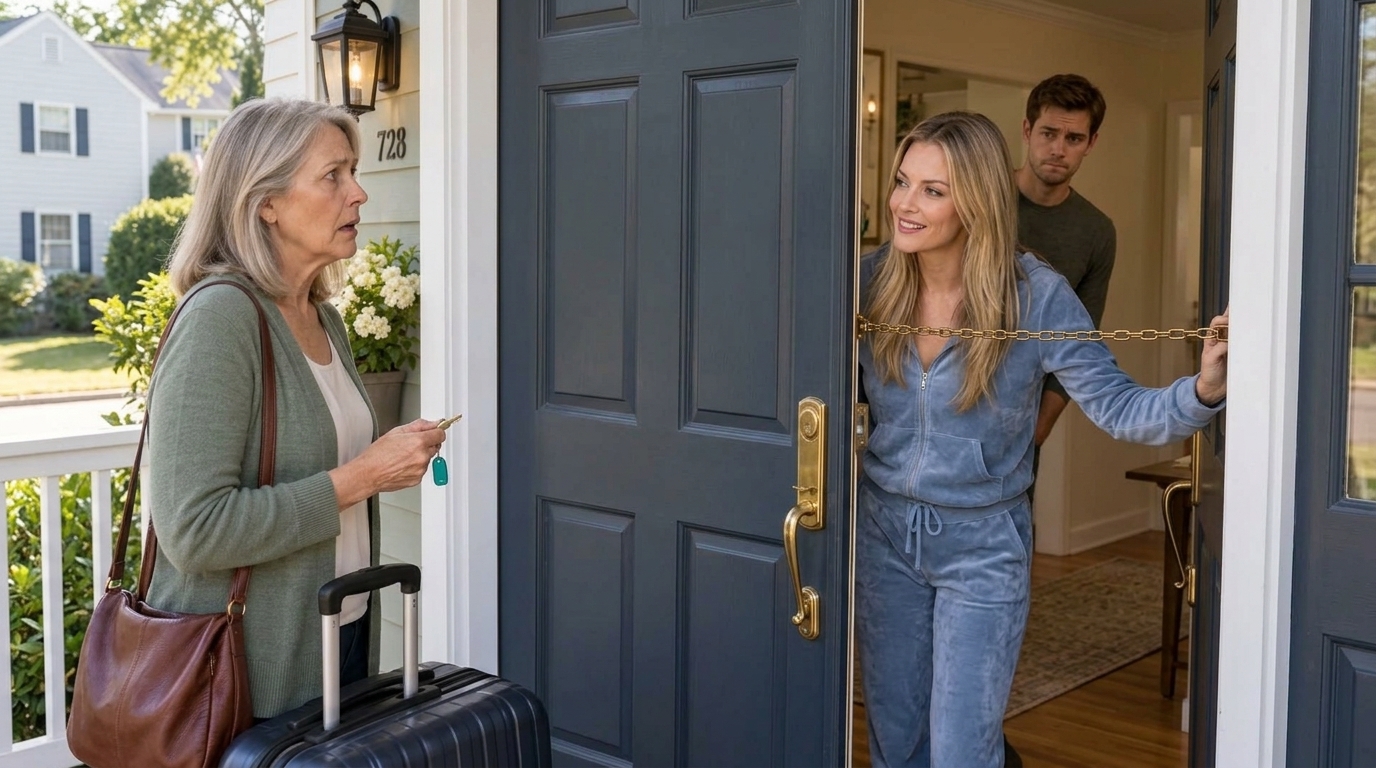
I stared at those three words until they blurred.
For a moment, I couldn’t remember why I had written them.
Then I remembered.
I had written them fifteen years earlier, the week I bought the house.
My hands began to shake.
I set the envelope on the motel bed and stared at it.
The room was quiet except for the air conditioner rattling above me
and the occasional sound of tires passing on Highway 41.
I had spent the entire evening telling myself that I had lost everything.
My home.
My family.
My dignity.
Maybe even my relationship with my only child.
But the envelope was sitting there like a voice from another version of my life.
A version I had almost forgotten.
I opened it carefully.
Inside was a stack of papers.
The first document was a closing statement.
The second was a copy of the deed.
The third was a property tax record.
I scanned the page.
Then I stopped.
My heart began beating so hard that I could hear it.
I read the line again.
Then again.
The property was still registered in my name.
Not Elliot’s.
Not Esme’s.
Mine.
I sat back slowly.
“No,” I whispered.
I reached for my reading glasses.
I checked the legal description.
Same street.
Same lot.
Same house.
The house where my son had just told me I was a guest.
The house where my daughter-in-law had changed the locks.
The house they had supposedly turned into their home.
My home.
I kept reading.
There was no transfer document.
No deed.
No sale.
No gift.
No ownership change.
Nothing.
Then I found another document.
A copy of the mortgage payoff statement.
Paid in full.
I stared at the date.
Ten years earlier.
I had forgotten that, too.
I had paid off the mortgage.
Not Elliot.
Not Esme.
Me.
I had worked for thirty-one years as a hospital billing supervisor.
I had lived carefully.
I didn’t own designer clothes.
I didn’t take expensive vacations.
I drove the same Toyota for eleven years.
I clipped coupons.
I brought lunch from home.
And when my husband left, I had learned to survive on one income.
The house had been my reward for all those years.
It was supposed to be my safe place.
My final chapter.
And somehow, I had allowed myself to believe that my own son could simply take it from me.
I picked up the phone.
My first instinct was to call Elliot.
I wanted to hear him explain himself.
I wanted to hear him say there had been some misunderstanding.
I wanted him to say, “Mom, come home.”
But I didn’t call.
Instead, I opened the camera on my phone and photographed every document.
Then I photographed the deed again.
And again.
I zoomed in on my name.
BELINDA MARSHALL.
The words looked almost unreal.
I whispered them aloud.
“Belinda Marshall.”
My name.
My house.
My life.
I looked at the ceiling.
Then something strange happened.
I smiled.
Not because I was happy.
Because for the first time since I had arrived home, I wasn’t helpless.
I had something they didn’t know I had.
Proof.
The next morning, I woke before sunrise.
I showered.
I put on the same blue blouse I had worn at the funeral home with my sister.
I packed the yellow envelope into my purse.
Then I drove to the county recorder’s office.
I didn’t know exactly what I was looking for.
I only knew I needed to understand what had happened.
A clerk named Denise sat behind the counter.
She was probably in her sixties, with silver glasses hanging from a chain around her neck.
“How can I help you?” she asked.
“I need a copy of my property records.”
She asked for the address.
I gave it to her.
Her fingers moved across the keyboard.
Then she frowned.
“Are you Belinda Marshall?”
“Yes.”
She looked at me.
“You’re the owner?”
“Yes.”
She turned her monitor slightly toward me.
“Well,” she said, “according to this, yes.”
My stomach tightened.
“Has there been any attempt to transfer it?”
She clicked through several pages.
“No recorded deed.”
“Any lien?”
“No.”
“Any recent filings?”
She shook her head.
“Nothing that changes ownership.”
I let out a breath.
“Can I get certified copies?”
“Of course.”
While she printed them, I asked, “If someone changed the locks and moved into the property without my permission, what does that mean legally?”
Denise paused.
“I can’t give legal advice.”
“I understand.”
“But if you’re the owner and someone is occupying the property without your permission, you should speak to an attorney before taking any action.”
“Would I be able to have them removed?”
She looked at me carefully.
“That depends on the circumstances.”
I nodded.
“I understand.”
She handed me the certified documents.
“Do you want a receipt?”
“Yes.”
I put everything in my purse.
Then I asked the question that had been sitting in my mind since the night before.
“Is there any way someone could have legally taken ownership without this office having a record?”
“Not through a standard deed transfer.”
I thanked her.
As I walked back to my car, I felt something I hadn’t felt in days.
Control.
Not victory.
Not yet.
Just control.
I sat behind the wheel and called a lawyer.
His name was Daniel Harper.
I had met him years earlier through my sister Linda.
He had handled some paperwork for her when she bought her condo.
I didn’t know whether he handled property disputes, but I called anyway.
His receptionist squeezed me into an afternoon appointment.
When I arrived, Daniel was standing beside a bookshelf with his glasses in one hand.
He was older than I remembered.
Maybe sixty.
His hair was almost completely gray.
He shook my hand.
“Belinda.”
“Daniel.”
“Linda used to tell me you were the practical one.”
I almost laughed.
“She was wrong.”
He smiled.
“Sit down.”
I told him everything.
I told him about the trip.
The changed locks.
Esme.
Elliot.
The nursing home.
The boxes.
The room they planned to turn into a nursery.
Then I placed the deed on his desk.
He read it.
Then the tax record.
Then the mortgage payoff.
His expression changed.
“Did you ever sign anything transferring this property to your son?”
“No.”
“Anything giving him ownership?”
“No.”
“Power of attorney?”
“No.”
“Life estate?”
“No.”
“Trust?”
“No.”
“Did you ever tell him he could have the house?”
I hesitated.
“I told him that someday, after I died, I wanted him to have it.”
Daniel looked up.
“That is very different.”
“I know that now.”
He leaned back.
“Did he contribute to the mortgage?”
“No.”
“Taxes?”
“Sometimes he paid a utility bill.”
“Repairs?”
“He helped replace the water heater once.”
“Did he ever pay you rent?”
“No.”
Daniel nodded slowly.
“Then we need to separate the emotional issue from the legal issue.”
“I don’t want to destroy my relationship with my son.”
He looked at me.
“Do you believe you still have one?”
The question hurt.
I looked down.
“I don’t know.”
Daniel tapped the deed.
“This is your property. Unless there is some document we’re missing, they don’t become owners simply because they live there.”
“What about the fact that I let them live with me?”
“That doesn’t transfer ownership.”
“What about the money I gave Elliot?”
“How much?”
“Forty-eight thousand.”
“Was it a gift?”
“Yes.”
“Do you have records?”
“I think so.”
“Find them.”
I stared at him.
“Why?”
“Because if they claim you gave them the house, we need to understand exactly what money changed hands and why.”
I nodded.
Daniel continued.
“And don’t confront them yet.”
“I already told them I’d leave.”
“You can leave physically without surrendering your legal rights.”
I looked at him.
“What should I do?”
“Document everything.”
He wrote several things on a yellow legal pad.
“Photographs of the boxes. Every text. Every email. Your motel receipt. Your original deed. Your tax records. Any messages where they acknowledge the property belongs to you.”
He looked directly at me.
“And don’t threaten them.”
“I wasn’t planning to.”
“Good.”
He slid the pad toward me.
“Let them keep talking.”
I understood.
People who believe they’ve won tend to become careless.
And my son and daughter-in-law clearly believed they had won.
I left the office with a strange feeling.
For four years, I had tried so hard not to make trouble.
I had swallowed comments.
Ignored insults.
Stayed quiet at dinner.
Pretended not to notice when Esme complained about my cooking.
Pretended not to notice when she referred to my bedroom as “the spare room.”
Pretended not to notice when she started making decisions about my house without asking me.
I had confused peace with love.
Now I was beginning to understand the difference.
My phone rang as I reached my car.
Elliot.
I watched the screen.
I didn’t answer.
It stopped.
A minute later, another call.
Esme.
I didn’t answer that one either.
Then a text appeared.
Where are you?
I stared at it.
I didn’t respond.
Another message.
Mom, we need to talk.
I still didn’t respond.
Then:
This isn’t what it looks like.
I almost laughed.
Of course it wasn’t.
It was worse.
I put the phone away.
Then I drove to the bank.
I needed to find the records of the $48,000.
I had given Elliot that money twelve years earlier.
At the time, I hadn’t thought of it as a sacrifice.
He had called me one night.
“Mom, I found a house.”
He sounded so excited.
“I can finally do it.”
The house was more expensive than he could afford.
He needed help with the down payment.
I had been saving for a new roof.
I withdrew most of the money.
I remember handing him the cashier’s check.
He hugged me.
“I’m going to pay you back.”
I laughed.
“You’re my son.”
“I mean it.”
“I know.”
Then he kissed my forehead.
“Someday I’ll take care of you.”
I almost cried when I remembered that.
Because the man who had promised that had been standing behind a locked door the night before.
At the bank, I requested archived records.
The clerk found the withdrawal.
It was exactly $48,000.
I asked for a copy.
Then I checked another account.
There were deposits from my employer.
Payroll.
Retirement contributions.
Insurance.
Everything I had worked for.
My finances weren’t spectacular.
But they were enough.
Enough to live.
Enough to retire.
Enough to never have to beg my son for a bed.
I drove back to the motel.
On the way, I stopped at a storage company.
I asked whether I could rent a unit.
The manager showed me several sizes.
I chose one.
Then I called the number on the text message from Esme.
She answered immediately.
“Where are you?”
I didn’t answer her question.
“I need to know where my belongings are.”
There was a pause.
“Why?”
“Because you said they’re in storage.”
“They are.”
“Where?”
“Why?”
“Because they’re mine.”
She sighed.
“Belinda, this is becoming dramatic.”
“I want the storage company’s name.”
Silence.
Then she said, “We’ll send it.”
“I need it today.”
“Fine.”
She hung up.
Thirty seconds later, a message arrived.
The storage company was six miles from my motel.
I drove there.
The manager checked my identification.
Then she frowned.
“Your name isn’t on the account.”
“What?”
“Your son rented the unit.”
I felt my stomach drop.
“Can I access it?”
“Not without the account holder.”
I showed her the deed.
She shook her head.
“I’m sorry.”
I called Daniel.
He answered on the third ring.
I explained.
“Don’t force your way in,” he said.
“I won’t.”
“Keep the receipt from the motel and document that you were denied access to your belongings.”
“Okay.”
“And Belinda?”
“Yes?”
“Do not go back to the house alone.”
That sentence stayed with me.
I drove back to the motel.
That evening, my sister’s daughter, Rachel, called.
She had been with me during Linda’s final week.
“How are you?” she asked.
I almost lied.
Instead, I said, “I’m not.”
There was silence.
Then she asked what happened.
I told her.
When I finished, Rachel said, “Aunt Belinda, you can’t let them do this.”
“I know.”
“Do you have somewhere to stay?”
“I have a motel.”
“That’s not a home.”
“I know.”
“Come stay with me.”
I smiled through tears.
“Rachel, you have two children.”
“I have a guest room.”
“I don’t want to burden you.”
“You’re not a burden.”
The words nearly broke me.
Because my own son had used that word without saying it.
A burden.
I packed the next morning.
Before leaving, I went to a coffee shop and bought a notebook.
On the first page, I wrote:
Everything I remember.
Then I started writing.
The day I bought the house.
The money I spent renovating it.
The years Elliot lived there.
The conversations about ownership.
The $48,000.
The mortgage payoff.
The taxes.
The repairs.
Every detail.
It took four hours.
By the end, my hand hurt.
But I felt lighter.
That afternoon, Daniel called.
“I found something.”
My heart stopped.
“What?”
“The deed history.”
“And?”
“Your deed is clean.”
I closed my eyes.
“What about the house?”
“Still yours.”
“Then why did they act like it was theirs?”
“That’s what we’re going to find out.”
He paused.
“There’s something else.”
“What?”
“There was an insurance inquiry made on the property six months ago.”
I sat upright.
“By whom?”
“Your son.”
“Why?”
“I don’t know yet.”
“Can you find out?”
“I’ll request the records.”
My pulse quickened.
Six months ago.
I had been living in the house.
Elliot had been living with me.
Esme had been talking about starting a family.
And apparently, they had been making plans involving my property.
That night, I barely slept.
The next morning, Daniel called.
“The insurance inquiry was for a homeowners policy.”
“Whose name?”
“Elliot’s.”
I stared at the wall.
“Did he insure himself as the owner?”
“That’s what it appears.”
“How?”
“I don’t know.”
“Can he do that?”
“Someone can submit information to an insurer. Whether the insurer accepts it is another matter.”
My hands tightened around the phone.
“Why would he do that?”
“I don’t know.”
Then Daniel said something that changed everything.
“Belinda, I think you should check your credit report.”
I did.
There were no new loans.
No mortgage.
No fraudulent credit card.
But there was an inquiry from a lender.
A home-equity lender.
I froze.
The inquiry was dated three months earlier.
Three months.
I had never applied for a loan.
I sent the information to Daniel.
He called back an hour later.
“Do you have any documents at home that you haven’t seen?”
“My home?”
“Yes.”
“The house.”
“Anything in your office? Filing cabinet? Desk?”
“I have some old financial records.”
“Find them.”
I drove to my house.
Then I remembered his warning.
I didn’t go inside.
Instead, I parked across the street.
I stared at the place.
The curtains were different.
My flowerpots were gone.
A baby-blue wreath hung on the door.
My home looked like a stranger’s house.
I took photographs from the public sidewalk.
Then I left.
That night, I searched my storage boxes.
The yellow envelope was only the beginning.
I found old tax returns.
Mortgage statements.
Insurance documents.
Bank records.
And then I found a second envelope.
This one was smaller.
It had been tucked inside an old folder.
On the front were three words:
DO NOT DISCARD.
I opened it.
Inside was a letter from the attorney who had handled my original home purchase.
I read it twice.
Then I called Daniel.
“What is it?”
I read the letter aloud.
His voice changed.
“Belinda, that matters.”
“What does it mean?”
“It means you should bring me the original.”
I drove to his office the next morning.
He read it carefully.
Then he looked at me.
“This explains why your son may have believed he had some claim to the property.”
I waited.
“Your original estate plan named Elliot as the beneficiary of the house after your death.”
“Yes.”
“That doesn’t make him the current owner.”
“I know.”
“But he may have interpreted it differently.”
I shook my head.
“He knew I was alive.”
Daniel looked at me.
“That doesn’t mean he wasn’t planning for the future.”
The words made my stomach turn.
I suddenly remembered conversations I had dismissed.
Elliot asking whether I had updated my will.
Esme asking whether the house was paid off.
Elliot asking how much money I had in retirement.
Esme once saying, “It would be nice if this place were actually ours.”
I had laughed.
I had thought she was joking.
Now I wasn’t so sure.
Daniel made several calls.
Then he said, “There’s something else.”
“What?”
“The lender inquiry.”
“Yes.”
“They weren’t just checking your credit.”
He slid a document toward me.
It was a property valuation request.
Someone had asked for an estimate of the home’s value.
My house.
The current estimated value was nearly four times what I had paid for it.
I stared at the number.
My hands went cold.
“How long have they been planning this?”
“We don’t know.”
“But they changed the locks.”
“Yes.”
“They packed my things.”
“Yes.”
“They told me I was going to a nursing home.”
“Yes.”
“And they think the house is theirs.”
“Apparently.”
I looked at him.
“What do I do now?”
Daniel leaned forward.
“First, we send a formal notice.”
My heart pounded.
“To whom?”
“Your son and daughter-in-law.”
“Ordering them out?”
“Not necessarily immediately. The exact legal procedure depends on how the occupancy is classified. But we can make your ownership clear and demand that they stop representing themselves as owners.”
I nodded.
Then my phone buzzed.
Elliot.
I stared at it.
Daniel said nothing.
I answered.
“Hello?”
“Mom.”
His voice was tense.
“Where are you?”
“Why?”
“We’ve been trying to reach you.”
“I know.”
“Can we talk?”
“You can talk.”
He sighed.
“Esme and I didn’t mean for this to happen this way.”
I closed my eyes.
“What way did you mean for it to happen?”
Silence.
“We thought you were going to stay with Aunt Linda longer.”
“Linda died.”
“I know.”
“You knew she was dying.”
“I know.”
“You knew I would come home.”
“I know.”
“Then why did you change my locks?”
He didn’t answer.
I heard Esme’s voice in the background.
“What is she saying?”
I heard Elliot whisper, “I’m talking to her.”
Then he came back.
“Mom, we had already made plans.”
“For my house?”
“For the house.”
“It’s my house.”
Another silence.
Then he said something that I will never forget.
“You always said it would be mine eventually.”
“Eventually,” I said. “After I died.”
“That’s not fair.”
“What’s not fair?”
“You’re acting like we stole something.”
I laughed bitterly.
“You changed the locks.”
“We needed the house.”
“You packed my belongings.”
“We needed the room.”
“You told me to go to a nursing home.”
“We thought you’d be better there.”
“Did you?”
He hesitated.
Then I heard Esme again.
“Just tell her.”
Elliot said, “Mom, we want to start our own family.”
“And I’m stopping you?”
“You’re making it difficult.”
I felt something inside me go completely still.
“Elliot,” I said quietly, “I am your mother.”
“I know.”
“No. You don’t.”
I hung up.
Daniel watched me.
“Are you okay?”
“No.”
Then I wiped my eyes.
“But I will be.”
That afternoon, the formal letter went out.
It stated clearly that I was the sole recorded owner of the property.
It demanded that they cease representing themselves as owners.
It requested access to my belongings.
And it warned that further action would follow if they refused.
I didn’t tell Elliot.
I didn’t need to.
The letter would tell him.
Three hours later, my phone rang.
Esme.
I answered.
“You sent us a legal letter?”
“Yes.”
“Are you serious?”
“Yes.”
“You’re humiliating us.”
“I didn’t change your locks.”
“You are unbelievable.”
“I didn’t pack your belongings.”
“You’ve always been manipulative.”
I closed my eyes.
“Esme.”
“What?”
“I don’t want to fight with you.”
“You’ve already started a fight.”
“No.”
I looked out the motel window.
“You started it when you locked me out.”
She went quiet.
Then she said, “You can’t do this.”
“I didn’t do anything.”
“You’re going to ruin our family.”
I almost laughed.
“Our family?”
“Yes.”
“You told me I wasn’t part of it.”
“That isn’t what I said.”
“You told me to go to a nursing home.”
“You’re twisting it.”
“You told me my room was becoming a nursery.”
Silence.
Then she said, “Because we need the space.”
“And you thought you could take my house?”
“We thought you’d give it to Elliot.”
“I already gave Elliot forty-eight thousand dollars.”
“That was years ago.”
“Yes.”
“You gave it freely.”
“I did.”
“Then why can’t you give him the house?”
I couldn’t believe what I was hearing.
“Because it’s mine.”
She hung up.
That night, I called Rachel.
I told her I needed somewhere to stay.
She didn’t hesitate.
“Come tomorrow.”
I drove to her house the next morning.
Her children ran to the door.
“Aunt Belinda!”
For the first time in days, I smiled.
Rachel hugged me.
“You’re home.”
Home.
The word nearly made me cry.
I stayed in her guest room for three nights.
On the fourth morning, Daniel called.
“There’s a development.”
I sat up.
“What?”
“The lender contacted your attorney.”
“Why?”
“They’ve withdrawn the inquiry.”
I frowned.
“Why?”
“Because the applicant couldn’t prove ownership.”
I closed my eyes.
“So Elliot tried to borrow against the house.”
“We don’t know that he was the applicant.”
“Who else would it be?”
“We can’t say yet.”
Then Daniel said, “But there’s more.”
He told me that the insurance company had also suspended the policy because of an ownership discrepancy.
My heart raced.
I suddenly understood.
They had been preparing to treat my house as their asset.
Maybe they had intended to refinance it.
Maybe they had planned to borrow against it.
Maybe the nursery was only the beginning.
But I didn’t want to assume.
So I asked Daniel to investigate.
Over the next week, the truth began to emerge.
Elliot had contacted a lender.
He had provided documents showing himself as the occupant.
He had told the lender that he was “in the process of transferring ownership.”
That phrase was enough to make my attorney concerned.
Because there had never been a transfer.
Then we found something worse.
A draft purchase agreement.
It was unsigned.
But it described my house as being transferred from me to Elliot for one dollar.
One dollar.
I stared at the document.
“Where did they get this?”
Daniel didn’t know.
But the document had my name typed on it.
My address.
My property description.
And a line for my signature.
It had never been signed.
My hands trembled.
“They were going to forge it.”
“We don’t know that.”
“They typed my name.”
“That alone isn’t proof of forgery.”
I knew he was right.
So I didn’t accuse them.
I simply preserved the document.
That was when I understood Daniel’s advice.
Facts mattered.
Not anger.
Not assumptions.
Facts.
I started keeping everything.
Every message.
Every voicemail.
Every document.
Every date.
Every conversation.
I even made a timeline.
And then something unexpected happened.
Esme called again.
This time, she sounded frightened.
“Belinda?”
“Yes?”
“We need to talk.”
“What about?”
“The house.”
“I’ve already made my position clear.”
“No.”
Her voice cracked.
“You don’t understand.”
“Then explain.”
She was silent for several seconds.
Then she said, “Elliot didn’t tell me everything.”
My heart started pounding.
“What do you mean?”
“He told me you were going to transfer the house.”
“I never said that.”
“I know that now.”
“Then what happened?”
“He told me the paperwork was being handled.”
“By whom?”
“I don’t know.”
“Esme.”
She started crying.
I didn’t say anything.
Finally she whispered, “He said you had agreed.”
I closed my eyes.
“And you believed him?”
“Yes.”
“Why?”
“Because he’s my husband.”
The words were almost childlike.
I felt no satisfaction.
Only sadness.
Then she said something that made me sit upright.
“He told me there was a document.”
“What document?”
“A document saying the house would be ours.”
“Did you see it?”
“No.”
“Did you sign anything?”
“No.”
“Did Elliot?”
“I don’t know.”
I took a breath.
“Esme, listen carefully.”
“What?”
“Do not destroy anything.”
She went silent.
“What?”
“Whatever documents you have. Whatever messages. Whatever emails. Don’t delete them.”
“Why?”
“Because if something illegal happened, destroying evidence will make things worse.”
She began crying harder.
“I didn’t know.”
“I believe you.”
“Do you hate me?”
I didn’t answer immediately.
“I don’t hate you.”
“But you won’t forgive me.”
“I don’t know.”
She whispered, “That’s fair.”
Then the line went dead.
I sat on Rachel’s porch for almost an hour.
I felt strangely tired.
This wasn’t how I imagined my life.
I had wanted a quiet retirement.
I wanted to travel.
I wanted to visit Linda.
I wanted to spend time with my grandchildren someday.
Instead, I was fighting my own family over the roof above my head.
But there was still one question.
Why had Elliot been so confident?
What had he believed he had?
Daniel found the answer two days later.
He called me into his office.
“We found the source.”
I sat down.
“The draft agreement?”
“Yes.”
“Who prepared it?”
“A local real-estate attorney.”
My stomach tightened.
“Was Elliot the client?”
“Yes.”
I stared at him.
“How?”
“Elliot approached the attorney six months ago.”
“Six months?”
“Yes.”
“What did he tell him?”
“That you intended to transfer the property.”
I felt sick.
“Did the attorney know it wasn’t true?”
“We can’t say.”
“Was there a signature?”
“Not on the final draft.”
“Why did he think I would sign?”
Daniel looked at me.
“Because apparently Elliot told him you had agreed verbally.”
I laughed once.
A sad little laugh.
“I never agreed.”
“I know.”
Then Daniel gave me another document.
It was a handwritten note.
The attorney had made it during a consultation.
One line caught my attention.
Client says mother is elderly and increasingly unable to manage property.
I stared at it.
Elderly.
I was sixty-three.
Not eighty-three.
Not ninety-three.
Sixty-three.
I was still working part-time before my sister became sick.
I still drove.
Paid my bills.
Managed my finances.
And yet my own son had apparently begun describing me as incapable.
Something broke inside me.
Not rage.
Something quieter.
I realized he hadn’t suddenly decided I was a burden.
He had been preparing himself to believe it.
And perhaps preparing others to believe it too.
Daniel looked at me.
“Belinda, I need to ask you something.”
“What?”
“Do you want to save your relationship with your son?”
I looked out the window.
“I don’t know.”
“You can pursue this legally and still leave room for reconciliation.”
“Can I?”
“Yes.”
“But what if he never apologizes?”
“Then you protect yourself anyway.”
I nodded.
That was the moment I stopped fighting to make Elliot understand.
I would let him understand or not.
My job was to protect myself.
The next step was simple.
The house had to be returned to me.
Daniel filed the appropriate paperwork.
I was advised not to enter the property without legal guidance.
So I waited.
Three days later, I received a call.
The police had been contacted.
By Elliot.
He claimed someone was harassing his family.
I almost laughed.
“Who?”
“Your son gave them your name.”
My stomach dropped.
“Why?”
“He told them you were threatening to remove him from the house.”
“I never threatened him.”
“I know.”
The officer wanted to speak with me.
I agreed.
I showed him the deed.
The letter.
The texts.
The photographs.
He reviewed everything.
Then he said, “Ma’am, this appears to be a civil property matter.”
I nodded.
“I understand.”
He looked at me.
“Do you feel unsafe?”
“No.”
“Do you believe your son will harm you?”
“No.”
“Then keep communicating through your attorney.”
“I will.”
After he left, I sat in the kitchen at Rachel’s house.
I felt exhausted.
Then my phone rang.
It was Linda’s old number.
For one second, I forgot she was gone.
I stared at the screen.
The call was coming from an old voicemail service.
I answered.
It was an automated notification.
A voicemail had been recovered.
I almost deleted it.
Then I remembered Linda.
I listened.
Her voice came through.
“Belinda, it’s me.”
My breath caught.
It was an old message.
Probably from months earlier.
She sounded tired but cheerful.
“I know you’re busy, but call me when you get this.”
I closed my eyes.
Then she said something else.
“Don’t let that boy talk you into giving up your house.”
My eyes opened.
I stopped breathing.
The message continued.
“I know you love him, but promise me you’ll protect yourself. You worked too hard for that place.”
I covered my mouth.
Linda had known.
Maybe she had seen something I hadn’t.
Maybe she had noticed the questions.
Maybe she had recognized the pattern.
At the end of the voicemail, she laughed softly.
“And if he wants it someday, make him wait until you’re dead. That’s what inheritance is for.”
The message ended.
I sat there crying.
Not because of the house.
Because I could hear my sister’s voice.
One last time.
Rachel came into the room.
“What happened?”
I played the message for her.
She cried too.
Then she said, “You know what you have to do.”
I nodded.
“Yes.”
I called Daniel.
“I’m ready.”
“For what?”
“To go home.”
The next morning, Daniel met me at the house.
A locksmith was there.
A police officer was present as well, simply to keep the peace.
Elliot and Esme came outside.
Elliot looked exhausted.
Esme looked terrified.
I stood on the sidewalk.
My house behind them.
My son in front of me.
For a moment, nobody spoke.
Then Elliot said, “Mom.”
I looked at him.
“I’m here to reclaim my property.”
His face tightened.
“You’re really doing this?”
“I didn’t change the locks.”
“We had nowhere else to go.”
“You had a house.”
“This is our home.”
“It was mine first.”
Esme started crying.
Elliot looked at her.
Then back at me.
“You’re going to put your own son out?”
I took a breath.
“No.”
He looked confused.
“I am asking you to leave my house.”
“That is the same thing.”
“No.”
I shook my head.
“The difference is that I’m not doing it because you’re my son.”
I looked at him carefully.
“I’m doing it because you’re an adult who chose to take something that wasn’t yours.”
He looked away.
The locksmith changed the locks.
I stood there and watched.
It was strangely emotional.
The first time that lock turned, fifteen years earlier, I had stood beside Linda.
She had held a bottle of champagne.
We had laughed.
I had cried.
I thought the house meant security.
Now I understood that security was something else.
It was knowing no one could convince you that you didn’t belong in your own life.
When the new key turned, Daniel handed it to me.
I held it tightly.
Elliot stood on the lawn.
“Mom.”
I turned.
“I never wanted to hurt you.”
I believed him.
That was the saddest part.
People can hurt you without waking up in the morning and deciding to be cruel.
Sometimes they simply want something badly enough that your pain becomes acceptable to them.
I said, “I know.”
He looked at me.
“Can we fix this?”
I wanted to say yes.
I wanted to run to him.
He was still my little boy somewhere inside my heart.
But the woman standing on that porch was not the same woman who had left three weeks earlier.
“I don’t know,” I said.
Then I went inside.
The house smelled different.
New furniture.
Fresh paint.
Someone had removed my curtains.
But the walls were still mine.
I walked into the living room.
My mother’s portrait was gone.
I found it in a closet.
Wrapped in a blanket.
I cried when I saw it.
They had hidden her.
I took the portrait out and placed it on the wall.
Then I walked to the bedroom.
The nursery decorations had already been purchased.
A crib was still in a box.
I stared at it.
For a moment, I imagined a baby sleeping there.
My grandchild.
I imagined holding that baby.
Reading stories.
Buying tiny shoes.
Being called Grandma.
Then I looked at the boxes.
My belongings.
My life.
Packed away.
I realized something.
I didn’t want to destroy my son’s future.
I just didn’t want him building it on top of me.
So I made one final decision.
I would give him thirty days to find another place.
Not because I owed him.
Because I wanted to be able to live with myself.
Daniel agreed.
The notice was revised.
Thirty days.
No more.
No less.
Elliot and Esme moved into a small rental house.
The first week, they barely spoke to me.
The second week, Elliot called.
“Mom.”
“Yes?”
“I’m sorry.”
I said nothing.
“I should have listened.”
I still said nothing.
“I thought you would eventually give me the house.”
“You knew I was alive.”
“I know.”
“You knew I had plans.”
“I know.”
“You knew I was grieving.”
His voice cracked.
“I know.”
I closed my eyes.
“Why?”
He took a long breath.
“Because I was scared.”
“Of what?”
“Being behind.”
“Behind whom?”
“Everyone.”
I didn’t understand.
He explained.
His friends were buying houses.
Having children.
Building careers.
He felt like he was failing.
Then Esme had become pregnant.
They had lost the pregnancy.
He hadn’t told me.
My heart broke.
“Why didn’t you tell me?”
“I didn’t want you to know.”
“Why?”
“Because I felt ashamed.”
I sat down.
That explained the nursery.
The urgency.
The desperation.
But it didn’t excuse what they had done.
“Elliot,” I said, “pain doesn’t give you permission to hurt someone else.”
“I know.”
“And being afraid doesn’t give you permission to take my home.”
“I know.”
“Do you understand what you did?”
“Yes.”
“Do you understand why I can’t simply pretend it didn’t happen?”
“Yes.”
We sat in silence.
Then he asked:
“Is there any chance you will forgive me?”
I looked at the ceiling.
“I already forgive you for being my son.”
He started crying.
“But trust,” I continued, “has to be rebuilt.”
“I’ll rebuild it.”
“Then don’t promise.”
“What?”
“Show me.”
He agreed.
The months that followed were slow.
There was no dramatic reconciliation.
No magical dinner where everything became normal.
Trust doesn’t work like that.
Elliot began paying back some of the money I had given him.
Not because I demanded it.
Because he said he needed to prove that he understood.
Esme eventually came to my house.
She stood on the porch.
“I owe you an apology.”
“Yes.”
She looked surprised.
“I expected you to say I didn’t.”
“I won’t lie.”
She nodded.
“I was cruel.”
“Yes.”
“I treated you like you were in the way.”
“Yes.”
“I believed Elliot.”
“You chose to believe him.”
She swallowed.
“Yes.”
Then she said, “I’m sorry.”
I let the silence sit.
Finally I opened the door.
“Come inside.”
She cried.
I did too.
But forgiveness wasn’t the same as forgetting.
I made that clear.
The house stayed in my name.
My will was updated.
My estate plan was changed.
And I made sure every important document was stored safely.
The yellow envelope became something almost sacred to me.
Not because it contained a secret fortune.
It didn’t.
It contained something more important.
The truth.
Months later, I received a call from the lender.
They had completed their review.
There had been no loan against my property.
No money had been taken.
No mortgage had been placed.
The situation had stopped before anything irreversible happened.
I thanked them.
Then I sat on my porch.
It was spring.
The flowers were blooming.
I could hear children playing in the neighborhood.
My mother was back on the wall.
My furniture was back where it belonged.
And my house felt like mine again.
My phone rang.
I looked at the screen.
Elliot.
I answered.
“Hi, Mom.”
“Hi.”
“Can I come over?”
“Why?”
“I have something for you.”
“What?”
“I’d rather show you.”
He arrived twenty minutes later.
He stood on the porch holding a small box.
I let him inside.
He put it on the table.
“What is this?”
“Open it.”
Inside was the original key to my house.
The one they had changed the locks on.
He had kept it.
“I thought you threw it away,” I said.
“I couldn’t.”
I touched it.
“Why?”
“Because every time I looked at it, I remembered what I did.”
I looked at my son.
He was older somehow.
Not physically.
Emotionally.
He had finally understood that being an adult meant accepting consequences.
“I don’t want you to be afraid of me,” I said.
“I’m not.”
“I want you to respect me.”
“I do.”
“Then we’re going to be okay.”
He smiled.
“Does that mean I can have dinner?”
I laughed.
“Only if you bring dessert.”
He grinned.
“Deal.”
That evening, we ate at my kitchen table.
It wasn’t perfect.
There were awkward pauses.
Some subjects were avoided.
But for the first time in a long time, we were together without anyone trying to take something from someone else.
After dinner, Elliot stood by the sink.
“Mom?”
“Yes?”
“Can I ask you something?”
“Sure.”
“Why did you laugh when Esme told you to go to the nursing home?”
I smiled.
“I wasn’t laughing because I was happy.”
“Then why?”
I looked at the yellow envelope sitting on the shelf.
“Because I suddenly remembered who I was.”
He nodded.
I continued.
“I had spent years making myself smaller because I thought loving people meant never disappointing them.”
He listened.
“But sometimes loving yourself means disappointing people who expect you to disappear for their convenience.”
He looked down.
“I understand now.”
I believed him.
Not completely.
But enough.
That night, after he left, I sat alone in my living room.
I opened the yellow envelope one more time.
The deed was still there.
My name was still there.
But I realized the most important thing it had given me wasn’t legal protection.
It had given me perspective.
For years, I had believed the house was the thing I needed to protect.
It wasn’t.
I needed to protect myself.
The house was only the symbol.
The real surprise wasn’t the lawyer’s letter.
It wasn’t the changed locks.
It wasn’t the deed.
It wasn’t even the fact that my son couldn’t legally take my home.
The real surprise was what happened afterward.
People started calling.
Not because I had won.
Because the truth had traveled.
My sister’s friends learned what happened.
My old coworkers heard.
My neighbors saw the locksmith.
And one by one, women I had known for years started telling me their own stories.
A friend whose daughter had pressured her to sell her home.
A widow whose son controlled her bank account.
A retired teacher whose family had convinced her to sign documents she didn’t understand.
A woman who had been told she was “too old” to manage her own money.
My phone rang nonstop.
At first, I thought everyone was calling to ask about the house.
They weren’t.
They were calling because they recognized themselves in my story.
And every time someone asked me what I had done, I told them the same thing.
“I stopped being afraid of disappointing people.”
I never told anyone to fight with their children.
I never told anyone to throw family away.
I told them to know what they owned.
Know what they signed.
Keep copies.
Ask questions.
Get independent advice.
And never confuse being generous with surrendering control of your life.
A year after I was locked out, I stood in my kitchen making coffee.
My phone rang.
Elliot.
I answered.
“Mom?”
“Yes?”
“Guess what.”
“What?”
“We’re expecting.”
My hand froze around the mug.
“Are you serious?”
“Yes.”
I started crying.
“So did Esme.”
He laughed.
“She’s sitting right here.”
I heard her voice.
“Hi, Belinda.”
“Hi.”
There was a pause.
Then Esme said:
“We want you to be the first person to know.”
I closed my eyes.
The baby wasn’t going to fix what happened.
Nothing could.
But perhaps something new could grow where something had been broken.
“I’m happy for you,” I said.
“We want you to be part of the baby’s life.”
I smiled.
“I’d like that.”
After the call ended, I walked to the living room.
I looked at my mother’s portrait.
Then at the yellow envelope.
Then at the front door.
The lock was new.
The key was mine.
And this time, I understood what that meant.
Nobody had the right to decide where I belonged.
Not my son.
Not my daughter-in-law.
Not fear.
Not age.
Not grief.
Not even the people I loved most.
I had spent years thinking that a home was four walls, a mortgage, a deed, and a front door.
I was wrong.
A home is the place where you are allowed to remain yourself.
And after everything that happened, I finally understood something my sister had known before I did.
You can love your children with your whole heart.
You can forgive them.
You can welcome them back.
You can even help them when they fall.
But you should never hand them the key to your life and hope they remember to give it back.
Sometimes they will.
Sometimes they won’t.
And sometimes the person who saves you isn’t a lawyer, a judge, or a stranger.
Sometimes it’s the version of yourself you thought you had lost.
Mine was waiting inside a yellow envelope.
And when I finally opened it, I discovered that the woman who had been locked out of her own home wasn’t powerless at all.
She had simply forgotten that the key had always been in her hands.
THE END THANK YOU FOR READING !!!