PART 3
The police officer held the document beneath the dining room light.
“Sir, I need you to explain why this document bears her signature.”
Marcus stopped moving.
For the first time that evening,
the man who had spent months lecturing
me about family responsibility looked genuinely frightened.
“I don’t know what you’re talking about,” he said.
The officer looked down at the paper.
“This appears to be a property transfer authorization.”
Marcus forced a laugh.
“It’s just preliminary estate planning. Nothing illegal.”
I pressed the blood-soaked napkin against my forehead.
Then why does it say I authorized
the transfer of my rental property to your daughter?
Marissa’s eyes widened.
“Dad?”
Marcus turned toward her.
“Don’t say anything.”
The room went silent.
Tyler looked between them.
“What transfer?”
I almost laughed.
Not because anything was funny.
But because the grandson I’d raised,
the boy who once cried
when he accidentally broke my favorite flowerpot,
apparently had no idea what his wife and
her father had been doing behind his back.
The officer placed the document on the table.
“Ma’am, let’s get you medical attention first.”
I nodded.
My forehead was throbbing, and blood had soaked through the napkin.
An ambulance was already on its way.
The second officer separated Marissa from the rest of us.
“Can you tell me what happened tonight?”
I took a breath.
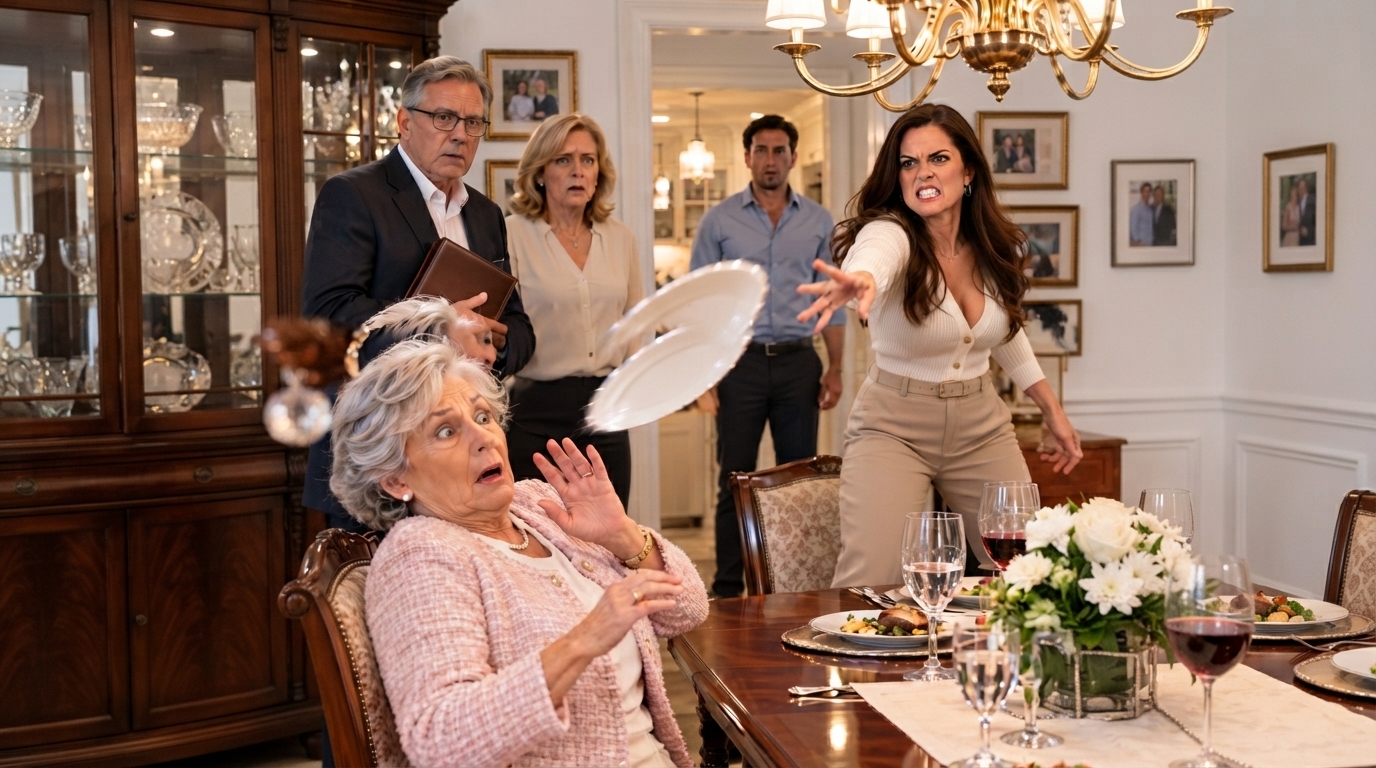
“Her father demanded that I sign over my rental house. I refused. She threw a plate at my head.”
Marissa screamed from across the room.
“She’s lying!”
I looked at the officer.
“My security camera recorded it.”
Marcus immediately interrupted.
“You can’t just record people without their permission!”
I looked at him.
“It was a visible security camera in my own dining room.”
His expression changed again.
The officer asked where the recording was stored.
I showed him the camera application on my phone.
The video began with Marcus pushing the seven-page proposal across my table.
Then Diane crying.
Marissa shouting.
Tyler begging everyone to calm down.
And finally, the plate leaving Marissa’s hand.
The impact was so loud that even I flinched while watching it.
Tyler covered his mouth.
Marissa stopped speaking.
The officer watched the recording again.
Then he looked at her.
“Ma’am, I need you to stand up.”
She shook her head.
“No.”
“Stand up, please.”
“This is ridiculous! She’s ruining my life over a stupid house!”
I stared at her.
A stupid house.
The house Harold and I had purchased when our knees were strong and our hair was dark.
The house where we’d spent weekends painting walls, fixing plumbing, and replacing rotten porch boards.
The house whose rental income helped pay my property taxes and medical expenses.
The house I’d planned to keep until I died.
To Marissa, it was simply something an old woman ought to surrender.
She was taken into custody while the officers continued their investigation.
Her mother began sobbing.
Marcus insisted the entire incident was a misunderstanding.
Tyler stood beside the kitchen doorway, staring at the floor.
And I sat there with blood running down my cheek, wondering how the family I’d spent my life protecting had become a room full of strangers.
When the paramedics arrived, one knelt beside me.
“What’s your name, sweetheart?”
“Evelyn,” I answered. “Evelyn Bennett.”
“Evelyn, we’re going to take good care of you.”
I wanted to tell him I didn’t need taking care of.
I’d survived widowhood.
I’d survived raising a grieving little boy.
I’d survived working double shifts when the rental property needed a new roof.
But when he gently lifted the napkin, I winced.
He examined the wound and said I needed stitches and further evaluation.
Tyler stepped forward.
“Grandma, I’ll ride with you.”
I looked at him.
For a moment, I saw the three-year-old boy who used to crawl into my lap after nightmares.
Then I remembered him standing silently while his wife screamed at me.
“No, Tyler.”
His face crumpled.
“Please.”
I swallowed.
“I need you to stay here and think about why you asked me to calm down instead of asking your wife to stop.”
He looked as though I’d struck him.
But I didn’t take the words back.
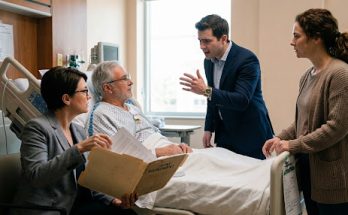
At the hospital, I received stitches and underwent tests to check for a more serious head injury.
Thankfully, the doctors found no acute internal injury.
They told me to watch for worsening symptoms and arrange follow-up care.
My forehead would heal.
The deeper wound was another matter.
Around midnight, my attorney, Rebecca Lawson, arrived.
She was fifty-eight, with silver-rimmed glasses and the kind of calm voice that made people stop interrupting.
I’d first met her after Harold died.
She helped me settle his estate.
Over the years, she’d become someone I trusted.
When she saw the bandage above my eyebrow, her expression tightened.
“Evelyn.”
I tried to smile.
“I’ve looked better.”
She pulled a chair beside my bed.
“Tell me everything.”
So I did.
The dinner.
The paperwork.
The plate.
The police.
And Marcus’s reaction to the transfer document.
Rebecca listened without interrupting.
Then she opened her briefcase.
“There’s something I need to explain.”
My stomach tightened.
Three weeks earlier, after Marcus emailed me his so-called family property proposal, I’d asked Rebecca to review it.
She discovered that the proposal wasn’t the first document connected to my rental house.
A title search had revealed an unusual recorded instrument purporting to authorize Marcus to act on my behalf in connection with a future property transfer.
The signature looked like mine.
But I had never signed it.
I’d never appointed Marcus as my agent.
I’d never given him permission to manage my property.
Rebecca had already contacted the relevant recording office and begun the process of formally challenging the document.
She’d also advised me to preserve every email, text message, and piece of paperwork.
“Evelyn,” she said quietly, “we received additional information this afternoon.”
I sat straighter.
“What information?”
“Marcus contacted a title company about transferring the property.”
My mouth went dry.
“He tried to sell my house?”
“Not exactly. He appears to have been exploring a transfer to Marissa, followed by a possible financing arrangement.”
I stared at her.
“Financing?”
Rebecca nodded.
“A loan secured against the property.”
For several seconds, I couldn’t speak.
Then I whispered, “They wanted to borrow money against my house?”
“That appears to have been the plan. We still need to establish who knew what and whether any lender relied on the paperwork.”
I looked toward the hospital window.
Outside, headlights moved through the parking lot.
I thought about Marcus sitting at my table, talking about retirement and fairness.
Diane describing curtains.
Marissa saying I didn’t need two houses.
And Tyler asking me to consider everyone’s feelings.
They hadn’t simply wanted a roof over Diane and Marcus’s heads.
Someone had been looking at my property as a source of cash.
“Why?” I asked.
Rebecca hesitated.
“Have you heard anything about Marcus’s business?”
I shook my head.
“He said he’d retired.”
“He closed his contracting company last year.”
“Yes.”
“According to the public records we’ve reviewed, the company faced several debts and legal claims before closing.”
I closed my eyes.
So that was it.
My house wasn’t their retirement dream.
It was their rescue plan.
And I was the obstacle.
Rebecca took my hand.
“You did the right thing by coming to me before signing anything.”
I looked at her.
“I almost didn’t.”
She frowned.
“Why?”
“Because Tyler asked me to trust his family.”
My voice broke.
“I raised that boy. I thought if he wanted something from me, there must be a good reason.”
Rebecca squeezed my fingers.
“Loving him doesn’t mean you have to surrender your property.”
I started crying.
Not because I was frightened of Marcus anymore.
But because I finally understood how close I’d come to losing something Harold and I had built together.
The next morning, Tyler appeared at my hospital room.
He stood in the doorway holding a paper cup of coffee.
His eyes were swollen.
“Grandma?”
I looked at him.
“Come in.”
He approached slowly.
“I brought your favorite.”
I glanced at the cup.
Hazelnut coffee.
Two sugars.
He remembered.
For some reason, that hurt more than if he’d forgotten.
He sat beside the bed.
Neither of us spoke.
Finally, he whispered, “I’m sorry.”
I looked at him.
“For what?”
He swallowed.
“For last night.”
“Be specific, Tyler.”
His eyes filled.
“For not stopping Marissa.”
I waited.
“For letting her scream at you.”
He looked down.
“And for acting like you were the problem because you wouldn’t give them the house.”
I nodded slowly.
“That was part of it.”
He rubbed his face.
“Grandma, I didn’t know about the transfer paperwork.”
I studied him.
“Did you know your wife wanted my house?”
“Yes.”
“Did you know her parents were pressuring me?”
He hesitated.
“Yes.”
“Did you know Marissa threatened that I’d end up alone if I refused?”
His head snapped up.
“She said that?”
I nodded.
“Three weeks ago. In my kitchen. Holding your grandfather’s coffee mug.”
He covered his face.
“Oh, God.”
I leaned back against the pillow.
“Tyler, I need you to understand something.”
He looked at me.
“I loved you before you could say my name.”
Tears spilled down his cheeks.
“I know.”
“I loved you when you wet the bed because you missed your mother.”
He began crying harder.
“I loved you when you failed your driver’s test and thought you’d never do anything right.”
“Grandma, please.”
“And I loved you when you married Marissa.”
I paused.
“But loving you doesn’t mean I must accept being hurt in my own home.”
He nodded.
“I know.”
“No,” I whispered. “I don’t think you did.”
He stared at me.
“Because last night, you watched your wife throw a plate at my head, and your first concern was keeping the peace.”
He began sobbing.
I wanted to hold him.
Every instinct in my body told me to reach for him.
But I stayed where I was.
For the first time in his life, Tyler needed to sit with the consequences of his choices without Grandma making them disappear.
Then he said something that changed everything.
“Grandma, Marcus told me you were already planning to give Marissa the house.”
I froze.
“What?”
Tyler wiped his face.
“He said you agreed months ago. That the dinner was just to finalize everything.”
I stared at him.
“And you believed him?”
He looked ashamed.
“Yes.”
“Why didn’t you ask me?”
He couldn’t answer.
I closed my eyes.
There it was.
The terrible truth.
My grandson had believed his father-in-law’s promises about my property more readily than he’d believed my repeated refusals.
I turned toward the window.
“Tyler, I think you should go home.”
He stood.
“Grandma—”
“I need time.”
He nodded.
Then he whispered, “I love you.”
I looked at him.
“I love you too.”
His face brightened slightly.
But I continued.
“And that doesn’t mean everything is forgiven.”
He lowered his head.
“I understand.”
After he left, I called Rebecca.
“There’s something else you need to know.”
And when I repeated what Tyler had told me, she became very quiet.
Then she said, “Evelyn, don’t contact Marcus. Let us preserve the evidence and handle this properly.”
I agreed.
Because by then, I understood that the next battle wouldn’t be about a plate.
It would be about the signature somebody had placed on a document without my permission.
And the people who thought an elderly widow would never fight back.
PART 4
Three days after I returned home from the hospital, I walked into my kitchen and stopped.
Harold’s coffee mug was sitting beside the sink.
The same brown ceramic mug he’d used every morning for thirty-six years.
The handle had a small chip.
The words WORLD’S BEST GRANDPA had faded almost completely.
Marissa had held that mug while threatening me.
Now I couldn’t look at it without hearing her voice.
“You don’t want to end up alone over a house, do you?”
I picked it up.
For a moment, I considered putting it away.
Then I remembered Harold sitting at our kitchen table, drinking coffee and reading the newspaper.
He’d always said, “Evelyn, the day somebody makes you feel guilty for saying no is the day you need to say it twice.”
I laughed through my tears.
“Oh, Harold,” I whispered. “You would have had something to say about this mess.”
I washed the mug.
Dried it carefully.
And placed it back on its shelf.
I refused to let Marissa steal that memory too.
The following week, Rebecca called.
“Evelyn, we have an appointment with the title company.”
I gripped the phone.
“Is my house safe?”
“Your recorded ownership remains in your name. We’ve put the relevant parties on notice of the disputed authorization, and we’re working through the steps necessary to clear the issue.”
I exhaled.
“So they can’t just take it?”
“They don’t have a valid transfer from you. But we need to resolve the false document formally.”
I nodded.
“Whatever it takes.”
Rebecca had also referred the suspected forgery to investigators.
The police were examining the assault separately.
Marissa had been released while her case proceeded.
A protective order was requested, and I followed Rebecca’s advice about avoiding direct contact.
I changed the locks.
Updated the alarm system.
And gave a trusted neighbor an emergency contact number.
For the first time in seventy-two years, I had to think about protecting myself from members of my own family.
That realization hurt more than I expected.
But it also brought a strange kind of clarity.
I wasn’t helpless.
I wasn’t confused.
And I wasn’t going to surrender simply because someone thought old age meant weakness.
Two weeks later, Diane called from an unfamiliar number.
I nearly didn’t answer.
When I heard her voice, I went still.
“Evelyn?”
“Yes.”
She began crying immediately.
“I need to apologize.”
I said nothing.
“Everything has gotten out of control.”
I looked toward the window.
“Diane, your daughter threw a plate at my head.”
She sobbed.
“I know.”
“And you rushed to comfort her.”
There was a long silence.
Then she whispered, “I was wrong.”
I waited.
She continued.
“Marcus told us the house was practically yours to give away. He said Tyler would inherit it anyway, so transferring it now wouldn’t matter.”
I closed my eyes.
“Diane, it mattered to me.”
“I understand that now.”
“No,” I said. “You understood it when I said no the first time. You just didn’t like my answer.”
She began crying again.
Then she said something unexpected.
“Marcus owes people money.”
I sat straighter.
“How much?”
“I don’t know the exact amount. More than he told me.”
I remained silent.
“He said if we could get the house transferred, he could arrange financing and pay everything off.”
I gripped the phone.
“So you knew.”
She hesitated.
“I knew he wanted to borrow against it.”
My stomach turned.
“And you sat in my dining room talking about curtains?”
She began sobbing.
“I was afraid we’d lose everything.”
I looked at Harold’s photograph above the fireplace.
“You were willing to let me lose everything instead.”
Diane didn’t answer.
I ended the call.
Then I wrote down the date, time, and what she’d said.
I sent the notes to Rebecca.
For years, I’d believed family problems could be solved by sitting around a table and speaking honestly.
But honesty only works when everyone is willing to tell the truth.
Marcus had built an entire plan around keeping me uninformed.
And Diane had helped him.
The next month brought more revelations.
Investigators interviewed the people involved in preparing and submitting the disputed authorization.
The title company preserved its records.
Rebecca obtained copies of correspondence showing that Marcus had represented himself as someone with authority to arrange a transfer of my rental house.
He’d used language about “family consent” and “anticipated inheritance.”
But he had never possessed my consent.
And inheritance was irrelevant because I was still alive.
Rebecca explained that the matter would take time.
A disputed document didn’t disappear simply because I declared it false.
There were procedures.
Evidence.
Hearings.
People who needed to be questioned.
I hated the waiting.
But I trusted her.
Meanwhile, Marissa’s assault case moved forward.
The recording showed exactly what happened.
There was no misunderstanding about a falling plate.
No accidental collision.
No confusion over who had thrown it.
Her attorney eventually contacted the prosecutor about a possible negotiated resolution.
I wasn’t asked to pretend the assault hadn’t happened.
I provided a statement describing the injury, the fear, and the emotional impact.
I also made it clear that I wanted the court to consider the seriousness of attacking an elderly person over a financial dispute.
I didn’t need revenge.
I needed accountability.
Marissa eventually entered a plea under an agreement that included supervised probation, restitution for medical expenses, required counseling, and restrictions on contacting me.
The judge emphasized that family disagreements did not excuse violence.
When I heard the decision, I felt neither joy nor triumph.
I felt tired.
A young woman who had once sat at my Christmas table had become someone I needed protection from.
That wasn’t a victory.
It was a tragedy that never should have happened.
But the court’s decision also meant the truth hadn’t been buried beneath excuses.
For that, I was grateful.
Tyler continued calling.
At first, I let the calls go to voicemail.
He left messages.
“Grandma, I just want to know you’re okay.”
“Grandma, I understand if you’re angry.”
“Grandma, I’m sorry.”
I listened to them.
Sometimes I cried afterward.
Sometimes I became furious.
Sometimes I missed him so much I nearly called back.
But I waited until I was ready.
One afternoon, nearly four months after the assault, Tyler appeared on my porch.
He wasn’t carrying flowers.
Or expensive chocolates.
Or some grand gesture meant to erase what had happened.
He held a small cardboard box.
I opened the screen door.
“Hello, Tyler.”
His eyes filled.
“Hi, Grandma.”
He looked thinner.
Older.
As though the past few months had finally forced him to grow up.
“Can we talk?”
I studied him.
Then I stepped outside and closed the door behind me.
We sat on the porch.
He placed the box between us.
“What’s that?” I asked.
He swallowed.
“Some things I found.”
He opened it.
Inside were photographs.
His first day of kindergarten.
His fifth birthday.
A picture of him holding a fishing rod beside Harold.
His high school graduation.
And a photograph from his wedding.
In that picture, Tyler had his arms around me.
Both of us were smiling.
I stared at it.
“I remember that day,” I whispered.
“So do I.”
He picked up the wedding photograph.
“I told you that you were the reason I turned out okay.”
I nodded.
He began crying.
“I don’t think I was right.”
My chest tightened.
“Tyler—”
“No, Grandma. Please let me say this.”
I fell silent.
He looked directly at me.
“You taught me how to be kind. You taught me to work hard. You taught me not to lie.”
His voice shook.
“But when I married Marissa, I started confusing loyalty with agreeing to everything she wanted.”
I watched him.
“I kept telling myself I was protecting my marriage.”
He wiped his face.
“But I wasn’t protecting anyone. I was letting people hurt you because I didn’t want them angry at me.”
Tears filled my eyes.
He continued.
“When she threw that plate, I froze.”
I remembered.
The blood.
The shattered ceramic.
The silence.
“I know,” I whispered.
“I should have helped you immediately. I should have called for an ambulance. I should have told her to stay away from you.”
He began sobbing.
“Instead, I asked you to calm down.”
I looked toward the yard.
The rosebush Harold planted years earlier was blooming.
For a long time, neither of us spoke.
Then Tyler said, “Marissa and I are separating.”
I turned toward him.
“Tyler, that’s your decision.”
“I know.”
He nodded.
“I’ve been seeing a counselor. I’ve been trying to understand why I kept making excuses.”
I studied him.
“And?”
He looked down.
“Because admitting something was wrong meant I might have to do something difficult.”
That answer stayed with me.
It was the first time he’d spoken without blaming Marissa for every choice he’d made.
He was finally accepting responsibility for his own silence.
I reached for his hand.
He held mine carefully.
“Tyler,” I said, “I love you.”
He began crying again.
“But rebuilding trust will take time.”
He nodded.
“I know.”
“And there will be boundaries.”
“Anything.”
I shook my head.
“Don’t promise anything just because you’re afraid of losing me. Listen first.”
He nodded again.
I continued.
“You will not pressure me about my property. You will not bring Marissa or her parents here. And you will not ask me to excuse what happened.”
“I won’t.”
“If we’re going to have a relationship, it has to be based on respect.”
He squeezed my hand.
“I understand.”
I hoped he did.
But this time, I would judge by actions rather than promises.
Over the following months, Tyler began visiting once a week.
Sometimes we had lunch.
Sometimes he helped with yard work.
Sometimes we simply sat on the porch.
He didn’t ask for money.
He didn’t mention the rental house.
He didn’t try to convince me that Marissa deserved another chance.
Slowly, cautiously, we began rebuilding something.
It wasn’t the same relationship we’d had before.
Perhaps it never would be.
But it was more honest.
And that mattered.
Meanwhile, the property investigation continued.
Marcus eventually acknowledged, through his attorney, that he had arranged for the disputed authorization to be prepared and submitted without obtaining my valid signature or consent.
The matter resulted in a formal resolution that cleared the disputed instrument from my property’s title records and required Marcus to pay certain costs.
His conduct was also reviewed by the appropriate authorities.
Rebecca carefully explained the limits of what had been established.
There were consequences, but she didn’t promise that every wrong would lead to a criminal conviction.
I accepted that.
What mattered most was that my ownership was protected and the false claim of authority had been defeated.
The rental house remained mine.
No transfer to Marissa occurred.
No loan was secured against it.
And nobody could pretend I’d agreed to give it away.
One afternoon, Rebecca invited me to her office.
When I arrived, she placed a folder on the table.
“Evelyn, the title issue has been resolved.”
I stared at her.
“Completely?”
“The disputed instrument has been formally addressed, and the current title report reflects your ownership without that claimed authorization.”
I covered my mouth.
For months, I’d lived with the fear that someone might find another way to take what Harold and I had worked for.
Now, finally, I could breathe.
Rebecca smiled.
“There’s something else we should discuss.”
I looked up.
“Your estate plan.”
I nodded.
We had already updated it after the assault.
But I’d spent the intervening months thinking about what I wanted my property to mean after I was gone.
Harold and I had never been wealthy.
We’d saved carefully.
Worked hard.
Gone without things other people took for granted.
And the rental house had always represented security.
Not luxury.
Security.
I told Rebecca I wanted to establish a carefully structured plan that would preserve my ability to use the rental income during my lifetime.
After my death, I wanted a portion of my estate to support a local organization helping grandparents who unexpectedly become primary caregivers for children.
Rebecca helped me explore an arrangement that matched my goals and complied with the law.
Tyler would still receive a personal inheritance under the terms I chose.
But nobody would automatically receive my rental property simply because they demanded it.
And nobody would gain control of it while I was alive.
When the documents were complete, I went home and placed them in the same wooden cabinet where Harold used to keep our mortgage statements.
I ran my fingers over the old brass handle.
Then I whispered, “We did it, sweetheart.”
For the first time since the assault, I felt genuinely peaceful.
That autumn, Tyler came over to help me repaint the rental house’s porch.
We worked together all morning.
At noon, we sat on the steps eating sandwiches.
He looked toward the freshly painted railing.
“Grandpa would have liked this color.”
I smiled.
“He chose it.”
Tyler laughed.
“Of course he did.”
Then he became quiet.
“Grandma?”
“Yes?”
“Can I ask you something?”
I looked at him.
“Go ahead.”
“Were you ever going to leave me the rental house?”
I studied his face.
There was no accusation.
No expectation.
Just a question.
“Once,” I said.
He nodded slowly.
“Before all this?”
“Yes.”
He looked down.
“I understand why you changed your mind.”
I placed my sandwich on its wrapper.
“Tyler, your grandfather and I wanted you to have a good life.”
He looked at me.
“But a good life isn’t something I can hand you in the form of a deed.”
He swallowed.
“I know.”
“You have to build it. With honesty. Responsibility. And the courage to do what’s right even when somebody you love is angry.”
His eyes filled.
I smiled gently.
“That’s the inheritance I always hoped you’d take from us.”
He wiped his face.
“I wish I’d understood sooner.”
“So do I.”
We sat together in the autumn sunshine.
And for once, I didn’t feel the need to fix his sadness.
He needed to carry some of it.
That’s how people learn.
Christmas arrived quietly that year.
I decorated my house with the same old ornaments Harold and I had collected over decades.
There was the little wooden snowman Tyler painted in kindergarten.
The silver bell from our twenty-fifth anniversary.
And the crooked angel Harold insisted belonged at the top of the tree.
Tyler came for dinner.
Just Tyler.
He brought a homemade apple pie.
It was slightly burned around the edges.
I laughed when he took it out of the box.
“Did you make this yourself?”
He grinned sheepishly.
“I tried.”
I hugged him.
“Then it’s perfect.”
We ate roast chicken.
Mashed potatoes.
Green beans.
And the slightly burned pie.
After dinner, Tyler helped me wash the dishes.
He picked up Harold’s old coffee mug from the drying rack.
For a moment, he stared at it.
Then he looked at me.
“Grandma, I remember Grandpa using this.”
I smiled.
“Every morning.”
He ran his thumb over the chipped handle.
“I miss him.”
“So do I.”
Tyler carefully placed the mug back on its shelf.
Then he turned toward me.
“I think he would have been proud of you.”
My eyes filled.
“For what?”
“For standing up for yourself.”
I looked toward Harold’s photograph.
The man I’d loved for forty-three years smiled back at me.
I thought about the night Marissa threw the plate.
The blood on my fingers.
The way Diane rushed to comfort her daughter.
Marcus trying to escape with his folder.
Tyler asking me to calm down.
And the police officer holding the document with my forged signature.
I thought about every moment I’d been tempted to give in simply to keep my family together.
Then I looked at my grandson.
“Tyler,” I said softly, “your grandfather taught me something a long time ago.”
“What?”
“That peace bought by surrendering your dignity isn’t peace.”
He nodded.
“And love that requires you to accept cruelty isn’t love.”
Tears rolled down his cheeks.
He stepped forward and hugged me.
I hugged him back.
Not because everything had been forgotten.
Not because every wound had healed.
But because he’d begun doing the difficult work of becoming someone I could trust again.
And because I had learned that forgiveness didn’t require giving anyone the power to hurt me twice.
Later that evening, after Tyler went home, I sat in Harold’s favorite chair.
The Christmas lights glowed softly.
The house was quiet.
My forehead had healed, leaving a small scar near my eyebrow.
Sometimes, when I looked in the mirror, I still noticed it.
But I no longer saw it as a mark of humiliation.
I saw it as a reminder.
At seventy-two, I’d been called selfish for refusing to give away something I’d spent a lifetime building.
I’d been threatened with loneliness.
Accused of choosing money over family.
And attacked because I wouldn’t sign a piece of paper.
But I had also discovered something extraordinary.
I could love my grandson without surrendering my home.
I could feel compassion for Marissa’s parents without paying their debts.
I could forgive mistakes without pretending violence was acceptable.
And I could grow old without giving anyone permission to treat me as though my life was already over.
I reached for Harold’s photograph.
“Remember what you always told me?” I whispered.
In my mind, I could almost hear his voice.
Never let anybody make you feel guilty for protecting what we worked for.
I smiled through my tears.
Then I placed the photograph back on the table.
Marissa had called me a selfish old bat.
Marcus had treated my property like an investment opportunity.
Diane had believed her family’s financial problems mattered more than my security.
And Tyler had nearly lost the grandmother who’d raised him because he was afraid to stand up to his wife.
But in the end, the house stayed mine.
My dignity stayed mine.
And the decisions about the rest of my life stayed exactly where they belonged.
With me.
They thought a seventy-two-year-old widow would be too frightened to fight back.
They forgot that I had already survived losing the love of my life, raising a child who wasn’t mine by birth, and rebuilding a future after grief nearly destroyed me.
A ceramic plate could leave a scar on my forehead.
But it could never take away the strength Harold and I had spent a lifetime building.
And that was something no forged signature, no family threat, and no amount of money could ever buy.
THE END THANK YOU FOR READING !!!