PART 3
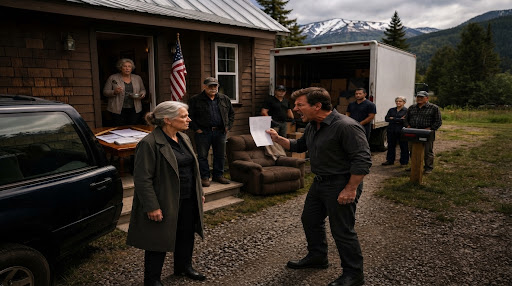
Grant stood in the middle of
my driveway with his arms crossed,
blocking the path to my front porch.
Behind him, a twenty-six-foot
moving truck sat with its rear doors open.
Dale’s brown recliner was lying sideways on my lawn.
Two movers stood beside it,
looking as though they wished
they had accepted a different job that morning.
Bernice was visible through my kitchen window.
She was holding a serving spoon.
Apparently, she’d already found the casserole.
I switched off my engine and stepped out of my truck.
Grant marched toward me.
“What have you done?”
I closed the driver’s door carefully.
“Good morning to you too, Grant.”
“Don’t play games with me, Holly.”
He pointed toward the house.
You left some ridiculous paperwork on the table.
My parents are scared half to death.
I looked past him.
Then perhaps we should explain
the paperwork before anyone unloads another box.
His face reddened.
“It’s a house, Holly. Not a government building.”
“No,” I replied. “It’s my house. And that’s exactly why we’re having this conversation.”
He laughed bitterly.
You think waving around some county form
gives you the right to throw two elderly people onto the street?
I looked at Dale.
He was standing beside the moving truck, holding his hat in both hands.
He looked exhausted.
For the first time, I noticed that his shoulders had begun to stoop.
Bernice appeared in the doorway.
“Holly,” she called, “we didn’t know there was a problem.”
I believed her.
That was what made the situation so painful.
Grant had made promises on my behalf.
Karen had allowed him to make them.
And Dale and Bernice had trusted their son.
Now everyone expected me to solve the disaster.
Just as Grant had planned.
“Come inside,” I told them. “Let’s sit down.”
Grant stepped in front of me.
“First, explain whose signature is on that notice.”
I looked directly at him.
“Mine.”
His expression changed.
“Yours?”
“Yes. The acknowledgment confirming that I received the county’s formal decision and understood the consequences of violating it.”
He stared.
“You signed something to get my parents rejected?”
“No, Grant. I signed to acknowledge a decision made under restrictions that have existed since I bought this house.”
He shook his head.
“You planned this.”
“I applied for permission to let them live here. The county denied it. I warned you. You came anyway.”
He opened his mouth.
I continued.
“And I submitted the notice acknowledging that you intended to arrive despite that denial. The county now has the information it needs to evaluate the situation.”
His confidence faltered.
“You reported me?”
“I reported the facts.”
For a moment, the only sound was the wind moving through the aspens.
Then Grant said something that told me he still hadn’t understood.
“Fine. Then I’ll buy the place from you.”
I almost smiled.
“That’s not how this property works.”
He glanced toward the house.
“A million-dollar property, Holly. You’re telling me you wouldn’t sell?”
I looked at him.
“I’m telling you that you don’t understand what you’re trying to take.”
He scoffed.
“Then explain it.”
So I did.
Nineteen years earlier, when my husband had been dead for six years and I was still working for the county, I’d qualified for a mountain workforce housing program.
The program existed because ordinary workers couldn’t afford homes in the area anymore.
Teachers.
Road crews.
Nurses.
County employees.
People who kept the community running but couldn’t compete with wealthy vacation-home buyers.
The house had been sold to me at a restricted price.
In exchange, I agreed to permanent conditions.
I had to use it as my primary residence.
I couldn’t turn it into a vacation rental.
I couldn’t transfer it freely.
Any sale had to follow the program’s eligibility and resale rules.
And additional permanent household members had to meet the program’s requirements.
Grant stared at me.
“So?”
“So the market analysis you found doesn’t tell you what I could legally sell this house for.”
His eyes narrowed.
“What market analysis?”
I folded my arms.
“The one you left on your patio table beneath a citronella bucket.”
His mouth closed.
I continued.
“One million and fifty thousand dollars. That’s what the house might bring without restrictions.”
Grant looked away.
“But it isn’t unrestricted property.”
He said nothing.
“And the county authority has rights under the recorded agreement that you can’t wish away.”
Dale slowly approached.
“Son,” he said, “you told us Holly owned the place outright.”
Grant snapped, “She does.”
I shook my head.
“I own it subject to the deed restrictions.”
Dale looked confused.
I softened my voice.
“That means it’s my home, Dale. But it also means I made promises when I purchased it, and those promises are legally binding.”
Bernice stepped onto the porch.
“Grant told us Karen would inherit the house someday.”
I looked at her.
There it was.
The second half of the plan.
Grant hadn’t simply wanted his parents to live in my spare bedrooms.
He’d already begun treating my home as his family’s future asset.
“Karen may have inheritance rights to whatever interest I legally own,” I explained. “But inheriting the house wouldn’t erase the restrictions. The program has rules about eligible successors and resale.”
Grant waved his hand.
“Those things can be worked around.”
I looked at him.
“You said something similar in 2017 when you wanted me to approve that unsafe staircase.”
His face darkened.
“Don’t bring that up.”
“You wanted me to sign a certificate before the building met code.”
“That was different.”
“No,” I said quietly. “It wasn’t.”
I looked at Dale and Bernice.
“I’d like to speak with you both inside.”
Grant followed us.
I didn’t stop him.
Not yet.
We sat at the dining table.
The four documents were still there beneath my father’s folding ruler.
Bernice had moved the casserole from the refrigerator to the counter.
The blue quilt I’d placed on the east bedroom bed was visible through the hallway.
I could see her looking at it.
She’d probably imagined sleeping beneath that quilt for years.
I hated that her son had put us in this position.
I lifted the first document.
“The recorded deed restriction.”
Then the second.
“The county’s decision denying the requested change in household composition.”
The third.
“My most recent occupancy certification.”
And finally, the fourth.
“The county’s acknowledgment and compliance notice, confirming the issue has been referred for review.”
Grant leaned back.
“So you invited an inspection?”
“I informed the county that you intended to move people in after the application was denied.”
“You could have kept quiet.”
“Yes,” I said.
He stared.
“But keeping quiet would have put my home at risk.”
Bernice reached for the denial letter.
Her fingers trembled as she read it.
“Unauthorized occupancy may result in enforcement action,” she whispered.
She looked at me.
“Could you really lose your house?”
“Under serious circumstances, the authority could pursue remedies that threaten my ownership. I’m not willing to gamble nineteen years of payments on someone else’s assurances.”
Dale slowly removed his glasses.
“Grant, did you know about this?”
Grant shrugged.
“It’s bureaucratic nonsense.”
Dale’s voice sharpened.
“Did you know?”
Grant looked away.
“Yes.”
Bernice made a small sound.
“You knew?”
He sighed.
“Mom, I didn’t think they’d enforce it.”
She stared at him.
“We sold our trailer.”
“I know.”
“We gave away half our furniture.”
“I know.”
“And you told us we were moving into a house where we weren’t legally allowed to live?”
Grant slammed his palm against the table.
“I’m trying to help you!”
Dale stood.
“Then why didn’t you tell us the truth?”
For the first time since I’d known him, Grant had no answer.
I looked at Bernice.
“You’re welcome to have lunch before you leave. And I’ll help you find somewhere safe to stay.”
Her eyes filled.
“But you can’t move in,” I added gently.
She nodded.
“I understand.”
Grant stood so abruptly his chair scraped the floor.
“This isn’t over.”
I looked up.
“No, Grant. It isn’t.”
He pointed toward me.
“Karen has a right to this house.”
I felt something settle inside my chest.
“Karen has a right to make decisions about her own life. She does not have the right to make decisions about mine.”
He laughed.
“You’re nearly seventy.”
“Sixty-nine.”
“Whatever. You can’t stay up here forever.”
I looked at him.
“Maybe not.”
He seemed encouraged.
Then I continued.
“But the day I need to leave will be determined by my circumstances and my choices, not by how badly you want my property.”
His face twisted.
“You’ll regret this.”
I didn’t raise my voice.
“Grant, you’ve been telling me that for nine years.”
He stormed outside.
Ten minutes later, Karen arrived.
She parked behind the moving truck and hurried toward the house.
Her face was pale.
“Mom!”
I met her on the porch.
“Hello, sweetheart.”
She looked at the recliner on the lawn.
Then the movers.
Then her husband pacing beside his pickup.
“What happened?”
I studied her.
“You knew about the application.”
She swallowed.
“Grant said it wasn’t important.”
“You knew the county denied it.”
She looked away.
“Mom—”
“Did you?”
Her eyes filled.
“Yes.”
I nodded.
“And you let his parents sell their trailer?”
She began crying.
“I thought Grant had figured something out.”
I looked at my daughter.
For years, I’d watched her make excuses for her husband.
I’d watched her apologize for things he said.
I’d watched her grow smaller whenever he became angry.
But this was different.
This time, her silence had endangered other people.
“Karen,” I said, “what did Grant tell you would happen to my house?”
She stared at me.
“Nothing.”
I waited.
Her eyes dropped.
“He said when you moved into assisted living, we could sell it.”
I felt the words like a blow.
“Assisted living?”
She began crying harder.
“He said it would be easier for everyone.”
I looked at her.
“Did you think I needed assisted living?”
“No.”
“Have I forgotten how to pay my bills?”
“No.”
“Have I become unable to care for myself?”
“No.”
“Then why were you discussing moving me out of my home?”
Karen covered her mouth.
“I don’t know.”
But I did.
Because Grant had told her that was what would happen.
And she’d become so accustomed to accepting his decisions that she had stopped questioning whether he had the right to make them.
I took her hand.
“Sweetheart, I love you.”
She cried harder.
“But loving you doesn’t mean surrendering my life.”
She nodded.
I looked toward Grant.
He was speaking angrily into his phone.
Then I said the words I’d been afraid to say for years.
“Your husband isn’t allowed to make decisions about this house anymore.”
Karen looked at me.
“And until he understands that, he isn’t welcome inside it.”
Her expression crumpled.
“Mom, please.”
I squeezed her hand.
“You can always visit me. But you don’t have to bring him.”
For a long moment, she said nothing.
Then she whispered, “I don’t know how to do that.”
My heart broke.
I pulled her into my arms.
“Then perhaps it’s time you learned.”
By late afternoon, the moving truck was gone.
Dale and Bernice had accepted a temporary room at a modest motel in town.
I paid for two nights directly at the front desk because I couldn’t bear the thought of them sleeping in their truck.
I made it clear that this was a gift, not an agreement to support them indefinitely.
Dale thanked me.
Bernice hugged me.
Grant didn’t say goodbye.
When the last vehicle disappeared down the mountain road, I stood alone in my driveway.
The wind moved through the aspens.
My house stood exactly where it had stood that morning.
The metal roof shone beneath the afternoon sun.
The blue bedroom was still ready.
The casserole was half eaten.
And for the first time in weeks, the cattle guard was silent.
I thought the worst was over.
I was wrong.
Because three days later, during the scheduled compliance inspection, the county officer handed me a copy of a letter.
It had been submitted by Grant.
And it claimed I was no longer mentally capable of managing my own home.
PART 4
I read the letter twice.
Then I read it a third time.
It was addressed to the housing authority.
The subject line said:
Concern Regarding Elderly Homeowner’s Capacity and Property Management.
My name appeared in the first paragraph.
Holly Thatcher.
Age sixty-nine.
Widowed.
Living alone.
Grant had written that I was becoming confused.
That I was making irrational financial decisions.
That I was refusing reasonable assistance from family members.
And that my daughter Karen should be permitted to help manage my affairs.
I stared at the paper.
Then I looked at the county compliance officer standing in my kitchen.
Her name was Melissa Grant.
No relation to my son-in-law.
She’d worked for the county for eleven years.
“Holly,” she said carefully, “I want you to know this letter doesn’t establish anything.”
I nodded.
“I understand.”
“We’re not making any determination about your capacity. It was submitted as correspondence related to the occupancy dispute.”
I looked down again.
Grant had signed his name beneath the final paragraph.
He’d also written that I had become emotionally unstable after retirement.
I almost laughed.
I’d spent twenty-eight years reviewing construction plans, interpreting building codes, and documenting safety violations.
I’d managed my own finances for decades.
I’d maintained my home.
Paid my taxes.
Handled repairs.
And now the man who couldn’t be bothered to read a deed restriction wanted the county to believe I was incapable of making decisions.
Melissa sat across from me.
“Would you like a copy for your records?”
“Yes, please.”
She slid it across the table.
I placed it inside my folder.
Then I looked at her.
“Can I ask you something?”
“Of course.”
“Does the county consider this relevant to whether Dale and Bernice can live here?”
“Not in the way he appears to suggest. The recorded restrictions and program requirements govern that issue.”
I nodded.
“Thank you.”
Melissa completed the inspection.
She confirmed that Dale and Bernice had not taken up residence.
Their belongings were gone.
The rooms were still arranged for guests, but no unauthorized occupants were living there.
She documented what she observed.
Before leaving, she paused at the doorway.
“Holly?”
“Yes?”
“I remember when you were the building official.”
I smiled faintly.
“So do I.”
She looked toward the woodshed.
“You taught half this county how to document things properly.”
I laughed.
“Mostly because nobody wanted to do the paperwork.”
She smiled.
“Keep doing it.”
After she left, I sat at the kitchen table.
I placed Grant’s letter beside the four documents I’d left beneath my father’s ruler.
Then I opened another folder.
The one Karen had helped me complete after my cataract surgery.
Two years earlier, I’d signed a limited authorization allowing her to help communicate with doctors and handle a few administrative matters during my recovery.
It had never been a general power of attorney.
It had never given her control of my house.
But Grant had apparently decided that because Karen once helped me with paperwork, she should be able to manage everything.
I called an attorney named Patricia Wells.
Patricia had helped me review estate documents after my husband’s death.
She was practical, direct, and unimpressed by intimidation.
I explained everything.
The moving truck.
The deed restriction.
The market analysis.
Grant’s letter.
Karen’s silence.
Patricia listened.
Then she said, “Holly, we need to make sure your legal documents reflect your current wishes.”
“I agree.”
“Do you still want Karen involved in your medical or financial decisions?”
I looked toward the window.
The aspens were beginning to leaf out.
“I love my daughter.”
“I know.”
“But I’m not comfortable with Grant having access to anything.”
“Then let’s review your authorizations and estate plan.”
We scheduled an appointment.
Over the next two weeks, Patricia reviewed my documents.
I revoked the temporary authorization that was no longer needed.
I updated my health care instructions.
I designated an independent professional to handle certain matters if I ever became unable to act for myself.
And I revised my estate plan to account for the housing restrictions.
Nothing was done to punish Karen.
I simply wanted my affairs arranged according to my wishes.
Patricia also explained something important.
“Grant cannot take control of your property merely by claiming you’re confused. Any attempt to establish legal authority over an unwilling adult requires proper procedures and evidence.”
I nodded.
“But he can make my life miserable.”
“He can try,” she said.
Then she looked at me.
“And you can establish boundaries.”
That afternoon, I wrote Grant a letter.
Not an angry letter.
Not a dramatic one.
Just four paragraphs.
I told him he was not authorized to enter my property without my permission.
He was not authorized to arrange occupants, movers, contractors, real estate agents, or property inspections on my behalf.
He was not authorized to represent himself as someone empowered to manage my affairs.
And any future communication about my home would need to be made in writing.
Patricia reviewed it.
Then we sent it.
Grant responded the next morning.
His message contained seventeen lines of accusations.
I was selfish.
Ungrateful.
Controlling.
Cruel to elderly people.
Manipulating Karen.
And destroying the family.
I read it once.
Then filed it away.
I didn’t answer.
For years, I’d mistaken defending myself for arguing.
Now I understood the difference.
I didn’t have to convince Grant I was right.
I only had to protect my rights.
A week later, Dale called.
I was stacking firewood when my phone rang.
“Holly?”
“Hello, Dale.”
He sounded tired.
“Bernice and I wanted to thank you.”
“For what?”
“The motel.”
I leaned against the woodshed.
“You’re welcome.”
He hesitated.
“Grant told us you were trying to punish him.”
I said nothing.
“But we’ve been thinking.”
I waited.
“Bernice says you prepared those bedrooms before you knew whether we’d be allowed to stay.”
I looked toward the house.
“Yes.”
“And you baked that casserole.”
“Yes.”
Dale’s voice cracked.
“You weren’t trying to hurt us.”
“No, Dale.”
He was silent for a moment.
Then he said, “We should have called you ourselves before selling the trailer.”
I closed my eyes.
“That would have helped.”
He sighed.
“We believed our son.”
I understood that better than he knew.
Dale continued.
“We’ve found a senior apartment in town. It’s smaller than we’d hoped, but the rent is manageable with some assistance.”
I smiled.
“That’s wonderful.”
“We’re on the waiting list. In the meantime, Bernice’s sister has offered us her guest room.”
I felt a weight lift from my chest.
“I’m glad.”
Then Dale said something I hadn’t expected.
“Holly, Grant doesn’t speak for us anymore.”
I stood very still.
“He’s our son,” Dale continued. “We love him. But we should never have let him decide where we were going to live.”
I looked toward the mountains.
“That’s something I understand.”
After we hung up, I sat on the porch for a long time.
I thought about the strange way families sometimes confuse love with obedience.
Parents expect children to obey.
Children grow up and begin expecting parents to obey.
And somewhere along the way, people forget that loving someone doesn’t give you ownership of their decisions.
That evening, Karen arrived.
Alone.
I watched her car cross the cattle guard.
For nine years, Grant had usually driven her up the mountain.
Sometimes he waited in his truck.
Sometimes he refused to come at all.
But this time, Karen was driving.
She parked beside my woodshed.
Then she stepped out carrying a grocery bag.
I opened the screen door.
“Hello, sweetheart.”
She looked nervous.
“Hi, Mom.”
I stepped aside.
“Come in.”
She placed the bag on the counter.
Inside were coffee beans, crackers, and a small lemon cake.
I smiled.
“You remembered.”
She nodded.
“It’s your favorite.”
We sat at the kitchen table.
For a while, we talked about ordinary things.
Her job.
The weather.
The road repairs near town.
Then she set down her cup.
“Mom, I need to apologize.”
I looked at her.
She took a shaky breath.
“I knew Grant was wrong.”
My chest tightened.
She continued.
“I knew he shouldn’t have promised your house to his parents.”
I waited.
“And I knew you were upset.”
Tears filled her eyes.
“But every time I tried to tell him, he’d get angry. So I told myself it would be easier if you just agreed.”
I looked at my daughter.
The little girl who used to collect pinecones in my backyard.
The teenager who cried when she didn’t make the volleyball team.
The young woman who’d married Grant because she believed he would always protect her.
Now she sat across from me, exhausted.
“Karen,” I said gently, “why was it easier for me to lose my home than for Grant to hear the word no?”
She began crying.
“I don’t know.”
I reached across the table.
She took my hand.
“Mom, I’m sorry.”
I swallowed.
“Thank you.”
She wiped her face.
“I saw the letter he sent the county.”
My expression changed.
“He told me he was trying to get someone to check on you.”
I looked at her.
“And what did you think?”
She shook her head.
“I was furious.”
For the first time, I saw anger in my daughter’s face that wasn’t directed at herself.
“I told him you weren’t confused. I told him you were the most organized person I’d ever met.”
I smiled faintly.
“He didn’t like that.”
“I imagine not.”
She looked down.
“Then he said I had to choose.”
My heart sank.
“Between what?”
“You and him.”
I stared at her.
Karen began crying again.
“He said if I kept visiting you, I was betraying our marriage.”
I took a slow breath.
“What did you tell him?”
She looked up.
“I told him I wasn’t choosing between my husband and my mother.”
I waited.
“I was choosing whether I was allowed to make my own decisions.”
My eyes filled.
She continued.
“And I told him I was coming here.”
I stood and walked around the table.
Karen rose.
I hugged her.
She clung to me like she had when she was little.
For a long time, neither of us spoke.
Then she whispered, “I’m scared, Mom.”
I held her tighter.
“I know.”
“I don’t know what happens next.”
“Neither do I.”
She pulled back.
I brushed the hair away from her face.
“But you don’t have to figure it out tonight.”
She nodded.
That evening, Karen stayed for dinner.
We ate roast chicken and potatoes.
Afterward, we sat on the porch while the sky turned pink behind the mountains.
She told me she had scheduled an appointment with a counselor.
Not because I asked her to.
Because she wanted to understand why she’d spent so many years avoiding conflict.
I told her I was proud of her.
And I meant it.
The following months brought changes.
Karen began making decisions without waiting for Grant’s approval.
Small ones at first.
Driving to see me.
Visiting friends.
Taking an afternoon off work.
Then larger ones.
She insisted they attend marriage counseling.
Grant refused initially.
He said counseling was for people who couldn’t handle their own problems.
Karen went alone.
Eventually, after several difficult conversations, he agreed to attend.
I didn’t ask for details.
Their marriage was theirs to manage.
But I made one thing clear.
Grant would not be welcomed back into my home until he could respect my boundaries.
For a long time, he couldn’t.
He continued telling relatives that I had humiliated him.
He claimed I’d chosen paperwork over family.
He complained that I’d destroyed his parents’ retirement plans.
But the facts remained the same.
I’d never invited his parents to move in.
I’d never promised them a room.
I’d warned him repeatedly about the restrictions.
And I’d tried to obtain permission before he ignored the denial.
Eventually, even some of his relatives stopped defending him.
Dale and Bernice moved into their senior apartment that autumn.
Karen helped them unpack.
I sent a housewarming basket with towels, tea, and a small reading lamp.
Bernice called me crying.
“You didn’t have to do this.”
“I know.”
She laughed softly.
“Thank you, Holly.”
I smiled.
“Enjoy your new home.”
And I meant it.
Because everyone deserved a home where they were wanted.
Not one they’d been promised by somebody who didn’t own it.
Winter arrived early that year.
Snow covered the mountain road.
The metal roof sang beneath the first hard storm.
I stacked firewood.
Checked the generator.
Filled the pantry.
And settled into the quiet routine I’d worked nineteen years to enjoy.
Then, one snowy afternoon in December, a letter arrived from the housing authority.
I carried it inside.
For a moment, my hands trembled.
I’d spent months worrying that Grant’s actions might still cause trouble.
I opened the envelope.
The letter confirmed that the unauthorized occupancy issue had been closed after the inspection established that no prohibited move-in had occurred.
My ownership remained subject to the existing restrictions, but no enforcement action was being pursued over the attempted move.
I sat down.
Then I cried.
Not loudly.
Not dramatically.
Just the quiet tears of a woman who’d spent months protecting the place she’d worked nearly two decades to call home.
I placed the letter in my filing cabinet.
Third folder from the front.
Exactly where it belonged.
On Christmas Eve, Karen came up the mountain.
She brought a small pine wreath and a container of homemade cookies.
She was still working through her marriage.
Grant was not with her.
We didn’t discuss him much.
Instead, we decorated the little tree beside my kitchen window.
We made soup.
We watched snow settle on the porch railing.
And for the first time in years, my daughter stayed until after dark without someone texting her to hurry home.
Before leaving, she hugged me.
“Mom?”
“Yes?”
“I’m glad you didn’t give up your house.”
I smiled.
“So am I.”
She hesitated.
“I’m sorry I ever made you feel like you had to.”
My throat tightened.
I kissed her cheek.
“I love you, Karen.”
“I love you too.”
After she drove away, I stood on the porch listening to the tires crunch along the snowy road.
Then I went inside.
The house was warm.
The fire was low.
The kitchen smelled like cinnamon and pine.
My father’s folding ruler rested on the shelf beside the filing cabinet.
I picked it up.
The wood was worn smooth from decades of use.
Dad had been a carpenter.
He used to tell me that a good measurement saved a lot of trouble later.
“Measure twice, cut once, Holly.”
I smiled at the memory.
Then I looked around my home.
The oatmeal-colored walls.
The old wood stove.
The windows overlooking the aspens.
The blue quilt folded neatly in the guest room.
Everything I’d spent nineteen years paying for.
Everything Grant had assumed was his to control.
He’d looked at the house and seen a million-dollar asset.
I’d looked at it and seen nineteen years of work.
He’d seen three bedrooms he could give away.
I’d seen a place where I could finally rest.
He’d seen an elderly widow who would eventually become too tired to argue.
He’d forgotten I was the woman who’d spent twenty-eight years refusing to sign documents that weren’t right.
And he had never understood the most important thing.
I wasn’t trying to keep his parents from having a home.
I was trying to keep him from taking mine.
The county paperwork hadn’t created my right to say no.
That right had existed all along.
The paperwork simply made it harder for him to pretend otherwise.
The following spring, I planted wildflowers beside the driveway.
Karen came to help.
We worked until our knees ached.
Then we sat on the porch drinking lemonade.
She looked toward the cattle guard.
“Do you ever think about moving down the mountain?”
I considered the question.
“Sometimes.”
She looked surprised.
“Really?”
I nodded.
“One day, the snow might become too much. Or the stairs might bother me. Or I might simply want to live closer to town.”
She smiled.
“So you might leave?”
“Of course.”
I looked at her.
“But when that day comes, I’ll decide where I want to go. I’ll follow the rules attached to this house, and I’ll make the choice because it’s right for me.”
Karen nodded slowly.
Then she smiled.
“I think I understand.”
I squeezed her hand.
“Good.”
We sat together while the wind moved through the trees.
Somewhere down the road, a truck crossed the cattle guard.
The familiar metal rattle echoed through the afternoon.
For a moment, I remembered the white moving truck.
Grant’s angry face.
Bernice standing in my kitchen.
Dale’s recliner lying on the grass.
The documents beneath my father’s ruler.
And the terrible certainty that everyone expected me to surrender because saying no would be inconvenient.
Then the sound faded.
The mountain became quiet again.
I leaned back in my chair.
And I smiled.
My son-in-law told me that if I didn’t like his plans, I should move out of my own home.
He thought my age made me powerless.
He thought my daughter’s silence meant he could decide for both of us.
And he thought a house worth a million dollars was simply waiting for him to claim it.
But he forgot something.
A home isn’t just a building with a price tag.
It’s the years you worked to pay for it, the promises you made to protect it, and the peace you earned inside its walls.
Grant arrived with a moving truck, two unsuspecting parents, and the confidence of a man who believed nobody would stop him.
I met him with four documents, a folding ruler, and the one word he’d never learned to respect.
No.
And at sixty-nine years old, I finally discovered that saying no could be the beginning of the peaceful life I’d worked so hard to build.
THE END THANK YOU FOR READING !!!