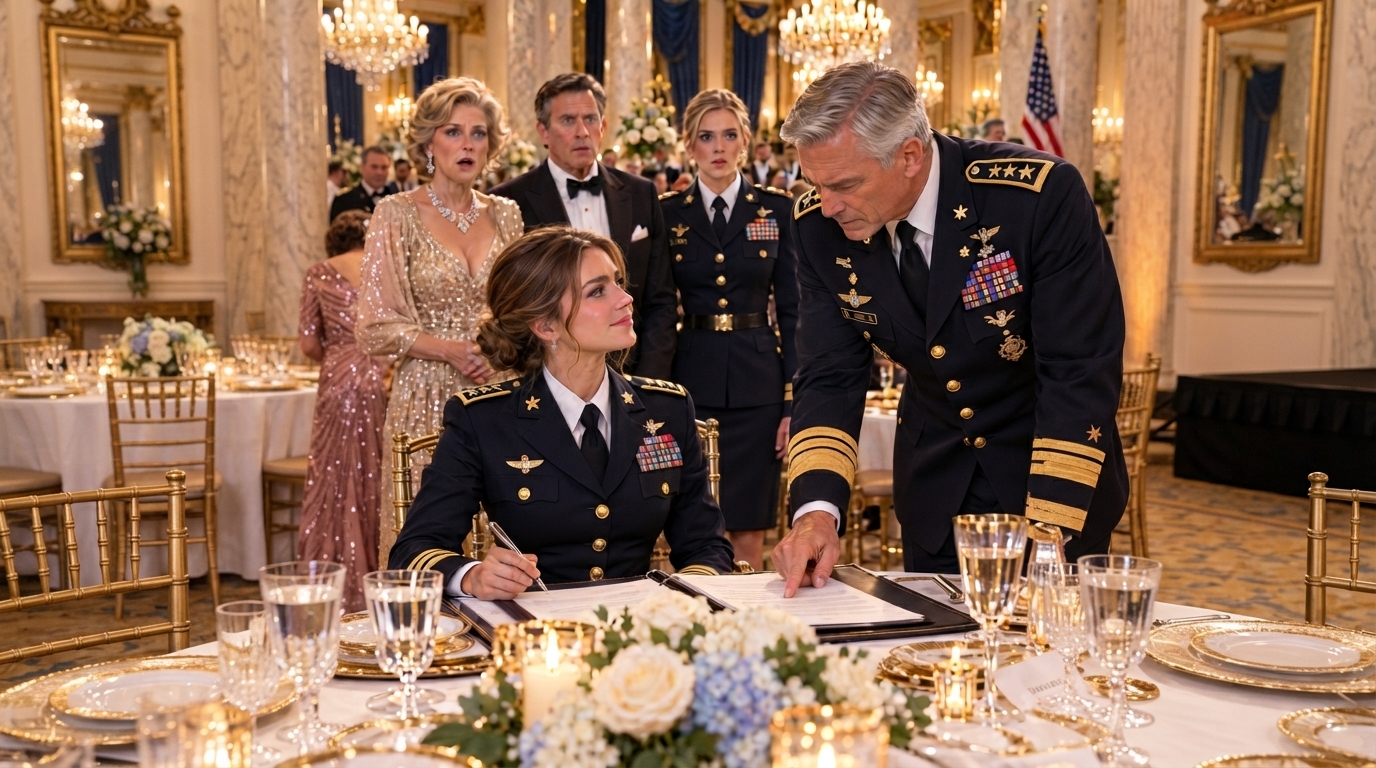
PART 3
For several seconds, nobody moved.
The ballroom that had been filled with laughter,
champagne, and congratulations
was suddenly so quiet that I could hear the faint hum of
the air-conditioning above the chandeliers.
General Harrison stood beside the stage,
holding the folder containing my sister’s promotion records.
My mother still had her fingers wrapped around my arm.
“Megan,” she whispered urgently,
“whatever this is, we can discuss it privately.”
I looked at her hand.
“Then please let go of me.”
She released my arm immediately.
My father stepped forward, his expression strained.
General, I’m sure there’s been some misunderstanding.
Emily has worked incredibly hard for this promotion.
General Harrison nodded.
“Major Whitlock’s promotion is not the issue, Mr. Whitlock.”
Emily exhaled.
For one brief moment, relief crossed her face.
Then the general continued.
“The issue concerns documents submitted in support of a separate leadership recognition package. Those documents contain representations that appear to be false.”
Emily’s relief disappeared.
“I don’t understand,” she said.
Neither did most of the guests.
But I did.
And that was what made the next few minutes so painful.
I had spent eleven years working in federal defense personnel oversight, moving through positions that my parents never bothered to understand.
I started as an analyst.
Then became a compliance supervisor.
Eventually, I was appointed civilian director of a specialized personnel-integrity program responsible for reviewing sensitive administrative actions, identifying irregularities, and referring suspected misconduct for independent investigation.
My work wasn’t glamorous.
I didn’t wear a uniform.
I didn’t appear in recruitment advertisements.
And I rarely discussed my responsibilities outside the office.
But the people who worked with me knew exactly what I did.
General Harrison was one of them.
He turned toward Emily.
“Major, did you personally prepare the three recommendation letters submitted last month?”
Emily shook her head.
“No, sir. My commanding officer told me the award package was being handled through administrative channels.”
“Did you review the completed submission?”
“I saw a summary.”
“Did you authorize anyone to include claims that you supervised classified operations?”
Emily’s eyes widened.
“No, sir.”
I watched her carefully.
She looked genuinely frightened.
And despite everything that had happened between us, I hoped she was telling the truth.
Because Emily could be arrogant.
She could be cruel.
She could enjoy being our parents’ favorite.
But I had never wanted her career destroyed.
General Harrison turned another page.
“Then we need to determine who submitted those claims.”
My mother cleared her throat.
“Surely this isn’t appropriate for a celebration.”
The general looked at her.
“Ma’am, I agree that this is not an appropriate venue for a personnel investigation. The administrative questions will be handled privately.”
Then he glanced toward the folder.
“However, I understand several people here have been publicly representing this award as already approved. That representation needs to stop.”
My mother went pale.
Because she’d been doing exactly that all evening.
She had introduced Emily to a state senator as the recipient of a prestigious national defense leadership honor.
She had told several guests that Emily was being considered for a position at the Pentagon.
And she had arranged for a large banner behind the stage.
MAJOR EMILY WHITLOCK — HONORING EXCELLENCE IN MILITARY LEADERSHIP.
The promotion itself was legitimate.
But the award my mother had been bragging about was still under review.
And now the supporting documents had raised serious concerns.
General Harrison closed the folder.
“Director Whitlock, may I speak with you and Major Whitlock privately?”
“Yes, sir.”
Emily looked at me.
For the first time that evening, there was no superiority in her expression.
Only confusion.
And fear.
We entered a small conference room behind the ballroom.
General Harrison’s aide closed the door.
Emily stood beside the table, twisting the edge of her uniform jacket between her fingers.
“General, I swear I didn’t falsify anything.”
Harrison nodded.
“Then the evidence should help establish that.”
He turned toward me.
“Director, explain what your team found.”
I opened the folder.
“Three letters were uploaded through an external submission portal associated with the recognition package. All three appeared to come from senior officials.”
Emily nodded.
“I was told those officials had agreed to support me.”
I continued.
“The problem is that two signatures do not match the officials’ verified records. The third official confirmed that he never wrote the letter attributed to him.”
Emily covered her mouth.
I turned another page.
“The letters also describe assignments you never held.”
She stared at me.
“What assignments?”
I hesitated.
Then answered carefully.
“Positions involving sensitive planning work. The claims were not supported by your personnel record.”
Emily shook her head.
“I never told anyone I’d done that.”
“I believe that’s possible,” I said.
She looked up sharply.
“You do?”
I nodded.
“That’s why the investigation matters.”
General Harrison folded his hands.
“Who had access to the submission account?”
I glanced at the report.
“Several authorized administrative personnel. But the questionable documents were uploaded using credentials assigned to a civilian event consultant.”
Emily frowned.
“An event consultant?”
I looked at her.
Then at the general.
“The consultant’s name is Patricia Whitlock.”
Emily stopped breathing.
Our mother.
For a moment, the room seemed to tilt.
“No,” Emily whispered.
I placed the record on the table.
“The submission originated from an account created using our mother’s business email address.”
Emily stared at the page.
Then shook her head.
“She wouldn’t know how to do something like that.”
I swallowed.
“She wouldn’t necessarily need to.”
General Harrison nodded.
“Someone may have assisted her. The account information is one lead, not a final determination.”
Emily sank into a chair.
“She told me she was helping with the celebration.”
I looked at my sister.
“What exactly did she say?”
Emily’s voice trembled.
“She said she knew people who could help make sure my accomplishments received proper attention.”
I closed my eyes.
Of course.
Our mother had spent our entire childhood arranging opportunities for Emily.
Extra tutoring.
Private coaching.
Expensive summer programs.
Introductions to influential family friends.
She had never been satisfied with Emily simply succeeding.
Emily had to be extraordinary.
And everyone had to know it.
When I received a scholarship to college, my mother barely acknowledged it.
When Emily won a regional debate competition, she hosted a dinner for thirty people.
When I accepted my first federal position, she asked whether I planned to find a better-paying job.
When Emily received her first military commission, my parents rented an entire restaurant.
I had learned to stop expecting fairness.
But I never imagined our mother’s obsession with appearances might place Emily’s career at risk.
Emily stared at me.
“Did you know it was Mom when you signed the review?”
I shook my head.
“I authorized the completed compliance assessment for release. The account details were confirmed afterward.”
She swallowed.
“And you didn’t call me?”
“The findings were referred through the proper channels. I couldn’t discuss an active review with you privately.”
Emily looked down.
For the first time, she seemed to understand that my job involved responsibilities beyond our family.
General Harrison stood.
“Major Whitlock, you will be contacted by the appropriate officials. Your promotion remains effective, but the award package is on hold pending review.”
Emily nodded.
“Yes, sir.”
He turned toward me.
“Director, thank you.”
Then he paused.
“And for what it’s worth, the work your team has done over the last eighteen months has been exceptional.”
I felt my throat tighten.
“Thank you, General.”
Emily looked between us.
Something changed in her expression.
Not jealousy.
Not embarrassment.
Recognition.
For the first time, she was seeing the professional life I’d built while our family had been busy dismissing it.
When we returned to the ballroom, my mother rushed toward Emily.
“Darling, what happened?”
Emily stepped away from her.
“Mom, did you submit recommendation letters for me?”
My mother’s expression froze.
“What?”
“Did you?”
Our father appeared beside her.
“Emily, lower your voice.”
But Emily didn’t.
“Mom, answer me.”
My mother looked toward me.
And there it was.
The familiar accusation.
The look that said I had somehow ruined everything.
“Megan,” she snapped, “what have you been telling people?”
I stared at her.
“The truth.”
She laughed bitterly.
“You’ve always been jealous of your sister.”
I felt the old wound open.
But this time, I didn’t retreat.
“Mom, Emily earned her promotion. Nobody is taking that away from her.”
My mother’s mouth tightened.
“But someone submitted false documents in support of another recognition package. That needs to be investigated.”
She looked around.
Several guests were watching.
Her cheeks reddened.
“Do you have any idea how embarrassing this is?”
I stared at her.
And suddenly, eleven years of swallowed humiliation rose inside me.
“You’re embarrassed?”
She blinked.
I continued.
“You told me to stand beside the service hallway tonight because you didn’t want important people hearing about my job.”
My father’s face changed.
“Megan, that’s enough.”
“No, Dad.”
The words came out more firmly than I expected.
“For years, you’ve introduced me as the daughter who pushes paperwork while Emily does meaningful work.”
My mother crossed her arms.
“Well, you never explain what you do.”
“Because you never ask.”
Silence.
I looked at my father.
“Do you know where my office is?”
He opened his mouth.
Then closed it.
“Do you know what division I oversee?”
He looked away.
I turned toward my mother.
“Do you even know my job title?”
She stared at me.
For the first time in my life, neither parent had an answer.
Emily stood beside us, completely still.
Then she whispered, “Megan, I didn’t know.”
I looked at her.
“I know.”
And somehow, that hurt more than anything else.
Because I had attended her commissioning ceremony.
I had sent flowers when she completed training.
I had celebrated every promotion.
But she had never once asked what I did.
My mother suddenly reached for my hand.
“Sweetheart, don’t make a scene.”
I stepped back.
“You’ve spent the entire evening telling everyone I’m a disappointment.”
Her eyes widened.
“I never said that.”
I looked directly at her.
“You didn’t have to.”
I left the ballroom before dessert.
The string quartet had started playing again.
People were pretending not to stare.
And behind me, my mother was already trying to explain away the evening.
I walked through the hotel lobby and stepped outside.
The humid South Carolina air wrapped around me.
For a moment, I stood beside my car, breathing slowly.
Then I heard footsteps.
“Megan.”
I turned.
Emily was standing behind me.
She had removed her uniform jacket and was carrying it over one arm.
Her eyes were red.
“Can we talk?”
I hesitated.
Then nodded.
She came closer.
“I didn’t know Mom had done any of that.”
“I believe you.”
She swallowed.
“But I knew how she treated you.”
I said nothing.
Emily looked down.
“I knew she made you sit at the back tables.”
My throat tightened.
“I knew she called your job boring.”
She wiped her eyes.
“And I never said anything.”
I looked away.
Emily’s voice broke.
“I liked being the successful one.”
There it was.
The truth I’d waited years to hear.
She continued.
“Every time Mom compared us, I felt important. I told myself you didn’t care.”
I stared at her.
“I cared, Emily.”
She began crying.
“I know that now.”
I looked toward the ballroom windows.
“Do you know what hurt the most?”
She shook her head.
“I was proud of you.”
Her face crumpled.
“I really was.”
I swallowed.
“But you never seemed proud of me.”
Emily covered her mouth.
Then whispered, “I’m sorry.”
For a moment, I wanted to hug her.
To pretend the apology erased everything.
But some wounds need more than one conversation.
I nodded.
“Thank you.”
She looked at me.
“Can we fix this?”
I took a breath.
“I don’t know.”
Her eyes filled again.
“But maybe we can start by telling each other the truth.”
She nodded.
And for the first time in years, we stood together without competing for our parents’ approval.
Then Emily’s phone rang.
She looked at the screen.
Her expression changed.
“It’s Mom.”
I nodded.
“Answer it.”
Emily hesitated.
Then put the call on speaker.
Our mother’s voice came through immediately.
“Emily, sweetheart, I need you to listen carefully. Whatever Megan told that general, you must deny knowing anything about the letters.”
Emily went pale.
“Mom?”
Our mother continued.
“And don’t mention the consultant I hired to prepare the documents. He assured me everything would look official.”
I closed my eyes.
Emily stared at the phone.
Then whispered the question that changed everything.
“Mom, what exactly did you pay that man to do?”
PART 4
There was silence on the phone.
Then our mother laughed nervously.
“Emily, don’t be dramatic.”
My sister’s expression hardened.
“What did you pay him to do?”
“Sweetheart, I was only trying to help.”
“Help me how?”
Our mother sighed.
“You know how competitive these military honors are. I wanted people to understand how exceptional you are.”
Emily closed her eyes.
“Mom, did you have someone forge recommendation letters?”
“Don’t use that word.”
I watched Emily’s face change.
She looked as though she had just discovered that the person she’d trusted most had been quietly undermining her.
“Mom.”
Our mother’s voice sharpened.
“I spent twenty thousand dollars making sure your accomplishments were presented properly. Do you have any idea how many connections I had to call?”
Emily stepped backward.
“Twenty thousand dollars?”
“Yes, and I would do it again for you.”
My sister began crying.
“You could destroy my career.”
Our mother scoffed.
“Don’t be ridiculous. Your father knows people.”
Emily looked at me.
I said nothing.
Then she spoke with a steadiness I had never heard from her before.
“Mom, I need you to stop contacting anyone about my promotion or awards.”
Our mother gasped.
“After everything I’ve done for you?”
Emily wiped her cheeks.
“Yes.”
“Emily!”
“And I need you to preserve every message, invoice, and document related to those letters. I’m going to cooperate with the investigation.”
Our mother began protesting.
Emily ended the call.
For several seconds, she stared at the dark screen.
Then she sat down on a stone bench outside the hotel.
“I can’t believe she did this.”
I sat beside her.
“She wanted you to look successful.”
Emily shook her head.
“I was successful.”
Her voice cracked.
“I worked for this promotion.”
“I know.”
“I passed every evaluation. I completed every assignment. I spent months away from home.”
“I know, Emily.”
She turned toward me.
“And now people might think I cheated my way into everything.”
I looked at her.
“Then cooperate fully. Let the evidence establish what happened.”
She nodded.
Then whispered, “Will you help me?”
I took a breath.
“I can’t intervene in the investigation.”
She looked down.
“But I can be your sister.”
Emily began crying again.
And this time, I put my arm around her.
The investigation continued over the following months.
Emily cooperated.
She provided emails, messages, and records of her communications with our mother.
The civilian consultant was interviewed.
The submission history was examined.
And the officials whose names had appeared on the questionable letters confirmed that they had not authorized the documents.
The investigation eventually established that our mother had hired the consultant to prepare and submit an inflated award package.
She had supplied biographical details about Emily, exaggerated several assignments, and approved the final documents without obtaining the supposed signatories’ permission.
The consultant had created the false letters.
Our mother had paid him.
Emily had not requested the false claims, and the evidence did not show that she knew about them before the review.
Her promotion remained intact.
The separate award package was withdrawn.
The consultant faced professional consequences and legal scrutiny over his conduct.
Our mother was referred for further review regarding her involvement.
But the most painful consequences weren’t professional.
They were personal.
For the first time, Emily had to confront the difference between being loved and being displayed.
Our mother had treated her like a trophy.
Every accomplishment had to become a family announcement.
Every promotion had to become a social event.
Every achievement had to be bigger than the last.
And when Emily’s real success wasn’t enough to impress everyone our mother wanted to impress, she had tried to manufacture more.
I watched my sister struggle with that realization.
One evening, she called me.
“Megan?”
“Hey.”
She hesitated.
“Can I ask you something?”
“Of course.”
“Did Mom ever celebrate anything you did?”
I stared at the wall.
There were so many answers.
My college graduation.
My first federal appointment.
My promotion to supervisor.
The day I received a distinguished civilian service award.
The afternoon I was selected to lead my current program.
I had invited my parents to several ceremonies.
They attended one.
My mother spent most of it complaining about the parking.
“No,” I answered quietly.
Emily went silent.
Then whispered, “I’m sorry.”
I closed my eyes.
“I know.”
She took a shaky breath.
“I’ve been thinking about all the times you came to my ceremonies.”
I smiled sadly.
“I was proud of you.”
“I know.”
Her voice broke.
“And I never came to yours.”
I swallowed.
“You were busy.”
“No, Megan.”
She began crying.
“I wasn’t always busy. Sometimes I just didn’t think it mattered.”
The honesty hurt.
But I appreciated it.
“Thank you for telling me.”
She sniffed.
“I want to do better.”
I looked toward the framed photograph on my desk.
It showed my team standing together after completing a major review.
People who respected me.
People who trusted my judgment.
People who knew the value of my work.
“You can start by getting to know me,” I said.
Emily laughed through tears.
“I’d like that.”
Three weeks later, my father came to my apartment.
He called first.
That alone was unusual.
My parents had always assumed they could arrive whenever they wanted.
When I opened the door, he stood holding a small paper bag.
“Hi, Megan.”
“Hi, Dad.”
He looked uncomfortable.
“May I come in?”
I stepped aside.
He entered and looked around.
My apartment wasn’t enormous.
It wasn’t decorated with expensive furniture.
But it was mine.
The bookshelves were filled with history books, policy journals, and photographs from trips I’d taken with friends.
My work awards hung along one wall.
My father stopped in front of them.
I watched him read the plaques.
He leaned closer to one.
“Director of the Year?”
I nodded.
“Three years ago.”
He looked at another.
“Distinguished Civilian Service Recognition?”
“Five years ago.”
He stared at the wall.
Then turned toward me.
“Megan, why didn’t you tell us?”
I felt something inside me tighten.
“I did.”
He blinked.
“What?”
“I told you when I received both.”
He looked confused.
I continued.
“When I received the director award, I called you and Mom. You said you were busy planning Emily’s promotion dinner.”
His face changed.
“And when I received the service recognition, I invited you to the ceremony.”
He looked down.
“Mom said it was just an office thing.”
I nodded.
“You believed her.”
He sat on the couch.
For several seconds, he said nothing.
Then he opened the paper bag.
Inside was a small framed photograph.
It showed me at twenty-two, standing in my graduation gown.
My parents were on either side of me.
I remembered that day.
Emily had received an acceptance letter for an elite military training opportunity that same morning.
My mother spent most of my graduation lunch talking about it.
In the photograph, I was smiling.
But I remembered how lonely I’d felt.
My father handed it to me.
“I found this in the attic.”
I looked at him.
He swallowed.
“I realized I couldn’t remember what degree you graduated with.”
My eyes filled.
“Public administration, Dad. With honors.”
He nodded slowly.
“I looked it up.”
I stared at him.
He continued.
“And then I looked up your work.”
I felt my chest tighten.
“I don’t mean classified things,” he added quickly. “Just the public information.”
I nodded.
He looked at me.
“I had no idea how much responsibility you carry.”
I swallowed.
“Dad, I never hid it.”
“I know.”
His eyes filled.
“I just never listened.”
For years, I had imagined what it would feel like to hear my father admit that.
I thought I’d feel victorious.
Instead, I felt exhausted.
Because the truth was simple.
He could have known me all along.
All he had needed to do was ask.
My mother didn’t apologize.
Not at first.
She called me several times, but every conversation began with a complaint.
“You embarrassed us.”
“You made Emily look terrible.”
“You could have handled everything privately.”
Eventually, I stopped answering.
Then she sent a long email.
It explained how much pressure she’d been under.
How difficult it was to raise two daughters with different personalities.
How she’d only wanted Emily to succeed.
And how unfair it was that everyone blamed her for trying to help.
There was one sentence about me.
I suppose I could have been more supportive of your career.
I read it twice.
Then closed the email.
For years, I had accepted crumbs of affection because I was afraid asking for more would make me seem ungrateful.
I wasn’t doing that anymore.
I wrote back three sentences.
Mom, I am willing to have an honest conversation when you’re ready to acknowledge what happened without blaming me or Emily.
Until then, I need some distance.
I hope you take care of yourself.
Then I sent it.
And for the first time in my life, I didn’t feel guilty.
Six months after the party, I received an invitation to speak at a professional leadership conference in Washington.
The audience included civilian defense employees, military officers, and agency leaders.
My presentation focused on integrity in personnel systems and the importance of independent oversight.
It was the kind of event I had attended for years.
Nothing glamorous.
Nothing designed for family photographs.
But this time, someone asked whether she could attend.
Emily.
I hesitated when she called.
“Are you sure?”
She laughed.
“Why wouldn’t I be?”
“It’s a long presentation.”
“I’ve sat through longer briefings.”
I smiled.
“Fair point.”
Then she said something that made my throat tighten.
“I want to see you do your job.”
I looked down at my desk.
“Okay.”
She arrived early.
She wore civilian clothes and sat in the third row.
When I walked onto the stage, I saw her smiling.
For the first time in my professional life, someone from my family had come simply to support me.
Not because there would be photographers.
Not because wealthy guests would attend.
Not because my success could improve the family’s social standing.
But because she wanted to be there.
Afterward, she waited while several attendees approached to ask questions.
When the room finally emptied, she walked toward me.
Her eyes were shining.
“Megan.”
I smiled.
“What?”
She shook her head.
“You were incredible.”
I laughed.
“It was a policy presentation.”
“I know.”
She stepped closer.
“But you made everyone listen.”
I looked at her.
She continued.
“You know what I realized?”
“What?”
“I’ve spent years thinking leadership meant being the person everyone notices.”
She glanced toward the empty stage.
“But you lead people who do work most of the public will never hear about.”
I swallowed.
“And you don’t seem to need applause.”
I smiled faintly.
“Everyone likes being appreciated, Emily.”
She nodded.
“I know.”
Then she hugged me.
And whispered, “I’m proud of you.”
For a moment, I couldn’t move.
Those were the words I’d spent most of my life waiting to hear from my family.
And somehow, hearing them from my sister meant more than I’d expected.
The following year, Emily invited me to dinner.
Just the two of us.
No photographers.
No expensive ballroom.
No politicians.
No speeches.
We met at a small Italian restaurant near her duty station.
She arrived wearing jeans and a sweater.
I almost didn’t recognize her without the perfectly polished image our mother had always demanded.
We ordered pasta.
We laughed about childhood memories.
And for the first time in years, we talked like sisters instead of competitors.
Halfway through dinner, Emily grew quiet.
“Megan, can I ask you something?”
“Sure.”
“Were you ever jealous of me?”
I thought carefully.
“Yes.”
She looked down.
I continued.
“But not because of your career.”
She looked up.
“I was jealous because Mom and Dad seemed to love your accomplishments more than they loved me.”
Her eyes filled.
“I know.”
I shook my head.
“No, Emily. I don’t think you understood how much it hurt.”
She wiped her cheeks.
“I’m starting to.”
I reached across the table.
“I never wanted you to fail.”
She squeezed my hand.
“I know that now.”
Then she smiled sadly.
“I think Mom convinced us there was only room for one successful daughter.”
I looked at her.
“And you believed her.”
Emily nodded.
“I did.”
I took a breath.
“Well, she was wrong.”
Emily smiled through tears.
“Yeah.”
She squeezed my hand again.
“She really was.”
My mother eventually began counseling.
I learned about it through my father.
At first, I didn’t know what to think.
Then, several months later, she called.
Her voice sounded different.
Less certain.
Less polished.
“Megan?”
“Hi, Mom.”
She hesitated.
“Do you have a few minutes?”
I sat down.
“Yes.”
For a moment, neither of us spoke.
Then she said, “I’ve been thinking about your graduation.”
My chest tightened.
She continued.
“I remember spending the entire lunch talking about Emily.”
I closed my eyes.
“Yes.”
“I remember you trying to tell me about a professor who recommended you for a fellowship.”
I swallowed.
“You told me we’d talk about it later.”
Her voice broke.
“And we never did.”
I stared at the floor.
“No.”
She began crying.
“Megan, I owe you an apology.”
I said nothing.
She continued.
“I treated Emily’s achievements as proof that I was a successful mother.”
Her breathing shook.
“And when you chose a career I didn’t understand, I acted as though it was less important.”
Tears filled my eyes.
She paused.
“I made you feel invisible.”
I wiped my cheek.
“Yes, Mom.”
Her voice broke.
“I am so sorry.”
For the first time, she didn’t add an excuse.
She didn’t blame my sister.
She didn’t mention embarrassment.
She didn’t explain how hard she’d worked as a mother.
She simply apologized.
I took a breath.
“Thank you.”
She began crying harder.
“Can you forgive me?”
I looked toward the window.
Outside, the evening sky was turning pink.
“I want us to have a better relationship,” I said.
She sniffed.
“So do I.”
“But it will take time.”
“I understand.”
“And I need you to respect my work even when you don’t understand every detail.”
She nodded, though she couldn’t see me.
“I will.”
I paused.
“Then we can start there.”
Two years after the night at Sea Pines Grand Club, I attended another military celebration.
This one was smaller.
A formal recognition ceremony honoring officers and civilian employees for their service.
Emily had invited me.
I arrived in a navy-blue dress and sat near the front.
My parents were there too.
But something had changed.
My mother didn’t tell me where to sit.
My father didn’t ask me to keep quiet.
And Emily didn’t act as though the evening belonged entirely to her.
During the reception, a young lieutenant approached our table.
“Major Whitlock,” he said to Emily, “congratulations.”
Emily smiled.
“Thank you.”
Then she turned toward me.
“Have you met my sister?”
The lieutenant shook his head.
Emily smiled proudly.
“This is Megan Whitlock. She’s a civilian director in defense personnel oversight.”
I felt my throat tighten.
Emily continued.
“She leads work that helps protect the integrity of our personnel systems.”
The lieutenant looked impressed.
“It’s an honor to meet you, ma’am.”
I shook his hand.
“Likewise.”
Then Emily added something I never expected.
“She taught me more about integrity than anyone else.”
I looked at her.
Her eyes filled.
And for the first time, I didn’t feel like the forgotten daughter standing in someone else’s shadow.
I felt like myself.
That was enough.
People sometimes ask whether I enjoyed what happened at Emily’s promotion party.
The truth is complicated.
A part of me will always remember the shock on my mother’s face when General Harrison recognized me.
I’ll remember my father’s silence.
I’ll remember the way Emily looked at me when she realized I wasn’t simply the sister who handled paperwork.
But I don’t celebrate the embarrassment.
I celebrate what came afterward.
The truth.
The accountability.
The conversations we’d avoided for years.
And the realization that our family had been measuring success with the wrong ruler.
Emily was a talented officer.
Her promotion was real.
Her dedication was real.
And she deserved to be proud of what she’d earned.
But my accomplishments were real too.
I had spent years building a career that required judgment, discipline, and responsibility.
I didn’t need gold oak leaves on my shoulders to prove I mattered.
I didn’t need a ballroom full of wealthy guests.
And I certainly didn’t need my parents to announce that I was successful before I could believe it myself.
The night General Harrison walked into that ballroom, everyone thought he was there to celebrate my sister.
Instead, one question changed the evening.
“Who signed this authorization this morning?”
My parents had spent years assuming that the daughter who wore a uniform was important and the daughter who worked behind a desk was not.
They never imagined that the quiet woman standing near the service hallway might be the person entrusted with reviewing decisions that affected careers across the defense establishment.
But that was the lesson I took from that night.
Never confuse visibility with value.
Some people lead from a stage.
Some lead in uniform.
Some lead behind closed doors, making difficult decisions nobody applauds.
And sometimes the person a family dismisses as ordinary is the one who has spent years doing extraordinary work without asking anyone to notice.
I still have the photograph from Emily’s promotion party.
It shows her standing beneath the chandeliers, smiling beside our parents.
I’m barely visible in the background.
Just a woman in a dark blazer near the ballroom entrance.
For years, a photograph like that would have hurt me.
Now, when I look at it, I smile.
Because I know something the camera didn’t capture.
I wasn’t standing in the shadows because I had failed.
I was standing there because I’d finally stopped needing the spotlight to know my own worth.
THE END THANK YOU FOR READING !!!