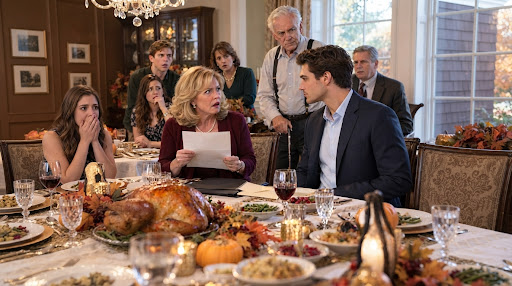
PART 3
For three full seconds, nobody said anything.
Then Ryan laughed.
It was short and uncertain,
the kind of laugh people use when they’re
waiting for someone else to
confirm that something is a joke.
Nobody did.
Diane’s smile disappeared.
“What does that mean?” she asked.
I picked up my drink.
“It means what I said.”
Ryan finally looked at me.
“You work for Nexra?”
“Not exactly.”
Diane folded her arms.
“Then you didn’t sign anything.”
There it was.
The certainty.
The same certainty she’d carried for years
whenever she explained my own life to me.
I could have corrected her immediately.
Instead, I looked at Ryan.
Did you read the name of the parent
company on your employment paperwork?
His expression changed.
Just slightly.
But I saw it.
Ryan had always been smarter than Diane gave him credit for.
He pulled out his phone.
Diane noticed.
“Ryan, what are you doing?”
He didn’t answer.
He searched something, stared at the screen, then looked at me again.
“No way.”
“What?” Diane demanded.
Ryan swallowed.
“Nexra was acquired six months ago.”
“I know that.”
“By Northstar Systems.”
Diane shrugged.
“So?”
Ryan turned the phone toward her.
She read whatever was on the screen.
Her eyebrows tightened.
Then she looked at me.
I didn’t say anything.
Grandpa, sitting at the end of the picnic table, suddenly started laughing.
Not loudly.
Just a quiet chuckle into his coffee.
Diane heard him.
“What’s funny?”
Grandpa shook his head.
“Nothing.”
But it clearly wasn’t nothing.
Ryan stood.
“Josh, are you with Northstar?”
“I am.”
“What do you do there?”
Before I could answer, Claire spoke.
“Wait.”
She was staring at her phone now too.
“Josh Mercer?”
I nodded.
Her eyes widened.
Mom leaned toward her.
“What?”
Claire slowly lowered the phone.
“There’s an article.”
I knew exactly which one.
I wished she hadn’t found it.
Not because I was ashamed.
Because I’d spent years keeping that part of my life separate from them.
Claire read the headline.
“Northstar acquires infrastructure startup VelaGrid in $12.8 million deal.”
The backyard became very quiet again.
My father took off his glasses.
Diane stared at me.
Ryan sat back down.
Claire kept reading.
“Founder Josh Mercer will join Northstar as director of strategic acquisitions and infrastructure integration.”
Mom’s face changed.
Not pride.
Not yet.
Mostly confusion.
“You founded that company?”
“Yes.”
“The little business?”
I almost laughed.
Instead, I nodded.
“That little business.”
Dad cleared his throat.
“How much did you make?”
Of course.
Not how did you build it?
Not how long did it take?
Not are you happy?
How much?
“Enough.”
Diane scoffed.
“Oh, come on. These acquisition numbers are always exaggerated.”
Ryan turned toward her.
“Mom.”
“What?”
“It literally says twelve-point-eight million.”
“That doesn’t mean Josh received twelve million.”
“She’s right,” I said.
Diane looked almost triumphant.
“I knew it.”
“I didn’t receive twelve million.”
Her smile returned.
“For once, Josh is being honest.”
“I received less than that after investors, employee equity, taxes, and deal expenses.”
The smile disappeared again.
Grandpa laughed harder.
Ryan rubbed his forehead.
I almost felt bad for him.
Almost.
Because none of this was Ryan’s fault.
He had gotten a good job.
He deserved to be proud.
The problem was that Diane had spent the afternoon using his accomplishment as a weapon.
So I turned toward him.
“Ryan, congratulations.”
He looked surprised.
“I mean it. Nexra has good people. You earned your position.”
“Thanks.”
“And for the record, I didn’t hire you.”
Diane immediately jumped in.
“Then you didn’t sign his paycheck.”
“I approved the payroll authorization for the division last week.”
Ryan gave a reluctant smile.
“So technically…”
“Technically.”
He laughed.
This time I laughed too.
The tension should have ended there.
It could have.
But Diane couldn’t let it go.
“So you came here knowing all this and waited for us to praise Ryan just so you could humiliate him?”
“No.”
“Sure looks that way.”
“I came because Grandma invited me.”
Grandma quietly nodded.
Diane ignored her.
“You always do this.”
I stared at her.
“Do what?”
“Make everything about you.”
That nearly impressed me.
For the last two hours, she had compared me to her son in front of everyone.
Now I was apparently the one making comparisons.
I stood.
“I’m going to get another drink.”
As I passed Grandpa, he caught my wrist.
His grip was surprisingly strong.
“Sit with me before you leave.”
I looked at him.
There was something in his expression I couldn’t read.
“Okay.”
An hour later, people started heading home.
Grandpa was waiting on the front porch.
He motioned toward the chair beside him.
I sat.
For a while, neither of us spoke.
Then he said, “I owe you an apology.”
That was not what I expected.
“For what?”
“For believing them.”
I looked at him.
He stared toward the road.
“Your mother used to tell me you were drifting. Your father said you refused to grow up. Diane said you were jealous of Ryan and Claire.”
I felt something tighten in my chest.
Grandpa continued.
“I believed some of it.”
“Why?”
“Because you never defended yourself.”
I looked down.
“I got tired.”
“I know.”
“No, Grandpa. I mean I got tired of explaining myself to people who had already decided what I was.”
He nodded slowly.
“That’s what I understand now.”
I expected advice.
Instead, he asked a question.
“How bad did it get?”
I knew what he meant.
The company.
The years before the acquisition.
“Pretty bad.”
“How bad?”
I hesitated.
“There was a month when I had eleven dollars in my checking account.”
He looked at me.
“I was sleeping in the office sometimes because I’d rented out my apartment room to save money.”
His jaw tightened.
“Did your parents know?”
“No.”
“Why not?”
“Because Dad would have said, ‘I told you so.’”
Grandpa looked away.
For the first time, I saw anger in his face.
Not at me.
At them.
“I should’ve asked.”
“You didn’t know.”
“I should’ve asked anyway.”
Then he stood carefully.
“Come see me next Saturday.”
“Why?”
“I want to show you something.”
That Saturday, I drove to his blue house outside town.
Grandpa was waiting.
He led me straight into his study.
I’d been inside that room hundreds of times growing up, but there was one cabinet behind his desk that had always remained locked.
He took a brass key from his pocket.
The lock clicked.
Inside were decades of documents.
Property deeds.
Bank statements.
Insurance policies.
Old contracts.
Family records.
Grandpa pulled out a thick manila folder.
He put it in front of me.
“Read.”
The first document was the deed to the lake house.
I knew that place better than almost anywhere on earth.
Summer mornings fishing off the dock.
Christmases when the snow came early.
Grandma teaching Claire and me how to play cards beside the fireplace.
Ryan breaking his arm jumping from the boathouse roof.
The lake house was practically family mythology.
Then I saw the transfer paperwork.
My name was on it.
I looked up.
“What is this?”
“Exactly what it looks like.”
“You’re giving me the lake house?”
“Already did.”
I stared at him.
“Grandpa, no.”
His eyebrows lifted.
“No?”
“It belongs to everyone.”
“No. It belongs to me.”
He tapped the document.
“Or it did.”
I pushed the folder toward him.
“I don’t want the family thinking I took this from you.”
“Then they can think whatever they want.”
“That’s easy for you to say.”
“No,” he replied. “It’s easy for me to say because I spent eighty-four years learning that people will think whatever suits them regardless of what you do.”
I sat back.
“There’s more,” he said.
There was.
Investment accounts.
A small commercial property.
A trust.
And finally, documents naming me executor of his estate.
I stared at the pages.
“Why me?”
Grandpa lowered himself into the chair opposite mine.
“Because I watched you.”
“What does that mean?”
“I watched how they treated you when they thought you had nothing.”
He paused.
“Then I watched how you treated them after you had something.”
I didn’t respond.
“You could have destroyed Ryan at that reunion.”
“I didn’t want to.”
“I know.”
“He didn’t do anything.”
“Exactly.”
Grandpa leaned forward.
“Character is what you do when revenge would be easy.”
I looked back at the papers.
“You should tell everyone.”
“I will.”
“When?”
“When I’m ready.”
That should have been the end of it.
But three weeks later, Diane found out about the lake house.
And everything exploded.
PART 4
It started with a phone call from my mother.
“Did Grandpa give you the lake house?”
No hello.
No how are you.
Just that.
I was sitting in my office when she called.
“Who told you?”
“So it’s true?”
“Mom.”
“Josh, answer me.”
“Yes.”
Silence.
Then she exhaled.
“Oh my God.”
“What?”
“That house is supposed to stay in the family.”
“It is staying in the family.”
“You know what I mean.”
Actually, I did.
She meant shared ownership.
Shared vacations.
Shared decisions.
Shared inheritance.
Shared, apparently, until Grandpa chose otherwise.
“Grandpa made the decision.”
“Did you ask him?”
“No.”
“Did you hint?”
“No.”
“Did you tell him about the way Diane treated you?”
“He was there.”
Another silence.
Then Mom lowered her voice.
“Your aunt is furious.”
“That sounds like her problem.”
“Josh.”
“What do you want me to do?”
“Give it back.”
I actually pulled the phone away from my ear.
“What?”
“Transfer it back to Grandpa.”
“No.”
“Why not?”
“Because he asked me not to.”
“You’re choosing property over your family.”
That sentence made something inside me go cold.
For years, they had chosen pride over me.
Appearances over me.
Comparisons over me.
But now that property was involved, suddenly family unity mattered.
“I have to go.”
“Josh—”
I ended the call.
That evening, Ryan texted me.
Sorry about Mom.
I stared at the message for a while before replying.
Not your fault.
Three dots appeared.
Then:
For what it’s worth, I didn’t know Grandpa was doing any of this.
I wrote:
I know.
Another message came.
And I don’t want the lake house.
That surprised me.
I called him.
He answered immediately.
“You serious?”
“Completely.”
“You know your mother probably expects you to fight me for it.”
“I’m twenty-eight, Josh. Mom doesn’t get to decide what I fight about.”
I smiled.
“Fair.”
He sighed.
“She’s been calling everybody.”
“About me?”
“About Grandpa. She says you’ve manipulated him.”
There it was.
The accusation.
I should have been angry.
Instead, I felt tired.
“Does she believe that?”
Ryan hesitated.
“I think she believes whatever lets her avoid admitting Grandpa made a decision she hates.”
That was probably the smartest thing anyone had said about Diane.
“Thanks for telling me.”
“There’s something else.”
“What?”
“She’s talking about challenging the estate.”
I sat straighter.
“He’s alive.”
“I know.”
“She realizes that, right?”
“I’m not defending the logic.”
I laughed despite myself.
Then Ryan’s voice became serious.
“She thinks Grandpa isn’t competent.”
That erased the smile.
“What?”
“She said he’s old and confused.”
Grandpa could recite the closing prices of stocks he’d bought forty years ago.
He did crossword puzzles in ink.
He remembered birthdays better than anyone in the family.
The idea that Diane would question his mind because she disliked his decision made my stomach turn.
“Did she say that to him?”
“Not yet.”
“Good.”
“Josh.”
“Yeah?”
“She’s planning some kind of family meeting.”
Of course she was.
Two days later, the invitation arrived.
Thanksgiving at Diane’s.
Everyone invited.
Including Grandpa.
Including me.
I almost declined.
Grandpa called that evening.
“You’re going.”
It wasn’t a question.
“I don’t think that’s a good idea.”
“I do.”
“Why?”
“Because I’m tired of people discussing my decisions as though I’m already dead.”
I rubbed my forehead.
“Grandpa…”
“Bring the folder.”
I went quiet.
“The manila folder?”
“No.”
Then he explained.
When he finished, I understood why he wanted me there.
Thanksgiving arrived cold and gray.
Diane’s house was already full when I pulled into the driveway.
I carried a bottle of wine in one hand.
And a small black folder in the other.
Mom saw the folder immediately.
“What’s that?”
“Paper.”
“Josh.”
“Happy Thanksgiving, Mom.”
Claire hugged me awkwardly.
We hadn’t spoken much since the reunion.
“You okay?” she whispered.
“Fine.”
“I heard about the lake house.”
“I assumed.”
“For what it’s worth, I’m staying out of it.”
“That’s probably wise.”
She hesitated.
“I’m sorry.”
I looked at her.
“For what?”
“For the way I treated your company.”
That caught me off guard.
Claire looked embarrassed.
“I thought you were being irresponsible. Mom and Dad talked about it so much that I just accepted it.”
“You weren’t exactly subtle.”
“I know.”
I could have made her work harder for forgiveness.
But I was tired of carrying old arguments.
“Thank you.”
She smiled.
“Are we okay?”
“We’re getting there.”
Dinner began surprisingly peacefully.
Football.
Weather.
Claire’s hospital residency.
Ryan’s job.
Nobody mentioned the lake house.
Not until dessert.
Grandpa had barely taken his first bite of pumpkin pie when Diane placed her fork down.
“So.”
Everyone knew.
The room changed.
Diane looked at Grandpa.
“I think we need to discuss something.”
Grandpa kept eating.
“Then discuss it.”
“The lake house.”
“What about it?”
“Why did you give it to Josh?”
Grandpa swallowed.
“Because I wanted to.”
“That’s not an answer.”
“It’s exactly an answer.”
Diane looked around the table, searching for allies.
Mom stared down.
Dad drank water.
Ryan looked miserable.
Diane continued.
“That house has belonged to this family for forty-seven years.”
“It belonged to me for forty-seven years.”
“You know what I mean.”
Grandpa put down his fork.
“I’m beginning to hate that sentence.”
Diane’s face reddened.
“You always said the house would be for all of us.”
“I said I wanted the family to enjoy it.”
“And now?”
“Now Josh owns it.”
“Why him?”
Grandpa looked directly at her.
“Because I trust him.”
That landed harder than any insult.
Diane leaned back.
“You trust him more than your own children?”
“I trust him with that property.”
“What about me?”
“What about you?”
“I’ve taken care of you.”
Grandpa’s expression hardened.
“You visit twice a month and complain about my thermostat.”
A couple of people looked away to hide smiles.
Diane slapped her palm against the table.
“This isn’t funny.”
“No,” Grandpa said. “It isn’t.”
She pointed at me.
“He got into your head.”
“Diane,” Mom warned.
“No. Everyone’s thinking it.”
“I’m not,” Ryan said.
Diane turned toward him.
“You stay out of this.”
“I’m literally part of the family you keep claiming to speak for.”
“Ryan.”
“No. Josh didn’t steal anything from me.”
“You don’t understand.”
“I understand perfectly.”
For the first time, Ryan sounded angry.
“You spent years comparing us. Every time I accomplished something, you used it to make him feel smaller.”
Diane stared at him.
“I was proud of you.”
“You can be proud of me without humiliating someone else.”
The room went still.
Ryan continued.
“And now Grandpa gave Josh something, and somehow you’ve turned that into another competition between us.”
Diane’s eyes filled with anger.
“After everything I’ve done for you—”
“This isn’t about me.”
Grandpa quietly said, “He’s right.”
That was when Diane lost control.
She stood so quickly her chair scraped backward.
“You manipulated an old man because you couldn’t stand watching Ryan succeed.”
Twenty relatives went quiet over half-finished pumpkin pie.
My mother looked down.
Claire stopped moving.
Ryan stared at his plate.
I didn’t raise my voice.
I just rested one hand on the small black folder beside me.
“What exactly do you think I manipulated him into doing?”
“You know exactly what.”
“Say it.”
“The house. The trust. Making you executor.”
Grandpa’s eyes narrowed.
“How do you know about the trust?”
Diane froze.
That was interesting.
Nobody spoke.
Grandpa repeated the question.
“How do you know about the trust?”
“I…”
She looked at Mom.
Mom shook her head immediately.
“I didn’t tell her.”
Grandpa turned back to Diane.
His voice was different now.
“Who told you?”
Diane’s mouth opened.
Nothing came out.
I looked at the black folder.
Suddenly, the envelope inside felt heavier.
Because that envelope had nothing to do with the lake house.
Nothing to do with my company.
Nothing to do with Ryan’s job.
It concerned something that had happened twenty-three years earlier.
Something Grandpa had discovered only after he started reviewing the family records.
And something Diane had spent more than two decades believing nobody would ever uncover.
Grandpa looked at me.
One small nod.
That was my signal.
I opened the folder.
“There’s one more thing.”
The envelope landed softly beside Diane’s plate.
Her name was typed across the front.
For the first time all evening, she stopped talking.
Claire leaned forward.
Ryan looked from Diane to me.
Grandpa sat perfectly still.
Diane opened the envelope with both hands.
She unfolded the page.
Her eyes moved across the first line.
Then the second.
And when she reached the signature at the bottom, every bit of color left her face.
Because she recognized it.
And so did Grandpa.
PART 5
“No.”
Diane whispered the word.
Then again.
“No.”
Her fingers tightened around the paper.
Ryan looked at her.
“Mom?”
She didn’t answer.
Grandpa’s voice was calm.
“Read it.”
Diane stared at him.
“You knew?”
“I know now.”
“What is it?” Mom asked.
Nobody answered.
I had learned about the letter four days earlier.
Grandpa had called me to his house and placed the black folder on his desk.
There had been no dramatic introduction.
He simply said, “I found something.”
The letter was dated twenty-three years earlier.
It had been written by Grandpa’s younger brother, Thomas.
Uncle Thomas had died when I was a kid.
I barely remembered him.
But Diane remembered him very well.
Years ago, Grandpa and Thomas had jointly owned a piece of commercial property on the edge of town.
When Thomas became ill, he decided to sell his share.
The family story was simple.
Thomas needed money for medical bills.
Grandpa bought him out.
Thomas died two years later.
End of story.
Except it wasn’t.
While reviewing old financial records, Grandpa had found inconsistencies.
A payment that had never reached Thomas.
A transfer authorization.
And finally, a photocopy of a letter.
The original had been stored with Thomas’s attorney.
The signature at the bottom belonged to him.
The letter began:
Diane,
I know what you did.
That was all she needed to read.
Now, sitting at the Thanksgiving table, she looked as if the room had tilted beneath her.
Ryan reached for the page.
“What does it say?”
She pulled it away.
“Nothing.”
Grandpa’s voice hardened.
“Give it to him.”
“No.”
“Then I’ll tell him.”
Diane looked at me.
“You did this.”
I almost laughed.
“I was seventeen when that letter was written.”
“You went digging.”
“Grandpa found it.”
“You poisoned him against me.”
Grandpa slammed his hand against the table.
“Stop speaking about me like I’m not here.”
Everyone jumped.
I had almost never heard him shout.
He pointed toward the letter.
“Twenty-three years, Diane.”
Her eyes filled.
“You don’t understand.”
“Then explain.”
She sat slowly.
Ryan looked between them.
“Somebody please tell me what’s happening.”
Grandpa looked at him.
“Your mother intercepted money that belonged to Thomas.”
Diane shook her head.
“That’s not what happened.”
“Then what happened?”
“I borrowed it.”
Grandpa stared at her.
“You forged my authorization.”
“I was going to put it back.”
The room erupted.
Mom gasped.
Claire whispered something I couldn’t hear.
Dad stood halfway from his chair.
Ryan just stared at his mother.
Grandpa raised one hand.
Everyone fell quiet.
“How much?” Ryan asked.
Diane said nothing.
Grandpa answered.
“Forty-eight thousand dollars.”
Ryan blinked.
“Twenty-three years ago?”
“Yes.”
“What did you do with it?”
Diane covered her face.
Nobody moved.
Finally, she lowered her hands.
“We were drowning.”
Ryan frowned.
“Who?”
“Your father and me.”
Ryan’s father had left when Ryan was six.
Nobody talked about him much.
Diane continued.
“He had debts. More than anyone knew. Credit cards. Loans. Gambling.”
Ryan’s jaw tightened.
“You told me Dad left because he had another woman.”
“He did.”
“That’s not what I asked.”
Diane looked away.
“The debts came first.”
Grandpa tapped the table.
“So you stole from a dying man.”
“I borrowed money.”
“You forged my signature.”
“I panicked.”
“And Thomas knew.”
Diane looked at the letter.
“Yes.”
“Why didn’t he tell me?”
Her voice cracked.
“Because I begged him.”
Grandpa stared at her.
She started crying.
Not theatrical crying.
Not the kind I had seen her use when she wanted sympathy.
This looked different.
Older.
Like something that had been waiting twenty-three years to come out.
“I went to the hospital,” she said. “I told him everything. I told him Ryan was little. I told him I was afraid we’d lose the house.”
Ryan looked stunned.
“You used me?”
“No.”
“You just said—”
“I was scared.”
“So Uncle Thomas agreed to hide it?”
Diane nodded.
“He told me I had to repay it.”
“Did you?”
Silence.
Grandpa closed his eyes.
That silence answered everything.
“How much did you repay?”
“Some.”
“How much?”
“Eleven thousand.”
Grandpa opened his eyes.
“And the rest?”
“I couldn’t.”
“For twenty-three years?”
“I had expenses.”
Grandpa stared at her.
“Twenty-three years.”
“I know.”
“No, I don’t think you do.”
He stood.
His hands trembled slightly, but his voice didn’t.
“For twenty-three years, you came to Christmas at my house.”
Diane cried silently.
“You sat beside me at Thomas’s funeral.”
She looked down.
“You watched me stand over my brother’s grave believing I had failed him financially.”
“I’m sorry.”
“You knew I blamed myself.”
“I know.”
“And you said nothing.”
“I was ashamed.”
Grandpa laughed once.
There was no humor in it.
“Ashamed.”
He turned away.
For several seconds, the only sound was the refrigerator humming in the kitchen.
Then Ryan stood.
“I need air.”
He walked outside.
Diane started after him.
“Ryan—”
“Let him go,” Grandpa said.
She stopped.
Claire looked at me.
“Did you know?”
“Four days.”
“And you brought the letter here?”
“Grandpa asked me to.”
Diane spun toward me.
“Of course he did. You’re his favorite now.”
That sentence finally made me angry.
Not enough to shout.
Enough to stop protecting her from the truth.
“You still don’t understand.”
She glared at me.
“No, Josh. I understand perfectly. You finally got money, and now you’re enjoying watching everyone who doubted you suffer.”
“If that were true, I would’ve exposed you the second Grandpa showed me that letter.”
“You just did.”
“No.”
I pointed at Grandpa.
“He gave you four days.”
Her expression changed.
Grandpa looked at me, but he didn’t stop me.
I continued.
“He called you Monday.”
Diane said nothing.
“Tuesday too.”
Still nothing.
“He asked you whether there was anything about Thomas’s finances he needed to know.”
Mom looked at Diane.
“You lied to him?”
Diane whispered, “I was scared.”
“Then yesterday,” I continued, “Grandpa asked you again.”
I remembered sitting in his study while he made that call.
He had put the phone on speaker.
“Diane,” he’d said, “I’m reviewing Thomas’s old paperwork. If there’s something I should know, tell me now.”
She had laughed.
Then she said:
“You’re digging through ancient history, Dad. Leave dead people alone.”
Grandpa had given her one last chance.
“Are you sure?”
“Yes.”
She lied.
Without hesitation.
Back at the Thanksgiving table, Grandpa looked exhausted.
“That was your chance.”
Diane wiped her eyes.
“What are you going to do?”
Nobody spoke.
She looked at me.
“Are you calling the police?”
“No.”
“Are you suing me?”
“No.”
Her shoulders lowered slightly.
Then Grandpa spoke.
“I’m changing the estate.”
Diane stared at him.
“What?”
“You heard me.”
“You’re cutting me out?”
“I didn’t say that.”
“What are you saying?”
“I’m saying Josh stays executor.”
She looked furious again.
“And the lake house?”
“His.”
“The trust?”
“Will be revised.”
Mom finally spoke.
“Dad, maybe we shouldn’t make decisions tonight.”
Grandpa turned toward her.
“I made the important decision weeks ago.”
“What decision?”
“That none of you are entitled to what I built.”
Nobody responded.
Grandpa continued.
“I spent years thinking inheritance meant dividing everything evenly so nobody’s feelings got hurt.”
He shook his head.
“But equal isn’t always fair.”
Diane whispered, “So this is punishment.”
“No.”
“It obviously is.”
“It’s accountability.”
She stood.
“You think Josh is better than us?”
Grandpa looked toward me.
“No.”
I wasn’t expecting that answer.
Neither was she.
“He has made mistakes too.”
Grandpa looked around the table.
“All of you have.”
Then his eyes returned to Diane.
“The difference is that when Josh failed, all of you made him carry it publicly.”
Nobody moved.
“When his company struggled, you mocked him. When he dropped out of school, you judged him. When he delivered groceries, you whispered about him.”
My mother looked down.
Grandpa continued.
“But when Diane failed, she hid it for twenty-three years and expected the family to protect her from the consequences.”
Diane’s lips trembled.
“You hate me.”
Grandpa’s expression softened.
That surprised everyone.
“No.”
She looked at him.
“You’re my daughter.”
He paused.
“I love you.”
Diane began crying again.
“But loving you doesn’t require pretending you didn’t do this.”
That ended the argument.
Not because Diane agreed.
Because there was nothing left to say.
I stepped outside a few minutes later.
Ryan was sitting on the front steps.
I sat beside him.
For a while, we watched our breath disappear into the cold air.
Finally, he spoke.
“Did everybody in this family lie to me?”
“No.”
“Feels like it.”
“I know.”
He rubbed his hands together.
“You know what the stupid part is?”
“What?”
“I was actually excited to tell you about Nexra.”
I looked at him.
“Really?”
“Yeah.”
He laughed bitterly.
“I knew your company had been acquired. I didn’t know the corporate structure yet, but I knew you’d done well.”
“Why didn’t you say anything?”
“Mom got there first.”
That sounded right.
“She turned it into this whole thing about how I’d finally surpassed you.”
I smiled faintly.
“Finally?”
“You know what I mean.”
“I do.”
He looked at me.
“I never thought I was better than you.”
“I know.”
“Did you?”
“Did I what?”
“Think I thought that?”
I considered it.
“When we were younger, sometimes.”
He nodded.
“Fair.”
“But mostly I thought you were trapped.”
“By Mom?”
“By being her evidence.”
He frowned.
“What does that mean?”
“Every accomplishment you had became evidence that she was right about how everyone else should live.”
Ryan stared out at the street.
“That’s exactly what it felt like.”
The front door opened.
Claire stepped outside.
“There you are.”
She sat on my other side.
“Grandpa’s leaving.”
“Is he okay?”
“I think he’s exhausted.”
I stood.
Inside, Grandpa was putting on his coat.
I helped him with it.
Diane remained at the table.
She looked twenty years older.
Before Grandpa left, he walked over to her.
He placed a hand on her shoulder.
“I want you to come see me Sunday.”
She looked up.
“Why?”
“Because we have twenty-three years to talk about.”
She started crying again.
Grandpa squeezed her shoulder.
Then he left.
I drove him home.
Halfway there, I asked, “You okay?”
“No.”
At least he was honest.
“Do you regret it?”
“The letter?”
“Everything.”
He looked out the window.
“I regret not knowing my daughter was desperate enough to do something like that.”
“That isn’t your fault.”
“Maybe not.”
We drove another mile.
Then he said, “And I regret what all of us did to you.”
I tightened my hands around the steering wheel.
“You don’t have to keep apologizing.”
“Yes, I do.”
“Grandpa.”
“I thought success would make this family kinder.”
I glanced at him.
“It didn’t.”
“No.”
“It just changed who they listened to.”
He nodded.
That was exactly it.
When I had been broke, my explanations sounded like excuses.
After the acquisition, the same words sounded like wisdom.
I hated that.
When we reached his house, I walked him inside.
Before I left, he handed me the black folder.
“Keep it.”
“I don’t want it.”
“That’s why you should have it.”
I laughed.
“That makes no sense.”
“It will.”
Three months passed.
The family didn’t magically heal.
Real families rarely do.
Diane repaid the remaining money into a trust Grandpa established in Thomas’s name for his grandchildren.
She sold a rental property to do it.
Grandpa did revise his estate.
But he didn’t disinherit her.
He divided certain assets differently and documented every decision with an attorney so nobody could later pretend he hadn’t understood what he was doing.
I remained executor.
The lake house remained mine.
But I did something nobody expected.
I created a family-use agreement.
Everyone could still visit.
Grandma’s birthday would still be celebrated there.
Ryan could bring his future kids.
Claire could use it whenever she needed a break from the hospital.
Even Diane could come.
The only difference was that nobody could sell it out from under everyone else.
When I told Grandpa, he smiled.
“Knew you’d do that.”
“You planned this?”
“No.”
He tapped his temple.
“I just know you.”
Diane and I didn’t become close.
Some wounds don’t disappear because somebody finally apologizes.
But she did apologize.
A real apology.
No excuses.
No “if you were hurt.”
No explanation disguised as justification.
She came to my apartment one Sunday afternoon and stood awkwardly by the door.
“I was cruel to you.”
I said nothing.
She continued.
“I think I needed Ryan to succeed in a way everyone could see because I felt like I had failed.”
“That wasn’t Ryan’s burden.”
“I know.”
“And it wasn’t mine.”
“I know that too.”
She looked at the floor.
“When your business struggled, I liked having proof that someone else had made worse choices than I had.”
That hurt.
But I respected the truth.
“At least you finally said it.”
She nodded.
“I’m sorry.”
I didn’t tell her everything was fine.
It wasn’t.
I simply said, “Thank you.”
Sometimes forgiveness starts there.
Not with forgetting.
Not with pretending.
Just with somebody finally telling the truth.
Ryan stayed at Nexra.
A year later, he earned a promotion.
This time, when Diane announced it at Christmas, she simply said she was proud of him.
No comparisons.
No sideways comments.
No “unlike some people.”
I raised my glass.
“To Ryan.”
Everyone joined.
Ryan grinned.
Then he looked at me.
“Did you sign this promotion too?”
The table erupted in laughter.
Even Diane laughed.
I shook my head.
“Actually, no.”
“Good.”
“Why?”
“Because I’m trying to have one accomplishment in this family that doesn’t somehow involve you.”
Grandpa nearly choked on his drink.
For once, the laughter didn’t feel cruel.
It felt like family.
Later that night, I stepped onto the porch of the lake house.
Snow covered the dock.
The water beyond it was black and still.
Grandpa joined me.
For a while, we stood without speaking.
Then he asked, “You know what I’m proudest of?”
“The company?”
“No.”
“The acquisition?”
“No.”
“The lake-house agreement?”
“Closer.”
I looked at him.
“What?”
He smiled.
“You never became them.”
I didn’t answer.
Because maybe that had been the real victory.
Not the money.
Not the title.
Not having my name above Ryan’s on an organizational chart.
Not owning the lake house.
For years, I thought success would mean finally becoming impressive enough that my family couldn’t look down on me.
I was wrong.
Success was realizing I didn’t need their permission to respect myself.
The company could have failed.
The acquisition could have disappeared.
The money could have vanished.
And Diane still would have been wrong to treat me like I mattered less.
That was the lesson I wished I had understood when I was twenty-three years old, sitting in a freezing car outside a warehouse with a job application in my hand.
I had thought quitting would prove them right.
So I drove home and kept building.
But what I understood now was simpler.
They never had the right to decide whether I was a failure in the first place.
Grandpa started toward the door.
Then he stopped.
“Oh, Josh.”
“Yeah?”
“Next summer, fix the dock.”
I laughed.
“You gave me the house. You could’ve fixed it first.”
“That’s why I gave you the house.”
He disappeared inside before I could answer.
I stood there smiling.
Through the window, I could see Ryan arguing with Claire over a card game.
Mom was helping Grandma in the kitchen.
Dad was asleep in an armchair.
And Diane was collecting empty plates from the table.
Nothing was perfect.
Nobody had transformed overnight.
There would be more arguments.
More awkward dinners.
More old resentments surfacing when someone said the wrong thing.
But the scoreboard was gone.
Or at least we were learning to stop looking at it.
I reached into my coat.
The black folder was still there.
I had brought it because I thought Grandpa might ask for it.
Inside was a copy of Thomas’s letter.
I looked at it one final time.
Twenty-three years of silence had almost broken a family.
Not because of the money.
Because every lie requires more silence to protect it.
I folded the letter.
Then I walked to the fireplace.
Grandpa noticed immediately.
He didn’t stop me.
I held the copy over the flames.
The corner caught first.
Then the fire crawled across the page until Thomas’s signature disappeared.
Diane watched from across the room.
Our eyes met.
I didn’t smile.
Neither did she.
She simply nodded.
I let the last piece fall.
Grandpa came beside me.
“You know I still have the original with the attorney.”
I looked at him.
“You could’ve let me have the moment.”
He grinned.
“I’m old, not sentimental.”
I laughed.
Then Ryan called from the table.
“Josh, get over here. Claire’s cheating.”
“I am not!” Claire shouted.
“You absolutely are.”
I walked toward them.
Diane moved a chair aside so I could sit.
It was a tiny gesture.
Nobody else noticed.
I did.
A year earlier, I might have wondered whether it meant she finally respected me.
Now I didn’t need to know.
I sat down.
Ryan dealt me a hand.
Grandpa settled into the chair across from us.
Outside, snow kept falling over the lake house that had nearly torn us apart.
Inside, nobody talked about salaries.
Nobody talked about titles.
Nobody compared careers.
For once, nobody needed to win.
And as I looked around that table, I finally understood why Grandpa had trusted me with the house.
He hadn’t given it to me because I had become successful.
He hadn’t given it to me because my company sold for millions.
He hadn’t given it to me because my name appeared higher than Ryan’s on some corporate chart.
He gave it to me because when the family spent years trying to turn life into a competition, I eventually learned something they hadn’t.
Winning was never about standing above Ryan.
It was never about proving Diane wrong.
It was never about making my parents regret doubting me.
The real victory was building a life that didn’t require somebody else to lose.
Ryan looked at my cards.
“Terrible hand.”
“Stop looking.”
“Just saying.”
Claire laughed.
Diane shook her head.
Grandpa leaned back in his chair and smiled.
And for the first time in years, when I looked around at my family, I didn’t feel like the dropout.
I didn’t feel like the disappointment.
I didn’t feel like the millionaire.
I didn’t feel like Ryan’s boss.
I was just Josh.
And finally, that was enough.
THE END THANK YOU FOR READING !!!