PART 3
The phone rang four times before someone answered.
“Channel 7 newsroom.”
My fingers tightened around the receiver.
“I need to speak with Tess Callaway.”
There was a pause.
“Who’s calling?”
“My name is Hannah Reed. It’s about the Hearts for Grace fundraiser.”
The woman on the other end went quiet.
Then she said, “Please hold.”
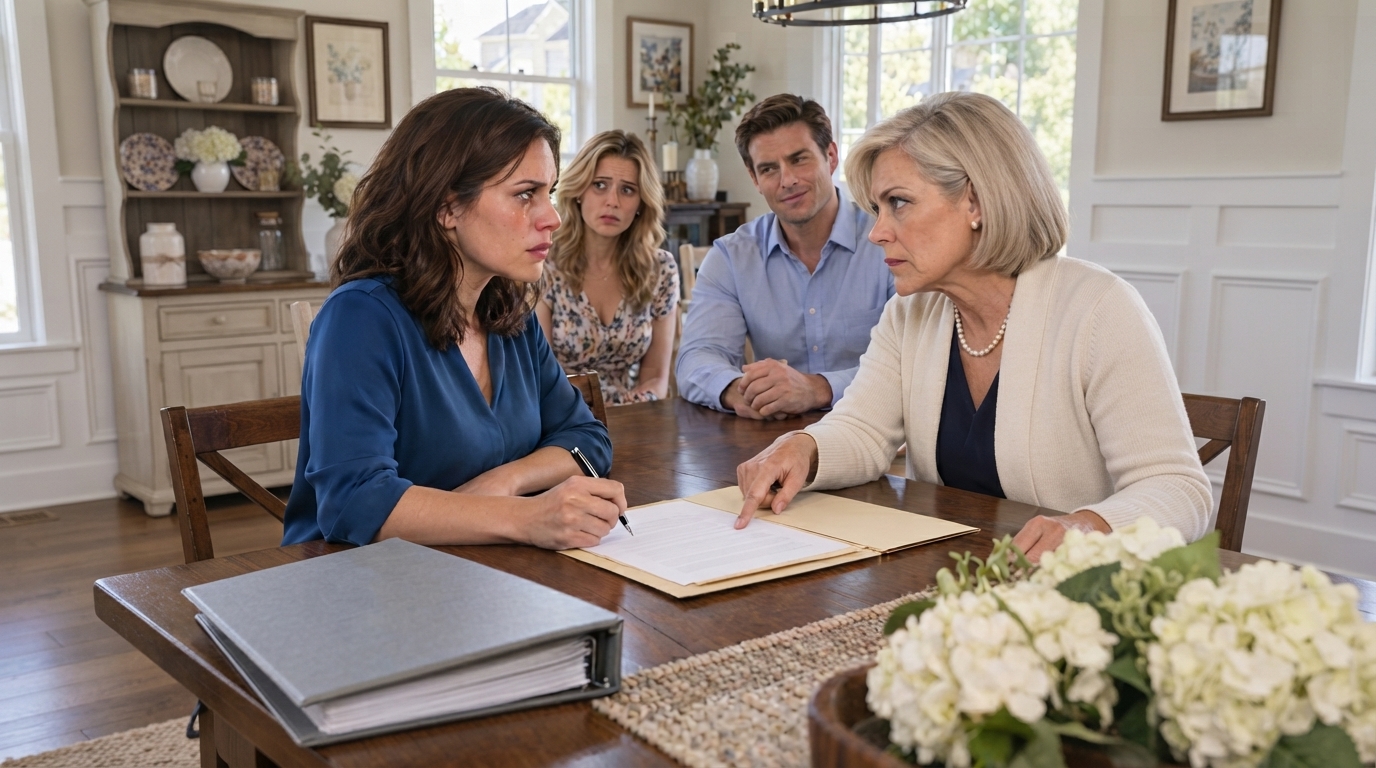
I stared at the gray binder sitting on my kitchen table.
For months, that binder had been my private insurance policy against a family that had convinced me I was supposed to be grateful for whatever scraps they threw in my direction.
Now it was about to become something else.
Evidence.
Tess came on the line.
“Hannah?”
“Yes.”
“I remember you.”
Of course she did.
She had interviewed Derek three months earlier.
I could still remember his performance.
He had sat beneath bright studio lights in a perfectly tailored suit, his eyes supposedly filled with concern for his niece.
He had talked about Grace as if she were the center of his universe.
He had told viewers that their family had come together to save a little girl’s life.
“Family is everything,” he had said.
The clip had gone viral locally.
People praised him.
Neighbors called my mother a devoted grandmother.
Strangers donated money.
And while Grace lay unconscious in a hospital bed, Derek smiled for cameras.
“I have documents,” I told Tess.
“What kind?”
“Financial records. Fundraiser records. Foundation records. Messages. Photographs. And evidence that money raised for my daughter’s medical care may not have been used for that purpose.”
Tess didn’t respond immediately.
Then she said something I wasn’t expecting.
“Can you come in tomorrow?”
I looked at the clock.
“It’s almost midnight.”
“I know.”
She lowered her voice.
“If what you’re telling me is accurate, don’t send anything by email yet.”
My heart began pounding.
“Why?”
“Because once you send documents electronically, you don’t know where they’ll end up.”
I swallowed.
“Are you saying you believe me?”
“No,” Tess said carefully. “I’m saying I want to see the documents before I believe anyone.”
That answer gave me more comfort than sympathy would have.
“I’ll be there.”
“Bring everything.”
“I will.”
I hung up.
For the first time in months, I didn’t feel helpless.
I felt terrified.
There was a difference.
The next morning, Grace was sitting at the kitchen table coloring a picture of a house.
Her cheeks were still pale.
Her hair was shorter than it had been before surgery because nurses had shaved a small section near the surgical monitoring equipment.
She looked up.
“Mom?”
“Yes?”
“Why were you awake all night?”
I smiled.
“Couldn’t sleep.”
She studied me.
“You’re doing your thinking face.”
I laughed softly.
“Do I have a thinking face?”
“You do.”
“What does it look like?”
She narrowed her eyes and imitated me.
I couldn’t help smiling.
Then she reached across the table and took my hand.
“Are we okay?”
The question nearly broke me.
“Yes.”
She looked at me for another second.
“Really?”
I squeezed her fingers.
“Really.”
I didn’t tell her about the documents.
I didn’t tell her about Derek.
I didn’t tell her that the adults who were supposed to protect her had turned her illness into a business opportunity.
Children shouldn’t have to carry that weight.
At ten thirty, I drove to Channel 7.
Tess met me in a small conference room.
She was younger than I expected.
Maybe forty.
Dark hair.
No makeup beyond what the studio required.
A notebook sat in front of her.
She didn’t touch it.
Instead, she pointed to the chair.
“Sit.”
I placed the gray binder on the table.
Then another folder.
Then another.
Tess stared at the stack.
“How long have you been collecting this?”
“Since the day of Grace’s surgery.”
“Why?”
“Because my family kept telling me everything was fine.”
“And you didn’t believe them.”
“No.”
“Why?”
I opened the binder.
“Because numbers don’t lie as easily as people do.”
She leaned forward.
The first document was the fundraiser’s public statement.
The second showed the total amount raised.
$112,418.
Tess looked at the number.
“That’s a lot.”
“Yes.”
“How much did Grace actually receive?”
“Five thousand dollars directly.”
“Five thousand?”
“Yes.”
“What happened to the rest?”
“I don’t know.”
“That’s what you’re trying to prove?”
“I’m trying to find out.”
She turned another page.
There were screenshots of messages between Derek and me.
One read:
The money is being held temporarily. Don’t create unnecessary drama.
Another:
The foundation has expenses.
Another:
You need to understand how charitable organizations work.
Tess looked up.
“Was there ever a formal agreement saying Derek could control the fundraiser?”
“No.”
“Was he Grace’s legal guardian?”
“No.”
“Did you authorize him to establish a foundation using Grace’s image?”
“No.”
She flipped through the pages.
Then she stopped.
“What is this?”
“A photograph.”
It was Derek standing beside a large check.
$25,000.
Underneath it was printed:
Grace Reed Children’s Cardiac Fund.
Tess looked at me.
“Did the hospital receive this?”
“No.”
“How do you know?”
I handed her the hospital correspondence.
She read it.
Then read it again.
“They never received the pledge.”
“Correct.”
Tess leaned back.
“Where did you get the bank records?”
I hesitated.
“Derek’s wife.”
“Rachel?”
“Yes.”
“Why would she give these to you?”
“Because she finally realized what was happening.”
Tess opened the folder.
Her expression changed.
The first page showed a foundation account.
Then another.
Then credit-card transactions.
A resort.
A luxury restaurant.
A furniture store.
A contractor.
A payment toward a truck.
Tess slowly looked up.
“Are these foundation funds?”
“They came from the foundation account.”
“Do you have confirmation?”
“I have the statements.”
She stared at the pages.
Then she asked, “Does Derek know you have these?”
“No.”
“Does your mother?”
“No.”
“Does Rachel know you’re here?”
“I assume so.”
Tess closed the folder.
“Don’t contact Derek.”
“I wasn’t planning to.”
“Don’t threaten him. Don’t accuse him. Don’t post anything online.”
“I won’t.”
“And don’t let him know what we have.”
I looked at her.
“Why?”
“Because if this becomes a story, he’ll have an opportunity to explain himself.”
“He’ll lie.”
“Maybe.”
“And everyone will believe him.”
“Maybe.”
I felt my throat tighten.
Tess’s voice softened.
“But facts are harder to argue with when they’re documented.”
She looked at the gray binder.
“You’ve done something very important.”
“What?”
“You kept the receipts.”
I almost laughed.
“My family always said I was obsessive.”
“Sometimes obsessive record-keeping is exactly what protects people.”
She stood.
“We’ll verify everything.”
“How long?”
“I don’t know.”
“What happens if the records are wrong?”
“Then we don’t run the story.”
“And if they’re right?”
She looked directly at me.
“Then your brother gets to answer questions in public.”
I left the station feeling as if I had stepped into another world.
But my family wasn’t waiting quietly.
That afternoon, Derek called.
I watched his name appear on my screen.
I didn’t answer.
He called again.
Then again.
Finally, he left a voicemail.
“Hannah, this is getting ridiculous. We need to talk.”
I deleted nothing.
That was another lesson I had learned.
Keep everything.
Twenty minutes later, my mother called.
I answered.
Her voice was cold.
“What are you doing?”
I said nothing.
“I know you went to Channel 7.”
My stomach dropped.
“How?”
“Derek knows people.”
I closed my eyes.
My mother continued.
“You’re going to destroy this family.”
I almost laughed.
“You didn’t say that when Grace was in surgery.”
Silence.
Then:
“You’re angry.”
“Yes.”
“You’re confused.”
“No.”
“You’ve always been emotional.”
“And you’ve always called me emotional whenever I asked questions.”
She took a breath.
“Hannah, Derek has worked hard to help Grace.”
“Where is the money?”
Another silence.
“What?”
“The $112,000.”
“You know how foundations work.”
“Where is it?”
“That’s none of your business.”
I looked at the gray binder.
“It is my business.”
“She isn’t your possession.”
“No,” I said quietly. “She’s my daughter.”
My mother hung up.
That night, I barely slept.
At 2:17 in the morning, my phone buzzed.
Unknown number.
I answered.
Nobody spoke.
Then the call ended.
Five minutes later, another message arrived.
Stop digging.
I stared at the words.
Then I took a screenshot.
I added it to the binder.
The next morning, Tess called.
“We verified the hospital.”
My heart stopped.
“And?”
“The $25,000 pledge was never received.”
I closed my eyes.
“What else?”
“We checked the foundation registration.”
She paused.
“There’s something you need to see.”
“Tell me.”
“Your brother listed Grace as a beneficiary.”
“That sounds good.”
“It would be.”
She paused again.
“If the beneficiary agreement had been completed.”
“What does that mean?”
“It means he created the appearance that the foundation was dedicated to Grace, but the documents we found give him broad control over the money.”
My hands began shaking.
“How broad?”
“Extremely.”
“Can he spend it?”
“That’s what we’re investigating.”
Tess lowered her voice.
“And Hannah?”
“Yes?”
“We found something else.”
“What?”
“Your mother’s name appears on the original incorporation paperwork.”
I sat down.
My mother.
The woman who had told me to stop making Grace their problem.
She hadn’t merely known about the foundation.
She had helped create it.
I opened the gray binder.
For the first time, I realized something.
The fundraiser hadn’t been a spontaneous act of generosity.
It had been planned.
And Grace’s surgery date hadn’t been a coincidence.
The gala had been scheduled months earlier.
Before the operation.
Before the money came in.
Before I even knew how sick my daughter was.
I whispered to myself:
“They planned this.”
But there was one thing I still didn’t understand.
Why?
The answer arrived three hours later.
Tess called again.
“There’s a property connection.”
“What property?”
“Your mother’s house.”
I froze.
“My mother’s house?”
“Derek recently took out a loan against it.”
My heart pounded.
“How?”
“He was listed as having a financial interest.”
“That isn’t possible.”
“That’s what I thought.”
I opened the gray binder.
Suddenly, another document made sense.
A document Derek had asked me to sign months earlier.
He had called it a “family emergency authorization.”
I had refused.
But apparently, someone else had signed something.
My mother.
Tess said:
“Hannah, we may be looking at something much bigger than a fundraiser.”
And for the first time, I wondered whether Grace’s illness had simply given my family an opportunity.
Or whether it had given them a reason.
PART 4
The next forty-eight hours felt like living inside a storm.
Tess’s investigative team began contacting banks, the hospital, the foundation’s registered address, the event company that organized the gala, and the people listed on the paperwork.
I stayed home with Grace.
She was recovering slowly.
Every day, she walked a little farther.
Every day, she complained about the hospital food.
Every day, I pretended my world wasn’t collapsing around us.
One afternoon, she asked:
“Mom, why does Uncle Derek keep calling?”
I looked at her.
“How do you know?”
“He keeps calling my tablet.”
I hadn’t realized.
“Did you answer?”
“No.”
“Good.”
She looked confused.
“Are you mad at him?”
I hesitated.
“I’m disappointed.”
“Because he didn’t visit?”
“Yes.”
She looked down.
“I don’t think Grandma likes me anymore.”
My heart broke.
“Why would you say that?”
“Because she said I was making everyone tired.”
I closed my eyes.
That sentence had been spoken while Grace was still recovering.
My little girl had heard it.
She had carried it.
And I hadn’t known.
I hugged her.
“None of this is your fault.”
She whispered:
“I know.”
But I knew she didn’t.
That evening, Rachel came to my house.
She looked exhausted.
She stood on the porch holding another folder.
“I found more.”
I let her in.
She sat at the kitchen table.
“I shouldn’t be doing this.”
“Then why are you?”
“Because I have a daughter too.”
She opened the folder.
Inside were text messages between Derek and my mother.
I read the first one.
Once the account reaches 100, we move the property.
My hands went cold.
“What property?”
Rachel shook her head.
“I don’t know.”
Another message.
Hannah will sign eventually.
Then:
If she refuses, use the capacity issue.
I stared at the screen.
“Capacity issue?”
Rachel nodded.
“That was the plan.”
“To declare me incompetent?”
“Yes.”
I felt something inside me crack.
“How long?”
“Months.”
“And the fundraiser?”
Rachel looked away.
“Part of it.”
I turned another page.
There were emails about a property purchase.
A condominium.
A luxury condominium overlooking the river.
The buyer name wasn’t Derek.
It was an LLC.
The registered manager was my mother.
And the funding source?
The foundation account.
I couldn’t breathe.
“They were buying property with Grace’s money.”
Rachel nodded.
“That’s what I think.”
I looked at her.
“Why didn’t you stop him?”
She started crying.
“Because I was afraid.”
“Of Derek?”
“Yes.”
“What has he done?”
She didn’t answer.
That was answer enough.
The next morning, Tess arrived at my house with a camera crew.
She didn’t interview Grace.
She didn’t even enter her bedroom.
Instead, she sat across from me at the kitchen table.
“We’ve confirmed several transactions.”
“How much?”
“We’re still calculating.”
“Approximately?”
She looked at her notes.
“More than $80,000 in expenses that appear unrelated to Grace’s medical care.”
My stomach turned.
“And the property?”
“Under investigation.”
“Is my mother involved?”
“We have documents showing she signed several filings.”
I looked down.
For thirty-four years, I had protected my mother.
I had defended her when Derek mocked her.
I had sent money when she needed help.
I had taken her to appointments.
I had spent holidays making sure nobody sat alone.
And now I was learning she had helped build a legal structure around my daughter’s identity and money.
I whispered:
“She chose him.”
Tess didn’t respond.
Maybe because there was nothing she could say.
That evening, Derek arrived.
He didn’t call first.
He simply walked onto my porch.
I opened the door but didn’t invite him in.
“What do you want?”
He looked at me.
“Stop.”
“Stop what?”
“This.”
He pointed toward the house.
“The accusations.”
“I haven’t accused you of anything.”
“You went to the news.”
“I went to a reporter.”
“Same thing.”
I said nothing.
He stepped closer.
“You’re embarrassing the family.”
I almost smiled.
“Grace was on television before she even woke up from surgery.”
“That was for charity.”
“Where’s the charity money?”
His face hardened.
“You don’t understand how complicated these things are.”
“Then explain them.”
“I don’t have to explain anything to you.”
“Why?”
“Because you don’t control the foundation.”
“Neither do you.”
He froze.
I knew immediately that I’d hit something.
“Who told you that?”
“Nobody.”
He stared at me.
Then his voice changed.
“You’re making a mistake.”
“I’ve made many.”
“What does that mean?”
“I trusted you.”
He looked away.
For a moment, I saw the little boy I had raised.
Then he disappeared.
“You’re going to regret this.”
I closed the door.
My hands were shaking.
But I didn’t cry.
Not anymore.
At 9:00 that night, Tess called.
“It’s happening tomorrow.”
“What?”
“The story.”
My heart stopped.
“You’re running it?”
“After verification.”
“What did you find?”
“We traced the foundation account.”
“And?”
“There are multiple transfers.”
“To where?”
“Businesses connected to your brother.”
I sat down.
“How much?”
“$94,600 that we can currently document.”
My eyes filled with tears.
“And the rest?”
“We don’t know yet.”
“Will you name him?”
“Yes.”
I looked toward Grace’s bedroom.
“Will you show her photograph?”
“No.”
“Why?”
“Because she didn’t choose this.”
I closed my eyes.
“Thank you.”
Tess continued.
“Hannah, there’s one more thing.”
“What?”
“The gala.”
“What about it?”
“We obtained the original event contract.”
“And?”
“The gala was originally scheduled for a different date.”
My heart began racing.
“What date?”
“The week after Grace’s surgery.”
I stared at the wall.
“So they moved it.”
“Yes.”
“Why?”
“We don’t know.”
Then she said:
“Actually, we do.”
She sent me a document.
I opened it.
The reason for the date change was written in an email from Derek.
The surgery will generate more public sympathy if we hold the event while the story is fresh.
I stopped breathing.
I read it again.
Then again.
The gala wasn’t merely about raising money.
They had planned to capitalize on Grace’s suffering.
I felt sick.
But there was more.
The next page contained a message from my mother.
Hannah won’t cooperate. If necessary, we can make her look unstable.
I covered my mouth.
They had planned to destroy my credibility.
To make me look incompetent.
To take control of my daughter’s money.
And potentially use that money to acquire property.
My family had not merely abandoned us.
They had built a system around our vulnerability.
At 8:30 the next morning, Channel 7 aired the first teaser.
A photograph of Grace appeared on screen.
Then the words:
WHERE DID THE MONEY GO?
The phone started ringing immediately.
My mother.
Derek.
Rachel.
Unknown numbers.
I turned the television off.
Grace walked into the room.
“What was that?”
“Nothing you need to worry about.”
She looked at me.
“You’re crying.”
I wiped my face.
“Happy tears.”
She frowned.
“That doesn’t look happy.”
I pulled her into my arms.
“I love you.”
“I love you too.”
At 6:00 p.m., the full report aired.
Tess stood outside the hospital.
Behind her appeared documents.
Bank records.
Foundation filings.
The gala photograph.
The $25,000 pledge.
Then the account transactions.
Viewers watched as she explained that money raised publicly for a child’s medical needs had allegedly been spent on expenses unrelated to that child’s treatment, according to financial records reviewed by the station.
Derek appeared on screen.
He said the accusations were “misleading.”
My mother said the family had been “trying to help.”
Derek’s attorney claimed the foundation had been properly managed.
Then Tess showed the documents.
The signatures.
The transfers.
The contracts.
The messages.
The email.
The surgery will generate more public sympathy if we hold the event while the story is fresh.
My mother had no response.
Derek had no response.
Then Tess asked the question everyone had been asking.
“Where is the money?”
The report ended.
My phone exploded.
Messages from people I hadn’t heard from in years.
Former neighbors.
Parents from Grace’s school.
People who had donated.
Some apologized.
Some demanded answers.
One message came from a woman who had donated $500.
She wrote:
“I gave because I thought I was helping a little girl.”
I couldn’t stop crying.
Not because of the money.
Because Grace had been turned into a photograph on a fundraising page while she lay unconscious.
At 10:00 p.m., the story went national.
At 10:07, Derek called.
I answered.
His voice was different.
Not angry.
Panicked.
“Hannah.”
I said nothing.
“You need to tell them it isn’t true.”
“What isn’t true?”
“All of it.”
“Which part?”
He went silent.
“The money?”
Silence.
“The foundation?”
Nothing.
“The documents?”
Still nothing.
I whispered:
“You knew.”
“I was trying to help.”
“No.”
“Hannah—”
“You were trying to control it.”
He started shouting.
Then I heard another voice in the background.
My mother.
“Give me the phone.”
Derek said:
“Mom, don’t.”
Then the call ended.
Ten minutes later, my mother’s number appeared.
I didn’t answer.
She left a voicemail.
Her voice sounded tired.
“Hannah, please. We need to talk.”
I saved it.
Then I opened the gray binder.
There was one section I hadn’t shown Tess.
It contained every financial document related to my own property.
Because before Grace became sick, I had been helping my mother refinance her house.
I had discovered something strange months earlier.
A signature.
My signature.
On a document I had never signed.
I had forgotten about it because everything with Grace had happened so quickly.
Now I pulled it out.
The signature looked like mine.
But beneath it was a date.
The date was impossible.
I had been in the hospital that day.
With Grace.
I stared at the page.
Then I called Tess.
“I found something.”
“What?”
“A document with my forged signature.”
“Send it.”
“I can’t.”
“Why?”
“Because I think it’s connected to the property.”
There was silence.
Then Tess said:
“Don’t touch anything else.”
I heard typing.
“What?”
“We checked the county records.”
My stomach tightened.
“And?”
“The property wasn’t your mother’s.”
“What?”
“It was yours.”
I couldn’t speak.
“The house was transferred months ago.”
“To whom?”
Tess hesitated.
Then she said:
“An LLC connected to Derek.”
Everything went silent.
My family hadn’t only taken Grace’s money.
They had taken my house.
And suddenly the conservatorship plan made sense.
They didn’t need me to disappear.
They needed me to become legally powerless.
PART 5
I didn’t sleep that night.
At 4:00 a.m., I sat at the kitchen table surrounded by documents.
The gray binder was open.
Grace was asleep down the hall.
Outside, the neighborhood was quiet.
I looked at the forged signature again.
I remembered signing nothing.
I remembered being in the hospital.
I remembered Derek telling me months earlier:
“Mom, it’s just paperwork.”
I remembered trusting him.
That was the part that hurt most.
Not the house.
Not the money.
Trust.
At 7:15, Rachel arrived.
She didn’t knock.
She stood at the door with tears in her eyes.
“I’m sorry.”
I let her inside.
“There’s something else.”
I looked at her.
She handed me a flash drive.
“What is this?”
“Everything Derek kept on his laptop.”
My heart stopped.
“How did you get it?”
“I copied it.”
“Rachel—”
“I know.”
She sat down.
“I know what I did.”
She took a breath.
“But I couldn’t keep watching.”
I plugged the drive into my laptop.
Folders appeared.
Foundation.
Property.
Legal.
Media.
There was one folder called:
Hannah
I opened it.
Inside were scans of my identification.
Bank information.
Medical records.
Tax documents.
Property records.
A spreadsheet.
My assets.
My debts.
My accounts.
My estimated net worth.
I stared at the screen.
They had been studying me.
Not helping me.
Studying me.
Then I opened another file.
A draft legal petition.
Petition for Conservatorship of Hannah Reed.
The proposed petitioner was Derek.
The stated basis was “progressive cognitive impairment.”
The supporting evidence included several statements about my supposed confusion.
One claimed I had “forgotten financial obligations.”
Another claimed I had become “paranoid about family members.”
Another claimed I had “displayed irrational hostility.”
Every accusation was false.
But then I saw something that made my blood run cold.
The filing date.
It was scheduled for the following week.
Before the news report.
Before the documents became public.
Before anyone outside the family knew.
They had already prepared everything.
Rachel whispered:
“He was going to file it Monday.”
I closed the laptop.
“Then we move first.”
At 9:00 a.m., I met Grace’s doctor.
I told him what had happened.
He listened.
Then he asked:
“Is Grace safe?”
“Yes.”
“Good.”
He looked at my notes.
“If anyone ever questions your ability to care for her, I can document what I’ve observed.”
I thanked him.
That afternoon, I met Grace Hollander, the attorney Tess had recommended.
She spread the documents across a conference table.
“This is serious.”
“I know.”
“Have you authorized anyone to access your accounts?”
“No.”
“Have you signed a power of attorney?”
“No.”
“Have you transferred your house?”
“No.”
She looked at the county records.
“You’re still the legal owner according to the original deed.”
“But the new filing says otherwise.”
“Yes.”
“That means fraud.”
“It may.”
She looked at me.
“But don’t use that word publicly until we prove it.”
I nodded.
She continued.
“We’ll request the full title history.”
“Can they take the house?”
“Not if the transfer was fraudulent and we act quickly.”
“What about the foundation?”
“We’ll deal with that separately.”
“And Derek?”
“We don’t need to fight him.”
She looked directly at me.
“We need to let the documents fight him.”
That sentence stayed with me.
For years, I had believed defending myself meant shouting louder.
It didn’t.
Sometimes it meant putting the truth on a table and stepping back.
The following Monday morning, Derek arrived at the courthouse expecting to file his petition.
He didn’t know Grace Hollander had already submitted our response.
He didn’t know the county records had been challenged.
He didn’t know the bank had frozen several disputed accounts pending investigation.
And he certainly didn’t know Rachel had given Tess the laptop files.
At 10:00 a.m., the courthouse doors opened.
Derek walked in wearing the same pressed suit he had worn at the gala.
My mother was beside him.
She looked confident.
Until she saw me.
I stood across the hallway with Grace’s attorney.
My mother stopped.
Derek’s face went pale.
“You.”
I said nothing.
His attorney approached.
“This is inappropriate.”
Grace Hollander smiled politely.
“Actually, Mr. Reed, I believe we’re exactly where we need to be.”
Derek looked at his mother.
“What did you do?”
She whispered:
“Nothing.”
But her face said everything.
The hearing began.
Derek’s attorney presented the petition.
He described me as unstable.
Confused.
Unable to manage my affairs.
Then Grace Hollander stood.
She presented my cognitive evaluation.
My financial history.
My employment records.
My medical records.
My documented caregiving history.
Then came the title records.
The judge frowned.
“Mr. Reed, explain this transfer.”
Derek’s attorney looked at the page.
Then at Derek.
“I’ll need a moment.”
The judge looked at Derek.
“You are listed as the manager of the purchasing entity.”
Derek swallowed.
“I was helping my mother.”
“Why does the document contain Ms. Reed’s signature?”
“I don’t know.”
Grace Hollander placed another page on the table.
“Because she did not sign it.”
The room went quiet.
She produced the hospital record showing I had been physically present in Cincinnati on the date the document was supposedly signed.
Then she produced the electronic timestamp from the original file.
It had been created on a computer registered to Derek’s business.
Derek’s attorney stopped talking.
My mother began crying.
I looked at her.
She wouldn’t meet my eyes.
Then the judge turned to Derek.
“Mr. Reed, did you have permission to create this document?”
“No.”
The answer came quietly.
I felt my entire body go still.
It was the first truthful thing he had said.
The judge continued.
“And did you have permission to use your niece’s photograph for the foundation?”
Derek looked down.
“I thought—”
“I asked whether you had permission.”
“No.”
The courtroom became silent.
There was no dramatic shouting.
No screaming.
Just the quiet collapse of a story my family had spent months constructing.
Then Grace Hollander opened the final folder.
“This concerns the foundation.”
She placed the financial records on the table.
The judge looked through them.
Resort charges.
Vehicle payments.
Luxury purchases.
Transfers to related entities.
Then the $25,000 hospital pledge.
“Where is this money?” the judge asked.
Derek didn’t answer.
My mother started crying harder.
Finally, Derek whispered:
“I intended to repay it.”
I closed my eyes.
That sentence told me everything.
The money wasn’t being “protected.”
It wasn’t waiting for Grace.
It wasn’t part of some complicated charitable process.
It had been spent.
The hearing ended with the court denying Derek’s emergency petition and ordering preservation of the disputed records while the property and financial allegations were investigated.
Outside, reporters were waiting.
Cameras flashed.
Microphones appeared.
Derek tried to walk past them.
One reporter asked:
“Where did the $112,000 go?”
He kept walking.
Another asked:
“Did you forge your sister’s signature?”
He said nothing.
My mother stopped.
For the first time in my life, I saw her without certainty.
She looked small.
Old.
Lost.
A reporter asked:
“Mrs. Reed, did you know about the foundation’s spending?”
She stared at the cameras.
Then at me.
“I thought he was helping.”
I didn’t respond.
Because there was nothing left to say.
Three weeks later, the financial investigation was still underway.
Some money had been recovered.
Some had not.
The property transfer was formally challenged.
My house was placed under protection while the case proceeded.
The foundation’s accounts were frozen pending further review.
Derek stepped down from his role.
Rachel filed for separation.
My mother stopped speaking to him.
But none of that mattered as much as what happened with Grace.
She returned to school.
The first day, she was nervous.
I walked her to the entrance.
She looked up at me.
“Mom?”
“Yes?”
“Are people going to talk about me?”
“Maybe.”
“Am I famous?”
I smiled.
“No.”
“Good.”
She took my hand.
“I don’t want to be famous.”
“I know.”
“I just want to be Grace.”
I hugged her.
“That’s all you ever have to be.”
Months later, Tess called.
The investigation had uncovered additional financial records.
More money had been spent outside the stated purpose of the foundation.
The authorities were reviewing the evidence.
Tess asked if I wanted to comment.
I said yes.
We met at the same studio where Derek had once sat beneath bright lights and told everyone that family was everything.
This time, I sat there.
Tess asked:
“What do you want people to know?”
I thought about it.
Then I said:
“Don’t confuse silence with consent.”
She nodded.
I continued.
“Don’t let someone convince you that asking where the money went makes you selfish.”
I looked into the camera.
“And if you’re caring for someone vulnerable, document everything.”
Tess asked:
“Do you regret not speaking sooner?”
I thought about the hospital.
The fundraiser.
The gala.
The $112,000.
The forged signature.
My daughter lying beneath fluorescent lights.
“No,” I said.
“I regret that I had to learn this lesson at all.”
The interview ended.
When I returned home, Grace was sitting at the kitchen table.
The gray binder was beside her.
She touched it.
“Is this the scary book?”
I laughed.
“Something like that.”
“Can I write something in it?”
I handed her a pen.
She opened the final page.
Then she wrote in large, uneven letters:
MOM DIDN’T GIVE UP.
I stared at those words.
Then I closed the binder.
Not because the story was over.
The legal process wasn’t finished.
The money hadn’t all been recovered.
The family relationships might never be repaired.
But something more important had changed.
Grace no longer believed her illness made her a burden.
And I no longer believed keeping the peace required destroying myself.
Six months after the surgery, Grace had another appointment.
The doctor smiled after reviewing her scans.
“She’s recovering beautifully.”
I nearly cried.
Grace looked at me.
“Is that good?”
“Very good.”
She grinned.
On the drive home, we stopped for ice cream.
She got chocolate.
I got vanilla.
She looked at me.
“Mom?”
“Yes?”
“Do you think Grandma is sorry?”
I looked through the windshield.
“I don’t know.”
“Do you forgive her?”
I took a breath.
“Forgiveness and trust aren’t the same thing.”
She thought about that.
“Can you forgive someone and still not let them hurt you?”
“Yes.”
“That’s good.”
She ate another spoonful of ice cream.
Then she smiled.
“I think I like that.”
That night, I put the gray binder into a drawer.
I didn’t throw it away.
It had protected us.
But I didn’t need to carry it everywhere anymore.
The next morning, a letter arrived.
No return address.
I opened it carefully.
Inside was a single sheet of paper.
Five words.
You still don’t know everything.
I stared at it.
For a moment, the old fear returned.
Then I smiled.
Because this time, I wasn’t alone.
I had my daughter.
I had people who believed evidence mattered more than appearances.
And I had learned something my family had spent thirty-four years trying to teach me incorrectly:
Peace isn’t the same as silence.
Love isn’t the same as obedience.
And family isn’t defined by who shares your blood.
Sometimes family is the person who sits beside you when everyone else walks away.
Sometimes it’s the person who tells the truth when lying would be easier.
And sometimes, family is the little girl who survives the impossible, takes your hand, and reminds you why you refused to give up.
I looked at Grace sleeping peacefully in the next room.
Then I folded the letter.
I placed it beside the gray binder.
And for the first time, I wasn’t afraid of what came next.
Because whatever came through that door…
I was ready.
THE END THANK YOU FOR READING !!!