PART 3
Marcus opened the leather briefcase.
The sound of the clasps snapping back seemed louder than the music that had just been playing.
Nobody spoke.
My mother stood beside the stage, one hand still trembling from the slap she had given me.
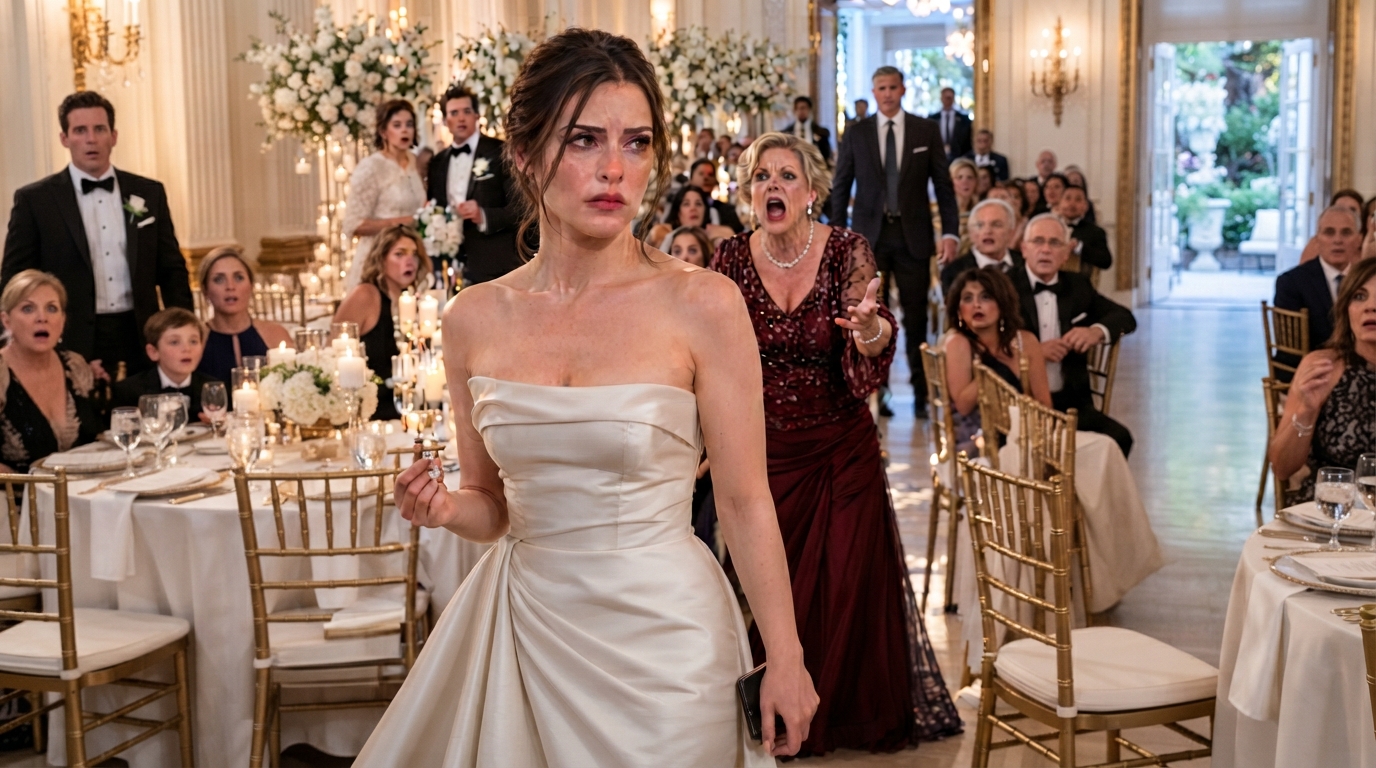
Madison stood in her wedding gown.
Tyler was beside her.
Two hundred guests watched.
My grandmother Eleanor took one slow step forward.
She looked directly at my mother.
“You told everyone I was confused.”
Victoria’s mouth opened.
“Mother—”
“Don’t.”
Eleanor’s voice wasn’t loud.
It didn’t need to be.
“I’ve spent three years listening to you tell people I don’t understand my own finances.”
My mother swallowed.
“That isn’t what happened.”
Eleanor looked at her.
“Then explain the penthouse.”
Silence.
Marcus removed a document from the briefcase.
He placed it on the table.
“The deed,” he said.
The room leaned forward.
I watched my mother’s face.
She already knew what was coming.
Marcus pointed toward the first page.
“Recorded owner: Paige Harrison.”
Then he turned the document.
“Beneficiary designation: Paige Harrison.”
Then another.
“Transfer restrictions.”
My mother stepped closer.
“What restrictions?”
Marcus looked at her.
“The property cannot be transferred, gifted, or pledged without the beneficiary’s written consent.”
My mother stared.
“I knew about the deed.”
Eleanor’s eyes narrowed.
“No.”
“You did.”
“You knew a piece of paper existed.”
Eleanor pointed toward the document.
“You did not understand what it said.”
My father stepped in.
“Eleanor, this is a wedding.”
She turned toward him.
“Yes.”
“And you’re humiliating my daughter.”
Eleanor stared.
“Your daughter was slapped on a stage because she refused to surrender property that wasn’t hers to give away.”
My father looked down.
Nobody spoke.
Eleanor turned toward Madison.
“Did you know about this?”
Madison shook her head.
“I thought Paige agreed.”
I looked at her.
“You didn’t ask me.”
“I thought Mom handled it.”
“Exactly.”
Tyler finally spoke.
“Paige, I had no idea.”
I looked at him.
“Neither did I, apparently.”
He frowned.
“What does that mean?”
“It means I didn’t know they had already planned the transfer.”
Marcus removed another document.
“This,” he said, “is the proposed quitclaim deed.”
He held it up.
“It was prepared before this wedding.”
Then another document.
“A transfer authorization.”
Then another.
“A notarized affidavit.”
I stared at the page.
My name was typed throughout.
But my signature was missing.
“That,” Marcus said, “is exactly why I was contacted.”
My mother laughed nervously.
“Contacted by whom?”
“Your mother.”
Victoria looked at Eleanor.
Eleanor nodded.
“I called him three months ago.”
My mother went pale.
“Three months?”
“Yes.”
“But you never told me.”
“I had no reason to.”
Marcus continued.
“She asked me to review the estate documents and the proposed transfer.”
My mother stepped closer.
“She had no right to interfere with a family arrangement.”
Marcus looked at her.
“This was never a family arrangement.”
He pointed to the deed.
“It was an attempted transfer of someone else’s property.”
My mother snapped:
“We were going to compensate Paige.”
Marcus raised an eyebrow.
“With what?”
She stopped.
“With—”
He waited.
She looked away.
“That isn’t the point.”
“The amount matters.”
He opened another folder.
The compensation figure appeared.
I stared at it.
Twenty-five thousand dollars.
For a penthouse worth several million.
My mother had expected me to surrender the property for the price of a used car.
Madison looked at the number.
“You were going to give her twenty-five thousand?”
My mother shook her head.
“We were trying to make things fair.”
Madison turned.
“That’s not fair.”
Victoria stared at her daughter.
“You don’t understand.”
“No.”
Madison looked at me.
“I don’t.”
That was the first time anyone from my immediate family had said it without hostility.
Tyler looked uncomfortable.
“You told me Paige had agreed.”
My mother looked at him.
“She would have.”
He stared.
“What?”
“She would eventually.”
He turned toward her.
“You didn’t have her agreement?”
No answer.
That was enough.
Marcus pulled out another document.
“The most important document,” he said.
My mother went completely still.
Eleanor looked at him.
“Show them.”
Marcus handed me the paper.
I looked down.
It was a letter from my grandmother.
The date was three years earlier.
The same month she had first told me she was changing her estate plan.
I began reading.
Paige,
If you are reading this, then someone is trying to convince you that I was incapable of deciding what should happen to my property.
My hands started shaking.
Eleanor looked at me.
“Keep reading.”
I did.
You are not receiving the penthouse because you need it more than Madison. You are receiving it because you have treated me as a person, not as an asset.
My eyes filled.
Your mother visited me twice last year. Both conversations centered on my finances. You came every Sunday and asked whether I had eaten.
I stopped.
Madison looked down.
Eleanor continued:
“Read the next part.”
I swallowed.
There is something I have not told you.
I looked up.
My grandmother’s expression had changed.
She was afraid.
Not for herself.
For me.
I continued.
Your mother did not merely ask about the penthouse. She asked Marcus whether I could be declared incompetent and whether guardianship could be transferred to a family member.
The room erupted.
My father turned toward Victoria.
“You asked that?”
My mother began crying.
“It was just a question.”
Eleanor shook her head.
“A question asked repeatedly.”
Marcus removed another page.
“She also requested a copy of the medical power-of-attorney forms.”
My father’s face went white.
“What?”
Victoria looked at him.
“I was trying to protect her.”
“From what?”
“She was getting older.”
Eleanor laughed.
Not kindly.
“I was seventy-five.”
My mother didn’t respond.
“I’m seventy-eight now.”
Eleanor looked around the ballroom.
“Apparently I became incompetent the moment my granddaughter received a property.”
My father’s shoulders dropped.
Marcus continued.
“The guardianship request was never filed.”
“Why not?” someone asked.
“Because Ms. Eleanor withdrew the authorization before it could be submitted.”
My mother looked furious.
“You were going to make us all look terrible.”
Eleanor turned.
“No.”
She looked at the guests.
“You were going to make me look helpless.”
Silence.
Then Tyler spoke.
“Madison.”
She turned.
“You knew any of this?”
She shook her head.
“I knew Paige had the apartment.”
“Not the rest?”
“No.”
My mother stepped toward her.
“Don’t turn against your family.”
Madison stared.
“I am trying to understand my family.”
That sentence hit hard.
Because for the first time, my sister was no longer following the version of events she had been given.
She was asking questions.
And my mother had no answers.
Eleanor looked at Marcus.
“Show them the financial records.”
He removed a thick stack.
“Your mother asked Paige to contribute to several expenses related to the wedding.”
My heart sank.
I already knew I’d been asked to help.
What I didn’t know was where the money had gone.
Marcus laid out the receipts.
Catering deposit.
Venue deposit.
Floral design.
Dress alterations.
Designer gifts.
Travel.
Jewelry.
Private transportation.
The total was enormous.
I stared.
“I paid those.”
Madison looked at her mother.
“Mom?”
Victoria didn’t answer.
“You told me Paige refused to contribute.”
My mother closed her eyes.
“I said she was difficult.”
“You said she gave us nothing.”
I looked at Madison.
“I paid.”
Madison looked stunned.
“How much?”
Marcus answered.
“Over eighty thousand dollars.”
The room went silent.
My sister turned toward my mother.
“Eighty thousand?”
Victoria whispered:
“She wanted to.”
“No,” Madison said.
“I asked her for help.”
My sister looked at me.
“I didn’t know.”
“I know.”
Then came the part I hadn’t known.
Marcus held up another page.
“There was also a second account.”
“What account?” I asked.
“A wedding expense account.”
He listed the transfers.
Some came from me.
Some came from my mother.
Some came from my father.
But several went elsewhere.
I frowned.
“Where?”
Marcus looked toward Tyler.
“To a business account.”
Tyler’s face changed.
“Mine?”
“Yes.”
He stared.
“What?”
Marcus explained.
“Payments were labeled as wedding services.”
Tyler looked stunned.
“I never received those.”
Marcus looked at me.
“That’s because they were transferred to a company owned by your father.”
My father stared at him.
“What?”
Marcus turned another page.
The company was a shell.
It had no employees.
No active contracts.
No legitimate wedding services.
Money had moved through it and then disappeared.
My mother began shaking.
“That’s not what it was.”
My father turned on her.
“Where did the money go?”
She said nothing.
“Victoria?”
She looked toward the floor.
My grandmother’s face had gone hard.
“I told you,” she said quietly.
My mother looked at her.
“Told me what?”
“That if you tried to manipulate Paige again, I would show them everything.”
My mother started crying.
Eleanor continued.
“I hoped I would never have to.”
I looked at my grandmother.
“Why didn’t you tell me before?”
“Because I hoped your mother would stop.”
I swallowed.
“She didn’t.”
“No.”
My mother looked at me.
“Paige, please.”
I stared at her.
“You lied about the house.”
“Yes.”
“You lied about my grandmother.”
“Yes.”
“You took money from me.”
“Yes.”
“You told Madison I was selfish.”
“Yes.”
“You prepared transfer documents without my consent.”
She looked down.
“Yes.”
“And then you slapped me because I said no.”
She began crying harder.
“Yes.”
The room was silent.
My grandmother walked toward the stage.
She stood beside me.
“I gave Paige that penthouse for one reason.”
She paused.
“She showed up.”
She looked at Madison.
“Not when there was an inheritance.”
“Not when there was a wedding.”
“Not when there was money.”
“She came when I had a fever.”
“She came when my roof leaked.”
“She brought me soup when I was too weak to cook.”
“She sat beside me when I couldn’t remember someone’s name.”
“She brought flowers when there was no occasion.”
My mother looked down.
Eleanor pointed toward me.
“She was there.”
Then she said the sentence that broke something open inside me.
“You cannot buy the love she gave me after you ignored me for years.”
No one moved.
The photographer quietly lowered his camera.
The wedding guests looked less like guests now.
They looked like witnesses.
Tyler walked toward Madison.
“Are you okay?”
She nodded.
Then she looked at me.
“Paige.”
“Yes?”
“I’m sorry.”
I looked at her.
“For what?”
“For believing them.”
I said nothing.
“For thinking you were selfish.”
I nodded.
“For never asking what really happened.”
I looked at her.
“You were told a story.”
She started crying.
“I should have asked.”
“Yes.”
She wiped her face.
“Can I hug you?”
I hesitated.
Then nodded.
She walked over.
We hugged.
My mother looked away.
Eleanor smiled faintly.
Then Marcus stepped forward again.
“We still have one document left.”
My grandmother nodded.
“This one ends the argument.”
Marcus took out a sealed envelope.
He opened it carefully.
Inside was an updated estate plan.
He placed it on the table.
“Ms. Eleanor’s estate was reviewed and updated six months ago.”
My mother stepped forward.
“What does it say?”
Marcus looked directly at her.
“It confirms Paige as sole beneficiary of the penthouse.”
My mother looked sick.
“The property is shielded from any claim based on family use, temporary occupancy, or wedding-related promises.”
My mother looked at me.
“And the rest?”
Marcus continued.
“Certain other assets are divided among the grandchildren.”
Madison looked relieved.
“Then I’m still included?”
“Yes.”
My mother looked stunned.
“You included Madison?”
Eleanor looked at her.
“Of course.”
My mother stared.
“But Paige gets the penthouse.”
“Yes.”
“And Madison gets other assets.”
“Yes.”
“You told me the family would be divided.”
Eleanor frowned.
“No.”
“I told you the family would be divided if you treated inheritance like a competition.”
My mother looked down.
“I don’t understand.”
“You don’t have to.”
Eleanor turned toward the room.
“People who love each other don’t need identical gifts to prove they’re equally loved.”
Applause started.
Not loud.
Not immediate.
But it spread.
I looked at my grandmother.
Then at Madison.
Then at Tyler.
The wedding was already over.
Nobody had said the formal words.
But everyone knew it.
The reception coordinator approached.
“Should we stop the reception?”
Eleanor shook her head.
“No.”
“What do you mean?”
“Let them eat.”
A few people laughed nervously.
Then she looked at me.
“You’ve missed enough dinners.”
I smiled.
For the first time that night, I laughed too.
But before we could sit down, Marcus leaned toward me.
“Paige.”
“Yes?”
“There is one more thing.”
“What?”
He lowered his voice.
“The penthouse isn’t the only property Eleanor left you.”
My smile disappeared.
“What?”
He looked at my grandmother.
She nodded.
“It’s time.”
Marcus placed another file in my hands.
On the cover were four words.
THE PROPERTY YOU DON’T KNOW.
PART 4
The room had finally started moving again.
Guests were talking in low voices.
Staff were bringing out fresh champagne.
The musicians hadn’t yet returned.
My mother stood near the stage surrounded by relatives who had stopped pretending not to watch her.
I opened the file.
The first page contained a property description.
Not the Seaport penthouse.
A brownstone.
Beacon Hill.
I recognized the address.
It was the building where my mother had lived briefly after my parents separated.
I looked at Eleanor.
“That’s yours?”
She nodded.
“It was.”
“What do you mean?”
“It isn’t anymore.”
Marcus turned another page.
The property had been transferred to a holding company years earlier.
That company was now owned by me.
My eyes widened.
“When?”
“Two years ago.”
“Why?”
Eleanor smiled.
“Because your mother kept saying you had nowhere stable to go.”
I stared at the paperwork.
The building was worth millions.
“You never told me.”
“I wanted you to learn how to handle one property before learning how to handle several.”
I laughed.
“That sounds like you.”
She smiled.
“You were always impatient.”
My mother overheard.
“Mother.”
Eleanor turned.
“What?”
“You gave her another property?”
“Yes.”
“Why?”
“Because I could.”
My mother looked furious.
“She doesn’t need it.”
Eleanor smiled.
“Neither do you.”
My father put his hand on my mother’s shoulder.
“Victoria.”
“What?”
“Stop.”
She looked at him.
“You’re taking her side?”
“No.”
He sighed.
“I’m taking reality’s side.”
She stared at him.
Then she walked away.
I followed Eleanor to a private room off the ballroom.
Marcus closed the door.
I sat down.
“This is too much.”
Eleanor smiled.
“Good.”
“Good?”
“Yes.”
“Why?”
“Because you’ve spent too long believing too little of yourself.”
I laughed.
“I don’t.”
“You do.”
She pointed toward the documents.
“You built a business.”
I smiled.
“A small one.”
“You built it without asking your parents for money.”
“Yes.”
“You paid for my care.”
“Yes.”
“You supported your sister.”
“Yes.”
“You survived being called selfish.”
I looked down.
“Barely.”
“That still counts.”
She reached for my hand.
“Paige, you have always been the person in this family who gives first.”
I looked at her.
“Maybe that’s why they kept taking.”
“Exactly.”
She squeezed my fingers.
“You cannot spend your life proving you’re generous.”
“I know.”
“Now prove you’re wise.”
I smiled.
“How?”
“Say no.”
I laughed.
“I’ve done that.”
“Tonight.”
She glanced toward the ballroom.
“Again.”
I looked at her.
“I don’t want the wedding ruined.”
“You didn’t ruin it.”
“I know.”
“They did.”
I sighed.
“I still feel terrible.”
“Good.”
I looked at her.
“Why is that good?”
“Because guilt means you still have a heart.”
She smiled.
“Just don’t let guilt make your decisions.”
I nodded.
Marcus cleared his throat.
“There is another reason I asked you to read this here.”
“What?”
He opened a second file.
“Your mother isn’t the only person who had plans for the penthouse.”
My stomach tightened.
“Who?”
He looked toward the ballroom.
“Madison’s husband.”
I frowned.
“Tyler?”
“Yes.”
I stared.
“He didn’t know.”
“He knew something.”
“What?”
Marcus handed me a printed email.
It had been sent months earlier.
The sender was Tyler.
The recipient was a real-estate broker.
The subject line:
Seaport unit — acquisition options
The message said:
Paige seems unwilling to sell. Once Madison is married, family pressure should change that. Find out whether there is a way to structure the property transfer without putting Paige in control of the process.
My chest tightened.
Tyler.
The man I thought was confused.
The man who had just apologized.
He had known.
Maybe not everything.
But enough.
I stood.
“I need to talk to him.”
Eleanor nodded.
“Not alone.”
Marcus rose.
“I’ll come.”
We went back into the ballroom.
Tyler was near the bar.
Madison was with friends.
I walked toward him.
“Tyler.”
He turned.
“Paige.”
“Come with me.”
He looked nervous.
“Why?”
“Because we need to talk.”
He followed.
We entered a side room.
Marcus closed the door.
I placed the email in front of Tyler.
He read it.
His face changed.
“I can explain.”
“Do.”
“I was told the penthouse would eventually belong to Madison.”
“By whom?”
“Your mother.”
“What did you believe?”
“That she had authority.”
“She didn’t.”
“I know.”
“Then why did you investigate a transfer?”
He rubbed his forehead.
“We were looking at buying property before the wedding.”
“Buying property.”
“Yes.”
“You knew I owned it.”
“I knew your name was on the deed.”
“But you believed family pressure could force me to sell.”
He said nothing.
“That was the plan.”
“It wasn’t my plan.”
“You sent the email.”
“I was trying to help.”
I laughed.
“Everyone says that.”
“I thought I was helping Madison.”
“With my property?”
“I thought your family had agreed.”
“No one asked me.”
He looked down.
“I know.”
“Did you tell Madison?”
“No.”
“Did she know you were doing this?”
“No.”
That mattered.
Not enough to restore trust.
But enough to know where the secret began.
I asked:
“Did you know my mother intended to present the quitclaim at the wedding?”
“No.”
“What did you think would happen?”
“I thought she’d negotiate.”
“With whom?”
“You.”
I looked at him.
“You assumed I’d surrender.”
He closed his eyes.
“Yes.”
I stepped back.
“Then you don’t understand me either.”
He nodded.
“I understand that now.”
I left.
Madison was waiting outside.
“What happened?”
I looked at her.
“Your husband knew about the penthouse.”
She stared at him.
“What?”
Tyler came out.
“I didn’t know about the rest.”
Madison looked furious.
“You told me my sister was refusing to help us.”
“I said I thought we could work something out.”
“You never told me you contacted a broker.”
He didn’t answer.
She turned toward me.
“I am sorry.”
I believed her.
But I didn’t need to be part of their argument.
I walked away.
At the end of the ballroom, my mother was crying.
My father stood beside her.
Eleanor watched from a distance.
I joined her.
“This night is a disaster.”
She smiled.
“No.”
“What?”
“It is a correction.”
I looked at her.
She nodded toward the room.
“Everyone came expecting a celebration.”
“What they got?”
“The truth.”
I laughed.
“That’s a very Eleanor answer.”
She smiled.
Then she whispered:
“There’s still one thing.”
“What?”
She looked toward my mother.
“You haven’t heard the most important confession.”
My stomach tightened.
“From whom?”
She didn’t answer.
She simply nodded toward my father.
I walked over.
“Dad?”
He looked at me.
“Yes?”
“Grandma says there’s something you need to tell me.”
He closed his eyes.
“I knew.”
I stared.
“Knew what?”
“About the transfer.”
“Since when?”
“Six months.”
I felt my chest tighten.
“You knew?”
“Yes.”
“And you did nothing?”
“I tried.”
“How?”
“I told your mother she couldn’t force you.”
“Then why didn’t you tell me?”
He looked ashamed.
“Because she said it would destroy the family.”
I stared at him.
“You chose peace.”
“Yes.”
“Again.”
He nodded.
“I was wrong.”
I looked at the ballroom.
“You watched her insult me.”
“Yes.”
“You watched her call me selfish.”
“Yes.”
“You watched her slap me.”
His voice broke.
“Yes.”
“And you still stood there.”
“I was afraid.”
“Of Mom?”
“Yes.”
That surprised me.
My father had spent his life seeming unafraid.
But fear had been hiding behind his silence.
“Why?”
He looked down.
“She threatened to leave.”
I frowned.
“And?”
“I didn’t know how to lose her.”
I stared.
“You were willing to lose me.”
He started crying.
“I didn’t think of it that way.”
“That was the problem.”
He nodded.
“I know.”
For the first time, I felt something other than anger.
Sadness.
A deep, exhausted sadness.
I hugged him.
Not because everything was forgiven.
Because he was my father.
He cried against my shoulder.
Then he whispered:
“I am proud of you.”
I pulled back.
“You never said that.”
“I should have.”
I nodded.
“Yes.”
He wiped his face.
“You don’t have to forgive me tonight.”
“I won’t.”
He nodded.
“But maybe someday.”
“Maybe.”
He smiled sadly.
“That is more than I deserve.”
We stood together.
Then my mother approached.
She looked at both of us.
“What did you tell her?”
My father answered:
“The truth.”
My mother closed her eyes.
“You’re turning against me.”
“No.”
He shook his head.
“I’m finally stopping the pretending.”
My mother looked at me.
“Paige.”
“Yes?”
“I am sorry.”
I looked at her.
“Which part?”
She started crying.
“All of it.”
That wasn’t enough.
But it was a start.
Then she said something I hadn’t expected.
“I didn’t think you would fight back.”
I nodded.
“I know.”
“You always stayed quiet.”
“I was trying to keep peace.”
She smiled bitterly.
“So was I.”
“No.”
I shook my head.
“You were trying to keep control.”
She stared at me.
Maybe that was the first time someone had said it to her directly.
She sat down.
“I don’t know how to fix this.”
I looked at her.
“You can’t fix it tonight.”
“What do I do?”
“Tell the truth tomorrow.”
She nodded.
“That is all?”
“For tonight.”
She wiped her eyes.
Then she asked:
“Can I still be your mother?”
The question broke my heart.
I answered honestly.
“You already are.”
She looked at me.
“But can you be my mother without trying to own me?”
She cried.
“I don’t know.”
“Then learn.”
She nodded.
I left her there.
The wedding reception slowly resumed.
Food came out.
Music started.
People danced awkwardly.
It wasn’t the celebration anyone had expected.
But nobody pretended anymore.
At midnight, I found Madison outside.
She was sitting on a bench.
Her wedding dress was slightly wrinkled.
Her makeup had run.
I sat beside her.
“Are you okay?”
She laughed.
“No.”
I smiled.
“Fair.”
She looked at me.
“Did you always know they treated you differently?”
“Yes.”
“Why didn’t you tell me?”
“I tried.”
She looked down.
“I didn’t listen.”
“No.”
“I’m sorry.”
“I know.”
She smiled.
“Can we start over?”
I thought.
“Yes.”
She hugged me.
This one felt different.
No audience.
No pressure.
No family performance.
Just sisters.
When I went back inside, Eleanor was waiting.
She handed me a small envelope.
“What now?”
“Read this when you’re alone.”
I laughed.
“Grandma.”
“You know me.”
I tucked it into my purse.
Then she kissed my cheek.
“Go home.”
“I don’t want to leave you.”
“I’ll be fine.”
I looked at her.
“You promise?”
She smiled.
“I have Marcus.”
Marcus laughed.
“I am still working.”
Eleanor waved him off.
“Exactly.”
I left.
But I didn’t open the envelope until I was in my apartment.
The letter inside was only one page.
It began:
Paige,
If you’re reading this after my death, I want you to know I never intended the penthouse to be your greatest inheritance.
I stopped.
Then I read the final line.
Your greatest inheritance is the ability to know when someone loves you—and when they simply wants what you possess.
I cried.
Then I looked toward the window.
The city lights were reflected in the glass.
My grandmother had given me a home.
But more importantly, she had given me permission to stop treating family obligation as a debt.
And somewhere across Boston, my mother was finally learning that lesson.
PART 5
Three months after the wedding, my mother called.
“Can you come over?”
I almost said no.
Then I remembered my grandmother’s advice.
Say no when you need to.
Say yes when you choose to.
So I went.
My mother opened the door.
She looked different.
Not transformed.
Just quieter.
The house was smaller than I remembered.
The giant flowers were gone.
The expensive decorations were gone.
The atmosphere felt lighter.
We sat in the kitchen.
She made coffee.
Then she put the mug in front of me.
“Cream?”
I smiled.
“Yes.”
She added it.
Then sat.
“I have something to tell you.”
I waited.
“The penthouse documents are final.”
“I know.”
“The house in Beacon Hill is final too.”
“I know.”
“I signed everything.”
“Thank you.”
She nodded.
“I also returned the money.”
“What money?”
“The money I moved through the family company.”
I stared.
“How much?”
“All of it that I could recover.”
I didn’t ask for details.
My attorney would handle the rest.
Mom looked at me.
“I entered therapy.”
“That sounds good.”
“I’ve been talking about why I treated you the way I did.”
I said nothing.
She looked down.
“I thought control was protection.”
I nodded slowly.
“And I thought if I kept everyone dependent on me, nobody would leave.”
I stared.
“That doesn’t work.”
“I know.”
“People don’t stay because you control them.”
“I know.”
“They stay because they want to.”
She nodded.
“I know that now.”
We sat quietly.
Then she said:
“I saw something in you that scared me.”
“What?”
“Independence.”
I smiled sadly.
“Why?”
“Because you didn’t need me.”
I looked at her.
“I still wanted you.”
Her eyes filled.
“That was the thing I didn’t understand.”
She wiped her face.
“You wanted me even when you didn’t need me.”
“Yes.”
“I kept thinking love was something you had to earn.”
“Why?”
“Because that’s what my parents taught me.”
She shook her head.
“My mother was cold.”
“My father was absent.”
“I thought if I controlled everything, nobody could hurt me.”
I reached across the table.
“You hurt me anyway.”
She nodded.
“I know.”
I squeezed her hand.
“I don’t want you to become someone who asks for forgiveness forever.”
“What do you want?”
“I want you to become someone who doesn’t need to be forgiven for the same thing again.”
She smiled through tears.
“That sounds fair.”
“It is.”
Then she said:
“I’ve been thinking about the lake.”
“What lake?”
“Your grandmother’s summer property.”
I hadn’t known Eleanor owned anything else.
“She left that to you too.”
I laughed.
“Of course she did.”
My mother smiled.
“She said you were the only one she trusted with it.”
I looked out the window.
“She always had secrets.”
“She did.”
My mother hesitated.
“Would you let us come sometime?”
I considered it.
“Maybe.”
She nodded.
“No pressure.”
That sentence was new.
I smiled.
“No pressure.”
Months later, I went to the lake property.
Eleanor’s old house stood near the water.
I walked through the rooms slowly.
There were old books.
A sewing machine.
Photographs.
A fishing rod.
A cabinet filled with dishes.
And on the mantel, another note.
I opened it.
You came.
I smiled.
That sounded exactly like her.
Then I read the rest.
I knew you would.
This place is yours too.
But don’t make the mistake of thinking ownership means isolation.
Invite people who respect you.
Keep away people who confuse access with entitlement.
I sat down.
The sunlight moved across the floor.
I thought about the wedding.
The slap.
The earring.
The stage.
The briefcase.
The documents.
My mother’s lies.
My father’s silence.
Madison’s apology.
Tyler’s secret.
And Eleanor.
Always Eleanor.
The woman who had seen me when nobody else bothered to look closely.
A month later, Madison and I had lunch.
She was working.
Really working.
Not planning a dream life funded by someone else.
She had moved into a modest apartment with Tyler.
Their marriage was shaky.
But they were trying.
She looked at me.
“I want to tell you something.”
“What?”
“I used to think you were lucky.”
I smiled.
“I wasn’t.”
“I know.”
She looked at her hands.
“I thought you got everything.”
“What changed?”
“I saw what everything cost.”
That sentence stayed with me.
Because the penthouse had cost something.
Not financially.
Emotionally.
It had cost years of being treated like I was selfish because I wouldn’t give it away.
It had cost one public humiliation.
One slap.
A family argument.
But it had also given me a lesson.
You cannot make people love you by giving them everything.
They simply learn to expect more.
Madison continued:
“Do you hate Mom?”
“No.”
“Do you hate Dad?”
“No.”
“Do you hate me?”
“No.”
She smiled.
“Then what happened?”
I thought.
“I stopped pretending.”
She nodded.
That was the answer.
I didn’t hate them.
I simply stopped pretending their behavior was acceptable.
My mother was still my mother.
My father was still my father.
Madison was still my sister.
But they were no longer people who could decide what happened to me.
That was the boundary.
One year after the wedding, my grandmother hosted what she called a “family dinner.”
She rented a private dining room.
She invited everyone.
I almost didn’t go.
Then I remembered her saying:
“Don’t let other people’s mistakes take you away from the table.”
So I went.
Eleanor sat at the head.
My mother was on one side.
My father on the other.
Madison and Tyler sat across from me.
Marcus was there too.
The room felt almost ordinary.
Until Eleanor lifted her glass.
“To family.”
Everyone raised theirs.
Then she added:
“And to people who finally learned that family isn’t a title.”
She looked toward my mother.
“It’s behavior.”
My mother smiled.
“I deserved that.”
Eleanor laughed.
“Yes.”
The dinner was surprisingly warm.
No one talked about the penthouse.
No one argued over money.
No one asked for favors.
Nobody expected anything.
At dessert, Madison asked Eleanor:
“Why did you leave Paige the penthouse?”
Eleanor smiled.
“Because she visited.”
Madison laughed.
“That’s it?”
“That was enough.”
“What about me?”
“You have other gifts.”
Madison looked down.
“I know.”
Eleanor nodded.
“Different doesn’t mean less.”
My mother heard that.
She became quiet.
Then she looked at me.
“I wish I had understood that earlier.”
“So do I.”
My father raised his glass.
“To understanding eventually.”
We laughed.
It was almost peaceful.
After dinner, Eleanor asked me to walk with her outside.
She stopped beneath a streetlamp.
“I need to tell you something.”
“What?”
“I am not getting younger.”
I smiled.
“You’re seventy-eight.”
“That is younger than some people.”
“Grandma.”
She laughed.
“Listen.”
I did.
“When I am gone, they may come to you again.”
“Who?”
“Everyone.”
She smiled.
“They will need something.”
I laughed.
“Probably.”
“Don’t be cruel.”
“I won’t.”
“Don’t be foolish either.”
“I won’t.”
“Help when you want to.”
“I will.”
“Say no when you need to.”
“I will.”
She kissed my forehead.
“And never let anyone convince you that the only proof of love is sacrifice.”
I nodded.
She squeezed my hand.
“Go home, Paige.”
“I am home.”
She smiled.
“That too.”
Six months later, Eleanor died peacefully.
The funeral was small.
There were flowers.
Photographs.
Stories.
Everyone cried.
At the end, I stood beside her casket holding the same silver earring my mother had knocked from my ear at the wedding.
I had repaired it.
I wore it that day.
Not because of the slap.
Because it reminded me of the moment I had picked it up.
That tiny act.
Bending down.
Retrieving something that had been knocked away.
Putting it back where it belonged.
Then walking out.
Maybe that was what I had done with my whole life.
Every time someone tried to knock me down, I picked myself up.
Repaired what I could.
And kept going.
After the funeral, Marcus approached me.
“She left you another letter.”
I smiled.
“Of course she did.”
He handed it to me.
I waited until I got home to open it.
My dear Paige,
You may wonder whether I regretted giving you the penthouse.
I never did.
What I regretted was not teaching you sooner that you were allowed to protect it.
I stopped.
Then continued.
People will tell you that boundaries are selfish when those boundaries stop benefiting them.
Do not believe them.
A locked door is not hatred.
A contract is not distrust.
A refusal is not cruelty.
And saying no does not erase love.
I cried.
Then I reached the last paragraph.
You spent years trying to prove you were a good daughter.
You never had to prove it.
You were one the whole time.
I pressed the letter against my chest.
Outside, Boston was quiet.
The penthouse windows reflected the city.
My city.
My home.
My choice.
I walked to the balcony.
For the first time, I didn’t see a property.
I saw a place where my grandmother had trusted me to become myself.
A few days later, my mother came over.
She stood at the door.
“Can I come in?”
“Yes.”
She stepped inside.
We sat together.
She looked around.
“It really is beautiful.”
“It is.”
“I used to think you had stolen something from the family.”
I looked at her.
“And now?”
“Now I think your grandmother gave you something.”
“What?”
“The chance to stop asking us for permission.”
I smiled.
“That’s what she wanted.”
My mother nodded.
Then she looked at the earring I was wearing.
“I remember that.”
“So do I.”
“I am sorry.”
I touched it.
“I know.”
She hesitated.
“Do you think we’ll ever be close again?”
I thought.
“Maybe.”
She smiled.
“That’s fair.”
I looked at her.
“But close doesn’t mean you get to control me.”
“I know.”
“And being my mother doesn’t give you the right to decide where I live.”
“I know.”
“And being family doesn’t mean I have to surrender what someone left me.”
“I know.”
I smiled.
“Then maybe.”
She laughed.
“Maybe.”
That was how we started again.
Not with a grand reconciliation.
With rules.
With honesty.
With space.
With choice.
My father followed later.
He didn’t ask about the penthouse.
He asked about the lake house.
“Can I see it?”
I smiled.
“Of course.”
“Thank you.”
He looked at me.
“I never understood why your grandmother trusted you.”
I smiled.
“I think I do.”
“What?”
“You don’t trust people because they’re perfect.”
He waited.
“You trust them because they show up.”
He nodded.
“She always said that.”
“She taught me.”
The family didn’t become perfect after that.
People rarely do.
But the old pattern broke.
Madison stopped expecting me to solve problems.
My mother stopped assuming access.
My father started speaking up.
Tyler learned that marriage didn’t give him the right to plan around someone else’s property.
And I stopped apologizing for owning what had been intentionally left to me.
Years later, the wedding became a story we could tell without anger.
People laughed about the champagne.
The ruined schedule.
The awkward photographer.
The briefcase.
Even the slap became something my mother spoke about with shame rather than defensiveness.
But I never forgot the feeling of that night.
Being called onto a stage.
Being handed papers for a home that was mine.
Being expected to smile while people decided my future.
And then hearing my grandmother say:
“Let’s finish this.”
That sentence changed everything.
Not because Eleanor rescued me.
She didn’t.
She simply made sure the truth had a chance to speak.
I did the rest.
I said no.
I walked away.
I called the lawyer.
I stood beside my grandmother.
I listened.
I learned.
I chose.
That’s what she had wanted.
Not a granddaughter with expensive property.
A woman capable of protecting herself.
And maybe that is the real inheritance.
Not the penthouse.
Not the brownstone.
Not the lake house.
The inheritance was knowing when to open the door and when to close it.
Knowing when to help and when to step back.
Knowing that love can coexist with boundaries.
Knowing that family can be rebuilt without pretending the past didn’t happen.
And knowing that the person who once asked you to surrender everything can still become someone you love—without ever again being allowed to decide what belongs to you.
My mother once slapped me because I said no.
She thought that no would cost me my family.
Instead, it gave me something I had never had.
A family relationship where my answer could actually be no.
At the next holiday dinner, my mother sat beside me.
She didn’t mention the penthouse.
She didn’t mention the inheritance.
She simply handed me a serving bowl.
“Pass this?”
I smiled.
“Of course.”
She thanked me.
No pressure.
No hidden request.
No expectation.
Just a small act between a mother and daughter.
I looked around the table.
My father was laughing.
Madison was telling a story.
Tyler was listening.
Marcus was drinking coffee.
And there was an empty chair where Eleanor would have sat.
I looked at it for a long moment.
Then I smiled.
Because even though she was gone, I could still hear her.
People will tell you what you’re supposed to give.
They’ll tell you what makes you a good daughter.
They’ll tell you what family owes each other.
Listen carefully.
Then decide for yourself.
I did.
And that decision changed everything.
I didn’t keep the penthouse because I wanted to hurt my sister.
I kept it because it was mine.
I didn’t expose my mother because I wanted revenge.
I exposed the truth because she had tried to erase my right to say no.
I didn’t stand up to prove I was stronger than my family.
I stood up because my grandmother had taught me that dignity doesn’t need permission.
And when two hundred people watched my mother strike me on a wedding stage, I thought the whole night would be remembered for the slap.
It wasn’t.
Years later, what everyone remembered was the moment the doors opened.
The moment an old woman walked into the ballroom.
The moment a lawyer opened a briefcase.
The moment a family discovered that the quiet granddaughter they had underestimated had never been powerless.
She had simply been patient.
And when the truth finally arrived, it didn’t shout.
It opened a document.
It showed a name.
Mine.
Then it closed the argument forever.
THE END THANK YOU FOR READING !!!