PART 3
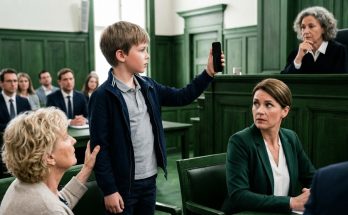
The first frame from my garage camera appeared on the courtroom screen.
It showed Noah walking into the garage alone.
He was carrying a small box of tools he had been
helping me organize earlier that afternoon. He looked completely calm.
Then Paul entered behind him.
The room went silent.
I could hear the projector humming.
Paul’s attorney stood and objected,
arguing that the footage had been taken on private property and
that the audio might be incomplete.
The judge overruled him.
“Continue.”
The prosecutor pressed play.
On the recording, Paul blocked the garage door.
Noah tried to walk around him.
Paul moved again.
Even without sound, I could see what was happening.
Noah wasn’t threatening him.
He wasn’t fighting him.
He was trying to leave.
Then the audio became clear.
Paul’s voice echoed through the garage.
“You think you’re better than everyone because your dad buys you expensive toys?”
Noah answered, “I don’t think that.”
“You just took something back from my son.”
“Because it belongs to me.”
Paul laughed.
“That’s what I mean. You’re spoiled.”
Noah stepped toward the door.
Paul stepped in front of him.
“Where are you going?”
“I’m going inside.”
“You’re going to apologize.”
“No.”
The courtroom heard the word clearly.
No.
Paul reached for the baseball bat leaning against the workbench.
Noah immediately backed away.
“Uncle Paul, put that down.”
Paul raised it.
Noah lifted his hands.
“I said put it down.”
Then Paul swung.
The sound of the impact came through the courtroom speakers.
Maria covered her mouth.
My mother began crying.
Not because the footage was shocking.
Not because her grandson had been nearly beaten to death.
She was crying because the story she had spent six months defending had just collapsed in front of her.
The prosecutor paused the video.
The frame showed Paul standing over Noah.
The bat was still in his hand.
Then the prosecutor played the next few seconds.
Paul looked toward the camera.
He had noticed it.
He stared directly at the lens.
Then he turned back toward Noah.
“You better not tell them I hit you,” he said.
The courtroom went completely still.
The prosecutor stopped the video.
He turned toward the jury.
“That is the defendant’s own voice.”
Paul’s attorney leaned toward him and whispered something.
Paul shook his head.
For the first time since the attack, he looked genuinely frightened.
But the prosecutor wasn’t finished.
He introduced photographs taken immediately after the incident.
Noah’s injuries.
The damaged concrete where he’d fallen.
The bat.
The hospital scans.
Then came the medical testimony.
The orthopedic surgeon explained that Noah had suffered major fractures around his pelvis and hip region, along with additional injuries caused by the impact and fall.
He said Noah would need months of physical therapy and that injuries of that severity at fourteen could have lasting effects.
I stared at the floor.
I had heard those words before.
But hearing them in court made something inside me burn.
Months.
Physical therapy.
Possible lasting effects.
All because my brother had decided a fourteen-year-old boy needed to be taught a lesson.
The prosecutor then presented another piece of evidence.
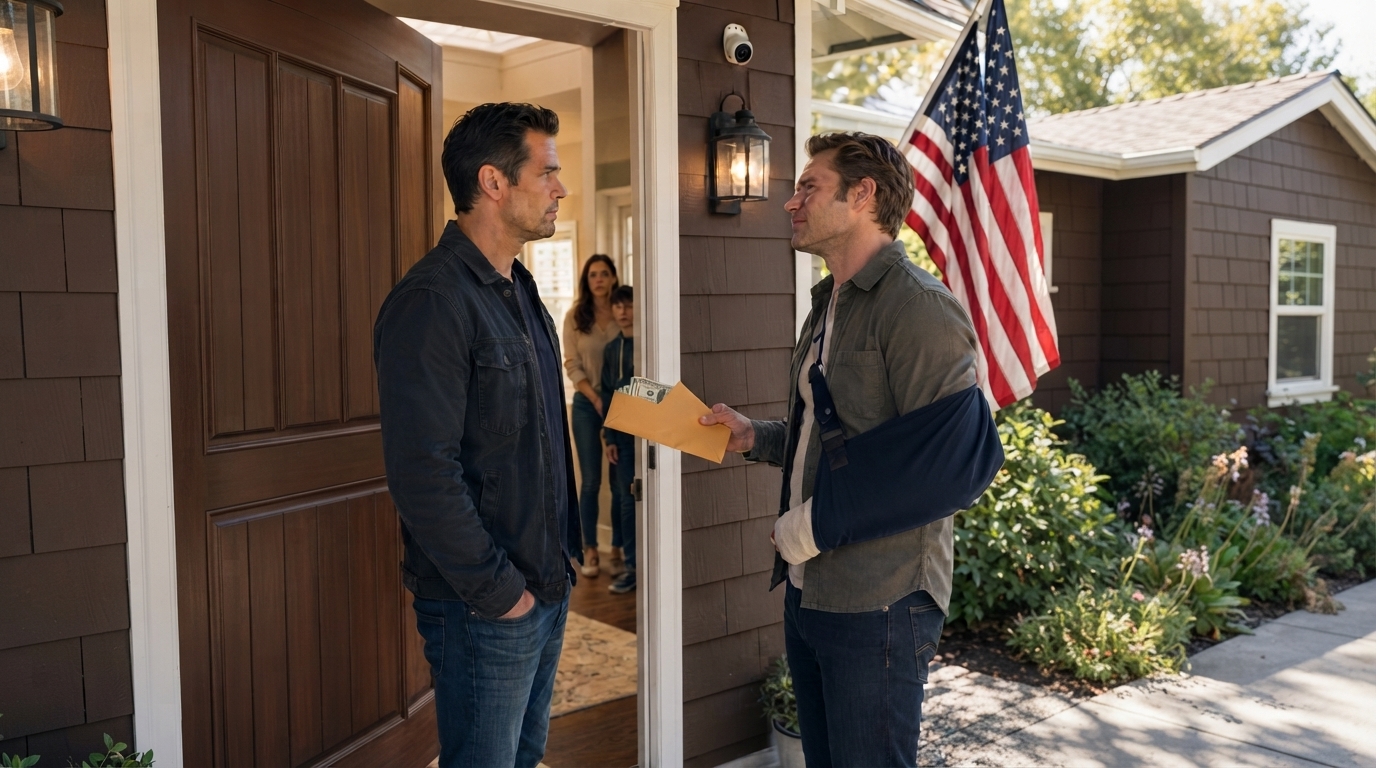
The envelope.
Ten thousand dollars in cash.
The judge examined it carefully.
The prosecutor explained that Paul had delivered the money after being ordered to stay away from Noah and our family.
He played the porch recording.
Paul’s voice filled the courtroom.
“You drop the charges. I cover the damage. Everybody wins.”
My voice answered him.
“You think you can buy silence?”
Paul’s response came immediately.
“I’m trying to keep this from destroying everybody.”
Then came the threat.
“Your business is going to suffer too, William. You think clients are going to want to work with a man who can’t even keep his family together?”
The prosecutor paused.
Then he asked, “Why was the defendant discussing your business when the alleged purpose of the payment was to help with medical bills?”
I looked at Paul.
He wouldn’t look back.
The judge ordered a recess.
Outside the courtroom, reporters were waiting.
I didn’t speak to them.
Neither did Maria.
We just walked through the courthouse doors and got into our car.
Noah had been watching the trial from a private room with a victim advocate. He didn’t want to sit in the courtroom all day, and we hadn’t forced him.
When we got home, he was waiting in the living room.
He looked thinner than he had before the attack.
His physical therapy had strengthened him, but he still moved carefully.
He looked at me.
“Did they play it?”
I nodded.
He swallowed.
“All of it?”
“Yes.”
He looked down.
“Good.”
That was all he said.
I sat beside him.
“Are you okay?”
He shrugged.
“I don’t know.”
Then he asked the question that broke my heart.
“Why didn’t Grandma believe me?”
I had no good answer.
So I told him the truth.
“She should have.”
He looked at me.
“But she didn’t.”
“No,” I said. “She didn’t.”
He was quiet for a moment.
Then he leaned against my shoulder.
That night, Maria and I sat at the kitchen table long after the kids had gone to bed.
She looked exhausted.
“We can’t keep doing this.”
“I know.”
“For years, you’ve told me your parents weren’t easy.”
“They weren’t.”
“But this was different.”
I nodded.
Maria stared at the table.
“They saw their grandson on the floor and still chose Paul.”
I didn’t answer.
Because she was right.
What happened in the garage wasn’t the beginning of the problem.
It was the moment the problem became impossible to ignore.
The next morning, my father called.
I almost didn’t answer.
When I did, there was no greeting.
“You’ve embarrassed us.”
I closed my eyes.
“Dad, Noah was almost killed.”
“He wasn’t killed.”
The words hit me harder than I expected.
“He suffered major fractures.”
“And Paul made a terrible mistake.”
“A terrible mistake?”
“He lost his temper.”
“He picked up a baseball bat.”
My father’s voice hardened.
“Don’t talk to me like I’m some stranger.”
“You stopped being my father the moment you asked me to protect Paul’s reputation instead of my son.”
Silence.
Then he said something I would remember forever.
“You are destroying this family.”
I looked through the kitchen window.
Maria was standing near the sink.
Noah’s crutches were beside the back door.
“My family is still here,” I said.
Then I hung up.
My mother called three hours later.
She cried.
She said Paul had always struggled.
She said he needed support.
She said prison would ruin his life.
I listened.
Then I asked her one question.
“What do you think happened to Noah’s life?”
She went quiet.
I could hear her breathing.
“I love him,” she whispered.
“Then why didn’t you defend him?”
“I was trying to keep peace.”
“No, Mom.”
My voice shook.
“You were trying to keep Paul comfortable.”
She started crying harder.
I ended the call.
For the first time in my life, I didn’t feel guilty.
I felt clear.
The trial continued for several days.
The prosecutor called neighbors.
He called the officers who arrived that night.
He called the emergency medical team.
He called the orthopedic surgeon.
He called me.
Then he called Maria.
Then came the most difficult testimony of all.
Noah asked if he could speak.
We hadn’t expected it.
His attorney advised him he had the right to avoid testifying because of his age and the trauma involved.
But Noah insisted.
He wanted Paul to hear him.
The courtroom doors opened.
Noah walked in slowly.
My heart nearly stopped.
Paul looked at him.
Noah sat down and answered the prosecutor’s questions.
He explained what happened.
He didn’t exaggerate.
He didn’t shout.
He simply told the truth.
At one point, the prosecutor asked him, “Did you believe your uncle was going to hit you?”
Noah looked toward the defense table.
“Yes.”
“Why?”
“Because he had a bat.”
The prosecutor asked, “Did you do anything to provoke him?”
“No.”
“Did you threaten him?”
“No.”
“What did you do?”
Noah looked at the jury.
“I tried to leave.”
That sentence hung in the courtroom.
I looked at my brother.
For the first time, I didn’t see the golden child.
I saw a man who had made a choice.
And now he had to live with it.
When Noah left the courtroom, Maria hugged him.
My father was sitting behind the defense table.
He looked smaller than I had ever seen him.
But he still didn’t apologize.
Not that day.
Not the next.
Not even after the verdict.
The jury deliberated.
And while they were gone, my mother approached me in the hallway.
She looked older.
Much older.
“William.”
I stopped.
She reached for my arm.
“I should have believed him.”
I said nothing.
“I know that doesn’t fix anything.”
“No.”
“I thought if I kept Paul out of prison, I could keep our family together.”
I looked at her.
“You kept the wrong person safe.”
She began to cry.
“I know.”
I wanted to be angry.
Part of me still was.
But standing there, I realized something.
I could forgive her someday.
But forgiveness would never mean pretending this didn’t happen.
It would never mean allowing Paul back into my children’s lives.
It would never mean becoming the version of myself who kept swallowing pain just to make everyone else comfortable.
A courtroom officer opened the doors.
“The jury is back.”
We all stood.
The judge entered.
Everyone sat.
The foreperson rose.
Paul looked straight ahead.
The verdict was read.
Guilty.
On every charge the jury had considered.
Maria squeezed my hand.
I closed my eyes.
I didn’t feel victorious.
I felt tired.
Then I looked at Noah.
He was crying.
I stood and hugged him.
“You did nothing wrong,” I whispered.
He nodded.
“I know.”
And for the first time since the attack, I believed that those words were finally reaching him.
The judge later imposed Paul’s sentence based on the offenses proven in court and ordered him to have no contact with Noah.
There was no dramatic outburst.
No shouting.
No movie-style confession.
Just a long silence after the sentence was read.
My father stood and followed Paul out.
My mother stayed behind.
She walked toward us.
“I don’t expect you to forgive me,” she said.
“You’re right.”
Her face crumpled.
“But I want to try to make things right.”
I looked at Noah.
Then at Maria.
Then back at my mother.
“You can start by telling the truth.”
She nodded.
So she did.
That evening, she admitted to relatives that Paul had not been “teaching a lesson.”
He had attacked his nephew.
She admitted my father had pressured me to drop the case.
She admitted they had cared more about their reputation than Noah’s safety.
Word spread through the family quickly.
The same relatives who had called me dramatic began calling me privately.
Some apologized.
Some claimed they had never known the full story.
A few tried to tell me they were staying neutral.
I didn’t argue.
I simply told them that neutrality was their choice.
Distance was mine.
PART 4
For years, my parents had presented themselves as the perfect family.
Sunday dinners.
Holiday photographs.
Birthday gatherings.
Smiling faces.
Matching stories.
Paul was the charming son.
I was the difficult one.
That narrative had worked for decades.
Until a camera recorded the truth.
Once the footage became part of the public court record, the family mythology started unraveling.
Relatives began telling me things I had never heard.
One cousin admitted Paul had broken a window during an argument years earlier.
Another said he’d once threatened her husband over money.
An uncle told me Paul had borrowed thousands of dollars and never repaid them.
Every story had the same ending.
My parents made excuses.
“He’s under pressure.”
“He’ll grow out of it.”
“He needs support.”
“He’s family.”
Apparently, “he’s family” had always meant something very different when the person being harmed wasn’t Paul.
Then something unexpected happened.
My father asked to meet me alone.
I almost refused.
But Maria said, “Go hear what he has to say. You don’t owe him forgiveness. Just hear him.”
We met at a diner halfway between our houses.
He looked tired.
Not sad.
Not guilty.
Just tired.
He stirred his coffee for several minutes without drinking it.
Finally, he said, “I failed both my sons.”
I didn’t respond.
“I treated Paul like he could do no wrong.”
“Yes.”
“And I treated you like you should always understand.”
“Yes.”
He looked at me.
“I thought because you were stronger, you could handle more.”
I leaned back.
“That wasn’t strength, Dad. That was neglect.”
He nodded slowly.
“I know.”
For the first time, he didn’t make an excuse.
He didn’t say Paul was stressed.
He didn’t say I misunderstood.
He didn’t call it a family matter.
He simply admitted it.
Then he said something I wasn’t expecting.
“Your mother wants to meet with you and Noah.”
I shook my head.
“Not yet.”
“I understand.”
I studied him.
“You really do?”
He looked down.
“No.”
That honesty almost made me laugh.
He continued.
“But I’m starting to.”
That was the closest thing to an apology I had ever received from him.
Months passed.
Noah continued physical therapy.
Some days were good.
Some were terrible.
He struggled with pain.
He struggled with anger.
He struggled with the fact that someone he had trusted had become the person he feared.
But slowly, he improved.
He started walking longer distances.
Then he returned to school.
Then one Saturday morning, he asked me if we could go to the garage.
I froze.
“The garage?”
“Yeah.”
“Are you sure?”
He nodded.
We walked there together.
The baseball bat had been removed as evidence months earlier, but the place still looked exactly the same.
Noah stood in the doorway.
He looked around.
Then he smiled.
“Dad?”
“Yeah?”
“Can we build something?”
I smiled back.
“What?”
“A workbench.”
So we did.
We tore apart the old shelving.
We measured boards.
We drilled holes.
We sanded every surface.
Noah moved slowly, but he refused to let me do everything for him.
At the end of the day, we stood back and looked at the bench we’d built together.
It wasn’t perfect.
But it was ours.
Noah ran his hand over the smooth wood.
“Better.”
“Better than what?”
He looked around the garage.
“Better than before.”
I understood what he meant.
The garage was no longer where Paul had attacked him.
It was where Noah had rebuilt something.
Not just furniture.
Part of himself.
That night, Maria and I sat outside.
She looked at me and said, “He’s healing.”
“Yes.”
“So are you.”
I looked at her.
“I didn’t realize I needed to.”
“You did.”
She was right.
For so long, I had measured my life by how well I could keep my parents happy.
I had thought success meant proving myself.
Owning a company.
Building a house.
Providing for my family.
But none of that mattered if I still allowed people to hurt the people I loved just because they shared my last name.
I began changing things.
I stopped attending family gatherings where Paul was discussed as though he were the victim.
I removed relatives who kept sending messages asking whether I’d “consider reconciliation.”
I changed the locks.
I updated every emergency contact and legal document.
I made it clear that Noah’s safety wasn’t negotiable.
And something surprising happened.
My relationship with my parents became quieter.
Less dramatic.
Less angry.
Because we were finally dealing with reality.
My mother started coming over once every few weeks.
At first, she sat awkwardly at the kitchen table.
Eventually, she brought food.
Then she helped Noah with a school project.
She never asked him to forgive Paul.
That mattered.
One afternoon, she brought over an old photo album.
She sat across from Noah and said, “I want you to know something.”
He looked up.
“You don’t have to forgive me.”
Noah stayed silent.
“But I was wrong.”
He nodded.
She opened the album.
There was a picture of Paul as a teenager.
Then another.
Then another.
Paul smiling beside my parents.
My mother stared at them.
“I spent years making excuses for him.”
She closed the album.
“I thought that was what a mother was supposed to do.”
Noah looked at her.
“Protect him?”
She swallowed.
“Yes.”
“Even when he hurts somebody?”
My mother shook her head.
“No.”
Then she looked him directly in the eyes.
“I was wrong.”
Noah didn’t hug her.
He didn’t forgive her.
He simply said, “Okay.”
And for her, that was enough.
Because she had finally stopped asking for the easy answer.
PART 5
A year after the attack, Maria planned another birthday barbecue.
The idea terrified me.
Not because I expected Paul.
He was still serving his sentence.
Not because I expected my parents to cause a scene.
Things were different now.
I was afraid because the date itself carried too much weight.
My fortieth birthday would always be the day my son was attacked.
The day my parents chose the family image over their grandson.
The day I finally stopped pretending that keeping peace was the same thing as having a family.
But Maria insisted.
“It’s your birthday,” she said.
“And?”
“And you’re allowed to make it belong to something else.”
So we invited a few close friends.
Some coworkers.
A couple of neighbors.
My parents.
No extended family circus.
No speeches.
No pretending.
Just people who had earned a place at our table.
Noah was outside with a group of friends when I walked into the backyard.
He was wearing a baseball cap.
I stopped.
For one second, my stomach tightened.
Then I noticed what he was doing.
He was throwing a baseball.
Not hard.
Not fast.
Just gently tossing it back and forth with one of his friends.
I watched from the porch.
He caught the ball.
Smiled.
Threw it back.
I felt something inside me release.
Maria came up beside me.
“He wanted to do it.”
“I know.”
“He said he didn’t want that day to own him.”
I looked at her.
“He said that?”
She smiled.
“He said, ‘I don’t want Uncle Paul to be the most important thing that ever happened on my birthday.’”
I laughed.
Then I cried.
Not because I was sad.
Because my son had become stronger without becoming cruel.
That mattered more to me than anything.
Later that evening, my mother arrived.
She stood near the gate for a moment before coming in.
In her hands was a wrapped box.
She handed it to me.
“Open it later.”
I raised an eyebrow.
“Now.”
She smiled nervously.
So I opened it.
Inside was an old family photograph.
The original.
Not a copy.
It showed me at ten years old.
Paul at fourteen.
My father behind us.
My mother beside us.
We were all smiling.
I turned the photograph over.
Written on the back were four words.
“Before we stopped seeing.”
I looked at my mother.
She was crying.
“I found that in an old drawer,” she said.
“What does it mean?”
She took a breath.
“It means I finally understand that families don’t fall apart all at once.”
She looked toward Noah.
“They fall apart every time someone is hurt and everyone else chooses silence.”
Nobody spoke.
Then my father walked into the yard.
He looked at Noah.
“Happy birthday, son.”
Noah hesitated.
Then he nodded.
“Thanks.”
My father looked at me.
“I should have protected him.”
I nodded.
“Yes.”
“I should have protected you too.”
I said nothing.
He lowered his eyes.
“I know saying that now doesn’t change anything.”
“No.”
“But I’m saying it anyway.”
We stood there for a moment.
There was no magical reconciliation.
No instant healing.
No pretending the last year hadn’t happened.
Just truth.
And sometimes truth is where rebuilding starts.
When everyone had left, Noah came over.
He looked at me.
“You okay?”
“Yeah.”
He held out the baseball.
“Your turn.”
I smiled.
We walked toward the far end of the yard.
He tossed it gently.
I caught it.
I tossed it back.
For a moment, everything was simple.
A father.
A son.
A baseball.
A birthday.
No lawyers.
No police.
No courtroom.
No family secrets.
Just us.
I thought about that day in the garage.
How quickly one decision had changed everything.
How close I had come to losing my son.
How easily my parents had tried to turn violence into discipline because admitting the truth would have destroyed the family image they had spent decades protecting.
But in the end, it wasn’t me who destroyed their “perfect family.”
The truth did that.
The truth that appeared on a security camera.
The truth spoken by a fourteen-year-old boy.
The truth that refused to be buried beneath excuses.
For forty years, I had been told that family meant forgiveness.
Now I understood something different.
Family means protection.
Family means accountability.
Family means believing someone when they are hurt.
And sometimes protecting your child means walking away from the people who insist that your child doesn’t matter enough.
I didn’t destroy my family that day.
I finally discovered which parts of it were real.
And as I threw the baseball back to Noah under the evening sky, I realized that whatever happened next, nobody would ever again convince me that protecting my son was something I should apologize for.
That was the birthday gift I had been given.
Not money.
Not business success.
Not my parents’ approval.
The courage to stop confusing blood with loyalty.
And the freedom to build a family where nobody had to earn the right to feel safe.
THE END THANK YOU FOR READING !!!