PART 3
Ms. Harlo closed the photograph folder.
“This is not just about hair.”
I stared at her.
“I know what you’re going to say.”
“No, you don’t.”
She picked up the photograph showing the cut above my daughter’s ear.
Your daughter is six years old. An adult took her somewhere
for what you were told was a recreational afternoon.
During that time, your daughter’s appearance was changed without your permission,
she was injured, and she was told the change was necessary
because her hair was somehow unfair to another child.
She paused.
“That matters.”
I swallowed.
“What do I do?”
“First, your daughter needs to be seen by a pediatrician and the injury documented.”
“She already saw one.”
“Good. Keep the records.”
“I have photographs.”
“Keep those too.”
She opened a new file.
“And you need to stop thinking about this as a family disagreement.”
I looked at her.
“What should I think about it as?”
“A boundary violation involving a child.”
That sentence hit differently.
For years, I had let Karen turn every problem into a personality conflict.
She was competitive.
She was difficult.
She had a sharp tongue.
She liked control.
She was dramatic.
I had used every softer word I could find because the harsher words required decisions.
Now I didn’t have that luxury.
Ms. Harlo asked me to describe exactly what happened from the moment I dropped my daughter off.
I told her everything.
The yellow dress.
The purple duffel.
The stuffed rabbit.
The braid.
The time I dropped her off.
The time Karen’s car left.
The pink bucket hat.
The way my daughter had walked toward me.
The first thing she said.
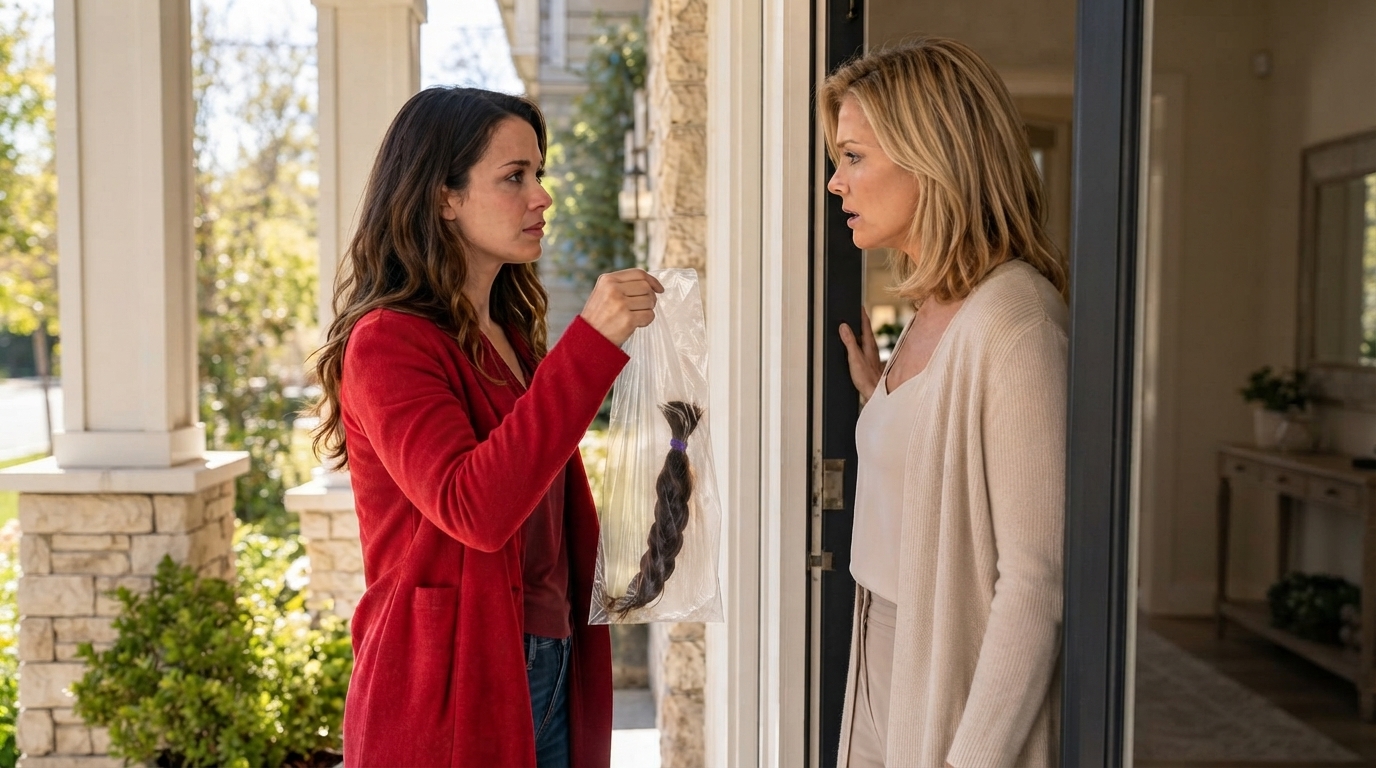
The bag containing the braid.
The cut above her ear.
The exact words she used.
Ms. Harlo wrote all of it down.
Then she asked:
“Did your daughter ever say Karen had permission to cut her hair?”
“No.”
“Did you give Karen permission?”
“No.”
“Did Reed?”
“No.”
“Did anyone?”
“No.”
“Did Karen claim she had permission?”
“She said she was fixing it.”
Ms. Harlo looked at me.
“That’s different.”
“I know.”
“Did she say why?”
I told her.
“She said Blair was uncomfortable because my daughter’s hair was prettier.”
Ms. Harlo stopped writing.
“Exact words?”
“As close as I can remember.”
“Write them down while they’re fresh.”
I opened my phone.
I wrote everything.
Every phrase.
Every detail.
Every pause.
Every reaction.
It felt strange.
Like I was turning my daughter’s pain into paperwork.
But I understood what Ms. Harlo was teaching me.
Pain gets minimized when it lives only in memory.
Paper doesn’t forget.
When I returned home, Reed was waiting in the living room.
He had barely spoken since the night before.
He looked at me.
“What did the attorney say?”
“She thinks this is serious.”
He nodded.
“I agree.”
I sat down.
“Reed, I need you to answer something.”
“Okay.”
“Did you ever give Karen permission to change Emory’s hair?”
“No.”
“Did she ever ask?”
“No.”
“Did you know she wanted to?”
“No.”
“Did you think something like this was possible?”
He rubbed his forehead.
“No.”
I watched him carefully.
He looked ashamed.
“I kept telling you Karen would never intentionally hurt her.”
“Yes.”
“I was wrong.”
“Yes.”
That was the first time in years he didn’t explain his sister.
He didn’t say she was stressed.
He didn’t say she meant well.
He didn’t say she was joking.
He just said he was wrong.
My daughter came downstairs.
She had one of my old oversized sweaters wrapped around her.
Her hair was uneven.
The little wound above her ear had been cleaned and covered.
She looked at us.
“Can I sit?”
I stood immediately.
“Of course.”
She curled beside me.
Reed sat across from us.
He stared at her hair.
“I’m sorry, Emory.”
She looked at him.
“For what?”
He swallowed.
“For not making sure you were safe.”
She looked confused.
“You didn’t do it.”
“No.”
“But you didn’t stop it.”
His eyes filled.
“No.”
She thought for a second.
Then asked:
“Are you mad at Aunt Karen?”
He looked at me.
“Yes.”
“Why?”
“Because she hurt you.”
Emory touched the side of her head.
“It was just hair.”
I froze.
Those were Karen’s words.
She had repeated them.
Like a child repeating something an adult has told her to believe.
I took her hand.
“It wasn’t just hair to you.”
She nodded.
“I liked it.”
“I know.”
“It was princess hair.”
“I know.”
She started crying.
“I didn’t want her to cut it.”
I pulled her close.
“You never had to let her.”
“I told her no.”
My entire body went still.
“What?”
She looked at me through tears.
“I said no.”
I stared at Reed.
He closed his eyes.
Ms. Harlo had asked whether my daughter had consented.
Now we knew.
She hadn’t.
I asked gently:
“What did Aunt Karen say when you said no?”
Emory sniffed.
“She said I was being selfish.”
My hands tightened.
“Then what?”
“She said Blair was crying.”
“And?”
“She said I had too much.”
“Too much what?”
“Hair.”
My daughter wiped her face.
“She said Blair was supposed to be the pretty one.”
Silence.
The room felt cold.
Reed stood abruptly.
“I’m calling my sister.”
I grabbed his wrist.
“No.”
He looked at me.
“Why?”
“Because she needs to talk to the attorney.”
“But—”
“We don’t confront her.”
He stared.
“Why?”
“Because I don’t want one angry conversation to become the story.”
He slowly nodded.
I was learning.
This wasn’t about winning an argument with Karen.
It was about making sure the truth couldn’t be rewritten.
The next morning, Ms. Harlo sent a formal notice to Karen.
No unsupervised contact with Emory.
No direct contact concerning the incident.
No communication about the legal matter.
And no further visits with the child unless agreed to in writing.
Karen responded within nineteen minutes.
Her message was short.
“This is absurd.”
Then:
“I gave her a cute haircut.”
Then:
“Children don’t own their appearance.”
Then:
“Delaney is turning a family moment into a legal circus.”
Ms. Harlo saved every message.
We did too.
Karen then called Reed.
He didn’t answer.
She called again.
Then again.
By lunch, she had called sixteen times.
At 2:14 p.m., she sent him a message.
“Your wife is destroying this family.”
At 2:19:
“Blair is devastated.”
At 2:23:
“I was trying to make the girls feel equal.”
At 2:31:
“She was going to outgrow that hair anyway.”
At 2:42:
“I cannot believe you are letting Delaney do this to me.”
Every message contradicted the last.
She had said it was accidental.
Then intentional.
Then necessary.
Then a joke.
Then equality.
Then a gift.
The more she explained, the more she revealed.
Ms. Harlo noticed.
“This is useful.”
I hated hearing that.
Nothing about it felt useful.
It felt like watching someone I had known for years unravel in real time.
Then the school called.
They wanted to know why Emory had come in with a different haircut and a bandage.
I explained.
The school counselor asked if Emory had told anyone else.
I said yes.
She had told one teacher that Aunt Karen had “fixed” her because Blair didn’t like her hair.
The teacher had documented it.
I felt sick.
There were now records.
Not just mine.
Not just Reed’s.
Not just the doctor’s.
A teacher had heard the same story from a six-year-old who had no idea what a legal dispute was.
The school counselor told me they would keep an eye on her.
I thanked her.
That evening, I opened the plastic bag again.
The braid was still there.
Purple elastic at the end.
I could still smell the detangling spray.
It was ridiculous how such a small object could carry so much grief.
I remembered morning after morning.
Emory on my bed.
Her little feet swinging.
“Are you almost done?”
“Yes.”
“Can I have the purple one?”
“Which purple one?”
“The sparkly one.”
“The sparkly one it is.”
She would look at herself in the mirror.
“Princess hair.”
“Princess hair.”
Three years.
Three years of building something she loved about herself.
Karen had cut it because she decided another child deserved it less.
That was the part I couldn’t stop thinking about.
Not the haircut.
The reason.
Jealousy.
Comparison.
Punishment disguised as fairness.
I called Ms. Harlo.
“I want to know everything about Karen’s daughter.”
There was a pause.
“What do you mean?”
“I need to understand the pattern.”
“We can look at relevant family records, but we’re not going to dig into a child who isn’t part of the dispute.”
“I know.”
I didn’t want to hurt Blair.
She was six too.
She had not asked for any of this.
She wasn’t responsible for her mother’s choices.
But I wanted to know whether Karen had been saying things to the girls.
Ms. Harlo said:
“Let’s focus on documented interactions.”
So I did.
And then we found them.
Birthday photos.
Messages.
School holiday invitations.
Family group chats.
I had thought Karen simply favored Blair.
The evidence showed something more deliberate.
She frequently compared the girls.
“Blair is so careful.”
“Emory is a little wild.”
“Blair has such beautiful hair.”
“Emory would look nice with something easier.”
“Blair photographs better.”
“Emory needs to learn that not everything is about her.”
At the time, each comment had felt small.
Now they formed a clear pattern.
Then came the photos.
Karen had taken pictures during the spa day.
She posted one privately to the family chat.
Blair sat smiling.
Emory sat beside her.
Her hair was already cut.
The photo had been taken before Karen sent her home.
Under the photo Karen had written:
“Much better balance now.”
My stomach turned.
I sent it to Ms. Harlo.
She called immediately.
“Don’t respond.”
“I wasn’t going to.”
“Good.”
Then another message appeared.
From Karen.
“Maybe now you’ll stop making her feel like she’s better than Blair.”
I stared.
She had finally said it.
That was the thing she had been afraid of all along.
She thought my daughter being praised made Blair smaller.
So she cut her down.
Literally.
Emotionally.
Publicly.
I didn’t answer.
Reed read it.
His face went pale.
“She really thought they were competing.”
“They weren’t.”
“I know.”
He sat down.
“Delaney.”
“What?”
“I don’t know how to fix this.”
“You can’t.”
He nodded.
“I know.”
“But you can decide what happens next.”
He looked at me.
“I already did.”
I waited.
“No more unsupervised family visits.”
I nodded.
“Ever?”
“Until I see a reason to reconsider.”
“That may be forever.”
He swallowed.
“Then it’s forever.”
That was the first time I saw my husband choose our daughter without hesitation.
I wish it hadn’t taken an injury to make that happen.
A week later, Karen requested a meeting.
Ms. Harlo advised against it unless counsel was present.
We agreed to a formal mediation session.
Karen arrived with her attorney.
She wore a cream suit.
Perfect hair.
Perfect makeup.
Perfect smile.
If someone looked at her without context, they might have thought she was there to solve a disagreement about a birthday invitation.
Then she saw the thick evidence binder on the table.
The smile disappeared.
She turned to her attorney.
“What is all this?”
He leaned toward her.
“Documents.”
She looked at me.
“You are really doing this.”
I said nothing.
Her attorney spoke.
“We understand there was an incident involving a haircut.”
“Incident?” I asked.
Karen cut in.
“It was not an incident.”
She looked at me.
“It was a haircut.”
I held her gaze.
“My daughter told you no.”
Karen crossed her arms.
“She was being difficult.”
“She was six.”
“Exactly.”
“So you ignored her.”
“She doesn’t get to dictate every adult decision.”
“She gets to dictate what happens to her body.”
Karen looked irritated.
“Hair isn’t her body.”
The room went quiet.
Even her attorney looked uncomfortable.
I leaned back.
“Then why did you need to cut it?”
She had no answer.
Her attorney asked her to stop speaking.
That was the first time I saw her lawyer realize he had a problem.
Because the problem wasn’t the haircut.
It was the reasoning.
Karen believed that because she was an adult, she had the right to override my daughter.
That belief explained every detail.
The comparison.
The jealousy.
The punishment.
The haircut.
The comments.
The photographs.
The cover-up.
The lawyer asked if Karen would agree never to cut or alter Emory’s appearance again without parental consent.
She resisted.
“She isn’t dangerous.”
“That is not the standard.”
Karen looked at me.
“You’re trying to make me sound dangerous.”
“No.”
“You are.”
“No.”
I opened my daughter’s drawing folder.
Emory had drawn a picture after the incident.
It showed three people.
Her.
Me.
Reed.
And off to the side was Karen.
There was a red line between them.
Under the picture, Emory had written:
“Auntie doesn’t get to change me.”
I slid the paper across the table.
Karen stared at it.
For the first time, she looked ashamed.
Then she said:
“She doesn’t understand.”
I answered:
“She understands more than you think.”
The mediation ended with strict boundaries.
No unsupervised access.
No physical alterations.
No posting images of Emory.
No discussing the legal dispute with either child.
No comparisons.
No gifts tied to behavior.
No “lessons” involving appearance.
Karen signed.
But on the way out, she looked at me.
“You’re breaking this family over a haircut.”
I stood.
“No.”
I looked at her.
“You broke something when you decided my daughter had to be smaller so another child could feel bigger.”
She left without answering.
PART 4
The formal boundaries should have ended it.
They didn’t.
Karen started telling relatives a different story.
She said I had overreacted.
She said Emory had asked for the haircut.
She said I was using the incident to get attention.
She said Reed was being manipulated.
She said the lawyer was making everything sound worse.
The family divided.
Some believed her.
Some didn’t.
A few stopped responding.
One aunt called me.
“I think Karen made a terrible mistake.”
I thanked her.
Then she said:
“But she’s still your sister-in-law.”
I waited.
“And?”
“You should find a way to move past this.”
That sentence used to work on me.
Not anymore.
I asked:
“If your granddaughter said no to an adult who was cutting her hair, would you want the adult to stop?”
There was silence.
“Yes.”
“Then why is my daughter different?”
The aunt didn’t answer.
We ended the call.
It was strange how quickly people understood once you changed the subject from family feelings to a child saying no.
Meanwhile, Emory’s hair began growing back.
Not quickly.
But enough.
She hated looking in mirrors.
She kept asking whether it would become long again.
I promised it would.
One evening, she asked:
“Mom, was my hair too pretty?”
I knelt.
“No.”
“Then why did she say it?”
“Because she was comparing you to someone else.”
“Was Blair jealous?”
“I don’t know.”
Emory frowned.
“Am I supposed to make myself less pretty?”
My heart broke.
“No.”
“Why not?”
“Because you never have to become smaller to make someone else feel better.”
She stared at me.
“Even if Grandma says?”
“Even then.”
“Even Aunt Karen?”
“Especially then.”
She smiled.
“Good.”
That conversation became one of the most important conversations of her childhood.
The issue wasn’t hair.
It was permission to exist fully.
I realized how many girls learn the opposite.
Be less loud.
Less bright.
Less beautiful.
Less successful.
Less talented.
Don’t make someone else uncomfortable.
Don’t outshine your friends.
Don’t wear too much.
Don’t speak too much.
Don’t be too much.
Karen had taught that lesson to a six-year-old in one afternoon.
I was determined that Emory would unlearn it.
Then came the surprise.
A week before Christmas, Karen mailed Emory a box.
I didn’t open it.
I brought it to Ms. Harlo.
She said:
“Document it.”
I photographed the box.
Then opened it with Reed beside me.
Inside was a pink hat.
A hairbrush.
And a letter.
The letter said:
“I know you’re upset. Sometimes adults have to make hard choices for children.”
There was no apology.
No acknowledgment.
Just another justification.
Then:
“Your hair will grow back.”
I felt sick.
She still didn’t understand.
I put the letter away.
We didn’t give the gifts to Emory.
But the box itself became another document.
Then something happened that changed the situation.
Blair’s school counselor contacted us.
Not because Blair had done anything.
Because Blair had begun expressing fear that her mother was angry whenever Emory received attention.
The counselor had heard Blair say:
“If Emory gets something pretty, Mommy gets mad.”
I sat silently on the phone.
My heart broke for that child too.
I asked what I could do.
The counselor said:
“Be careful not to pull Blair into the adult conflict.”
“I will.”
That night, I told Reed.
He looked devastated.
“She did this to both girls.”
“Yes.”
Karen’s obsession with comparison wasn’t protecting Blair.
It was teaching Blair that love depended on winning.
That was worse than I had realized.
Karen wasn’t simply trying to make my daughter smaller.
She was teaching her own daughter to fear anyone who stood out.
The family attorney recommended a child-focused approach.
We stopped using the word “favoritism” around the children.
We stopped discussing Karen’s motives.
We focused on boundaries and safety.
That helped.
Emory slowly became herself again.
She started wearing headbands.
Then clips.
Then eventually, no hat.
One morning, she looked in the mirror.
“Mom?”
“Yes?”
“I don’t hate my hair anymore.”
I smiled.
“Good.”
“It’s growing.”
“Yes.”
“Can we do the braid again?”
I almost cried.
“Of course.”
She sat on the edge of my bed.
I sprayed detangler.
Separated the strands.
And made the braid.
When I finished, she touched it.
“Princess hair.”
I kissed the top of her head.
“Princess hair.”
Then she stood.
“I’m ready.”
Those were the same words she had said for years.
And hearing them again felt like getting part of her childhood back.
The legal situation continued.
Karen tried to challenge the restrictions through family mediation.
The mediator asked us to consider reconciliation.
We said reconciliation could happen only if there was accountability.
Karen said she had already apologized.
She hadn’t.
She had explained.
She had justified.
She had minimized.
Those were different.
At one meeting, the mediator asked:
“Karen, what do you believe you did wrong?”
Karen sighed.
“I cut her hair.”
“What else?”
“I suppose I should have asked first.”
“Anything else?”
She hesitated.
“I upset Delaney.”
I looked at her.
The mediator repeated:
“Anything else?”
Karen looked down.
“I suppose I compared the girls.”
“And?”
She didn’t answer.
Finally, she whispered:
“I made Emory feel less than.”
That was the first real acknowledgment.
I felt tears in my eyes.
Not because everything was fixed.
Because something true had finally been said.
The mediator asked:
“How will you prevent that from happening again?”
Karen answered:
“I will stop comparing the children.”
“And if Emory says no?”
Karen paused.
“I will stop.”
That was the beginning.
Not forgiveness.
Accountability.
The new agreement allowed brief supervised contact.
I sat nearby the first time.
Karen brought a coloring book.
No comments about hair.
No gifts for Blair that excluded Emory.
No comparisons.
No pressure.
She asked Emory what she wanted to draw.
Emory said:
“Flowers.”
Karen smiled.
“Can I draw one too?”
Emory looked at her.
“Okay.”
They drew flowers.
It was ordinary.
That was the point.
No dramatic scene.
No forced hug.
No speech about family.
Just an adult learning to accept a child’s answer.
When we left, Emory asked:
“Can Aunt Karen cut my hair again?”
“No.”
Karen heard.
She nodded.
“Never without permission.”
Emory looked at her.
“Okay.”
That was enough.
But then Karen made another mistake.
She posted a photograph of the supervised visit.
Emory’s face was visible.
The caption read:
“Family healing.”
I saw it ten minutes later.
I called Ms. Harlo.
She was furious.
“Did she have permission?”
“No.”
“Remove it immediately.”
I messaged Karen.
“Take the photo down.”
She replied:
“I thought it was positive.”
“Remove it.”
She did.
But the damage was already done.
We documented it.
The supervised visits stopped temporarily.
Karen accused me of trying to punish her.
I answered:
“No.”
Then:
“I’m enforcing the boundary you agreed to.”
The lesson repeated.
Good intentions do not erase broken agreements.
That became the final condition.
If Karen wanted a relationship with Emory, she had to follow the rules consistently.
Not when someone reminded her.
Not when she was afraid of consequences.
Because she understood.
That was the only way trust could return.
Months passed.
Emory’s hair grew.
The wound healed.
Her confidence returned.
She began entering school pictures without hiding.
She asked for ribbons again.
She chose hairstyles again.
One morning, she stood on a chair in the bathroom and practiced braiding her own hair.
It was terrible.
The sections were uneven.
One strand was sticking sideways.
I laughed.
“It’s perfect.”
“No, it’s not.”
“It doesn’t have to be.”
She smiled.
“I’ll practice.”
That sentence stayed with me.
Practice.
Not perfection.
That was how healing actually worked.
Slowly.
Awkwardly.
Repeatedly.
And with permission to make mistakes.
A year after the haircut, our family gathered for a cousin’s birthday.
Karen was there.
Emory wore her hair in a long braid again.
Karen noticed.
She looked at it.
Then looked away.
She didn’t comment.
That small act of restraint was worth more than a hundred apologies.
Later, Emory approached her.
“Do you remember my hair?”
Karen nodded.
“Yes.”
“I like it long.”
“I know.”
“I’m growing it really long.”
Karen smiled.
“You should wear it however you like.”
Emory nodded.
“Okay.”
Then she ran back to me.
I watched Karen watch her go.
For the first time, she didn’t look jealous.
She looked thoughtful.
Maybe that was growth.
Maybe not.
But it was progress.
PART 5
Two years after the spa day, Emory was eight.
Her hair reached past her shoulders again.
She still called it princess hair.
She had started taking art classes.
She was loud when she was excited.
She talked too fast when she had an idea.
She wore bright colors.
She loved glitter.
She hated socks with seams.
She was completely herself.
Exactly as I wanted.
Karen had changed too.
Slowly.
She attended counseling.
She learned to catch herself before comparing the girls.
Sometimes she apologized before anyone asked.
She became careful around Emory.
Not distant.
Respectful.
There was a difference.
One afternoon, Karen asked me a question.
“How do I earn her trust back?”
I thought about it.
“You don’t.”
She looked surprised.
“You don’t earn it with one big gesture.”
“Then how?”
“You earn it every time she says no and you listen.”
Karen nodded.
“That makes sense.”
“It may take years.”
“I know.”
“Maybe longer.”
“I know.”
She accepted that answer.
That mattered.
Emory began seeing her occasionally.
Always with clear boundaries.
One Saturday, Karen asked:
“Would you like me to help braid your hair?”
Emory looked at me.
I said:
“Your choice.”
Emory looked back at Karen.
“Okay.”
Karen picked up the brush.
She was incredibly gentle.
She worked slowly.
When she finished, Emory touched the braid.
“Good.”
Karen smiled.
“Good.”
No one mentioned the past.
But we both remembered.
Afterward, Emory ran into the yard.
Karen stayed beside me.
“She trusts you again,” I said.
She shook her head.
“Not completely.”
“No.”
“I know.”
Then she smiled.
“Maybe that’s fair.”
It was.
Trust should not return simply because the person who broke it wants it back.
It should return because the person who broke it proves, over time, that they understand.
The family changed too.
The jokes about beauty stopped.
The comparisons stopped.
Relatives became more careful.
People started complimenting both girls.
They began asking what each child liked.
Not which one was prettier.
Not which one was more talented.
Not who had better hair.
They stopped turning children into scoreboards.
That was one of the most unexpected effects of the incident.
Everyone had seen what comparison could become.
And most people didn’t like it.
Even Blair changed.
She began telling her mother:
“Mom, Emory can have one too.”
“That’s okay.”
“You don’t have to buy me something because she got something.”
“I’m fine.”
“Then why are you upset?”
Those conversations were important.
Blair was learning too.
She wasn’t responsible for what Karen had done.
But she had been taught the same competitive framework.
Now that framework was being dismantled.
One Christmas, Karen handed identical envelopes to both girls.
Inside were art-store gift cards.
Emory looked at hers.
Blair looked at hers.
Then Blair said:
“Same.”
Karen smiled.
“Same.”
Emory laughed.
“That’s fair.”
Karen looked at me.
I smiled.
That was enough.
The old conflict became a reminder rather than an active wound.
Not forgotten.
Not erased.
Transformed.
Years later, I found the original plastic bag in a storage box.
The braid was still inside.
It had dried and faded.
The purple elastic had loosened.
I held it for a long time.
Then I showed it to Emory.
She was ten by then.
She stared at it.
“That used to be my hair?”
“Yes.”
“Why did you keep it?”
I thought about that.
“Because I wanted to remember.”
“Remember what?”
“How important it was to protect your voice.”
She nodded.
“Did I say no?”
“Yes.”
“Then why did she do it?”
“She thought being older meant she could decide.”
Emory frowned.
“That’s not how it works.”
“No.”
She smiled.
“You taught me better.”
I hugged her.
“I tried.”
She touched the braid.
“Can I keep it?”
I looked at her.
“Why?”
“Because I want to remember too.”
I gave it to her.
She placed it in a little box.
Then she closed the lid.
She didn’t cry.
She didn’t look angry.
She just moved on.
That was the moment I knew she was okay.
Not because she had forgotten.
Because the memory no longer controlled her.
One afternoon, years later, Karen asked if she could come to the Emory Center.
The building had grown from a small community project into a place where girls could take art classes, attend workshops, and learn about confidence and creative expression.
Karen stood at the entrance.
She looked around.
Then she saw the wall.
A quote was painted across it:
YOU NEVER HAVE TO BECOME SMALLER TO MAKE SOMEONE ELSE FEEL BIGGER.
Karen stopped.
She read it twice.
Then looked at me.
“You put this here because of me.”
“Yes.”
She nodded.
“I deserve that.”
I shook my head.
“It isn’t about you anymore.”
She looked around at the girls drawing, painting, laughing.
“I understand.”
That was the point.
It wasn’t about punishing her.
It was about giving children a different message.
One that my daughter needed.
One that Blair needed.
One that I wished someone had given me years earlier.
You don’t have to become smaller.
You don’t have to hide.
You don’t have to apologize for being beautiful.
You don’t have to dim yourself so someone else feels safe.
You don’t have to accept someone else’s definition of fairness.
Fairness does not mean cutting down the person who has more.
It means making room for both people.
That lesson changed Karen.
It changed me.
It changed Reed.
And it changed the girls.
One evening, Reed and I sat on the porch after the center closed.
He looked at me.
“Do you remember when you said you needed me to choose?”
“Yes.”
“I think that changed my life.”
“How?”
“I realized I had spent years choosing comfort.”
He looked toward the garden.
“Then I watched our daughter lose something because I had stayed quiet.”
I nodded.
“And?”
“I couldn’t do it anymore.”
He took my hand.
“I should have listened to you sooner.”
“You should have.”
He smiled.
“I know.”
That was enough.
We didn’t need to rewrite our marriage as perfect.
It wasn’t.
But it became stronger because we stopped pretending silence was kindness.
One day, Emory asked:
“Mom, what do you think family means?”
I thought about it.
“People who protect each other’s dignity.”
She smiled.
“That’s good.”
“Why?”
“Because then it isn’t about who wins.”
“No.”
“Or who gets more.”
“No.”
“Or who has prettier hair.”
I laughed.
“Definitely no.”
She hugged me.
“Then we’re good.”
Yes.
We were.
Good.
Not perfect.
Good.
Years later, Karen sat at our dining table during Thanksgiving.
Emory was twelve.
Her hair was halfway down her back.
Blair sat beside her.
The girls were laughing about something that had happened at school.
Karen listened.
Then Emory said:
“Aunt Karen, do you remember when you cut my hair?”
The table went quiet.
Karen looked at her.
“Yes.”
“I’m not mad anymore.”
Karen’s eyes filled.
“Thank you.”
“But I want you to promise something.”
“What?”
“You never do that to another kid.”
Karen swallowed.
“I promise.”
“Even if their hair is prettier?”
Karen smiled through tears.
“Especially then.”
Everyone laughed.
This time, it wasn’t cruel.
It was relief.
The kind of laughter that comes after a storm when everyone realizes the house is still standing.
I reached across the table.
Emory took my hand.
Her braid was tied with a purple elastic.
The same color.
Not the same one.
But close enough.
I looked at it.
And remembered the six-year-old girl on the porch in the pink hat.
The little girl who had said:
“Auntie said my hair wasn’t fair to Blair.”
The little girl who had whispered:
“I told her no.”
The little girl who had believed adults were allowed to decide everything.
And then I looked at the twelve-year-old sitting beside me.
Confident.
Loud.
Bright.
Whole.
She had learned something important.
No one gets to make you smaller for their comfort.
Not an aunt.
Not a friend.
Not a teacher.
Not a family member.
No one.
And if someone tries, your voice still belongs to you.
The incident had started with a braid in a trash bag.
It ended with a lesson that reached far beyond hair.
Karen learned that love isn’t ownership.
Reed learned that silence isn’t neutrality.
Blair learned that another girl’s beauty does not diminish her own.
I learned that peace without boundaries is not peace.
And Emory learned the most important lesson of all.
She never had to apologize for being herself.
The braid eventually went into a memory box.
The pink bucket hat disappeared.
The wound healed.
The hair grew back.
But the lesson stayed.
Not as bitterness.
As protection.
As confidence.
As a quiet rule in our family.
If someone says no, stop.
If someone is hurt, listen.
If someone shines, don’t dim them.
Make room.
And if you’re ever tempted to believe that another person’s beauty, talent, success, or happiness somehow takes something away from you, remember:
There is enough room for both of you.
No one has to lose for you to feel worthy.
No child should ever have to be cut down to make another child feel beautiful.
And no mother should ever have to choose between keeping the family peaceful and protecting her daughter.
Because sometimes protecting your child means ending the peace.
Sometimes it means collecting every photograph.
Every message.
Every date.
Every piece of evidence.
Sometimes it means saying:
Enough.
And sometimes, the quietest sentence becomes the most powerful one.
Not a threat.
Not revenge.
Just a boundary.
You do not get to do that again.
Years after the spa day, Emory stood in front of her mirror before school.
Her hair was long.
Her braid was neat.
A purple elastic held it at the end.
She looked at herself.
Then she smiled.
“Okay.”
I called from downstairs.
“Ready?”
She grabbed her backpack.
“Ready.”
She came running down the stairs.
I kissed her forehead.
“Princess hair?”
She grinned.
“Princess hair.”
Then she ran outside.
I followed.
And for one second, before she climbed into the car, I watched that braid swing behind her.
It wasn’t just hair.
It was three years of mornings.
It was a little girl’s favorite thing about herself.
It was her voice saying no.
It was the boundary an adult should have respected.
And eventually, it became something else.
Proof that she could lose something and still grow it back.
Not only hair.
Confidence.
Trust.
Joy.
Herself.
That is what Karen never understood.
You can cut a braid.
You can remove a ribbon.
You can change someone’s appearance.
But you cannot own their worth.
You cannot cut away their voice.
You cannot decide whether they belong.
And you cannot make yourself more beautiful by taking beauty from someone else.
That day on the porch, I thought I was protecting my daughter’s hair.
I was.
But I was also protecting something much bigger.
Her right to say no.
Her right to be different.
Her right to be beautiful without apology.
Her right to grow without being compared.
Her right to enter a room without wondering who wants her to be smaller.
And that was why the conversation could never again be dismissed as:
“Just hair.”
It was never just hair.
It was a six-year-old girl’s first lesson in whether adults would respect her boundaries.
And because I was there, because Reed finally listened, because the truth was documented, and because Emory never had to carry the blame, that lesson ended differently than Karen expected.
My daughter grew her hair back.
But more importantly, she grew up knowing this:
No one gets to cut pieces off you so they can feel whole.
Not your family.
Not your friends.
Not anyone.
You are already enough.
And you never have to become less for someone else to feel like more.
THE END THANK YOU FOR READING !!!