PART 3
Then she opened the file.
The first thing I saw was a property report.
The second was a bank statement.
The third was a document with a signature that made my stomach tighten.
I looked at my attorney.
“What am I looking at?”
Her name was Elaine Mercer.
She was in her early fifties, direct without being cold,
and had the unnerving habit of reading every
page twice before answering a question.
She turned the first document toward me.
“This is a title search.”
“I know what a title search is.”
“Then look at the highlighted section.”
I did.
The house was still titled solely in my name through the revocable trust.
Nothing surprising there.
Then I noticed another line.
A lien inquiry.
I looked closer.
“What’s this?”
Elaine took a breath.
“Someone attempted to use the property as collateral.”
I stared at her.
“For what?”
“A private business loan.”
“Who?”
She slid another page forward.
Trent’s name appeared.
I felt my chest tighten.
“He tried to borrow against my house?”
“Yes.”
“When?”
“Three months ago.”
I looked down at the date.
That was before he started ordering me around.
Before the beer.
Before the suitcase.
Before I left.
He had already been treating my property as though it belonged to him.
I asked the question I didn’t want answered.
“Did Paisley know?”
Elaine didn’t answer immediately.
“That depends on what you mean by know.”
I looked at her.
“Did she know he was trying?”
“There are communications between them about financing.”
She slid a transcript across the desk.
It was an email thread.
Paisley had written:
“Mom won’t agree if we tell her.”
Trent replied:
“She doesn’t have to agree if she doesn’t understand what we’re doing.”
My hands went numb.
I read the exchange again.
Then another message.
Paisley:
“We can call it a temporary line.”
Trent:
“Once it’s approved, we’ll move the business debt off the cards.”
Then:
“She trusts me more than she trusts paperwork.”
I looked up.
Elaine watched me carefully.
“They thought you didn’t understand your own documents.”
I laughed.
It came out hollow.
“I understood every word.”
“I know.”
She turned another page.
“This gets worse.”
A bank statement showed more than $31,000 in transfers from my retirement account over two years.
Not all of it had gone directly to Paisley or Trent.
Some payments had been disguised.
Car repairs.
Business consulting.
Furniture.
Household expenses.
Medical bills.
A credit card payment.
An insurance premium.
And one transfer labeled simply:
“Mom’s contribution.”
I stared.
“Contribution to what?”
Elaine pointed at a company name.
“Trent’s business.”
I looked at the amount.
Nearly $9,000.
“I never agreed to invest in his business.”
“You may not have.”
“What does that mean?”
Elaine tapped another line.
“The money was transferred from an account that you had given Paisley access to years ago.”
I closed my eyes.
I remembered that.
After Walter died, Paisley had helped me set up online banking.
I had been exhausted.
She had told me she could help pay a few bills.
I trusted her.
That access had apparently never been removed.
Elaine continued.
“There were forty-six transfers.”
“Forty-six?”
“Yes.”
“Over how long?”
“Twenty-four months.”
I stared at the spreadsheet.
Some were small.
$180.
$240.
$620.
Others were larger.
$2,000.
$3,500.
$5,400.
The pattern became obvious.
They weren’t asking me for money anymore.
They were taking it.
I looked at Elaine.
“Why didn’t my bank stop this?”
“Because the transfers were initiated through an account with authorized credentials.”
“So they looked legitimate.”
“Exactly.”
I felt sick.
The $600 a month I had been paying into the household.
The extra groceries.
The “one-time” emergency.
The money for the truck.
The deposit.
The repairs.
The countless little things I had blamed on bad budgeting.
They hadn’t been random.
They had been deliberate.
Then Elaine handed me the fourth page.
A handwritten list.
“What’s this?”
She looked at it.
“We found it in a digital file associated with Trent’s business.”
I read the heading.
Things Mom Pays For.
Underneath were categories.
House.
Utilities.
Groceries.
Insurance.
Vehicle.
Taxes.
And beside several entries were amounts.
My amounts.
Then one final line:
“Eventually refinance house and move.”
I stared at the page.
“Move where?”
“That part isn’t clear.”
I looked at the list again.
I felt a strange calm.
Not because I wasn’t hurt.
Because the confusion was gone.
I finally knew.
They hadn’t simply become entitled.
They had built a plan.
And I had been funding it.
I leaned back.
“What do I do?”
Elaine folded her hands.
“We stop them.”
“How?”
“Legally.”
She explained that because the house was in my trust, I retained control.
The attempted lien had not gone through.
The transfer had been denied.
The moving truck had no legal basis to remove my property.
My belongings remained mine.
The furniture remained mine.
The house remained mine.
And the financial transfers could be investigated.
I nodded.
“Then let’s investigate.”
The next week was a blur of paperwork.
Bank records.
Statements.
Receipts.
Emails.
Phone logs.
Digital account histories.
Every time we found something, we found another thing beneath it.
Trent had opened a business credit line using my address.
He had listed my household expenses as proof of financial stability.
Paisley had signed several documents as “property manager.”
She wasn’t.
She had no legal authority.
But she had been acting as if she did.
Then we found something unexpected.
A property-management agreement.
My signature appeared at the bottom.
I stared at it.
“I never signed this.”
Elaine nodded.
“I know.”
It was dated eight months earlier.
The agreement gave Paisley authority to manage the property.
She could collect rent.
Approve repairs.
Access financial information.
And, most importantly, represent herself as having an interest in the house.
My stomach turned.
“This is forged.”
“Yes.”
“Then why was it created?”
Elaine pointed to another page.
“Because it was used to support a loan application.”
I looked at the lender.
A small private finance company.
The loan amount?
$95,000.
The collateral?
My house.
The proposed borrower?
Trent.
And one of the guarantors?
Paisley.
My daughter had signed a guarantee based on a house she did not own.
She wasn’t just helping Trent.
She was putting herself on the line to take control of my property.
Then I noticed the date.
The loan application had been submitted a week after Paisley told me:
“Mom, we’re trying to get our finances together.”
I laughed softly.
I remembered answering:
“I hope you do.”
I had no idea she was doing it with my house.
Elaine sat quietly.
I asked:
“Why did they think I would let this happen?”
She looked at me.
“Because they believed you would avoid conflict.”
I nodded.
That was the sentence everyone had used to understand me.
Marlene doesn’t fight.
Marlene doesn’t want trouble.
Marlene will eventually give in.
They had mistaken kindness for surrender.
They had built their strategy around that mistake.
Then Elaine showed me something else.
A message from Paisley to Trent.
“She’ll calm down. Give her a few days.”
Another from Trent:
“She always does.”
I stared at it.
Then one more.
“We just need possession long enough to make the next move.”
I looked up.
“Possession?”
Elaine nodded.
“They wanted to establish practical control of the house.”
“How?”
“The moving truck.”
I felt cold.
“They planned to move my furniture.”
“Yes.”
“Why?”
“So they could claim the house as their residence.”
I stared at her.
“You mean if they had moved in, they would have tried to establish some kind of occupancy claim?”
“Potentially.”
“And if I had come home too late?”
“They may have changed the locks.”
I sat back.
The moving truck suddenly looked different in my memory.
It hadn’t been about furniture.
It had been about possession.
They weren’t taking objects.
They were trying to take control.
I asked Elaine:
“What would have happened if I hadn’t come home?”
“They might have escalated the situation.”
I shook my head.
I had left because I thought I was protecting myself from a family argument.
In reality, I had left while they were already preparing to take my property.
I looked at the folder.
“How much did I give them?”
Elaine calculated.
“Direct transfers and identifiable expenses? Approximately thirty-one thousand, eight hundred dollars.”
I nodded.
“And potential value of the house?”
She told me.
It was many times that amount.
I sat quietly.
“Then why didn’t they simply ask me for help?”
Elaine gave me a look.
“Because asking gives you the ability to say no.”
That sentence stayed with me.
They hadn’t wanted help.
They wanted control without permission.
The next morning, we filed notices against the forged property agreement.
The lender was notified.
The false lien inquiry was challenged.
The bank accounts were reviewed.
And I changed every password.
Then I did something I never thought I would do.
I removed Paisley from every account.
Every single one.
She no longer had access to my banking.
My utilities.
My records.
My emails.
Nothing.
That evening, Paisley called.
“You changed everything.”
“Yes.”
“Why?”
“Because I needed to.”
She sighed.
“Mom, you’re making this way more serious than it is.”
I almost laughed.
“Am I?”
“You’re angry about what happened with Trent.”
“No.”
“Then what?”
“I know about the loan.”
Silence.
I knew immediately.
She had been involved.
“How much do you know?”
I asked.
“All of it.”
Another silence.
“Mom—”
“I know about the $95,000.”
She began crying.
“We weren’t going to take your house.”
“You used it as collateral.”
“We were going to pay it back.”
“With what?”
She didn’t answer.
“Paisley.”
“I don’t know.”
I closed my eyes.
“That isn’t a plan.”
“I was trying to help Trent.”
“You were trying to build a life with money you didn’t have.”
“He’s my husband.”
“And I’m your mother.”
“I know.”
“You forgot.”
She started crying harder.
“I didn’t mean to hurt you.”
“But you did.”
“I know.”
Then she asked:
“Are you going to sue us?”
I looked at the wall.
“I don’t want revenge.”
“What do you want?”
“The truth.”
She went silent.
Then she whispered:
“I’m sorry.”
I didn’t answer.
Because sometimes “sorry” arrives after the damage is already documented.
A week later, the attorney for Trent contacted Elaine.
He requested a meeting.
Elaine asked whether I wanted to attend.
“Yes.”
The meeting was held in a conference room.
Trent arrived with an attorney.
He looked different without his usual confidence.
He didn’t swagger.
He didn’t smile.
He sat quietly.
His lawyer spoke first.
“There may have been misunderstandings.”
I almost laughed.
“Let’s not use that word.”
The lawyer looked at me.
“Mrs. Hale, my client maintains that he believed the property arrangement was informal.”
“Informal?”
“Yes.”
“He tried to borrow $95,000 against it.”
The lawyer coughed.
“We’re discussing intent.”
“No.”
I shook my head.
“We’re discussing documents.”
Elaine opened the folder.
“Here is the loan application.”
Another page.
“The forged management agreement.”
Another.
“The financial transfers.”
Another.
“The messages between your client and Ms. Paisley.”
The lawyer looked at Trent.
Trent stared at the table.
Then I asked him one question.
“Why did you think you could take my house?”
He looked up.
“You weren’t using it.”
I almost couldn’t believe what I heard.
“I wasn’t using it?”
“Yes.”
“It was my home.”
“You moved out.”
“Because you told me to.”
He looked away.
The absurdity finally became clear.
He thought leaving meant surrendering.
He had no idea I had left because I chose peace.
Not because I had given up my rights.
I asked:
“Did my daughter know about the loan?”
“Yes.”
He answered before Paisley could.
The room went silent.
Then Paisley started crying.
I looked at her.
She didn’t deny it.
That was the end of their story.
They had a plan.
They had paperwork.
They had money.
They had access.
They had each other.
What they didn’t have was ownership.
And now they didn’t have me to manipulate either.
PART 4
The legal process took months.
There were hearings.
Financial reviews.
Document requests.
Depositions.
The lender withdrew from the loan.
The forged agreement was invalidated.
The attempted lien disappeared.
The bank recovered some unauthorized funds through internal processes.
Other amounts remained part of the civil dispute.
Nothing happened overnight.
That is the part no one tells you about standing up for yourself.
The dramatic moment comes quickly.
The rebuilding takes time.
My daughter moved out of the house she shared with Trent.
Not because I forced her.
Because their marriage was already collapsing.
Without my money, everything became difficult.
The business had been built on borrowed cash.
The truck payments were overdue.
Credit cards were maxed.
The apartment deposit was gone.
And the lifestyle they had built around my support was suddenly impossible.
Paisley came to my door one evening.
She stood there holding a small overnight bag.
I almost didn’t recognize her.
She looked exhausted.
“Can I come in?”
I hesitated.
Then opened the door.
She stepped inside.
The house was quiet.
I had moved back in two months earlier.
The first night I slept there, I had sat in Walter’s old recliner for hours.
I had cried.
I had slept.
I had cried again.
That chair no longer represented what Trent took.
It represented what I had reclaimed.
Paisley sat at the kitchen table.
“I left Trent.”
I nodded.
“Why?”
“He lied to me.”
I almost said something.
Instead, I waited.
“He told me he was going to fix everything.”
“Did he?”
“No.”
“What happened?”
“He had more debt than I knew.”
“And the house?”
“He thought once he had the loan, we could sell or refinance.”
I looked at her.
“You knew.”
“Yes.”
“You knew enough.”
She cried.
“I thought we could pay you back.”
“With what?”
“I don’t know.”
That answer was becoming familiar.
I poured myself tea.
“You didn’t take the house because you hated me.”
She shook her head.
“No.”
“You took it because you wanted the life you thought it represented.”
“Yes.”
I nodded.
“That is not better.”
“I know.”
She looked down.
“Mom, I was jealous.”
I stayed quiet.
“Of what?”
“You were always stable.”
I laughed softly.
“My husband died.”
“I know.”
“You were in this house.”
“I know.”
“You had support.”
“I know.”
“And I was trying to make everything work with one income.”
She started crying.
“I didn’t understand.”
I looked at her.
“You understood enough to use my accounts.”
She had no answer.
I let the silence remain.
After a while, she asked:
“Do you hate me?”
“No.”
She looked surprised.
“I don’t hate you.”
“Then what?”
“I don’t trust you.”
She nodded.
“That hurts.”
“It should.”
She lowered her eyes.
“But it can change.”
She looked at me.
“How?”
“Time.”
She wiped her tears.
“What can I do?”
“Tell the truth.”
“I will.”
“Then start.”
She did.
Paisley gave Elaine access to additional messages.
She provided passwords to accounts she had previously hidden.
She identified other transactions.
She explained how Trent had convinced her the loan was harmless.
She admitted she knew my house was being used without my permission.
And she told the truth about the night they moved my furniture.
They had planned it.
The furniture wasn’t random.
They intended to leave their old apartment and establish the house as theirs.
They had already ordered new locks.
They had scheduled a contractor.
They had planned to repaint two rooms.
They had discussed making my return “too complicated.”
I listened without interrupting.
Then I asked:
“Did you ever think about my feelings?”
She started crying.
“Yes.”
“When?”
“After.”
I nodded.
That was honest.
It was also devastating.
She had thought about me only after they believed the plan was failing.
I didn’t yell.
I simply said:
“That is why trust takes time.”
Months later, the financial case moved toward settlement.
Some funds were recovered.
Some were repaid.
Other disputes remained contested.
Trent’s business collapsed.
His creditors pursued him separately.
He and Paisley divorced.
The house remained mine.
The trust remained under my control.
And the money I had lost became one of the lessons I had paid too much to learn.
I wasn’t ashamed that I had helped my daughter.
I was ashamed that I had believed helping meant never setting limits.
Those are different things.
Generosity without boundaries can become a system where the person receiving help forgets it was ever a gift.
That had happened.
The more I gave, the more they expected.
The more they expected, the more I felt guilty saying no.
Eventually, there was no line between kindness and obligation.
I drew it again.
One day at work, a younger colleague asked why I had suddenly become so protective of my personal accounts.
I told her:
“Because love and financial access should never be the same thing.”
She laughed.
“That’s oddly specific.”
I smiled.
“Experience.”
Meanwhile, my daughter started rebuilding.
She found a job.
Moved into a small apartment.
Opened a new bank account.
Started therapy.
She didn’t ask me for money.
That mattered.
One afternoon, she came by with groceries.
“I brought you something.”
“What?”
She opened the bag.
Fresh bread.
Fruit.
Coffee.
“You don’t need to do that.”
“I know.”
She smiled.
“I wanted to.”
I looked at her.
Then I smiled back.
“Thank you.”
That was the first time in a long time she had given me something without expecting anything back.
It felt important.
Our relationship didn’t return to the way it had been.
It became something new.
Smaller.
More careful.
More honest.
She stopped calling me whenever she had a financial problem.
I stopped solving everything before she asked.
When she wanted advice, I gave it.
When she wanted money, I said no if the answer was no.
There were awkward silences.
Hard conversations.
One Christmas, she asked:
“Do you think we’ll ever be normal?”
I answered:
“What is normal?”
She laughed.
“Fair point.”
I smiled.
“We can be honest.”
“I’d like that.”
“So would I.”
My relationship with Trent was different.
There was no rebuilding.
No second chance.
No need.
He had made his choices.
Eventually, he moved out of state.
I heard he started another business.
I wished him no harm.
I simply wanted distance.
My mother was the one person I couldn’t completely understand.
She had defended him.
She had encouraged Paisley to “let her husband lead.”
She had watched the moving truck.
She had never warned me.
I asked her about it one afternoon.
We were sitting in a diner.
She looked older than she had a year earlier.
“I thought you were being difficult.”
“Why?”
“Because I believed Trent needed respect.”
“I respected him.”
“You challenged him.”
“Yes.”
She sighed.
“I thought that was disrespect.”
I looked at her.
“Mom, asking my son-in-law not to order me around isn’t disrespect.”
“I know now.”
I nodded.
She looked down.
“I was wrong.”
Those words were easier to accept now.
Not because they erased anything.
Because I had stopped needing them.
My mother had always been the person who taught me to keep the peace.
Now I realized she had never learned what peace actually was.
Peace is not silence.
Peace is not obedience.
Peace is not one person swallowing everything so everyone else can remain comfortable.
Peace is knowing your boundaries will be respected.
I told her that.
She cried.
Then she said:
“I should have defended you.”
“Yes.”
“I should have defended Paisley too.”
“Yes.”
“But I thought keeping the family together was more important.”
I shook my head.
“You can’t keep a family together by teaching people to tolerate disrespect.”
She nodded.
“I know.”
That was the last serious conversation we had about it.
And maybe that was enough.
A year passed.
The legal matters faded.
The house was peaceful again.
I replaced the front door.
Repainted the kitchen.
Restored Walter’s garden.
I planted the roses he had wanted.
I moved the recliner back beside the window.
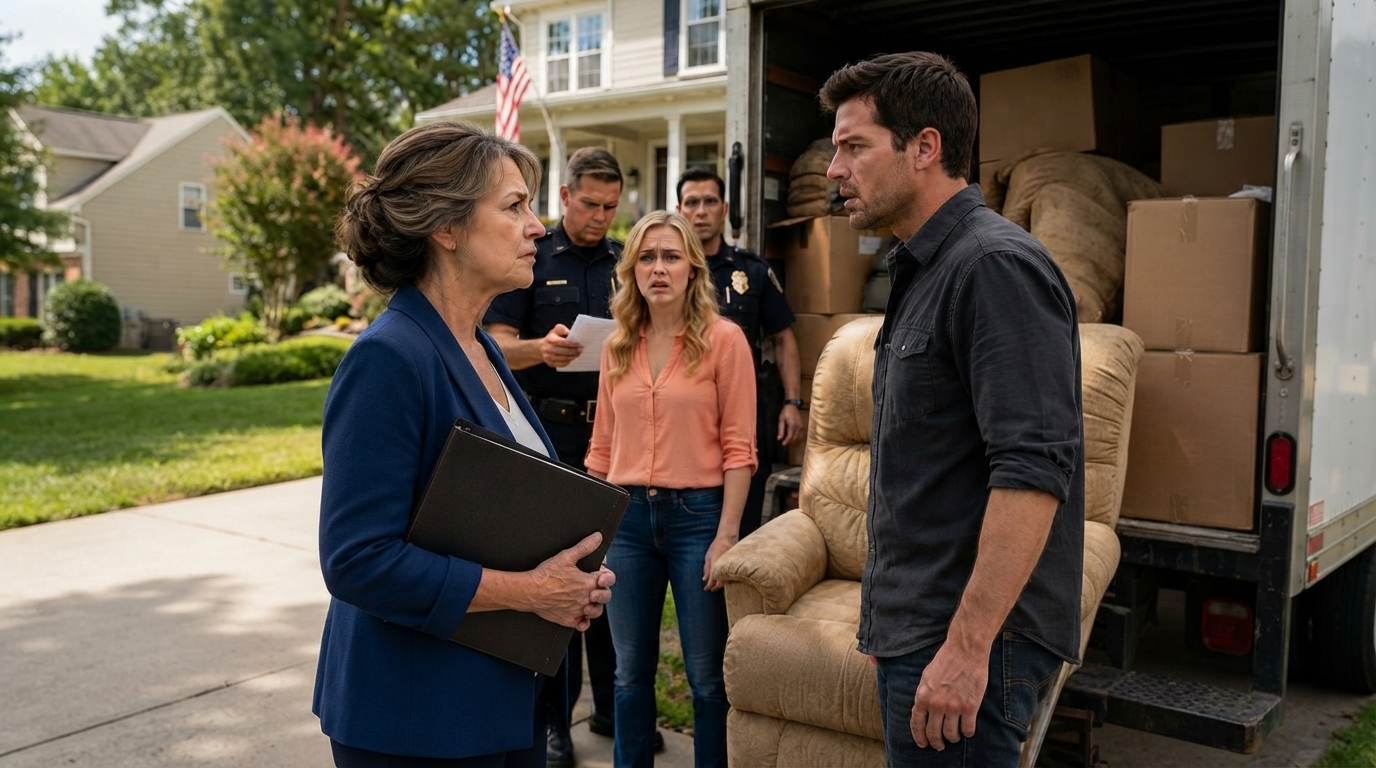
The same chair Trent had carried toward the truck.
Now it belonged exactly where Walter had left it.
Sometimes I sat there and read.
Sometimes I listened to the rain.
Sometimes I thought about how close I had come to losing everything because I was afraid of upsetting my daughter.
Then I’d remember the first night in the motel.
The one suitcase.
The quiet room.
My phone.
The moment I realized I had a choice.
I could chase them.
Or I could leave.
I left.
That was the beginning.
The day I chose myself.
PART 5
Three years after the moving truck incident, I was standing in the garden when Paisley walked up the path.
She had a six-year-old son with her.
My grandson.
He was carrying a toy dinosaur.
“Grandma?”
“Yes?”
“Can we see the roses?”
I smiled.
“Of course.”
He ran ahead.
Paisley stayed beside me.
“You look happy.”
“I am.”
She nodded.
“I wanted to tell you something.”
“What?”
“My son asked me yesterday why we don’t live here.”
I waited.
“What did you say?”
“I told him because this is Grandma’s house.”
I smiled.
She continued.
“And he said, ‘So Grandma decides who lives there?’”
I laughed.
“What did you say?”
“I said yes.”
She looked down.
“Then he said, ‘That’s fair. It’s her house.’”
I smiled again.
“Smart kid.”
“He is.”
We stood quietly.
Then Paisley said:
“I used to think having a house meant having power.”
“And now?”
“Having a house means having responsibility.”
I looked at her.
“That took you a while.”
She smiled.
“I know.”
My grandson ran back holding a rose.
“Grandma!”
“What?”
“This one is pretty.”
I crouched beside him.
“It is.”
“Can I take it?”
I looked at Paisley.
She smiled.
“Only if Grandma says yes.”
I laughed.
“Yes.”
He carefully snapped off the stem.
Then ran away.
That tiny moment meant more to me than any courtroom victory.
Not because I had won.
Because the next generation was learning something different.
Permission mattered.
Ownership mattered.
Respect mattered.
Love did not cancel boundaries.
One evening, I opened the old folder.
The one Elaine had assembled.
It contained everything.
The attempted loan.
The forged agreement.
The transfers.
The messages.
The bank records.
The legal notices.
The final settlement.
I turned through the pages.
Then I found the first document.
The title report.
My name.
My house.
My trust.
My father’s legacy.
Mine.
I smiled.
Then I closed the folder.
I didn’t need it anymore.
Not because the truth had changed.
Because I no longer needed proof to believe myself.
That was the real victory.
Not the house.
Not the money.
Not the legal outcome.
Believing myself.
For years, I had asked other people whether my boundaries were reasonable.
Whether I was too demanding.
Whether I was making things difficult.
Whether I should just cooperate.
I don’t ask anymore.
If something feels wrong, I investigate.
If someone crosses a line, I say so.
If someone needs help, I decide what help I can give.
And if the answer is no, I don’t apologize for it.
That’s what I learned.
A year later, Paisley came to me with a business proposal.
She wanted to open a small flower shop.
I looked at the plan.
It was detailed.
Careful.
Conservative.
Realistic.
“You’ve learned.”
She smiled.
“I tried.”
“How much do you need?”
She froze.
“I wasn’t going to ask.”
“I didn’t say I was giving it to you.”
She laughed.
“Fair.”
We discussed it.
I helped her review the numbers.
She obtained a legitimate small-business loan.
She contributed her own savings.
I offered a limited gift.
Not an open-ended stream.
A specific amount.
Documented.
With no expectations beyond honesty.
She accepted.
The shop opened six months later.
She named it Walter’s Garden.
I cried when I saw the sign.
She hugged me.
“I thought Grandpa would like it.”
“He would.”
The shop did well.
Not spectacularly.
But steadily.
That was enough.
Paisley learned how to build something instead of borrowing someone’s stability.
She learned how to say no.
She learned how to ask.
She learned how to repay.
And she learned that family support doesn’t mean family ownership.
One evening, after closing, we sat outside the shop.
She asked me:
“Do you regret helping me back then?”
I thought about it.
“No.”
She looked surprised.
“Really?”
“I regret not having boundaries.”
She nodded.
“That makes sense.”
“I helped because I loved you.”
“I know.”
“That wasn’t wrong.”
“No.”
“But I should have made the terms clear.”
“Yes.”
She smiled.
“I think I’m finally understanding the difference.”
“What difference?”
“Being loved and being entitled to someone else’s life.”
I nodded.
“That is the difference.”
Years passed.
My mother died quietly.
She and I had repaired some part of our relationship before she died.
Not everything.
But enough.
At the funeral, Paisley stood beside me.
We listened to people tell stories.
Some were true.
Some were generous.
Some were complicated.
Afterward, Paisley asked:
“Are you okay?”
I looked at her.
“I will be.”
She squeezed my hand.
“You don’t have to do everything alone.”
I smiled.
“That’s true.”
She hugged me.
And for the first time in many years, family support didn’t feel like a trap.
It felt like what it was supposed to be.
A choice.
The old house stayed in the trust.
Eventually, I moved some of its ownership structure into long-term planning for my grandson.
But I did it carefully.
With clear documents.
Independent advice.
No promises made at kitchen tables.
No assumptions.
No emotional transfers.
I had learned.
The house was not a bargaining chip.
It was an asset.
It was a legacy.
And it could be shared without being surrendered.
Years later, my grandson asked me:
“Grandma, was Grandpa in this chair?”
“Yes.”
“Did he like it?”
“Yes.”
“Then why didn’t Uncle Trent get to keep it?”
I smiled.
“Because it wasn’t his.”
“Who did it belong to?”
“Your grandfather.”
“And now?”
“Me.”
He thought about that.
“Can I sit there?”
I laughed.
“Yes.”
He climbed into the recliner.
His legs didn’t reach the floor.
For a moment, I saw Walter sitting there again.
Then I saw my grandson.
And I understood something.
Everything I had fought for had never really been about a chair.
Or a house.
Or a bank account.
It was about teaching the people I loved that generosity is a choice.
Respect is required.
And family is not ownership.
I had spent years believing that being a good mother meant giving until I had nothing left.
I was wrong.
A good mother teaches her children how to stand.
Even when standing means they don’t get what they want.
Even when they are angry.
Even when they call you selfish.
Even when they walk away.
Sometimes saying no is the most loving thing you can do.
I learned that the hard way.
But I learned it.
And the next time someone asked me to give up something valuable for the sake of family peace, I knew what I would say.
No.
Not because I was cruel.
Because I had finally learned that peace without respect is just surrender with a nicer name.
I looked at my grandson in Walter’s recliner.
He was smiling.
“Grandma?”
“Yes?”
“Can I have a cookie?”
I laughed.
“One.”
“Two.”
“One.”
“Okay.”
He jumped down and ran toward the kitchen.
I followed.
The house was full of sunlight.
The roses outside were blooming.
The recliner was safe.
The paperwork was in order.
The locks were secure.
The accounts were mine.
My daughter’s life was her own.
And mine was finally mine too.
Sometimes people think the strongest person is the one who wins the argument.
I no longer believe that.
The strongest person is the one who can walk away without needing anyone to understand why.
I left with one suitcase.
They thought it meant I had lost.
It didn’t.
It meant I had stopped participating in a life where I was expected to serve people who treated me like a tenant in my own home.
I left.
I got a lawyer.
I read the records.
I found the truth.
And then I reclaimed my life one page at a time.
Seven days after I walked out, my phone had exploded with twenty-two missed calls.
At the time, I thought something terrible had happened.
Now I understand those calls differently.
They weren’t proof that I had been wrong to leave.
They were proof that my absence had finally made them realize what my presence had been providing.
Money.
Access.
Convenience.
Control.
They missed what they could get from me.
Not who I was.
That realization hurt.
But it also freed me.
Because when you stop confusing being needed with being loved, you become much harder to manipulate.
I still love my daughter.
I love my grandson.
I love the memories of my husband.
I even have compassion for the people who hurt me.
But none of that requires surrender.
None of it requires obedience.
None of it requires handing over the keys.
And none of it requires staying in a room where someone has already decided you don’t belong.
The house my daughter once called hers is still standing.
The rose garden is thriving.
Walter’s recliner is beside the window.
There is a small plaque near the front door.
It says:
A home is a place where people feel safe, not a place where one person gets to control everyone else.
I didn’t put it there for Trent.
I didn’t put it there for Paisley.
I put it there for myself.
Because I need the reminder too.
That kindness without boundaries can become self-erasure.
That love without respect becomes a burden.
That generosity should never require surrender.
And that leaving is not always losing.
Sometimes leaving is how you finally get your life back.
So when I think about the day I packed one suitcase and walked away, I don’t remember the fear first.
I remember the calm.
I remember closing the door.
I remember choosing myself.
And I remember one simple thought:
They can have whatever they think they earned.
But they cannot have what was never theirs.
Not my house.
Not my money.
Not my peace.
And not my future.
That was the part they never understood.
The woman who left with one suitcase was not giving up.
She was finally taking everything that mattered with her.
Her dignity.
Her judgment.
Her boundaries.
Her future.
And her ability to say one word without guilt.
No.
Sometimes, that one word is not the end of a family.
It is the beginning of a healthier one.
THE END THANK YOU FOR READING !!!