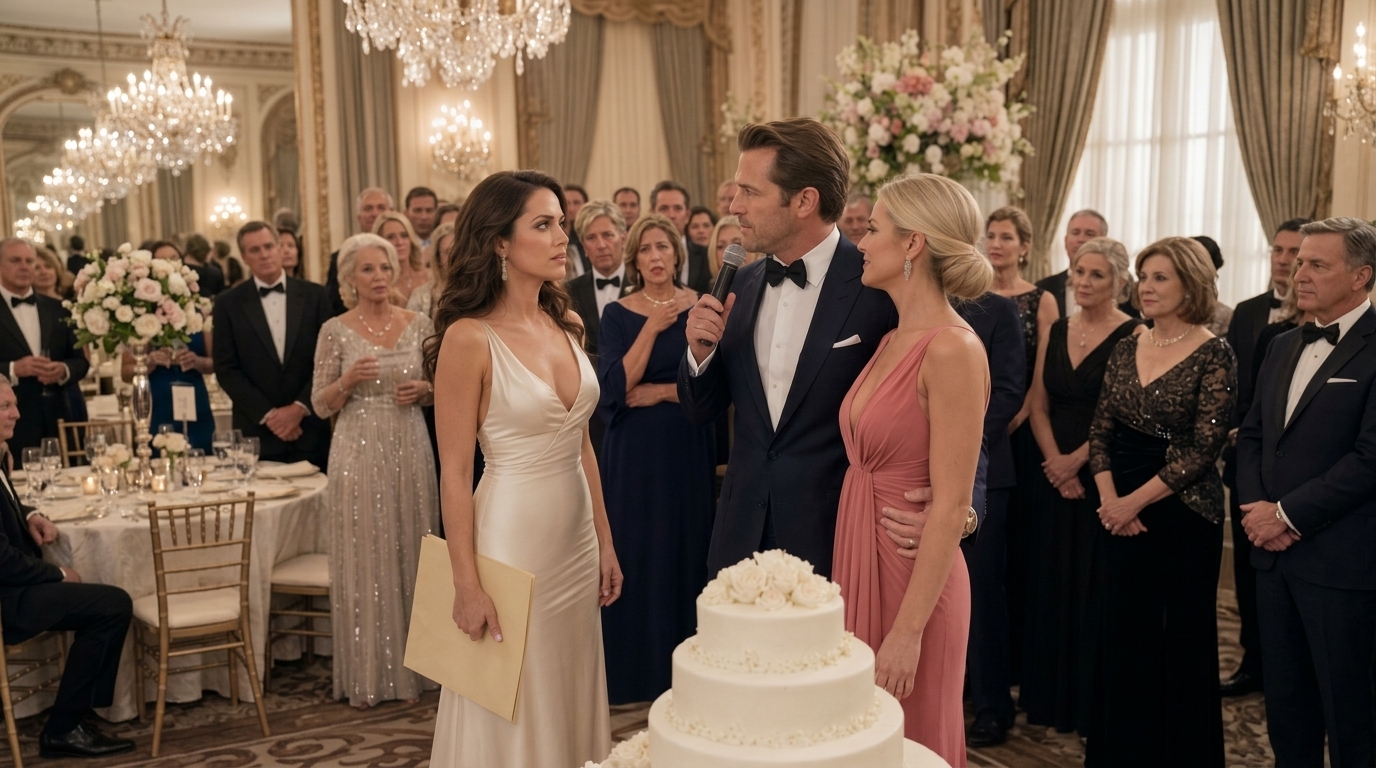
Nearly two hundred guests stood
beneath the crystal chandeliers of our Bel Air estate,
champagne glasses suspended in midair,
while my husband smiled into the microphone
as though he were announcing a merger
instead of dismantling our marriage.
Tiffany Blake stood beside him in a red dress designed
to make sure no one looked at the birthday woman.
Me.
Christian slipped one hand around her waist and looked directly at me.
For five years, Audrey has been a supportive wife, he said,
his voice polished and almost tender.
But some people simply stop belonging in the life you’ve built.
A few guests lowered their eyes.
Others stared openly.
Tiffany’s smile widened.
Christian had invited business partners, reporters, old friends,
and every social climber in Los Angeles who mattered to him.
He wanted witnesses.
He wanted the room to watch me understand that I had been replaced.
Then he gave me the cruelest part.
“Let’s see how you survive without my money.”
The words landed softly, but they cut deeper than shouting ever could.
I didn’t cry.
I didn’t ask him to explain.
I stood beside the white birthday cake in an ivory gown, one hand resting against the marble table,
and watched the man I had loved turn my humiliation into entertainment.
Christian mistook my silence for surrender.
That had always been his favorite mistake.
Seven years earlier, I met him in a worn little bookstore café in Silver Lake.
He was ambitious, broke, and typing a business plan on a laptop that sounded like it might catch fire.
He didn’t know my last name.
He didn’t know my father controlled one of the largest private financial empires in the country.
To Christian, I was Audrey, a former foster child trying to open a small boutique.
I had lied because I wanted one person to love me without calculating what my family was worth.
For a while, I believed he did.
When his medical-device company collapsed, an anonymous investment firm rescued it.
New capital arrived.
New contracts followed.
Within five years, Christian had become the celebrated CEO of Global Harmony Group.
Business magazines called him self-made.
He began to believe them.
What he never knew was that I had spent those years quietly building the road beneath his feet.
I reviewed the deals he later took credit for.
I corrected the strategies he repeated onstage.
I watched him replace loyal employees with flatterers and use company money to rent Tiffany a penthouse at the Ritz-Carlton.
Every night, he came home smelling like perfume that wasn’t mine.
Every morning, I still poured his coffee.
Not because I was weak.
Because I was waiting to see how far a man would go once he believed there were no consequences.
At the party, Christian raised his glass while Tiffany leaned against him like she had already moved into my bedroom.
The room began breathing again.
Nervous laughter floated through the chandeliers.
I smiled once, just enough to make him think I had accepted defeat.
Then I walked upstairs.
Inside my dressing room, behind a row of plain coats Christian used to mock, was a blue fireproof box.
Inside that box was a manila folder, a trust document, five years of bank records, and a phone containing an audio recording Christian never knew existed.
On that recording, his voice was clear.
“If she won’t leave quietly, we’ll make it look like she cheated.”
Tiffany laughed.
Then Christian described the doctored photographs, the fake messages, and the secret wedding they planned to hold in France ten days later.
I listened only once.
After that, I called my father.
“Dad,” I said, “I’m ready.”
There was a long pause on the other end.
Then he answered, “Open the box.”
By sunrise, three attorneys were seated around a law-office table in downtown Los Angeles.
The manila folder lay between us.
No one raised their voice.
No one needed to.
While Christian flew to Paris believing he had broken me, emergency filings moved through county court.
While Tiffany walked through a French château in a crystal-covered wedding gown, bank officers began receiving confidential notices.
While Christian toasted to his new life, a board he believed he controlled convened without him.
For the first time, the empire stopped answering his calls.
His assistant told him it was a technical issue.
His banker said the compliance department was reviewing something.
Christian laughed it off and ordered more champagne.
Ten days later, he returned to Los Angeles with Tiffany on his arm and the confidence of a man coming home to evict his unwanted wife.
A company Rolls-Royce carried them through the gates of the Bel Air estate.
But the fountain was off.
The gardens were unusually still.
And when Christian pressed his thumb against the front-door scanner, the light flashed red.
Access denied.
He tried again.
Then a third time.
Tiffany stepped away from him.
The front door opened slowly.
Charles, our estate manager, stood inside with two sheriff’s deputies and a process server holding a thick sealed envelope.
Christian’s smile disappeared.
“Where is my wife?” he demanded.
Charles looked past him at Tiffany, then back into the face of the man who still believed everything belonged to him.
“Sir,” Charles said quietly, “following the divorce, Madam has taken all her assets and left with her new husband.”
Christian stared at him.
“What?”
Charles handed him the envelope.
The process server stepped forward.
“Mr. Christian Blake?”
Christian took the documents.
“Yes.”
“You’ve been served.”
His fingers tightened around the papers.
Then he looked at Charles again.
“My wife isn’t divorced.”
Charles didn’t answer.
Christian opened the envelope.
The first page carried the court seal.
Below it was the date.
The date of the divorce judgment.
Nine days earlier.
His face changed.
Tiffany leaned over his shoulder.
“What does it say?”
Christian didn’t respond.
She snatched the document from his hand.
Her eyes moved quickly.
Then stopped.
“Christian…”
“What?”
“She filed for divorce.”
“I know she filed.”
“No.”
Tiffany’s voice dropped.
“She finalized it.”
Christian looked at her.
For several seconds, neither of them moved.
Then he laughed.
It wasn’t a happy laugh.
It was the confused, brittle laugh of a man waiting for someone to tell him this was an elaborate joke.
“That’s impossible.”
The process server cleared his throat.
“It’s not.”
Christian turned on Charles.
“Where is Audrey?”
Charles folded his hands behind his back.
“I was instructed not to disclose her location.”
“By whom?”
“Madam.”
“I’m her husband.”
Charles looked at the judgment.
“Not anymore, sir.”
Silence.
The chandelier above them seemed suddenly too bright.
Tiffany stepped backward.
“Christian, what does this mean?”
He ignored her.
He walked into the foyer and looked around.
The enormous marble staircase.
The antique console table.
The portraits.
The grand piano.
The silver vase Audrey had inherited from her grandmother.
Everything looked exactly as it had before he left.
Except it didn’t feel like home anymore.
Because there was one thing missing.
Audrey.
He rushed upstairs.
The bedroom doors were open.
The master closet was almost empty.
He pulled open drawers.
Empty.
The jewelry safe was gone.
The watches Audrey had collected were gone.
Her handbags were gone.
He opened the bathroom cabinet.
Her perfume bottles were gone.
He ran into the dressing room.
The shelves were bare.
He opened the blue fireproof box.
Nothing.
Christian froze.
He turned around slowly.
Tiffany stood in the doorway.
“What are you looking for?”
“My documents.”
“What documents?”
“My passports. My stock certificates. My watches.”
Tiffany swallowed.
“Maybe she took them.”
“She couldn’t.”
“Why?”
“Because they’re mine.”
A voice came from behind them.
“Actually, sir…”
Charles stood at the end of the hallway.
Christian spun around.
“What?”
Charles held a second folder.
“The inventory was completed before Madam departed.”
Christian marched toward him.
“What inventory?”
“Personal property.”
“Give me that.”
Charles handed it over.
Christian flipped through the pages.
His face became red.
Almost everything he had assumed was his had been documented as Audrey’s separate property.
The estate.
The art.
The jewelry.
The vintage cars.
The wine collection.
Even the private jet he had bragged about at business dinners.
His name appeared beside only a handful of items.
And most of those were corporate assets, not personal property.
Christian looked up.
“This is fake.”
“No, sir.”
“Who prepared this?”
“Our attorneys.”
“My attorneys?”
“Madam’s attorneys.”
Christian stared at him.
“When did she do all this?”
Charles hesitated.
“Before you went to France.”
The room became silent again.
Christian’s mind raced.
He remembered Audrey standing in the foyer the morning he left.
She had been wearing a simple beige coat.
She had kissed his cheek.
“Have a safe flight.”
He had laughed.
“You’re not going to wish me a good trip?”
“I just did.”
“You’re acting strange.”
“I’ve been acting strange for months.”
He had shrugged.
He hadn’t understood.
Now he did.
Or thought he did.
“Where did she go?”
Charles looked toward the window.
“Madam asked me to tell you one final thing.”
Christian’s jaw tightened.
“What?”
Charles looked directly into his eyes.
“She said she hopes you enjoy the life you chose.”
Christian’s face went pale.
Tiffany whispered, “She knew.”
He turned toward her.
“What?”
“She knew about us.”
Christian said nothing.
Tiffany’s expression changed.
“You told me she didn’t know.”
“I thought she didn’t.”
“You said she was too dependent on you to leave.”
“I was wrong.”
Tiffany crossed her arms.
“And now?”
Christian looked at the empty bedroom.
“Now I get her back.”
Tiffany stared at him.
“You think she’s coming back?”
Christian didn’t answer.
He grabbed his phone.
The call went directly to voicemail.
He called again.
Voicemail.
Again.
Blocked.
He stared at the screen.
Then he tried another number.
Audrey’s assistant.
Blocked.
Her attorney.
No answer.
Her father.
The call was declined.
Christian’s breathing became shallow.
He had spent seven years believing Audrey needed him.
He had believed she was afraid of losing him.
He had believed her silence meant obedience.
But somewhere between Paris and Los Angeles, the world he knew had shifted beneath his feet.
And he hadn’t even noticed.
The first time I met my father after leaving the estate, he didn’t hug me.
He simply opened the door of his private office and said, “You look tired.”
“I am.”
“You slept?”
“A little.”
“Eat?”
“Not much.”
He pointed toward the chair.
“Sit.”
I did.
For several minutes, neither of us spoke.
My father, Alexander Laurent, was not a man who wasted words.
He built his fortune by buying distressed companies and turning them around. He had made mistakes, lost billions, recovered, and learned to keep emotion away from business.
But when it came to me, he had always struggled.
He looked at me.
“Are you certain?”
“Yes.”
“You don’t want to reverse anything?”
“No.”
“You understand that once the public learns who you are, there will be no going back to anonymity.”
“I know.”
He nodded.
Then he pushed a folder toward me.
Inside was a copy of Christian’s corporate ownership structure.
I already knew most of it.
But the final page was new.
A series of holding companies.
Private trusts.
Convertible notes.
Cross-collateralized loans.
My father tapped one line.
“This is where he made his mistake.”
I looked closer.
Christian had used shares of Global Harmony Group as collateral for a massive private loan.
“Why?”
“To fund the expansion.”
“How much?”
“Three hundred and eighty million.”
I looked at him.
“And he can’t repay it?”
“He could.”
“But?”
My father leaned back.
“He believed the company would continue growing because he believed you would continue protecting it.”
I said nothing.
“You were the silent investor,” he continued. “You were the guarantor behind several early financing agreements. When you withdrew those guarantees, the lenders reviewed the structure.”
“And?”
“They discovered several irregularities.”
“What kind?”
“Executive expenses that were misclassified. Related-party transactions. Undisclosed benefits. Payments to consultants who appear to have provided little or no service.”
My stomach tightened.
“Tiffany?”
“We’re still investigating.”
I looked down.
I had expected betrayal.
I had not expected the scale.
My father closed the folder.
“You don’t need to destroy him.”
“I don’t want to destroy him.”
“What do you want?”
I thought about the birthday party.
The microphone.
The laughter.
His hand around Tiffany’s waist.
His words.
Let’s see how you survive without my money.
“I want him to live with the consequences of his own choices.”
My father nodded.
“That is different.”
“Yes.”
“And what about the company?”
I looked at him.
“Employees didn’t betray me.”
“No.”
“Customers didn’t betray me.”
“No.”
“Investors who trusted the company didn’t betray me.”
“No.”
“Then they shouldn’t pay for Christian’s mistakes.”
My father smiled faintly.
“That answer sounds more like the daughter I raised.”
I smiled.
“I wasn’t raised by you.”
He paused.
“You’re right.”
The room became quiet.
He had never liked discussing my childhood.
Neither did I.
My biological mother had died when I was young.
My father had been absent for years afterward.
By the time he returned, I had already learned to survive without him.
That was why I had hidden my identity from Christian.
I didn’t want to be someone’s daughter.
I wanted to be someone’s wife.
I had learned the hard way that people often loved the idea of what you could provide more than they loved you.
Christian had been the one exception.
Or so I thought.
My father stood.
“Your flight leaves tonight.”
I looked up.
“Where?”
“Geneva.”
“With whom?”
He smiled.
“With your new husband.”
I laughed.
“I don’t have a new husband.”
“Not yet.”
The office door opened.
A man stood outside.
Tall.
Dark-haired.
Wearing a navy suit without a tie.
He looked familiar.
Too familiar.
I stared at him.
“Julian?”
He smiled.
“Hello, Audrey.”
Julian Laurent was my father’s longtime legal adviser.
But he had been much more than that.
He was the boy who used to sit beside me in the library when we were teenagers.
The boy who knew my real name before Christian ever did.
The man who had quietly helped me establish the trust.
The person who had spent the last six months helping me prepare to leave.
I hadn’t told Christian about him because there had never been anything romantic between us.
Until the night I finally understood that love wasn’t supposed to feel like fear.
Julian stepped inside.
“I heard you were awake.”
“Barely.”
“Then you need coffee.”
He handed me a cup.
I took it.
My father watched us.
“You two should leave before I change my mind.”
I laughed.
“About what?”
“Everything.”
Julian smiled.
“Come on.”
We left the office together.
Outside, the city glittered beneath the evening sky.
For the first time in years, I didn’t feel like I was running away.
I felt like I was going somewhere.
Christian spent the next forty-eight hours trying to undo the divorce.
He called attorneys.
He called judges’ offices.
He called friends.
He called politicians.
He called anyone who might know how to reverse a finalized judgment.
Nothing worked.
The divorce had been properly filed.
He had been served.
He had received notices.
He had ignored them.
Because he had been in France.
Getting married.
To Tiffany.
He had assumed Audrey would wait.
She hadn’t.
Then came the financial shock.
His personal accounts were not frozen.
They were simply much smaller than he remembered.
The accounts Audrey had quietly funded were gone.
The luxury credit cards attached to her private trusts stopped working.
The Bel Air estate was no longer available to him.
The private jet was registered to a holding company he didn’t control.
The cars belonged to an investment trust.
The art belonged to a foundation.
Even the wine collection had been transferred.
Christian stared at his accountant.
“Tell me how much I have.”
The accountant hesitated.
“Personally?”
“Yes.”
“Approximately twelve million in liquid and readily accessible assets.”
Christian laughed.
“Twelve million?”
“Yes.”
“That isn’t possible.”
“It is.”
“I made hundreds of millions.”
“On paper, the company did.”
Christian leaned forward.
“What about my shares?”
The accountant looked uncomfortable.
“They’ve been pledged.”
“To whom?”
“The lenders.”
“Can I sell them?”
“Not without approval.”
“Then get approval.”
“Christian…”
“What?”
“The board has suspended your voting rights pending an independent review.”
His face hardened.
“Who authorized that?”
“The board.”
“I am the CEO.”
“Not currently.”
Christian stood.
“You’re fired.”
The accountant closed his laptop.
“I expected that.”
He left.
Christian remained alone.
Then Tiffany walked in.
She was wearing sunglasses indoors.
“I need to talk to you.”
“I don’t have time.”
“You do now.”
“What do you want?”
She removed her sunglasses.
“Where are we living?”
Christian stared.
“What?”
“The hotel.”
“You can’t stay at the hotel?”
“They’re asking for another deposit.”
“Put it on the card.”
“I did.”
“And?”
“They declined it.”
Christian looked away.
“I’ll handle it.”
Tiffany stepped closer.
“No, Christian.”
“What?”
“You promised me a life.”
“I know.”
“You promised me the house.”
“I know.”
“You promised me the company would be ours.”
“I said I’d take care of it.”
“And now you’re telling me everything is gone.”
“It’s temporary.”
She laughed.
“Temporary?”
He glared at her.
She folded her arms.
“Did you know Audrey had this much?”
“No.”
“Did you know she was the investor?”
“No.”
“Did you know she was leaving?”
“No.”
Tiffany stared at him.
Then she asked quietly:
“Did you ever actually know your wife?”
Christian had no answer.
Three weeks later, the story broke.
Not about the divorce.
Not at first.
It was about Global Harmony Group.
An investigative journalist published a report detailing unexplained executive payments, private travel expenses, luxury accommodations, and consulting contracts connected to people close to Christian.
The article did not accuse him of a crime.
It simply asked questions.
Questions investors immediately began asking too.
The stock fell.
The board hired forensic accountants.
The Securities and Exchange Commission opened an inquiry.
Christian’s lawyers told him not to speak publicly.
He ignored them.
He appeared on television.
“This is a coordinated attack against me,” he said.
The interviewer asked, “Who is behind it?”
Christian paused.
Then he made the mistake that would follow him for years.
“My former wife has always been jealous of my success.”
The interviewer raised an eyebrow.
“Your former wife?”
“Yes.”
“Are you suggesting she is responsible?”
“I believe she has personal motives.”
The clip went viral.
My father called me that night.
“Did you authorize the leak?”
“No.”
“Good.”
“You think I should respond?”
“No.”
“Why?”
“Because he’s doing the work for you.”
I watched the interview once.
Then turned it off.
Julian sat beside me.
“You don’t look happy.”
“I don’t want him ruined.”
“I know.”
“I just wanted out.”
Julian nodded.
“That is why you’re different from him.”
I looked at him.
“Different?”
“You’re thinking about what happens to everyone else.”
“And he isn’t?”
“He’s thinking about what happens to him.”
I sighed.
“What if the company collapses?”
“Then we protect the employees.”
“How?”
Julian handed me a document.
“We can buy the debt.”
I looked at him.
“Would that give us control?”
“Eventually.”
“And Christian?”
“Would lose control.”
I stared at the document.
“No.”
Julian raised an eyebrow.
“No?”
“Not like that.”
“Why?”
“Because if I take the company from him, he’ll say I planned everything.”
“You did plan everything.”
“I planned my divorce.”
“Fair.”
“I don’t want to become the villain in his story.”
Julian smiled.
“You aren’t responsible for the story he tells.”
I looked out the window.
The city lights reflected across the glass.
For years, I had thought freedom meant having enough money to leave.
Now I understood.
Freedom was not needing the person who hurt you to understand why you left.
Six months passed.
Christian’s world continued shrinking.
Tiffany left first.
She waited until the company accounts were restricted.
Then she filed for an annulment, claiming Christian had misrepresented his financial position before their marriage.
He called her a traitor.
She called him a liar.
The tabloids loved it.
Their French wedding photos appeared beside headlines about corporate collapse.
Christian’s friends disappeared.
People who once waited hours to see him stopped returning calls.
The same journalists who had called him visionary now asked questions about his finances.
He moved into a smaller house.
Then another.
Eventually, he rented a condominium.
He began selling watches.
Cars.
Art.
Anything that could generate cash.
One evening, he found himself sitting alone in a restaurant where Audrey and he had once celebrated their third anniversary.
He remembered her laughing.
She had ordered chocolate cake.
He had teased her about eating dessert before dinner.
She had stolen his fork.
He closed his eyes.
For the first time, he remembered the woman rather than the money.
And something inside him broke.
He called her.
The number was still blocked.
So he called Julian.
Julian answered.
“Hello, Christian.”
“I need to speak with Audrey.”
“She doesn’t want to speak with you.”
“I need five minutes.”
“No.”
“Please.”
There was silence.
Christian swallowed.
“I made a mistake.”
Julian didn’t answer.
“I know what you’re going to say.”
“What?”
“That I should have known better.”
“Yes.”
Christian closed his eyes.
“I loved her.”
Julian’s voice became colder.
“No, Christian.”
“What?”
“You loved being loved by her.”
Christian couldn’t speak.
“That isn’t the same thing.”
The call ended.
Christian stared at the phone.
Then he started crying.
Not because he had lost his company.
Not because he had lost the estate.
Not because he had lost Tiffany.
He cried because, for the first time, he understood that the woman who had spent years quietly supporting him had not left because she stopped loving him.
She had left because she finally realized that loving him was destroying her.
One year after the birthday party, I returned to Los Angeles.
Not to the Bel Air estate.
That house no longer felt like mine.
I returned for a board meeting.
Global Harmony Group had survived.
Barely.
My investment group had purchased enough distressed debt to stabilize the company, but we had kept the original employees and created an independent management structure.
Christian no longer had any operational role.
He retained a small financial interest.
The company survived without him.
That mattered to me.
I entered the boardroom at nine.
The executives stood.
I waved them down.
“Please.”
We began the meeting.
For three hours, we discussed budgets, research programs, employee benefits, product safety, and expansion.
At noon, the chairman looked at me.
“There is one final matter.”
“What?”
“Christian requested permission to attend.”
I froze.
“Why?”
“He says he wants to speak to you.”
I looked around the table.
Then nodded.
“Let him in.”
The door opened.
Christian walked inside.
He looked older.
Not dramatically.
Just tired.
The expensive suits were gone.
His hair was slightly gray at the temples.
He held a thin folder.
He stopped several feet away.
“Hello, Audrey.”
I nodded.
“Hello, Christian.”
The room was silent.
He looked around.
“This is awkward.”
“It is.”
He smiled faintly.
“I deserved that.”
I said nothing.
He placed the folder on the table.
“I brought something.”
“What?”
“The final accounting.”
I looked at the folder.
“What is it?”
“Everything you put into the company.”
I opened it.
Inside were records.
Transfers.
Investments.
Guarantees.
Notes.
Every dollar I had contributed.
Christian had spent months reconstructing the financial history.
He looked at me.
“I didn’t know.”
“I know.”
“I thought I built it.”
“I know.”
He swallowed.
“You did more than invest.”
“Yes.”
“You saved me.”
“Several times.”
“I treated you like you were holding me back.”
“Yes.”
He lowered his eyes.
“I don’t expect forgiveness.”
I closed the folder.
“Good.”
His eyes lifted.
“I just wanted you to know that I finally understand.”
I studied him.
“What do you understand?”
“That you weren’t trying to control me.”
“No.”
“You were trying to help me.”
“Yes.”
“And when I became successful, I started resenting you because I thought your help made my success less real.”
I said nothing.
He continued.
“I spent years wanting everyone to believe I was self-made.”
“You weren’t.”
“I know.”
He took a breath.
“I was ashamed that I needed you.”
“That wasn’t the problem.”
“What was?”
“You needed me.”
He looked confused.
“You depended on me.”
“Yes.”
“And that’s what you’re angry about?”
“No.”
I leaned back.
“I was never angry that you needed me.”
“Then what?”
“I was angry that you needed me but didn’t respect me.”
He looked down.
That sentence seemed to hurt more than anything else.
After a moment, he nodded.
“You’re right.”
I closed the folder.
“Christian.”
“Yes?”
“I don’t hate you.”
His eyes lifted.
“I don’t want your apology.”
He looked confused.
“Why?”
“Because I don’t need it.”
“What do you need?”
“Nothing from you.”
He stood there quietly.
Then he smiled.
It was the first real smile I had seen from him in years.
“I suppose that’s the hardest thing to hear.”
“It should be.”
He nodded.
Then he turned toward the door.
Before he left, he stopped.
“Are you happy?”
I thought about the question.
Then I smiled.
“Yes.”
He nodded.
“Good.”
And he left.
That evening, Julian and I drove to the coast.
The sun was setting over the Pacific.
We had been married for eight months.
Quietly.
No magazine.
No announcement.
No social-media spectacle.
Just a small ceremony in the south of France with twelve people.
Julian had never asked me how much money I had.
He had never asked what my father owned.
He had never asked what I could do for him.
The first time we had dinner together after my divorce, he asked me what kind of life I wanted.
I had said, “A quiet one.”
He said, “Then let’s build one.”
And we did.
Not perfect.
Not dramatic.
Real.
We bought a small house overlooking the sea.
We traveled.
We argued about stupid things.
We laughed.
We learned how to make breakfast together.
Sometimes, at night, I would wake up and remember Christian.
Not with longing.
Not with anger.
Just memory.
A chapter that had once consumed my whole life.
A chapter that now fit on a few pages.
One afternoon, nearly two years after the birthday party, I received a letter.
There was no return address.
Inside was a single handwritten page.
It was from Christian.
He wrote:
Audrey,
I don’t expect you to respond.
I only wanted to tell you something.
The hardest part of losing everything wasn’t losing the house.
It wasn’t losing the company.
It wasn’t losing Tiffany.
It was discovering that I had spent years chasing proof that I was important while ignoring the one person who had loved me when I had nothing.
You were there when I had no money.
You were there when no one believed in me.
You were there when I was difficult.
You were there when I was afraid.
And when I finally became the man I had always wanted to be, I became someone you couldn’t stay with.
I used to think you abandoned me.
Now I understand that you saved yourself.
I’m sorry it took losing everything for me to understand.
I folded the letter.
I didn’t cry.
I didn’t forgive him.
Not because he didn’t deserve forgiveness.
But because forgiveness wasn’t something I owed him.
I simply placed the letter in a drawer.
Then I walked outside.
Julian was waiting near the terrace.
“You’re quiet.”
“I got a letter.”
“From him?”
“Yes.”
He didn’t ask what it said.
That was one of the reasons I loved him.
He never demanded access to wounds that weren’t his.
Instead, he held out his hand.
I took it.
We walked toward the water.
The ocean stretched endlessly ahead of us.
And for the first time in my life, I understood something I should have learned much earlier.
Leaving wasn’t revenge.
Silence wasn’t weakness.
And losing someone who never truly valued you wasn’t the same thing as losing.
Sometimes the greatest victory was simply walking away before they convinced you that their version of your worth was the truth.
Christian had returned from France expecting to find the woman he had humiliated.
Instead, he found an empty estate.
He found legal papers.
He found a company no longer controlled by him.
He found a life he had built on assumptions.
But most importantly, he found the truth.
I had never needed his money.
I had never needed his name.
I had never needed his permission to leave.
He had mistaken my patience for dependence.
He had mistaken my kindness for weakness.
He had mistaken my silence for surrender.
And by the time he finally understood the difference, I was already gone.
Not broken.
Not defeated.
Not waiting for him.
Gone.
And beside the man who loved me without asking what I could give him, I finally became the woman I had spent seven years trying to remember how to be.
Myself.
THE END THANK YOU FOR READING !!!