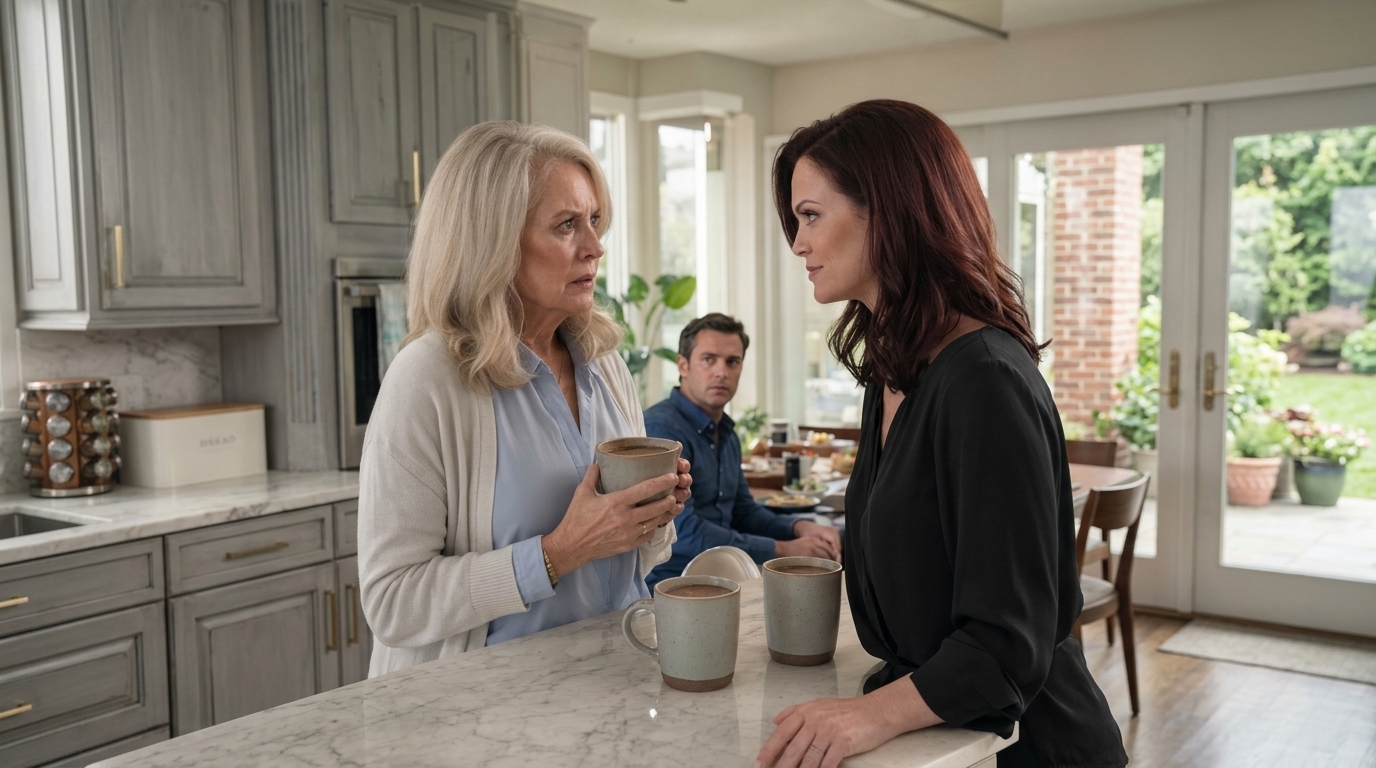
My daughter handed me a cup of hot chocolate and smiled sweetly. “Drink it while it’s hot, Mom.” I was sixty-seven years old, and I had spent thirty years believing I knew exactly what that smile meant.
Love.
Until that afternoon.
I lifted the mug.
The chocolate smelled warm and sweet.
But underneath it was something else.
Something bitter.
Something strangely familiar.
My stomach tightened.
Monica was watching me.
Not my face.
The cup.
That was when the first warning bell went off in my head.
David, her husband, was sitting across the kitchen island. His own mug sat untouched beside him.
Monica turned toward the pantry.
I pretended to look for sugar.
Then, quietly, I switched our cups.
Mine went in front of David.
His went in front of me.
It took less than three seconds.
Twenty minutes later, David collapsed on the kitchen floor.
And Monica began screaming.
“Mom! Call 911!”
I grabbed the phone.
But while she knelt beside her husband, crying and begging him to wake up, I watched her.
Something about her reaction bothered me.
She looked terrified.
But there was a tiny pause before every expression.
As if she had to decide how frightened she should look.
At the hospital, doctors rushed David into emergency treatment.
Hours later, a doctor finally approached us.
“Your husband is alive,” he told Monica.
She covered her mouth.
“Oh, thank God.”
“But we believe he was poisoned.”
The doctor looked at me.
“Did you prepare anything he ate or drank today?”
“No.”
My daughter stiffened.
“My daughter did.”
The doctor frowned.
Monica grabbed my arm.
“What are you saying?”
“I’m saying I didn’t make the hot chocolate.”
She stared at me.
Then the doctor asked:
“Did you drink yours?”
“No.”
“Why not?”
I looked at Monica.
“It smelled strange.”
“What did it smell like?”
“Bitter almonds.”
The doctor and detectives exchanged a look.
Monica’s face changed.
Only for a second.
But I saw it.
And suddenly, thirty years of memories began rearranging themselves in my mind.
Because Monica wasn’t always my daughter.
She became my daughter when she was five.
Her biological parents had died in a house fire.
She survived.
They didn’t.
The social worker told me she was traumatized and barely spoke.
The first day I met her, she crawled out from beneath a table, touched my cheek, and whispered:
“Are you my new mommy?”
I said yes.
And from that moment on, I gave her everything.
I changed my career.
I gave up relationships.
I paid for therapy.
I built my life around her.
When my cat died suddenly shortly after she came to live with me, I called it an accident.
When three fish died within a week, I blamed the water.
When my sister became violently sick after Monica’s birthday dinner, I blamed the food.
When money disappeared from my purse, I blamed my own memory.
When a classmate fell down the stairs, I believed Monica when she said it was an accident.
I always believed her.
Because I thought that was what love meant.
Then came the husbands.
Monica married an older man at eighteen.
Six months later, he died.
She inherited money.
At twenty-three, she married another older man.
Two years later, he died too.
Another inheritance.
I noticed the pattern.
I just refused to name it.
Until David.
After the doctors stabilized him, two detectives arrived.
“Who made the hot chocolate?” Detective Clark asked.
“I did,” Monica answered.
“Who had access to the ingredients?”
“Only me.”
Then Detective Clark looked at me.
“Did you drink yours?”
“No.”
“Why?”
“Because it smelled wrong.”
Monica’s eyes dropped.
That night, she begged me to stay at her house.
“Please, Mom. I’m too scared to be alone.”
I agreed.
But she thought she was keeping her frightened mother close.
She didn’t realize she was giving me access to the house.
After she went upstairs, I returned to the kitchen.
I searched quietly.
Behind several spice containers, I found a small unlabeled jar.
Inside was a white crystalline substance.
I didn’t touch it.
I photographed it.
Then I found something else.
A syringe hidden beneath cleaning cloths.
I photographed that too.
My hands were shaking.
I walked into David’s study.
His financial records showed months of large cash withdrawals.
Then I found a letter addressed to his brother.
I read the first line.
“If anything happens to me, it wasn’t an accident.”
I froze.
David wrote that he suspected Monica had been deliberately making him sick.
He had started avoiding food she prepared.
He was afraid to leave because she had threatened to hurt me.
Then I reached the final paragraph.
“Don’t let her get away with it again.”
Again.
That word wouldn’t leave my mind.
I went upstairs.
Monica’s private study was locked.
But I noticed a small brass key above the doorframe.
I opened it.
Inside were boxes.
Insurance papers.
Death certificates.
Bank statements.
Inheritance records.
Documents from her first marriage.
Then her second.
Everything was organized.
Everything was documented.
I opened a black notebook.
Dates.
Symptoms.
Money.
Names.
My daughter’s handwriting.
I turned the page.
Her first husband’s name.
Then his death.
Then the inheritance.
Another notebook.
Her second husband.
His illness.
His death.
Another inheritance.
I sat down on the floor.
This wasn’t grief.
This wasn’t coincidence.
Someone had been keeping records.
And that someone was my daughter.
Then I found a blue folder.
My name was written across the front.
CARMEN HALE.
My hands went cold.
I opened it.
Inside were copies of my bank accounts.
My retirement information.
My house valuation.
My medical records.
My will.
My life insurance policy.
Monica was the beneficiary.
I turned another page.
There was a handwritten note.
Two words.
“Mother — timing.”
I stared at it.
Then I heard footsteps in the hallway.
Slow.
Soft.
Coming closer.
The doorknob began to turn.
I closed the folder.
The door opened.
Monica stood there.
She looked at me.
Then at the folder.
Then back at me.
“Mom?”
I couldn’t speak.
She stepped inside.
“What are you doing in here?”
I swallowed.
“I couldn’t sleep.”
Her eyes moved toward the folder.
“You opened my things.”
“I was scared.”
“Of me?”
I looked into my daughter’s eyes.
For the first time in thirty years, I didn’t see the little girl who had asked me to be her mother.
I saw a woman standing between me and a terrible secret.
“Should I be?” I whispered.
Her expression changed.
And then she smiled.
“Of course not.”
She reached toward the folder.
I pulled it closer.
And that’s when Monica said something that made the blood drain from my face.
“Mom…”
Her voice was soft.
Almost tender.
“You really shouldn’t have opened that.”
TO BE CONTINUED…
PART 2 — THE FILE WITH MY NAME ON IT
“You really shouldn’t have opened that.”
Monica’s voice was so calm that I felt colder than I had a moment earlier.
I kept my hand on the blue folder.
“Why?”
She stared at me.
Then she smiled.
“You’ve always been curious.”
“What’s in it?”
“Things that don’t concern you.”
“My name is on it.”
She didn’t answer.
That was answer enough.
I stood slowly.
“Did you put my name on this?”
Monica’s expression hardened.
“You’re misunderstanding everything.”
“Then explain it.”
“I don’t have to explain my private documents to you.”
“I’m your mother.”
“Exactly.”
The word landed strangely.
Exactly.
As though being my daughter gave her some claim over me.
I stepped toward the door.
She moved in front of it.
For a moment, neither of us spoke.
Then she whispered:
“You’re making a mistake.”
“No.”
I looked at her.
“I made the mistake thirty years ago.”
Her face tightened.
“What does that mean?”
“It means I should have listened to myself sooner.”
She stepped aside.
I walked past her.
I didn’t run.
I didn’t scream.
I didn’t confront her.
I simply went downstairs, took my purse, and left.
The moment I reached my car, I called Detective Clark.
“I found something.”
“What?”
“My daughter has a file on me.”
“What kind of file?”
“Financial records. Medical records. Insurance. My will.”
There was silence.
Then:
“Mrs. Hale, don’t go back inside.”
“I won’t.”
“Go somewhere safe.”
I looked toward the house.
Monica was standing behind the upstairs window.
Watching me.
“I think,” I whispered, “she already knows.”
The police obtained a warrant.
The house was searched.
What they found changed the entire case.
There were records connecting Monica to previous insurance claims.
There were notes about my finances.
There were conversations with people who had helped her obtain information about my accounts.
And there was evidence concerning David.
But investigators were careful.
They didn’t treat every suspicious event as proven.
Some things were allegations.
Some were circumstantial.
Some required more investigation.
The strongest evidence concerned the poisoning.
David survived.
Barely.
When he was strong enough to speak, he told detectives something that made everything worse.
He had suspected Monica for months.
He had started saving evidence.
He had secretly recorded conversations.
He had even written a letter to his brother.
“If anything happens to me, it wasn’t an accident.”
The police found the letter.
Then they found something else.
A recording.
Monica’s voice.
“She has everything.”
David answered:
“She’s your mother.”
Monica said:
“That doesn’t mean she has to keep it forever.”
The recording ended.
I listened to it once.
Only once.
Then I asked Detective Clark to turn it off.
Because I couldn’t bear hearing my daughter’s voice talking about my life as though I were an account waiting to be closed.
The hardest part came afterward.
People began asking questions.
Neighbors.
Friends.
Reporters.
Relatives.
Everyone wanted to know how I hadn’t noticed.
How could a mother miss something so obvious?
The truth was painful.
I had noticed.
I just explained everything away.
Every warning had been given a softer name.
The dead cat was an accident.
The sick relative was food poisoning.
The missing money was my memory.
The dead husbands were tragedies.
The strange behavior was trauma.
The warning signs were always there.
I just loved my daughter more than I trusted my own instincts.
And that was my mistake.
Monica was arrested.
She cried when they took her away.
“Mom!”
I stood across the street.
She looked frightened.
For one second, I saw the five-year-old girl again.
The girl who had touched my cheek.
“Are you my new mommy?”
I almost stepped forward.
Then I remembered David on the kitchen floor.
I remembered the blue folder.
My insurance policy.
My bank accounts.
The handwritten words:
“Mother — timing.”
I stayed where I was.
Monica’s expression changed.
The tears stopped.
Her face became cold.
And I realized something.
The child I loved might still exist somewhere inside her.
But she was no longer the only person I had to think about.
There were victims now.
There was David.
There was me.
And there was the truth.
Months later, I testified.
The prosecutor asked:
“Mrs. Hale, did you love the defendant?”
“Yes.”
“Do you still love her?”
I looked at Monica.
“Yes.”
The courtroom became completely silent.
The prosecutor waited.
“Even after everything?”
“Yes.”
“Why?”
I swallowed.
“Because love doesn’t disappear just because trust does.”
Monica began crying.
But I didn’t look away.
The prosecutor asked:
“Do you believe your daughter is innocent?”
I answered carefully.
“I believe the evidence should speak for itself.”
That was the first time in my life I refused to protect Monica from consequences.
Not because I hated her.
Because I finally understood that protecting someone from the truth can become another kind of harm.
David eventually recovered.
He divorced Monica.
He moved away.
Before leaving, he came to my house.
He handed me a photograph.
It was Monica at sixteen.
She was standing beside me in the backyard.
Her hair was messy.
She had braces.
She was laughing.
Really laughing.
I stared at the photograph for a long time.
“She loved you,” David said.
“I think she did.”
“What happened?”
I shook my head.
“I don’t know.”
Maybe there wasn’t one answer.
Maybe people become who they are through thousands of choices.
One lie.
One secret.
One justification.
One manipulation.
Until eventually, the person standing in front of you is someone you don’t recognize.
A year later, I sold my house.
I bought a smaller one near the mountains.
It had a garden.
A porch.
A bright kitchen.
And nobody else’s fingerprints on my life.
For the first time in decades, I made decisions based on what I wanted.
I traveled.
I joined a book club.
I planted flowers.
I learned to say no.
I learned that guilt isn’t responsibility.
I learned that being a mother doesn’t mean sacrificing yourself until there is nothing left.
And I learned that sometimes the most loving thing you can do is stop rescuing someone from the consequences of their choices.
Eventually, Monica asked to see me.
I agreed.
We met in a small conference room.
She looked older.
Tired.
Human.
For several seconds, neither of us spoke.
Then she whispered:
“Hi, Mom.”
My heart hurt.
Because that single word still belonged to the little girl in my memory.
“Hi, Monica.”
She began crying.
“I don’t know how to fix this.”
“You can’t.”
“I destroyed everything.”
“You destroyed trust.”
She nodded.
“I know.”
“You hurt people.”
“I know.”
“You almost killed David.”
She covered her face.
“I know.”
Then she looked at me.
“Do you hate me?”
“No.”
Her eyes filled with tears.
“Why?”
“Because hate isn’t what I feel.”
“What do you feel?”
I thought for a long time.
“Sad.”
“For me?”
“For both of us.”
She looked down.
“Will you ever forgive me?”
“I don’t know.”
She nodded.
“That’s fair.”
I leaned forward.
“I may forgive you someday.”
Her eyes lifted.
“But forgiveness doesn’t mean you’ll get the old version of me back.”
She swallowed.
“I understand.”
“Do you?”
“Yes.”
“Because I won’t pretend nothing happened.”
“I don’t expect you to.”
For the first time, I believed her.
Not because I trusted her.
Because I had learned something important.
Forgiveness doesn’t require trust.
And love doesn’t require access.
Years later, I still kept one photograph of Monica.
Sixteen years old.
Laughing beside me.
I kept it because I refused to let one terrible chapter erase every good memory.
But I also kept another photograph.
One of myself.
Taken on my porch.
My silver hair blowing in the wind.
My face relaxed.
My smile real.
No one needed anything from me.
I wasn’t rescuing anyone.
I wasn’t explaining anyone.
I wasn’t afraid.
I was simply happy.
Sometimes I look at those photographs together.
The girl I loved.
The woman I became.
And I finally understand something I wish I’d known thirty years ago.
Being a good mother doesn’t mean ignoring your instincts.
Compassion doesn’t mean blindness.
Trust isn’t something someone is entitled to forever.
And love doesn’t require surrender.
People ask me what saved my life.
They expect me to say the doctors.
The ambulance.
The detectives.
The hospital.
But I know the answer.
It was the moment I listened to myself.
That tiny voice that whispered:
Something isn’t right.
For thirty years, I had silenced that voice whenever it pointed toward Monica.
Not anymore.
I still think about the cup.
Her smile.
Her voice.
“Drink it while it’s hot, Mom.”
I wonder what she expected.
Maybe she expected me to do what I’d always done.
Trust her.
Protect her.
Believe her.
But this time, I didn’t.
I switched the cups.
And twenty minutes later, the screams began in the kitchen.
That was the moment everything changed.
Not because I stopped loving my daughter.
Because I finally understood something I should have understood years earlier:
You can love someone with your whole heart and still refuse to let them destroy your life.
I didn’t save myself by becoming heartless.
I saved myself by finally listening.
And after thirty years of putting everyone else first, I learned that sometimes the person you are responsible for saving…
is yourself.
THE END THANK YOU FOR READING !!