When I was eleven, my mom left me home alone with twenty dollars.
She told me she’d be gone for a month.
“A month?” I asked.
She zipped her suitcase.
“You’re old enough to take care of yourself.”
I stared at the twenty-dollar bill she placed on the kitchen counter.
“What if I need something?”
“There’s food in the pantry.”
Then she walked out.
I stood at the window and watched her car disappear down the street.
At first, I wasn’t scared.
I thought she’d come back after a few days.
But a week passed.
Then two.
The food started running out.
I stretched one can of soup into two meals. I ate dry cereal for dinner. I stopped turning on the lights to save electricity.
And every night, I checked my mother’s phone number.
No calls.
No messages.
Nothing.
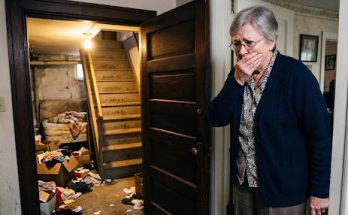
Then, on the twenty-fourth day, my neighbor, Mrs. Alvarez, knocked on the door.
She looked past me into the dark house.
“Sweetheart,” she whispered, “where is your mother?”
“She’s traveling.”
“For how long?”
I hesitated.
“About a month.”
Her expression changed.
She stepped inside and looked at the nearly empty kitchen.
Then she looked at me.
“Have you been here alone this whole time?”
I nodded.
Mrs. Alvarez immediately pulled out her phone.
I didn’t know who she was calling.
But three hours later, there was a knock at the door.
And when I opened it, two police officers were standing outside.
Part 2
The officers didn’t rush inside.
One of them crouched down so we were eye level.
“What’s your name?”
I told him.
“Where’s your mother?”
“She went on a trip.”
“How long has she been gone?”
“Twenty-four days.”
The officer exchanged a look with the other one.
“Has she called you?”
I shook my head.
“Has anyone stayed here with you?”
“No.”
He looked toward the kitchen.
“Have you been eating?”
I nodded quickly.
It was a lie.
The truth was, I’d eaten my last piece of bread that morning.
Mrs. Alvarez quietly opened the pantry.
There were only three cans left.
The officer’s expression changed.
He asked me to sit down.
Then he said something that made my stomach twist.
“We’re going to make sure you’re safe.”
I thought that meant my mother was coming home.
Instead, the woman from child services arrived twenty minutes later.
She packed a small bag for me.
I kept looking at the front door.
“Will my mom be angry?”
The woman paused.
“You didn’t do anything wrong.”
That wasn’t the answer I wanted.
Before I left, I took the twenty-dollar bill from the counter and folded it into my pocket.
I didn’t know why.
Maybe because it was the last thing my mother had ever given me.
That night, I slept in a warm bed for the first time in weeks.
And for the first time, I wasn’t afraid of being alone.
I was afraid of what would happen when my mother came back.
Part 3
For the first time in twenty-four days, I slept without listening for my mother’s key in the front door.
The bed was unfamiliar.
The room was unfamiliar.
Even the smell was unfamiliar.
But it was warm.
There was a night-light beside the bed, a clean blanket tucked beneath my chin, and a glass of water sitting on the table.
I stared at it for a long time.
Then I started crying.
Not loudly.
I pressed my face into the pillow and tried to make myself stop.
A woman named Ms. Carter had brought me there.
She worked with the county and had spent most of the evening asking questions.
She wasn’t angry.
She didn’t accuse me of anything.
She simply kept asking the same kinds of questions in different ways.
When did Mom leave?
What did she say?
How much food did she leave?
Did she call?
Did anyone visit?
Did I feel safe?
I answered everything.
But there was one question I didn’t know how to answer.
“Are you afraid of your mother?”
I looked down at my hands.
“No.”
Then I thought about the way Mom had yelled whenever I asked too many questions.
I thought about the times she told me I was a burden.
I thought about the twenty-dollar bill.
“I don’t know,” I whispered.
Ms. Carter nodded.
“You don’t have to know tonight.”
The next morning, I woke up to the smell of pancakes.
For a few seconds, I forgot everything.
Then I remembered.
I wasn’t home.
My mother was still gone.
And I had no idea where she was.
Ms. Carter was sitting at the kitchen table with a cup of coffee.
She smiled when I walked in.
“Good morning.”
“Good morning.”
“There are pancakes.”
I looked at the plate.
There were four.
I sat down.
I ate slowly at first.
Then faster.
Ms. Carter pretended not to notice.
When I finished the first plate, she quietly pushed another one toward me.
I looked at her.
“You can eat.”
I swallowed.
“Are you sure?”
Her face changed.
Not dramatically.
Just enough that I knew something about my question hurt her.
“Yes,” she said softly. “You can always eat.”
I finished every pancake.
After breakfast, she drove me to school.
The moment I stepped through the doors, everyone seemed to know something had happened.
My teacher, Mrs. Wilson, rushed toward me.
She knelt down and hugged me.
I froze.
Adults hadn’t hugged me much lately.
Then she whispered, “I’m so glad you’re safe.”
Safe.
That word followed me all day.
During math, I couldn’t concentrate.
During lunch, I stared at the food on my tray.
A full tray.
Chicken.
Rice.
Vegetables.
Fruit.
Milk.
I wanted to save half of it.
I actually started putting an apple into my backpack.
Mrs. Wilson saw me.
“You don’t have to save it.”
I looked at her.
“Can I take it home?”
She smiled.
“Yes.”
I didn’t tell her I didn’t have a home to take it to.
Not really.
At the end of the day, Ms. Carter picked me up.
She told me there had been developments.
“Your mother knows where you are.”
My stomach tightened.
“Is she coming?”
“She wants to see you.”
I didn’t answer.
“Do you want to see her?”
I thought about it.
Part of me wanted to run into her arms.
Part of me wanted to scream.
Mostly, I wanted to ask one question.
Why?
Why had she left me?
Why hadn’t she called?
Why had twenty dollars been enough?
“I’ll see her,” I said.
But Ms. Carter shook her head.
“Not yet.”
“Why?”
“Because we’re still trying to understand the circumstances.”
“What circumstances?”
She looked at me in the rearview mirror.
“Your mother told us she believed you were staying with a family friend.”
I stared at her.
“What?”
“She gave us an address.”
“I don’t know anyone at that address.”
Ms. Carter nodded.
“That is one of the things we’re investigating.”
I suddenly felt cold.
My mother had lied.
Not just to me.
To the people who were trying to find me.
That night, I stayed with Mrs. Alvarez.
She had insisted.
“I’ve got a spare room,” she told Ms. Carter. “If that’s allowed.”
It was.
When we arrived, Mrs. Alvarez had already prepared a small bedroom.
There were clean pajamas on the bed.
A stuffed bear sat against the pillow.
I picked it up.
“Where did you get this?”
“Your mother once told me you liked bears.”
I stared at her.
“She remembers that?”
“Of course she does.”
I hugged the bear.
For the first time since Mom left, I felt something other than fear.
Hope.
Maybe she hadn’t forgotten me.
Maybe there was an explanation.
Maybe she had been sick.
Maybe her phone had broken.
Maybe something terrible had happened.
Children are very good at creating excuses for the people they love.
I spent the next morning waiting for my mother to call.
She didn’t.
The next day, she didn’t.
The third day, still nothing.
Then the police came back.
This time, they weren’t smiling.
Detective Harris sat across from me at Mrs. Alvarez’s kitchen table.
He placed a folder on the table.
“I’m going to ask you some questions.”
I nodded.
“Your mother said she left you with twenty dollars and enough food for the month.”
I looked at him.
“She did.”
“Did she?”
I thought about the empty pantry.
“She left some food.”
“How much?”
“I don’t know.”
“Did she leave instructions?”
“She said not to open the front door for strangers.”
Detective Harris exchanged a glance with the other officer.
“Did she tell you who to call if you got sick?”
I shook my head.
“Did she give you a number?”
“No.”
“Did she tell you where she was going?”
“She said she was traveling.”
“Did she tell you why?”
I shook my head.
He opened the folder.
Inside was a photograph.
It showed my mother standing outside a hotel.
She was smiling.
Behind her was a sign with a name I didn’t recognize.
I stared at it.
“Do you know where this is?”
“No.”
“When your mother left, did she take any of her things?”
“Yes.”
“What things?”
“Clothes. Her suitcase. Her jewelry.”
“Did she take her passport?”
“I think so.”
Detective Harris nodded.
Then he asked something strange.
“Did your mother ever talk about leaving permanently?”
My heart started beating faster.
“No.”
“Are you sure?”
“Yes.”
He closed the folder.
“We believe your mother may not have been where she told us she was.”
“What does that mean?”
He hesitated.
“It means we’re looking into whether the trip was ever a trip at all.”
That night, I couldn’t sleep.
I kept thinking about Mom.
About the suitcase.
About the twenty dollars.
About the way she’d said, “I’ll be gone for a little while.”
What if she had never planned to come back?
What if she had left me behind because she didn’t want me anymore?
I pulled the twenty-dollar bill from my pocket.
I’d been carrying it everywhere.
I unfolded it.
There was something written on the back.
I hadn’t noticed before.
Tiny handwriting.
My mother’s handwriting.
Three words.
FOR EMERGENCIES ONLY.
I stared at those words until my eyes filled with tears.
I almost laughed.
Then I almost cried.
Because if abandoning your eleven-year-old daughter for a month wasn’t an emergency, I didn’t know what was.
The following afternoon, Detective Harris returned.
This time, he brought a woman with him.
She was wearing a dark suit and carrying a thick envelope.
She introduced herself as an investigator.
Then she placed the envelope on the table.
“We found your mother’s car.”
I looked at her.
“Where?”
“Three states away.”
My mouth went dry.
“She drove?”
“Yes.”
“Is she okay?”
The investigator didn’t answer immediately.
That frightened me more than anything.
Finally, she said, “She’s alive.”
I exhaled.
Then she added,
“But she’s not alone.”
The room became completely silent.
Mrs. Alvarez looked at me.
Detective Harris leaned forward.
“We need to tell you something about why your mother left.”
I gripped the twenty-dollar bill inside my pocket.
And for the first time, I realized that the biggest secret wasn’t that my mother had abandoned me.
It was that she had been running away from something.
And whatever she was running from…
might have been coming straight back to us.
Part 4
Detective Harris didn’t tell me everything that night.
He said some information was “adult business.”
I hated that phrase.
Adults had been using it for weeks.
Adult business was apparently why my mother could leave me alone.
Adult business was why she could disappear.
Adult business was why everyone whispered whenever I entered a room.
But I was the one who had been sleeping alone in a dark house.
So I finally said, “I’m not five.”
Detective Harris looked at me.
“I know.”
“Then tell me.”
He sighed.
“Your mother has been hiding money.”
I frowned.
“What kind of money?”
“A lot.”
“How much?”
He hesitated.
“Enough to create serious problems.”
I didn’t understand.
Then he explained that my mother had been involved in a financial scheme with a man she had known for several years.
She had been moving money between accounts, using other people’s names and falsifying documents.
When the investigation began, she panicked.
And instead of staying to answer questions, she disappeared.
“But why leave me?”
Detective Harris looked down.
“That part doesn’t make sense yet.”
I did.
At least I thought I did.
Mom had always told me I was the reason she couldn’t have the life she wanted.
Maybe she’d finally decided to live without me.
A week later, my mother was arrested.
I wasn’t there.
Mrs. Alvarez didn’t let me watch the news.
But I heard enough.
Her picture appeared on television.
The woman smiling beside a suitcase.
The woman who had left me twenty dollars.
The woman accused of stealing nearly $200,000.
I expected to feel angry.
Instead, I felt empty.
Then came the part nobody expected.
My mother asked to see me.
Ms. Carter asked if I wanted to go.
I said yes.
The meeting room smelled like disinfectant.
Mom walked in wearing a gray uniform.
She looked smaller.
Older.
For several seconds, neither of us spoke.
Then she said,
“I’m sorry.”
I looked at her.
“Why didn’t you call?”
She started crying.
“I was scared.”
“Of what?”
“Everything.”
“You left me alone.”
“I know.”
“You gave me twenty dollars.”
“I know.”
“You didn’t even make sure I had food.”
“I know.”
Her voice broke.
Then she said something I wasn’t expecting.
“I thought you would be safer without me.”
I stared at her.
“That doesn’t make sense.”
“I had people looking for me.”
“Who?”
“People I owed.”
She wiped her face.
“I thought if I disappeared, they’d stop looking.”
“And you left me there?”
“I thought nobody knew you were alone.”
That sentence hurt more than anything.
Because it meant she hadn’t forgotten me.
She had simply decided I wasn’t important enough to protect.
I stood.
“I waited for you every day.”
She covered her mouth.
“I know.”
“No.”
I shook my head.
“You don’t know.”
Then I walked out.
I didn’t look back.
For the first time in my life, I chose myself.
Part 5
I stayed with Mrs. Alvarez.
At first, everyone called it temporary.
A week became a month.
A month became six months.
Then a year.
Eventually, the court asked me where I wanted to live.
I didn’t hesitate.
“With Mrs. Alvarez.”
She cried when she heard.
I pretended I didn’t notice.
She became the person who attended my parent-teacher meetings.
The person who remembered my favorite cereal.
The person who waited outside the school office when I was sick.
The person who taught me that asking for help wasn’t weakness.
Meanwhile, my mother went to trial.
She pleaded guilty to several charges.
She received a prison sentence.
She sent letters.
At first, I didn’t open them.
Then, one afternoon, Mrs. Alvarez placed a stack of envelopes on the table.
“You don’t have to read them.”
I picked up the first one.
The handwriting was familiar.
I opened it.
My mother wrote about regret.
About fear.
About how she’d convinced herself that leaving me behind was temporary.
She said she thought she could fix everything and return before I understood what was happening.
But she hadn’t.
I read every letter.
I didn’t forgive her.
Not then.
But I stopped hating her.
There was a difference.
Years passed.
I graduated high school.
Then college.
I studied social work.
People often asked why.
I never knew how to explain it.
Maybe because I remembered what it felt like to be eleven years old and have nobody answer the door.
Maybe because I wanted to become the person I needed back then.
At twenty-four, I got a job working with children in foster care.
My first case involved a little boy whose mother had disappeared.
He had been left alone for three days.
He kept apologizing for “causing trouble.”
I sat beside him.
“You didn’t cause anything.”
He looked at me.
“Are you sure?”
I nodded.
“I promise.”
And suddenly I understood why Mrs. Alvarez had never given up on me.
Sometimes saving one child doesn’t require extraordinary courage.
Sometimes it only requires an adult to notice.
Years later, I bought my first house.
The first thing I did was put a framed twenty-dollar bill in the hallway.
Mrs. Alvarez laughed when she saw it.
“You still have that?”
“Yes.”
“You could’ve spent it.”
“I know.”
“What does it mean to you?”
I looked at the frame.
“It means someone left me with twenty dollars.”
I paused.
“And someone else gave me a home.”
Part 6
I was thirty-two when my mother was released from prison.
By then, I had a career, a home, and a life of my own.
I hadn’t seen her in years.
Then one afternoon, she appeared outside my office.
I almost didn’t recognize her.
Her hair was gray.
Her shoulders were bent.
She held a small paper bag in both hands.
“I wasn’t sure you’d see me.”
I didn’t know what to say.
She handed me the bag.
Inside was an old photograph.
Me.
I was eleven.
I was sitting at the kitchen table, holding a bowl of cereal.
On the back, my mother had written:
The happiest day of my life.
I looked at her.
“Why did you take this?”
“Because I was terrified I’d forget what I was losing.”
I swallowed.
“You already lost me.”
She nodded.
“I know.”
We sat across from each other.
For a long time, neither of us spoke.
Finally, she said,
“I don’t expect forgiveness.”
“Good.”
She nodded.
“I just wanted to tell you something.”
“What?”
“You were never the reason my life fell apart.”
I looked away.
She continued.
“I blamed everything on everyone else because I couldn’t admit that I was the one making the choices.”
I said nothing.
“I left you because I was selfish.”
My eyes filled with tears.
“But Mrs. Alvarez saved you.”
“Yes.”
“I’m grateful to her every day.”
“So am I.”
My mother smiled sadly.
“I heard you work with children now.”
“I do.”
“Why?”
I looked at her.
“Because I know what it feels like when adults decide a child can handle more than they should have to.”
She lowered her eyes.
“I deserved that.”
“Yes.”
She nodded.
Then I said something I hadn’t planned to say.
“But I don’t want to spend the rest of my life hating you.”
She looked up.
“I don’t know if I can forgive everything.”
“You don’t have to.”
“But I can stop carrying it.”
My mother cried.
So did I.
We didn’t hug.
Not that day.
There was too much history between us.
But when she stood to leave, she paused at the door.
“Can I see you again?”
I thought for a moment.
“Yes.”
It wasn’t forgiveness.
It wasn’t forgetting.
It wasn’t pretending the past never happened.
It was simply a door opening a few inches.
And sometimes that’s enough.
That evening, I returned home.
I walked past the framed twenty-dollar bill.
For years, I had looked at it as proof that my mother had abandoned me.
But that night, I saw something different.
The bill wasn’t the story.
The story was everything that came afterward.
The neighbor who noticed.
The teacher who cared.
The officer who listened.
The woman who opened her home.
And the little girl who survived long enough to become someone who could protect others.
I touched the frame.
Then I smiled.
Because my mother had left me with twenty dollars.
She thought that was all I had.
She was wrong.
I had a future.
And eventually, I learned something that eleven-year-old me could never have understood:
Being abandoned can change your life.
But it does not have to decide what your life becomes.
Years passed before I understood what that month had really given me.
At eleven, I thought my mother had left me with twenty dollars because I wasn’t worth more.
At thirty-two, I finally understood that the twenty dollars had never been the important part.
What mattered was what happened after she left.
Mrs. Alvarez stayed.
My teacher noticed.
The police listened.
A stranger opened her home to me.
And I learned that family isn’t always the person whose name is written on your birth certificate.
Sometimes family is the person who sees you standing alone and decides you shouldn’t have to be.
I kept the twenty-dollar bill framed on my wall.
Not as a reminder of my mother’s failure.
As a reminder of my survival.
My mother and I never went back to the relationship we’d had before.
Maybe that was impossible.
But we eventually learned how to speak without anger.
How to remember without pretending.
And how to forgive without forgetting.
When she died years later, I found one final letter among her belongings.
It said:
I thought leaving you would give me a chance to start over.
I was wrong.
You were the one who deserved a chance to start over.
I folded the letter and placed it beside the twenty-dollar bill.
Then I closed the frame.
Because my mother had once left an eleven-year-old girl alone with twenty dollars.
She thought she was leaving behind a helpless child.
Instead, she left behind someone who would grow up, survive, build a life, and make sure other children never had to wonder whether anyone would come for them.
And that was the ending my mother never saw coming.
She didn’t get to decide who I became.
I did.